Ari Kuschnir: I’m not trying to start a cult
By Kylie Robison
Published: 2026-11-18
URL: https://www.corememory.com/p/ari-kuschnir-ai-videos-tech-ceos
Let’s go ahead and put this on the record so that history does not forget the full scope of the moment.
Over the past month, we have transitioned from the mind-bending blockbuster of You Can See Everything into the political vibe shift of The Dems Win Everything into the business and technology scandal of Jensen Does Everything. I’m not sure what rapture will look like, but, for a journalist, this has to be pretty close. Pity the poor, Substackless souls still writing for print outlets who must meet deadlines in the midst of this absolute mayhem. It’s one Billy Evans dick jumpscare after another.
Thankfully, we have prepared for this moment by teaching sand to think and then putting that thinking sand toward its ultimate purpose. I refer, of course, to the AI videos that have been our prime means of capturing the full grandeur of the last month.
It’s a real grab bag of generated goodies: We have Jeffrey Epstein on the campaign trail; Sam Altman, Jensen Huang, and Elon Musk singing a ballad about their newfound leftism; Donald Trump as a retro style private eye investigating Chinese spies; and Jeff Bezos pitching labor camps in space.
Chances are you’re one of the millions of people who have watched one of these clips. I got sucked into this world after seeing the fake 80s commercial in which Sam Altman sells a computer that does everything for you, that is, until its customers break free à la Plato’s Cave. I knew the moment I saw Altman’s digitized tears that I must call the man behind the curtain. And so I did.
ARI KUSCHNIR, 46, LOOKS like most big city creative directors I’ve come to meet in this business. He talks in long, looping sentences, mellow and warm, often wandering three tangents deep before finding his way back. Mid-thought, he’ll tousle his salt-and-pepper curls and nudge his chunky black aviators up his nose.
On a video call, Kuschnir and I bonded over our shared Californian hippiness—he’s a Gemini, I’m a Cancer, and we both understand the importance of healing your inner child. He’s based in Ojai, a small town in California best known to the rest of us for its crystal-loving, organic-eating, sound-bath-having locals.
He and his “beloved” (girlfriend, he says, “doesn’t do it justice”) had just returned from a conference in Basel, Switzerland where they spent a couple days with fellow artists trying to imagine what a protopian 2048 might look like. The pair took everything said from the first two days of the event, turned it into an AI-generated film in about 12 hours, and screened it on the conference’s last day.
“It was very heartfelt and received,” Kuschnir said. “I could feel some people were tearing up… As a storyteller… when you feel the resonance in people, that’s kind of like you’re doing your work.”
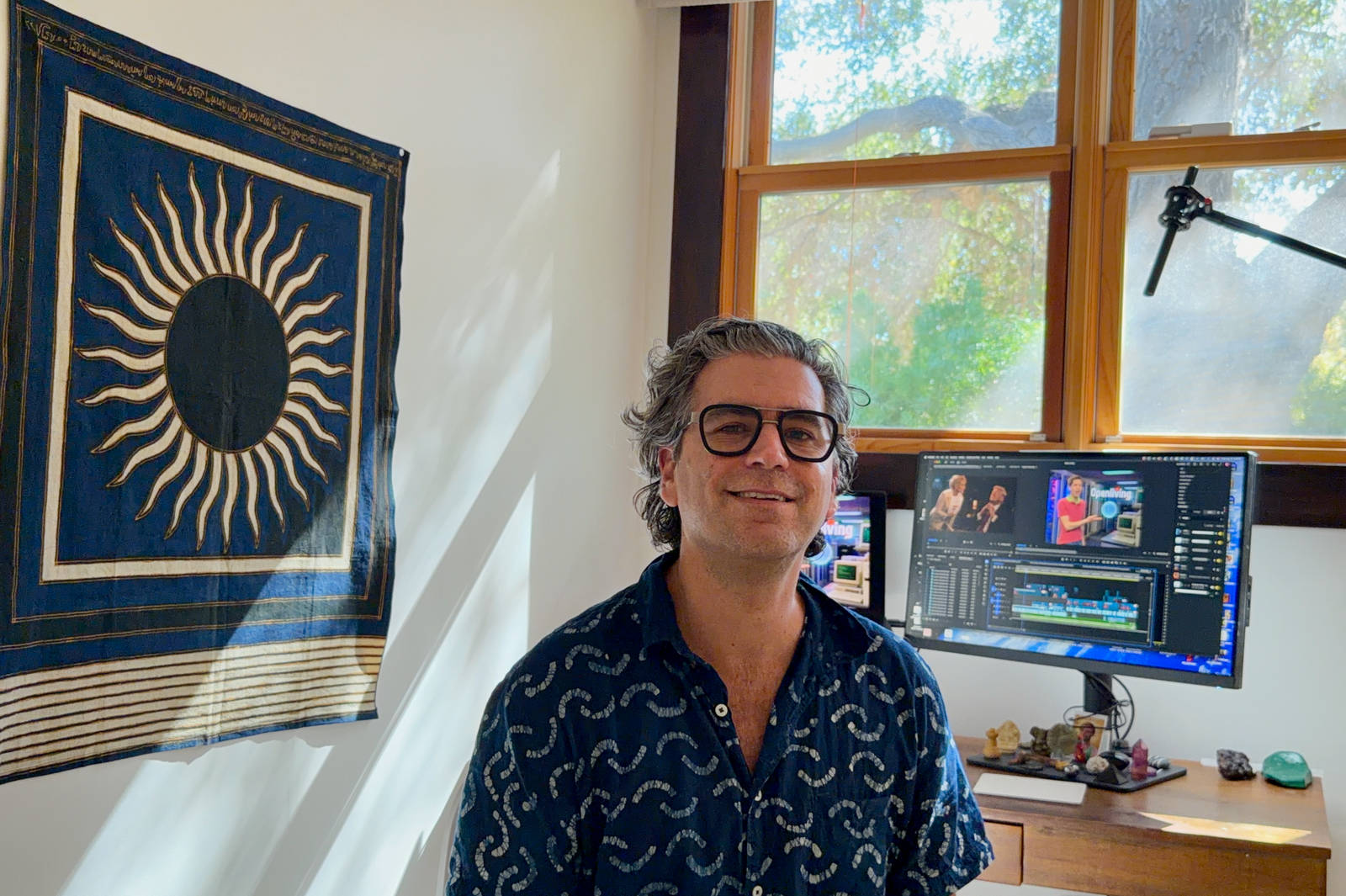
\Ari Kuschnir in his Ojai studio.\
Kuschnir got his start like a typical filmmaker. He went to film school, fell in love with editing, and moved to New York with a film-school buddy to start M ssng P eces (get it?), a commercial production company they sold to Tribeca Films in 2021. He spent two decades producing music videos for artists like MGMT and Radiohead plus commercials for big companies like Starbucks and Heineken.
“We were just like making stuff for brands, you know, and I missed the audience,” he said. The Tribeca sale gave him room to start making things for himself again. In the summer of 2024, he created his first viral AI-generated video: Trump doing ayahuasca.
“I made it in three hours. And then the next day, 30 million people watched it,” Kuschnir said. That’s when he realized AI could be “a very powerful way to say what I want to say.”
AFTER TRYING OUT a few different bizarro worlds, like Joe Biden in an Amazonian jungle and RFK Jr. getting sucked into an ancestral wormhole [?], Kuschnir finally landed on the format that’s become his signature—the retro infomercial.
He’d been trying to drop these guys into cinematic set pieces, he explained, but “really they’re so much better suited for the infomercial, it’s the perfect vehicle for them.” This, right here, is the weird truth that his audience gravitates to, that I find myself gravitating to…too! These tech guys really are the late-night TV pitchmen of our childhoods. Except the product is us, our dreams and our fears. All that good stuff.
“I am not a cynic. I have grown my, let’s say, biting satire muscle over the years,” Kuschnir told me. “But I really feel more at home in this place of life, protopias, imagining better futures. I think too much cynicism is part of the nihilism and doomer vibes of the culture right now. We need to get out of cynicism.”
In one of Kuschnir’s first stabs at the infomercial idea, Mark Zuckerberg dons JNCO jeans and orange-tinted sunglasses in a dot-com office circa 1999. In his hand is a digital companion, a clunky beige gadget, which he promises will solve loneliness. His spiel would not be out of place in an earnings call—the gadget gives you all the benefits of friendship, Zuck says, without the cost of dealing with any yucky human needs.
“These videos are almost like the seeds… and I’m not trying to start a cult, but like, we need ways to gather that are benign and fun and interesting and, you know, human to human,” Kuschnir said.
Kuschnir said his goal is to reveal “the hidden truths about power.” These men aren’t cartoon villains mining our souls for data. They’re broken, and that brokenness is what does the damage. It’s why the future they’re selling, at least in his videos, is the loneliest possible outcome.
“Do you ever worry AI could kill everyone you love? So do I,” an AI-generated Dario Amodei says in another clip. “That’s why we’re building it.”
THE MOST COMMON misconception about Kuschnir’s work is that he presses a button and the machine does the rest. In reality, there are a lot more buttons being pressed and a lot more machines getting it done.
To demonstrate, he offered to show me the guts of the Altman video. After sharing his screen, he went through each step, starting with a long back-and-forth (often voice dictated on his end) with Claude, which, he said, will “always offer me kind of dumb ideas,” until he has a rough script.
I watched as he scrolled past messages. “Taking away the fun in creating, right?” he wrote to the chatbot.
It responded: “Right, that’s the thesis: not that the machine is evil, but that it’s cheerfully removing the part that made a life feel like yours.”
Once he has a script, he works out the look. He feeds reference images into Magnific, an AI image tool, and uses the stills it generates as a kind of storyboard. For the Altman video, he took shots from a 1982 MIT demo of a room where people could talk to a computer, plus some random ’70s tech imagery and photos of Altman. He prompts the tool to configure the reference images into an instructional video with granular detail:
“Shot on 1982 three-tube Plumbicon broadcast video camera, 4:3, interlaced, soft resolution, heavy chroma bleed, comet-tail smear on highlights, warm ruddy skin tones with pink cast, blues that swim. Colour throughout — never black and white. Available light only, warm dim institutional fluorescents. Deadpan, locked-off unless stated. Text handled in post.”
After the world feels solid, he clones Altman’s voice with a tool called Fish Audio and brings it, along with the stills, into ByteDance’s Seedance, which turns them into video clips. He downloads the best clips, makes music in Suno, and cuts everything together the old-fashioned way in Adobe Premiere. There’s “still quite a bit of work to land the beats,” he said, like “when to cut, how long to leave this shot before the reaction.”
“It’s still very handcrafted,” Kuschnir said. From start to finish, the Altman video took about eight hours.
PART OF MY AWE with these videos is not just the content per se. It’s that he could even get away with making it, and on top of that, people totally fucking love it.
Most Americans hate artificial intelligence. They hate the data centers, the deepfakes, the slop. Creators have apologized for using it. Duolingo spent a week getting torched online after going “AI-first.” Influencers now swear off ad money from AI companies.
Kuschnir is going after the people running AI, so naturally, the people who consume his content aren’t the biggest fans of it either. “There would be a lot of like, ‘Oh, I love this, but it’s AI,’” he said. “If you can get me $150,000, I will make the ballroom video,” he said of one Trump clip he made. (Mark Ruffalo even added himself as a collaborator on this one). “It’ll take me three weeks, 150K, and I’ll cast the extras and I’ll do some green screen. But we have to build half of it.” People, he said, “have no idea what things cost.”
Once his videos started skewering the AI industry itself, the complaints mostly dried up. What’s left, he said, is “just a little bit of... the irony of using AI.” He doesn’t feel weird about it though. To him, he’s using “the master’s tools,” and there’s no other way to make what he makes at the speed the news demands. When a Hollywood type suggested pitching a TV show, he passed. “What would be the point of that? Like, I already have the audience,” Kuschnir said. Not even SNL could turn a response around overnight, he added.
It’s not a totally easy moral argument for him to make as an artist, though. He mentioned the energy use of AI and the ethics of how the models were trained, as in, vacuuming up all of humanity’s copyrighted material. But still, Kuschnir said, film sets aren’t clean either. “There’s a lot of trucks. There’s a lot of waste,” he told me. “Those are the contradictions worth living with.” Making something that counters the doomscrolling outweighs them. “Maybe that’s a justification that I do for myself, but I do believe it.”
He’s also not getting rich. Even when his videos go “super mega viral,” he said, “the amount of money you get is so low.” For now, he treats the work as R&D.
It’s an odd twist gifted by our odd times. Those who typically capitalize in the zeitgeist are the SNLs and late night TV hosts of the world—but even that’s gotten complicated now, hasn’t it? Jimmy Kimmel was threatened by FCC chair Brendan Carr, and the media company signing Kimmel’s checks was quick to bend that knee. The millennial catnip served by John Oliver might see some changes now that HBO, which runs Last Week Tonight, was scooped up by Skydance, which is owned by David Ellison, who is quite friendly with the butt of Oliver’s jokes, President Trump.
Now, the same audience who consumes any Jimmy, John, or Jon is glued to Kuschnir’s content. While the networks bend the knee to the powerful, Kuschnir is putting them in JNCO jeans.
“I always think I’m done with Trump or I’m done with Elon,” he told me. “And they do some other thing, and it’s like, fuck... And then I think, okay, is there someone else who could do it?... Is SNL just going to do it this week so I don’t have to do it? And then I realize, like, they’re not going to be able to get this piece plus this piece. So then I have to do it.”
The day before we spoke, Elon Musk posted that spreading superintelligence to the stars would be “a great success condition for a biological bootloader,” meaning us. Kuschnir wasn’t holding his breath for a great SNL sketch on this moment. He was already planning his own video.
“If I don’t make it,” Kuschnir said. “I feel like he gets away with it.”
Thanks for reading Core Memory! This post is public so feel free to share it.