AI by Hand ✍️ Seminars
By Prof. Tom Yeh
Published: 2026-07-08
URL: https://www.byhand.ai/p/qwen-3-6-seminar-recording
Library › Seminar Series 2026
- Manifold-Constrained Hyper Connections (mHC) from DeepSeek (Jan 9, 2026)
- How Small Models Learn Tool Use (Jan 11, 2026)
- Generative AI (Jan 11, 2026)
- Attention (Jan 15, 2026)
- Google Ironwood TPU: From Bits to HBM (Jan 19, 2026)
- 9 AI Eval Formulas You Must Know (Jan 24, 2026)
- Meta Superintelligence Labs vs Facebook AI Research (Jan 30, 2026)
- Transformer: Six Levels of Understanding (Feb 13, 2026)
- OpenClaw Seminar (Feb 23, 2026)
- PPO → DPO → GRPO → Rubrics (Mar 2, 2026)
- Gemma 4 (May 7, 2026)
- Qwen 3.6 (May 21, 2026)
Thank you to everyone who came out for the Frontier AI Seminar on Qwen 3.6. There is something special about a room full of people willing to slow down and trace a single token by hand, and I am grateful you spent that hour with me.
In the Gemma 4 seminar, we looked at the transformer techniques that have settled, the parts of the modern recipe you can now expect almost everywhere. In this session we turned to the parts that are still moving, and we followed a single token through three of them.
We started with position. I worked RoPE by hand, rotating the query and key vectors by their position, and then YaRN, which stretches a trained context window toward 256K or even 1M without retraining.
We then looked at gated attention. I showed the learned gate that Qwen places on the attention path, and we compared the same attention output with the gate and without it, so you could see what it actually buys over a plain GQA or MLA setup.
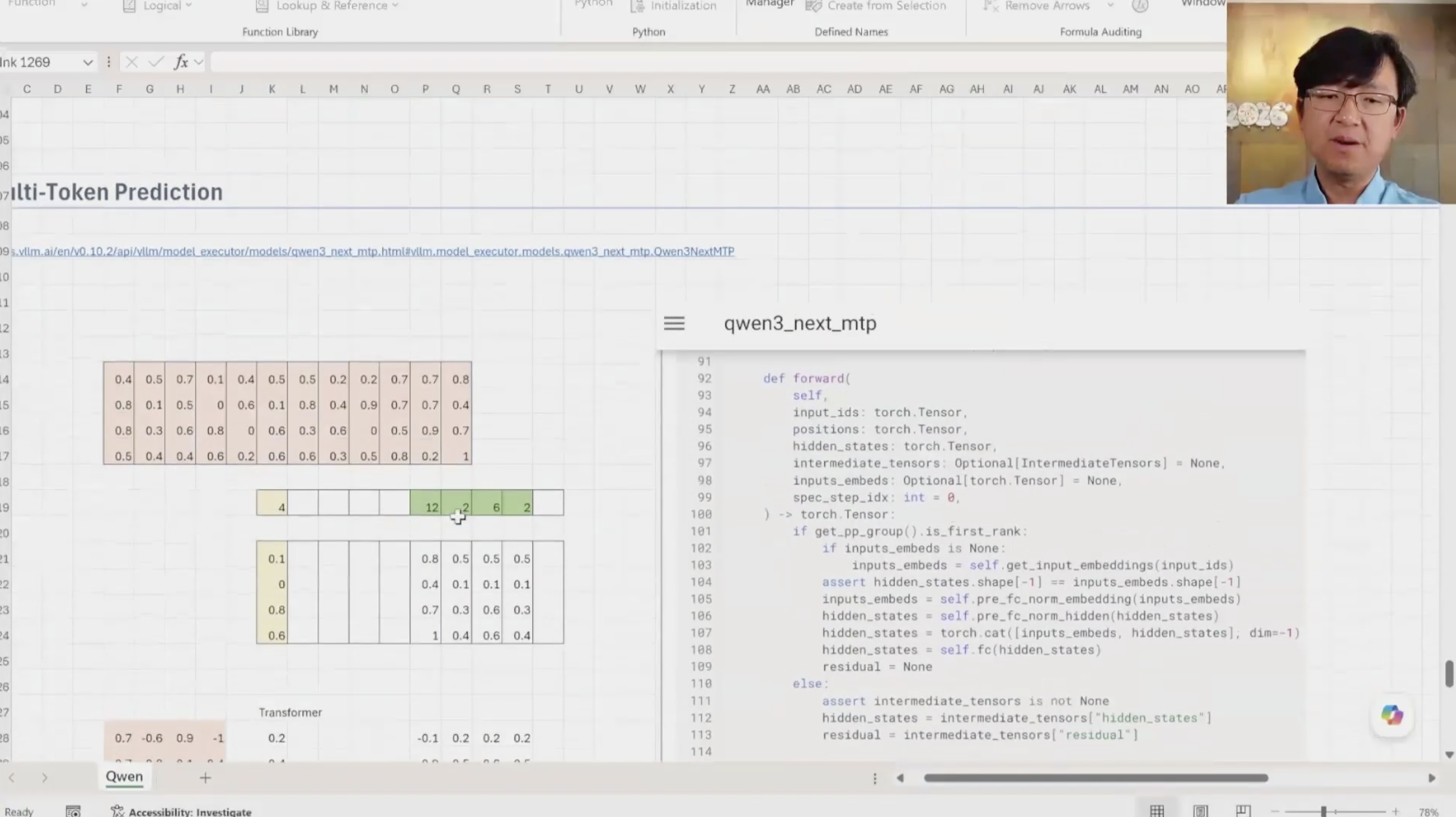
We finished with decode. I traced speculative decoding, where a small drafter proposes tokens and the model verifies them in parallel, and then multi-token prediction, where the model emits several tokens in one step instead of one at a time.
Here is what I wanted you to walk away with. Once you have rotated the vector, gated the output, and drafted a token by hand, the acronyms stop being intimidating, and you can look at any model's spec sheet, its context length, its attention variant, its decode speed, and see what is actually doing the work.
Outline
- PE, RoPE, YaRN
- No Positional Encoding
- Linear Positional Encoding
- Sinusoidal Positional Encoding
- Input vs Key Positional Encoding
- RoPE: Rotary Positional Encoding
- YaRN: Yet another RoPE extensioN
- Gated Attention
- Decoding: Fast and Furious
- Auto-Regressive
- Train
- Speculative Decoding
- Multi-Token Prediction
Recording & Workbook
Limited-time free: the full recording and the Excel workbook are open to everyone for now.