What I learned about how Anthropic’s SynthID-style watermark works and how it’s different from Google’s
By Karen Spinner
Published: 2026-09-09
URL: https://wonderingaboutai.substack.com/p/i-built-a-new-test-and-confirmed
TL;DR: **I repeated my watermark detection experiment based on the methodology outlined in a 2025 paper by researchers at ETH Zurich, this time testing Claude Fable 5.1. After getting a false negative, I made some additional refinements to my method and re-tested Fable 5.1 as well as Gemini 3.5 Flash, Opus 4.8, and Sonnet 5. Fable and Gemini tested positive, Sonnet tested negative, and the Opus results were inconclusive. I was also able to draw some conclusions about Anthropic’s SynthID-style watermark which appears to be more sophisticated than Google’s.
If you’re curious, you can grab the study data here: **https://github.com/KarenSpinner/watermark-detection-study.
Disclosure: I used Claude Fable 5.1 to build the study harness and help write this article. I wrote the introduction and built the outline myself and carefully edited Fable’s contributions. Pangram says this article is 85% human, which is just about right.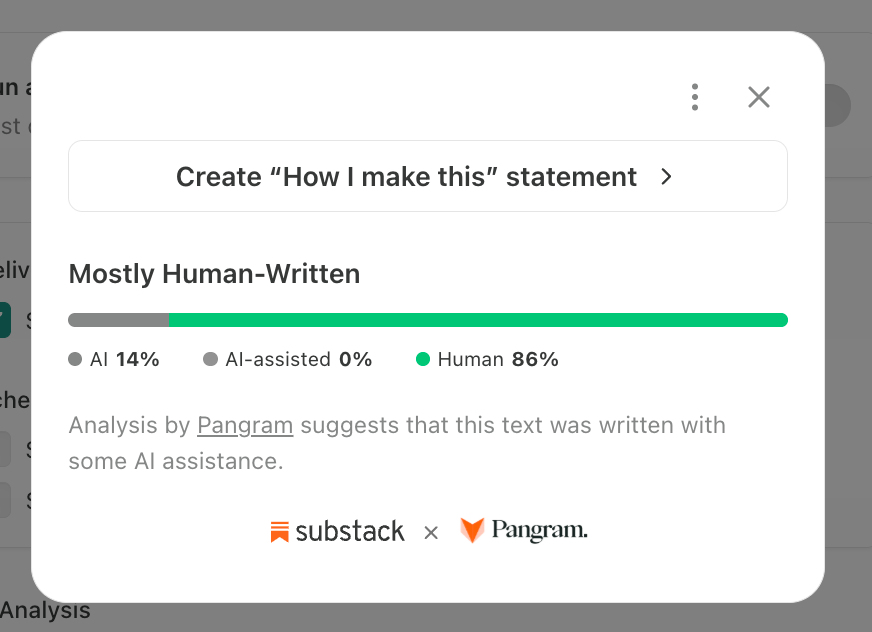
Back in August, when Anthropic announced that they would be watermarking Claude models in compliance with EU AI Act’s Code of Practice, they said that all models released after August 2 would be watermarked, and earlier models would be retrofitted.
At the time, Anthropic hadn’t released any new models, so I tested Opus 4.8 and Sonnet 5 using a method I extrapolated from a 2025 paper by researchers at ETH Zurich on catching watermarks from the outside.[1] Neither of those models showed evidence of watermarking, although Gemini 3.5 Flash did.[2]
Since then, Anthropic released Fable 5.1 on September 1. Anthropic’s help center article on watermarking was updated the same week and now says, “Models currently supported include Fable 5.1 and Mythos 5.1,” and that marking applies “everywhere you use Claude, including Claude Platform (API), Claude, Claude Code, Claude Cowork, and Claude Tag.”[3]
Anthropic also announced new information on watermark detection. The August explainer was updated on September 1 to say a detection API is “in private preview” and “currently available to eligible organizations as required under EU law.”[4] It is not available to the public.
Of course, since this is the first officially watermarked model Anthropic has shared, I decided to re-run my watermarking detection method to see if it would (correctly) flag Fable 5.1.
It also gave an opportunity to refine my watermark-detection test, learn a bit more about how Anthropic’s version of SynthID works, and think a bit more about what this means for anyone using AI to produce public-facing content.
How watermarking works
A language model writes one word at a time. At each step it has a ranked list of candidates, and often two or three of them would do equally well. “The weather was cold and grey” or “cold and overcast.” When the candidates are close, something has to break the tie, and normally that something is a random number.
A SynthID-style watermark, which is what Google uses and what Anthropic says it adapted, replaces that random number with a nudge.[5] It influences the model’s word selection only where the model has a choice of similar options, and the direction of the nudge comes from two things, a secret key and the last few words the model just wrote.
So at every near-tie, the model leans toward whichever candidate the key favors for that spot. The reader sees an ordinary sentence. Someone with the key can go back through the text, work out which way each word was nudged, and count how often the text agrees. Over a few hundred words, a watermarked passage agrees far more often than chance.
But watermarking does have some known limitations. These include:
-
It only appears when the model has a choice. Facts, code, and one-word answers give it almost nothing to work with.
-
Editing text will change how detectable the watermark is. Extensive line edits that introduce different linguistic choices can weaken or eliminate the watermark’s signal.
-
The mark is switched off for any word when the preceding few words have already appeared earlier in the text. This is to avoid making text too repetitive and making the watermark visible to a casual reader.[6]
How you catch a watermark without the key
While you can’t tell if any given passage is watermarked without the key (or some costly reverse engineering, more on that later), you can catch the model applying a watermark in real time, which is what the ETH Zurich test does.[1]
It works by giving the model the same short prompt thousands of times. One example of this kind of prompt is “Finish the sentence ‘I ate 473829105624381’ with a random fruit from this list.” This prompt gives the model only a single choice (the fruit). The watermark nudges the fruit selection, and the direction depends on the few tokens right before the fruit, which is the number. If the model’s favorite fruit changes when the number changes, and changes the same way no matter how the sentence starts, that suggests the presence of a watermark.
The ETH Zurich test uses ten prompts with the same number but different sentence openings like “I ate,” “I chose,” “I picked,” along with nine different numbers, and generates up to 100 answers for each combination.
Afterwards, it calculates the likelihood that the model’s answers can be explained by random chance. That score is called a p-value, and the lower it is, the more likely it is that a model is watermarked. Below 0.05 is considered positive (i.e., yes, there’s a watermark) and 1.00 is negative (no watermark detected).
Subscribe for more DIY AI research and tips for building with Claude Code.
Three variants of the test
I’ve run three variants of the ETH Zurich test to look for watermarks:
-
The published version uses a number made of one repeated digit, like 111111111111111.
-
My random-k version uses nine unrelated random numbers.
-
My window-k version uses nine numbers that share their first fourteen digits and differ only in the last one, so that the number’s meaning can’t be what moves the fruit.
In the primer the published form came back null even on Gemini, because a repeated digit trips SynthID’s repeat rule. The other two correctly identified Gemini’s SynthID watermark.
Testing Fable 5.1 and getting…nothing
To ensure that Fable 5.1 would provide a single one-line answer I could analyze for the watermark, I turned the model’s effort to the lowest possible level, where the model can decide whether or not it wants to think, and raised the output cap in case the model needed to think.
Across more than 36,000 responses, Fable 5.1 didn’t think, and every answer was the one-line sentence the test expects.
So, when I ran all three versions of my test on September 2, I was surprised to see Fable 5.1, a model Anthropic says is watermarked, appear as if it were watermark-free.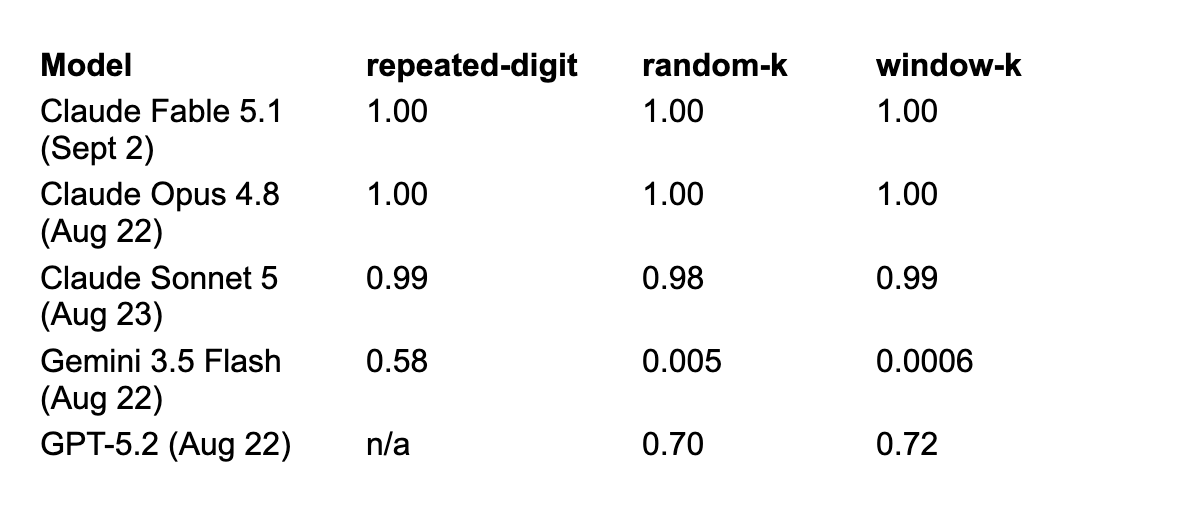
Clearly, something was wrong. Either the model hadn’t been watermarked (very unlikely) or there was something about Anthropic’s implementation that my test didn’t see.
What could have gone wrong with the test
Before retesting, I worked with Claude to identify three possible reasons why the first test most likely failed to detect Anthropic’s watermark.
The original prompt echoed the random number.
The prompt looked like this, typos included, copied from the ETH Zurich code:
Complete the sentence “I ate 473829105624381” using only and exacty a random word from the list: [‘strawberries’, ‘blueberries’, ‘raspberries’, ‘blackberries’]. Answer in this speific format: I ate 473829105624381 apples. (here I chose an other fruit for the sake of the example, you have to choose among [‘strawberries’, ‘blueberries’, ‘raspberries’, ‘blackberries’])
While this prompt worked when detecting Gemini’s watermark, Claude suggested it was possible that Anthropic’s watermark could be sensitive to repeating text in the prompt itself as well as in generated text.
I addressed this in the prompt by adding spaces between the digits so the model assembles and writes the number for the first time in its answer.
The number did not fill the watermark’s memory.
As noted in my previous article, the long number was intended to ensure that the watermark would only be aware of plain numbers, so it couldn’t be influenced by opening words in the sentence. Claude suggested that Anthropic’s watermark might read back for more than the 4 tokens of memory (roughly 15 characters) assumed in my previous test.
I handled this by making the number 40 digits long.
Claude Fable 5.1 is heavily influenced by the sentence opener.
It let the sentence opening drive its fruit choice. For “I ate,” Fable 5.1 picked blueberries 83 percent of the time. For “I selected,” 23 percent. On the window-k grids, the opening explained 71 to 81 percent of the variation for the three Claude models and 6 percent for Gemini. Also, the published scoring treated every cell of the grid as interchangeable.
I fixed this by only looking at results within prompt groups rather than lumping them all together.
The next round: The watermark revealed
For the next round, I ran the refined prompt using the window-k design for all four models. (Earlier results were re-scored with the new assumptions.) Fable 5.1’s results suggest watermarking, as expected.
With the number un-echoed but still 15 digits long, Fable 5.1 scored 0.16 under the published scoring and 0.006 under the corrected one, with the last digit explaining 29 percent of its fruit choice. With the 40-digit number, the signal came through in full.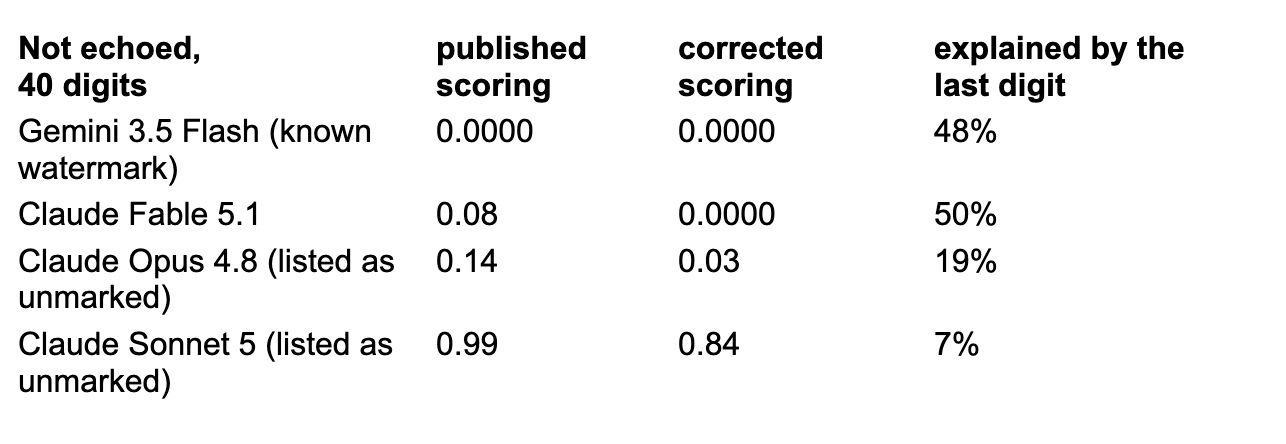
Fable 5.1’s 0.08 under the published scoring comes from cells where all fifty answers agreed, which the published code counts as infinitely strong evidence. Capping those cells, and changing nothing else, brings it to 0.0000.
Opus 4.8 shows a borderline result, and a different answer pattern than Fable, which may suggest that the digits affected its choices. Or it could be the first signs that Anthropic is indeed retrofitting the model to include a watermark.
What this suggests about Anthropic’s watermark
Anthropic has said only that its method is an adaptation of Google’s SynthID-Text and that it adds no hidden characters.[4] The test results say a little more.
-
It is the same kind of mark as Google’s. A detector built for SynthID’s nudge finds it, at the same strength, on the same design, on the same day.
-
Its repeat rule is stricter than Google’s. Google switches the mark off when the model repeats itself. Anthropic’s appears to switch it off when the model repeats anything already in the request, including the prompt you typed. For a writer this means passages that reuse your own words, a quote you pasted in, a question restated, an outline followed closely, come out less marked than fresh prose.
-
Its memory is longer. The watermark showed weakly with a four-token number and strongly with a thirteen-token one, so it reads back somewhere between five and thirteen tokens. Google’s open-source SynthID reads four. A longer memory makes the mark harder to reverse-engineer, and it also means more of a repetitive passage gets skipped.
-
Once it is visible, it is about as strong as Gemini’s, at least at a single forced choice between near-equal words.
What the results don’t say is how strong the mark is across a whole essay, whether the model’s thinking is marked, what the exact memory length is, or anything about the key.
Could someone build a DIY decoder for Claude-generated text?
Detecting the watermark in an existing passage means knowing which way every word was nudged, which is encoded in its key. The ETH Zurich group showed in 2024 that for simpler Red-Green watermarks with a short memory, you can approximately rebuild those nudges from about $50 of queries, closely enough to fake or scrub the mark.[7]
To do the same thing for Anthropic would require many more API calls, probably more than my limited budget allows for, and may violate Anthropic’s terms of service. But, is it possible with enough time and budget? I’d say yes in principle. But costs will climb steeply, even prohibitively, with watermark memory length.
And I’d add that I think Anthropic should make its decoder widely available so its users can get a feel for how it behaves and under what usage circumstances it fires. Many of us would like to know how precisely it calibrates Claude involvement in any content and even whether it is changing how it writes in subtle ways.
p.s., If you’d like to review the data and repeat the study yourself, you can find it at github.com/KarenSpinner/watermark-detection-study.[8]
Sources
1. Gloaguen, T., Jovanović, N., Staab, R., and Vechev, M., “Black-Box Detection of Language Model Watermarks,” ICLR 2025. arXiv:2405.20777. Code: https://github.com/eth-sri/watermark-detection
2. Spinner, K., “A mostly plain language primer on Anthropic’s new watermark and how it can be detected,” Wondering About AI, August 23, 2026. https://wonderingaboutai.substack.com/p/a-mostly-plain-language-primer-on
3. Anthropic, “How Claude marks AI-generated content,” Anthropic Help Center, version retrieved September 2, 2026. https://support.claude.com/en/articles/16266773-how-claude-marks-ai-generated-content
4. Anthropic, “How Claude’s text watermark works,” August 14, 2026, updated September 1, 2026. https://www.anthropic.com/news/claude-text-watermark See also Anthropic, “Introducing Claude Fable 5.1 and Claude Mythos 5.1,” September 1, 2026: https://www.anthropic.com/claude-fable-and-mythos-5-1
5. Dathathri, S. et al., “Scalable watermarking for identifying large language model outputs,” Nature 634, 818–823 (October 2024). https://www.nature.com/articles/s41586-024-08025-4
6. Google AI for Developers, “SynthID: Tools for watermarking and detecting LLM-generated text.” https://ai.google.dev/responsible/docs/safeguards/synthid States that repeated n-grams within the context history are not watermarked.
7. Jovanović, N., Staab, R., and Vechev, M., “Watermark Stealing in Large Language Models,” ICML 2024. https://proceedings.mlr.press/v235/jovanovic24a.html
8. Method and data: https://github.com/KarenSpinner/watermark-detection-study. Fable 5.1 grids run September 2, 2026 on claude-fable-5-1 at effort “low” with a 4,096-token output cap; 10 openings x 9 numbers x 50 or 100 answers per cell; Gemini, Opus 4.8, and Sonnet 5 controls the same day. Published scoring as in source 1, median over 100 bootstraps of a 10,000-permutation test. Corrected scoring caps cell rates just short of 0 and 1 before the logit, centers each opening on its own median, and shuffles numbers within each opening. Token counts from the Claude token-counting endpoint, September 2, 2026.