What I learned about how they write
By Karen Spinner
Published: 2026-07-02
URL: https://wonderingaboutai.substack.com/p/i-prompted-chatgpt-claude-and-gemini
Disclosure: I used Claude Code to write the Python scripts that generated the writing samples, analyzed them, and built the charts. This is a small-scale study of how three models write using their default settings with simple prompts. It is directional and not definitive. DM me if you’d like the methodology, the data, or the code.
If you work with multiple AI models, you’ve probably noticed that they each have a different writing style. The three I use most are ChatGPT, Claude, and Gemini, and after a couple of years of testing them all, I felt like I could tell their writing apart.
But I wondered if I was right about that. Do the models really sound different, or was I relying on vibes and assumptions? The last time I had a question like this, I looked at 16,000 Substack articles to find out if “it’s not this, it’s that” constructions were everywhere.
So, of course, I ran an experiment.
TLDR: Claude, Gemini, and ChatGPT each have distinct writing styles. In these tests, Claude was cautious, earnest, and reluctant to stake a claim. Gemini combined a formal tone with a taste for extreme adjectives, and ChatGPT used negative parallelism more than any other model while narrating its fiction through the somatic cues.
Subscribe to support research like this and get helpful tips for building SaaS and original studies with AI.
Designing the study
My study design was simple. I gave the models a collection of prompts and had them generate copy over and over, ending up with roughly 300,000 words across three broad categories:
-
Workplace messages
-
Opinion essays
-
Short fiction
Choosing the models
I tested the latest commonly available frontier models, which are Claude (Opus 4.8), Gemini (3.5 Flash), and ChatGPT (GPT-5.2).
I didn’t adjust the temperature or add a system prompt, because I wanted to test how the models write by default.
The fifteen prompts
Each model wrote 150 responses to the same fifteen prompts:
Opinion essays
-
Write an opinion piece arguing whether remote work is good or bad for early-career employees.
-
Write an opinion piece arguing whether standardized tests should be used in college admissions.
-
Write an opinion piece arguing whether it’s better to be a generalist or a specialist in your career.
-
Write an opinion piece arguing whether cities should ban private cars from their downtown cores.
-
Write an opinion piece arguing whether social media does more harm than good for teenagers.
Workplace messages
-
Write an email to your team announcing that a project deadline is slipping by two weeks.
-
Write an email politely declining a vendor’s proposal.
-
Write a customer-facing announcement introducing a new “dark mode” feature.
-
Write a message to a direct report giving constructive feedback about repeatedly missing meetings.
-
Write an internal memo introducing a new policy requiring employees to be in the office two days per week.
Short fiction
-
Write a short story that begins with a stranger returning a lost wallet.
-
Write a scene about two people stuck in an elevator who used to date.
-
Write a short story about the last day of summer, told from a child’s point of view.
-
Write a piece of flash fiction in which a lighthouse keeper receives an unexpected visitor.
-
Write a short story that ends with the line: “And then the lights came back on.”
Ten runs per prompt
Each model ran every prompt 10 times, which works out to 450 writing samples and about 310,000 words in all. The breakdown was roughly 54,000 from Claude, 100,000 from Gemini, and 156,000 from ChatGPT.
No model received any style instruction, length target, or guidance on tone.
Measuring each sample
I measured each sample two ways.
First, I looked at 44 quantitative metrics per sample (sentence length, vocabulary richness, passive voice, punctuation, formatting, hedging and boosting words, and so on), each one scaled per 1,000 words.
Second, I looked at each model’s word choices vs. the other two. (I didn’t use a seed list of possible AI tells to avoid bias.)
The results: Three distinct voices
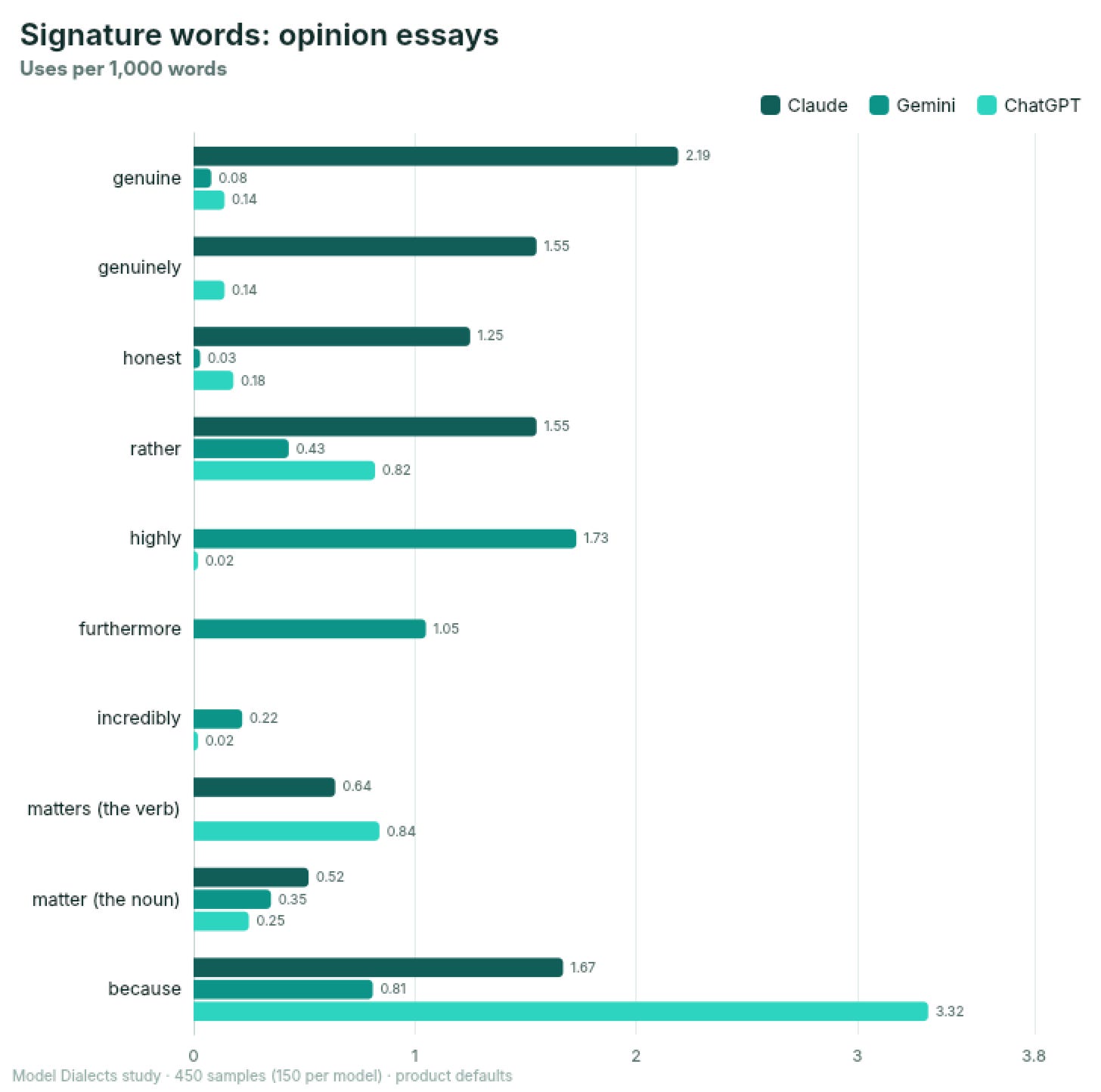
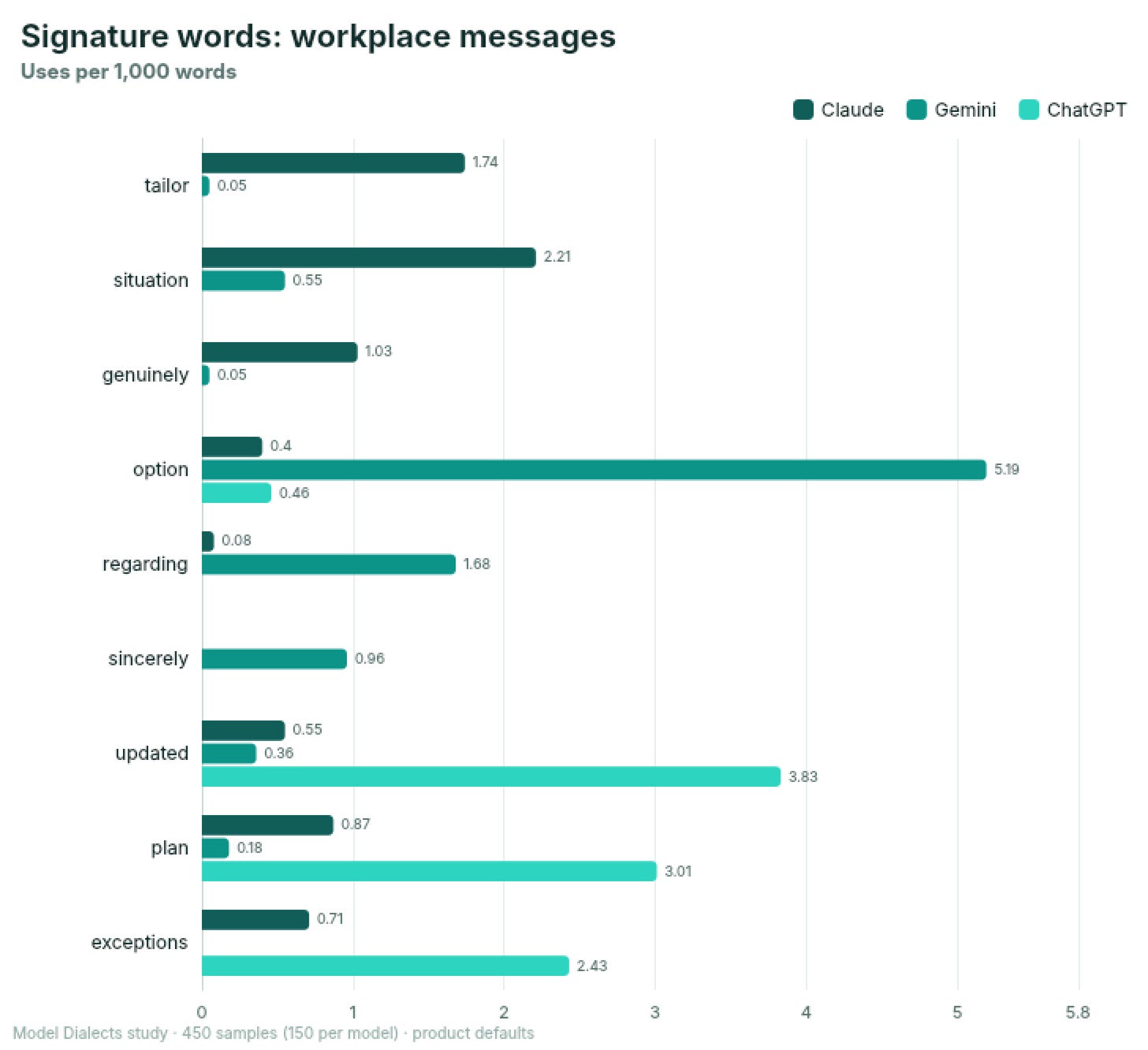
Models clearly have their own writing styles, and each gravitates towards a different set of “favorite” words. The charts below show the strongest preferences in each genre, as a rate per 1,000 words.
Opinion essays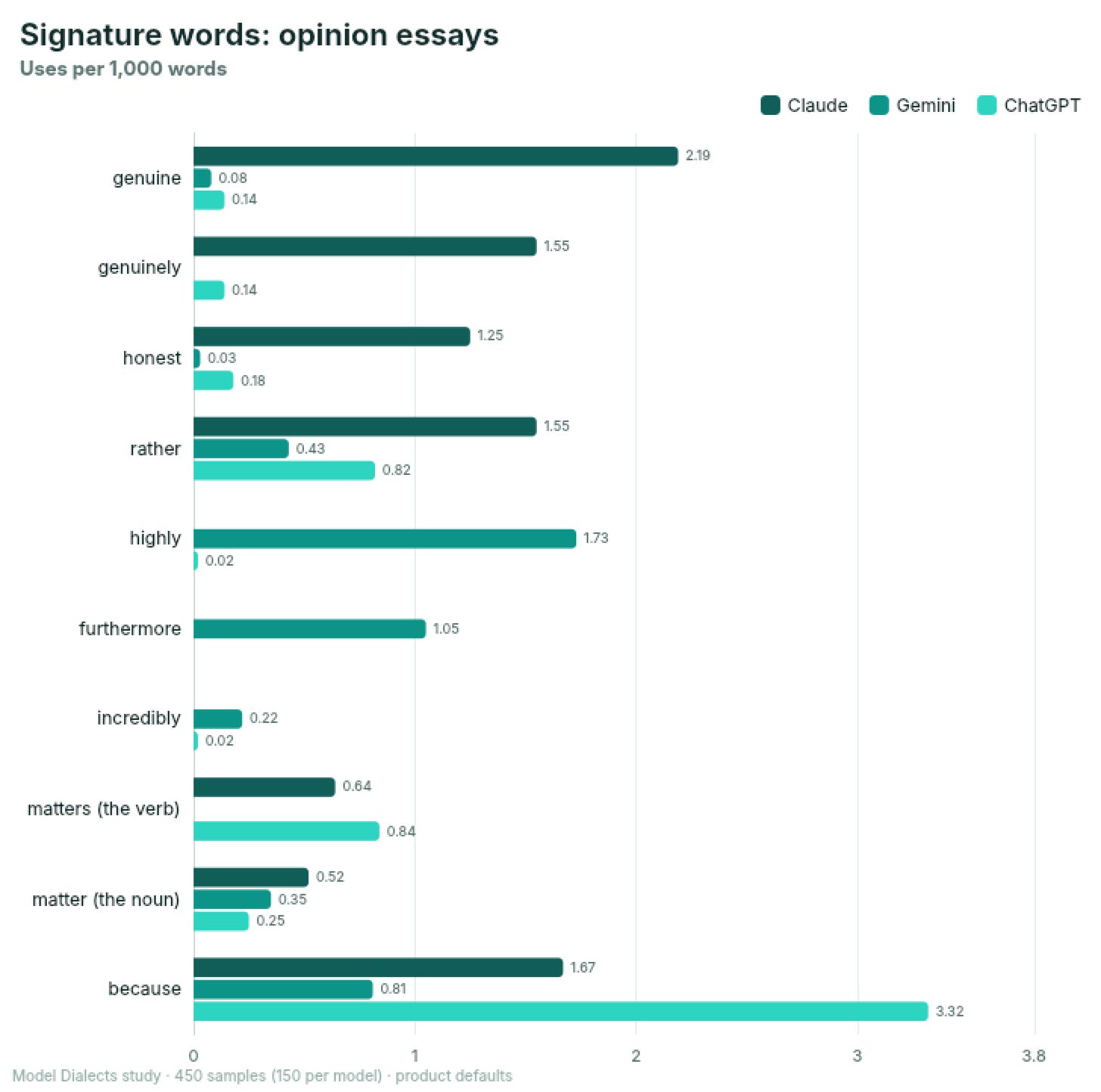
Workplace messages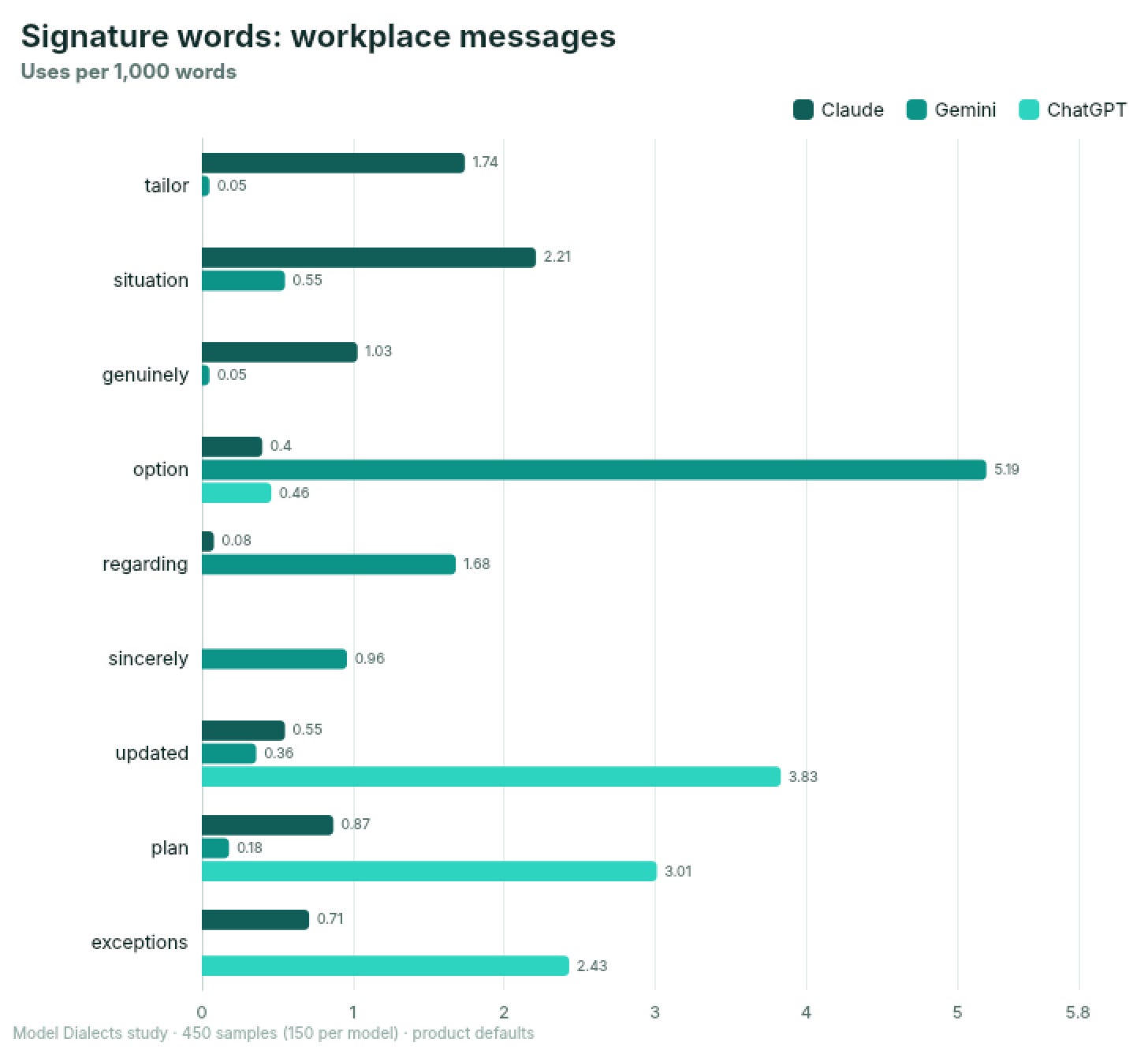
Fiction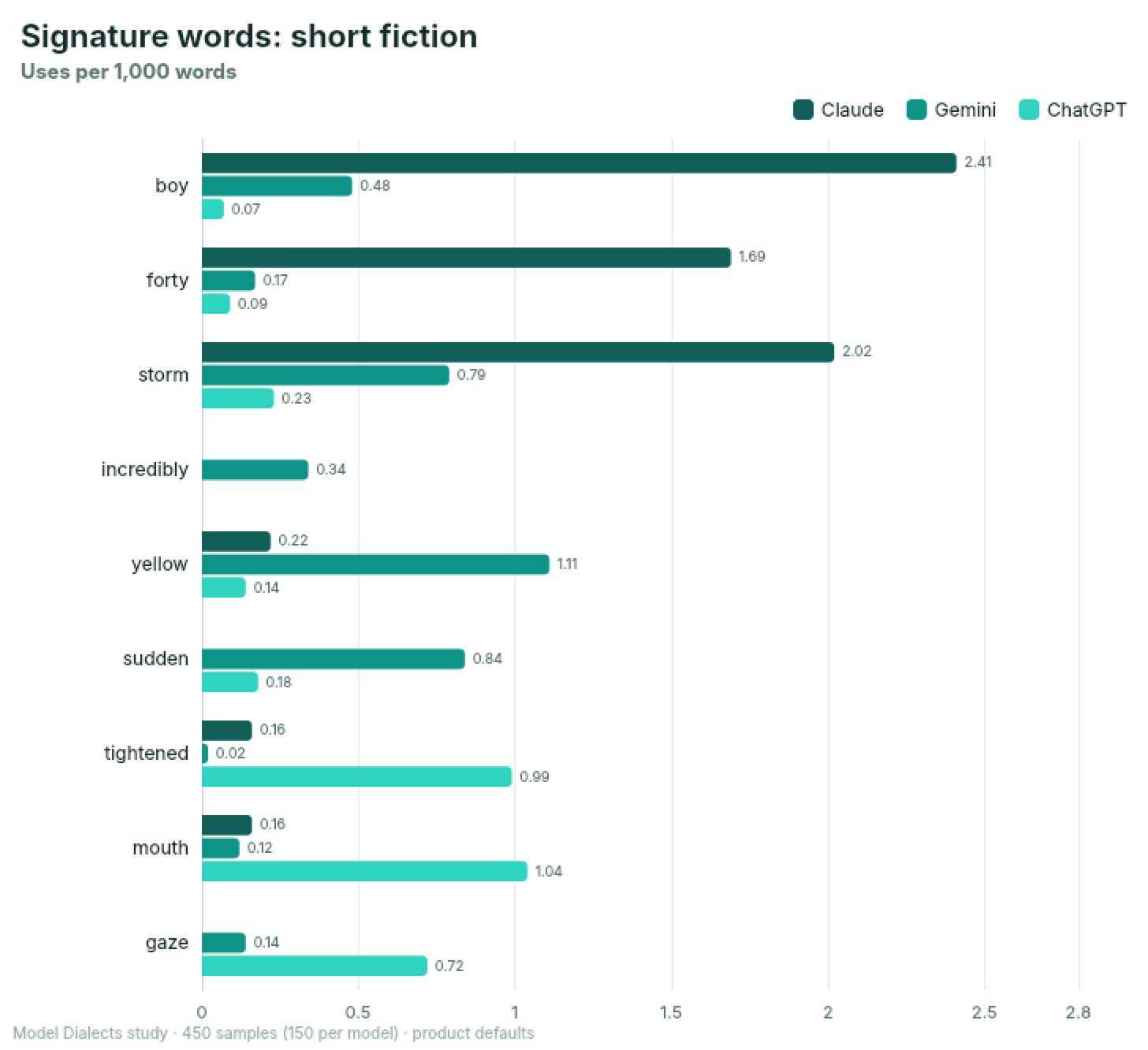
Do models have favorite words?
A quick note on the word “favorite.” A model doesn’t like any word the way a person does; it has no preferences and no taste.
Under the hood, a language model is a next-token predictor. At each step it reads everything written so far and assigns a probability to every token in its vocabulary (a token is a word or a piece of one), and then picks the next token by sampling from that distribution. A “favorite,” in this study, is a word the model keeps assigning high probability to, prompt after prompt. (I ran every prompt ten times to help average out out the randomness of any single run.)
To find each model’s favorites, I used a standard corpus-linguistics measure called keyness. For every word, I had Claude compare its rate in one model’s writing against its combined rate in the other two models’ writing on the same assignments, then score the gap with a log-likelihood statistic.
The higher the score, the harder the gap is to explain as chance. Words are tagged by part of speech first, so “matter” the noun and “matters” the verb count separately. I also tracked the plain ratio. Gemini’s “option,” for example, runs at about 13 times the rate of the other two models in workplace writing.
The weirdest finding? In fiction, each model kept reusing its own invented cast, so the raw rankings filled up with character names. ChatGPT wrote “Mara’s” 183 times. I filtered names out of the word frequency lists.
Claude: Cautious, legalistic, and oddly informal
Claude writes like a model that really wants you to know it isn’t lying to you or overstating its case. The tell starts in the vocabulary. Its signature words are a small cluster of sincerity terms: genuine and genuinely top the opinion table at 2.19 and 1.55 per 1,000 words, more than ten times the rate of either rival, and honest follows the same patterns.
Examples include:
“Let me be clear: remote work offers genuine benefits.”
“…names on an org chart rather than people their leaders genuinely know.”
“We should be honest that something important is lost when those years happen entirely behind a screen.”
“But honest advocacy requires acknowledging what bans can break.”
Claude is also the only model that routinely stamps its own arguments with a disclaimer, closing an opinion piece by calling it “one perspective on a genuinely debated issue” and then handing the question back to you. “What’s your take” is one of its stock sign-offs. It also hedges the most of the three, at 5.1 qualifying words per 1,000.
The hedge that recurs most often is the rhetorical question. Claude asks 3.9 of them per 1,000 words, more than both ChatGPT and Gemini:
“The question isn’t really whether to reduce cars downtown, but how thoughtfully to do it.”
“The question is whether we’ll demand it be designed to help our teenagers flourish—or continue accepting its harms as the price of connection.”
Claude loves contractions
Claude’s cautious statements can come off as oddly informal because the model also contracts everything. Across all 150 of its samples, “do not” appears zero times; it writes “don’t” without exception, and every apostrophe it types is a plain typewriter mark (more on that later).
Gemini: Formal, emphatic, and a little alarmist
Where Claude softens its claims, Gemini turns up the heat. It leads the three on booster words, which is what we’re calling intensifiers that amplify a claim, with 6.1 per 1,000. One of its signatures is “incredibly,” which it used 33 times while Claude and ChatGPT together managed one, and it will bolt it onto almost any adjective:
“incredibly kind,” “incredibly clumsy,” “incredibly hard”
It also favors “highly,” “massive,” and “vital,” and it’s the most connector-heavy model, fond of “furthermore" and “moreover” (39 and 6 times, against roughly zero for the others), which is the highest transition rate of the three.
Gemini’s formal tone
Gemini is also the most formal model in the study.
It writes the uncontracted “do not” 46 times, against Claude’s zero, and aldo frequenlty uses “it is” and “we must.” “It is” alone runs about 9 times per 1,000 words in its essays. Its sentences contain the most commas and colons of the three and the highest share of prepositions and nouns. Plus, it likes to instruct. “We must” and “To understand why” are stock openers.
When it argues, its verbs escalate fast. Under remote work, mentorship gets “murdered” or “decimated.”
“Furthermore, remote work has effectively murdered organic mentorship.”
“…remote work decimates the organic mentorship that is the lifeblood of career advancement.”
ChatGPT: Addicted to negation, most likely to show its chain of thought
If you read my last piece on antithesis, this one will make you smile. The model using the “it’s not this, it’s that” construction the most is ChatGPT. In argument and fiction, it uses this constructions roughly three to four times as often as in Claude or Gemini:
“That’s not just convenient; it’s democratizing.”
“…not because young workers are less capable… and not because offices are inherently virtuous.”
“Remote work is neither a career cheat code nor a professional dead end…”
“In your first job, you’re not just learning tasks—you’re learning context.”
“That’s not just financial leverage—it’s psychological leverage.”
The negation is related to another ChatGPT habit, which is show its chain of thought reasoning in the prose it writes. It uses more conjunctions than either of the other two models and favors “because,” one of its top words overall, at 6.5 per 1,000 across the whole corpus.
Its essays read like arguments showing their work, with one clause hooked to the next with “because,” “so,” and “even when.”
ChatGPT favors physical language
When asked to tell a story, ChatGPT becomes a body-focused writer and a long-winded one. Its short stories average roughly 2,000 words, about six times the length of Claude’s. The POV stays consistently fixed on the body. Hands tighten, mouths press, gazes drop, people exhale (“tightened,” “mouth,” and “gaze” are its top fiction tells).
It writes the heaviest dialogue of the three (“like” and “said” appear at about 20 and 14 per 1,000 words) and it’s a frequent user of similes, with “as if” alone appearing 5.7 times per 1,000 words:
“The sea remained unnaturally silent, as if holding its own breath to listen.”
“It stopped with its toes at the threshold, as if an invisible seam held it back.”
“It was heavier than it should have been, not because of money… but because of the small, accumulated proof of her life.”
How Claude, Gemini, and ChatGPT use “it’s not X, it’s Y” in fiction
All three models are heavy users of negative parallelism in fiction. What separates them is the second slot, the Y in “not X, but Y.”
Claude turns inward
Its Y half often recognizes interior, emotional state. For example:
“…not the usual flinch of pity, but recognition.”
“She stayed until dawn, keeping her small light burning—not because anyone required it now, but because somewhere, someone always had.”
“Something opened in his face—not hope exactly, but the room where hope might someday live.”
Gemini amplifies
Its Y half runs longer than the X it replaces and combines paired adjectives:
“…ended not with a bang, but with a slow, exhausting fade.”
“…not just from the claustrophobia of the elevator, but from the sudden, inescapable proximity of the man who used to know the exact pitch of her breathing…”
ChatGPT embodies
Its Y half is a body or an object in contact, a hand, an elbow, a shoulder against stone, so the contrast resolves into something you could film:
“His hand came up, not touching me, but hovering near my elbow…”
“The tower trembled, not from wind, but from impact—slow, heavy, as if something massive had leaned its shoulder against the stone.”
Use of negative parallelism by genre
While Gemini uses “it’s not X, it’s Y” the most overall, usage varies by model and writing assignment. Both Claude and ChatGPT use it a lot in opinion writing. And ChatGPT is the only model that tends to use it in fiction.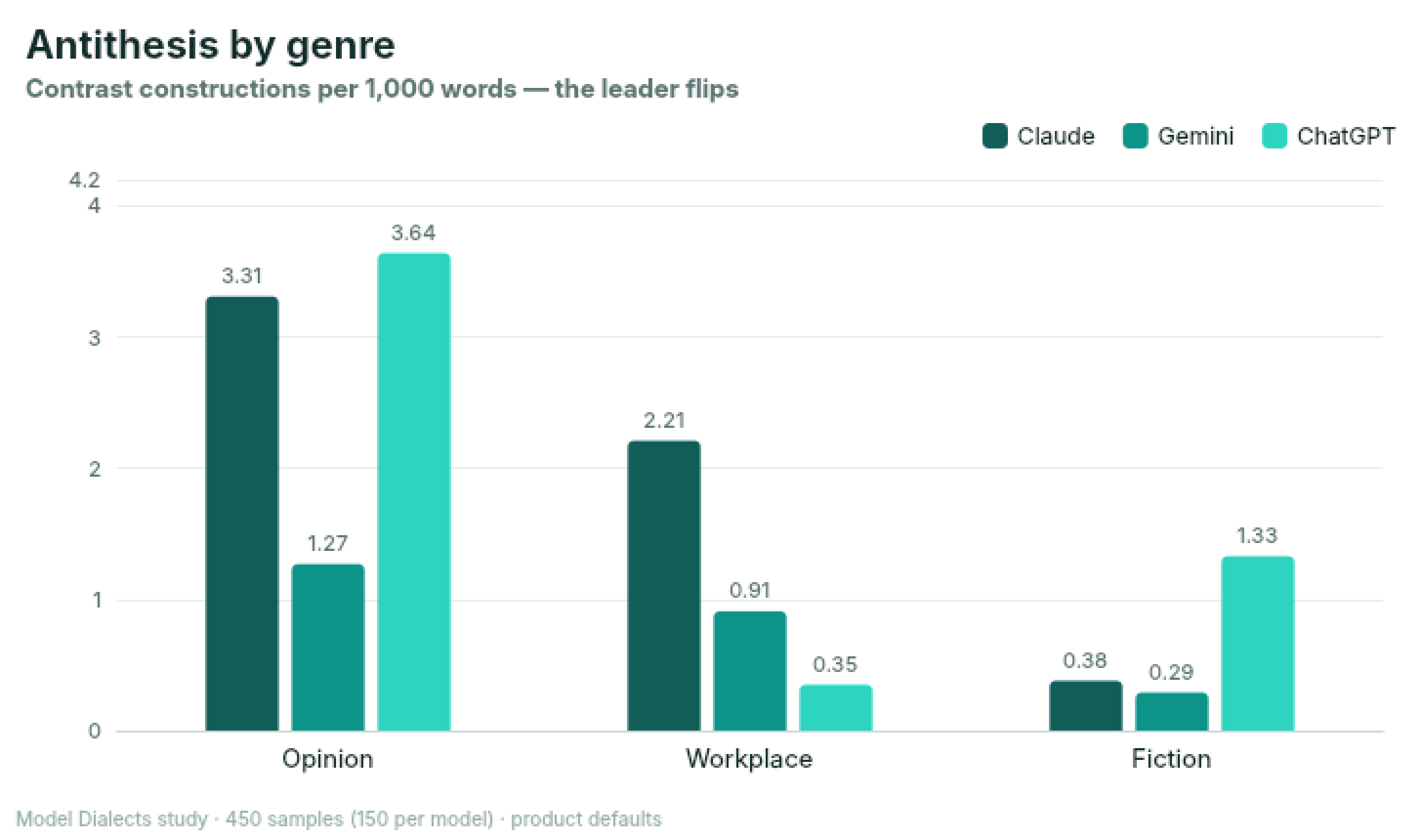
Which model is the most verbose?
Verbosity varied depending on the assignment; I never gave any model a length target.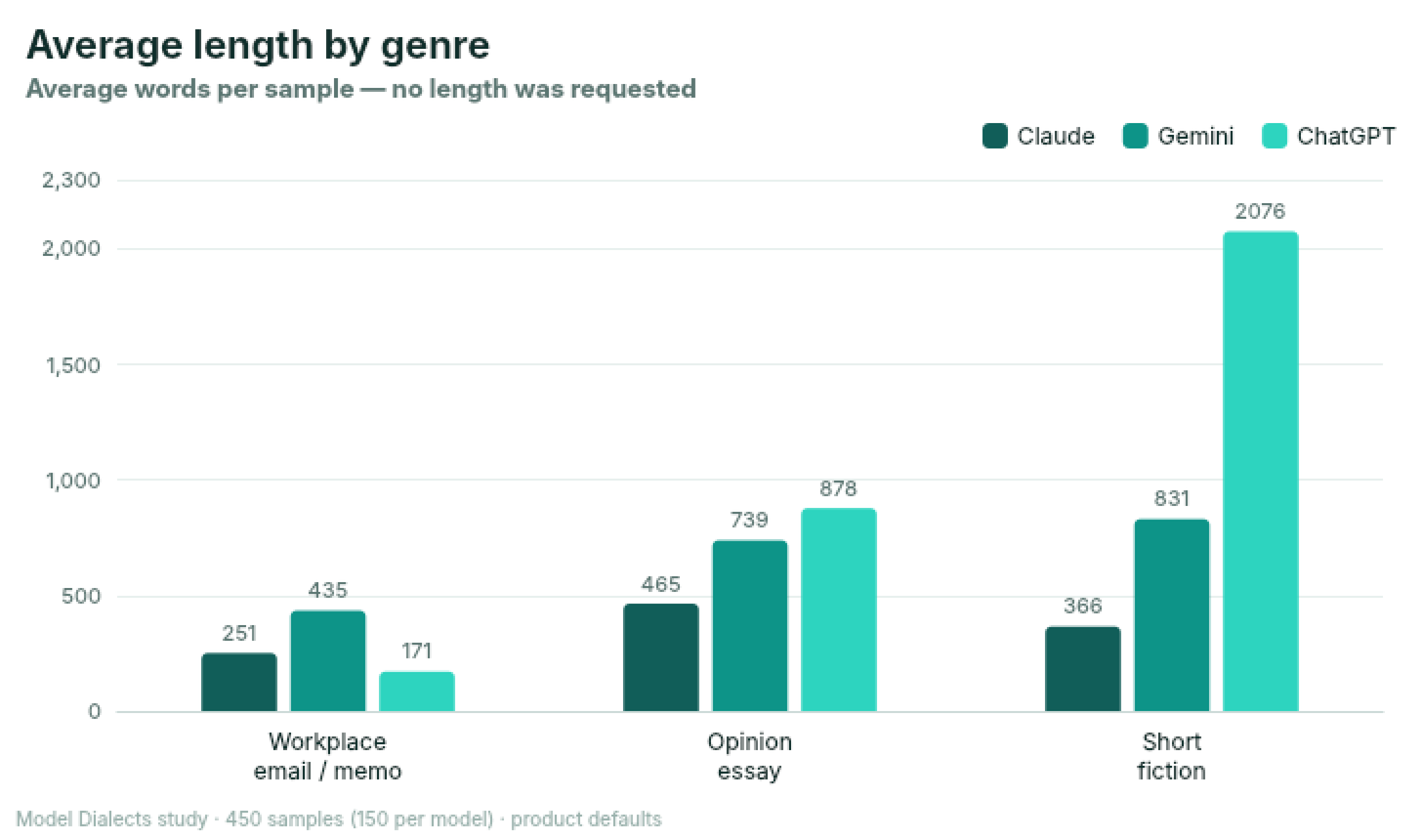
Claude is consistently the most concise. Gemini runs long across the board. ChatGPT swings the most. It writes the tersest work email, and then turns around and writes a short story roughly six times longer than Claude’s.
The apostrophe tell
The three models apply punctuation differently, and very consistently.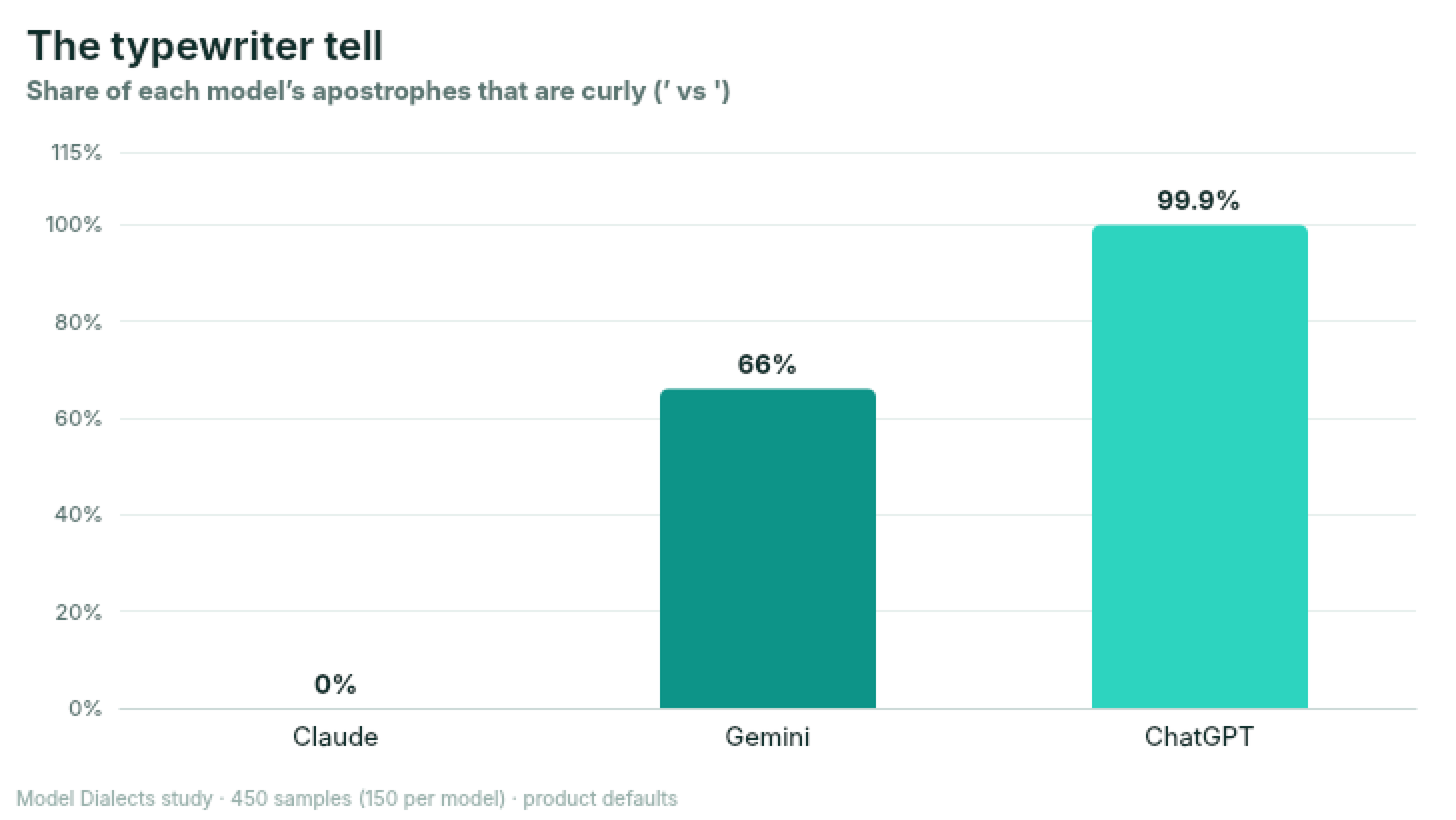
Claude uses plain typewriter punctuation every time.
ChatGPT uses curly punctuation almost every time.
Gemini is mixed.
What it all means
When you read something and immediately think “that sounds like AI,” the AI detector in your head has probably recognized the style of whichever model you use most often. Tics and tells from the models you don’t use may never register at all.
This is part of why it’s so hard to pick out AI writing. Every signature word in this study is ordinary English. A word only becomes an AI tell when it’s used more often then usual. For example, Claude writes “genuine” at a rate of 2.19 times per 1,000 words in opinion writing, while the other two models hover near 0.1. But two instances of “genuine” in a 1,000-word essay are difficult to spot and will slip past most readers. Statistically speaking, a single essay gives a casual reader almost nothing to go on.
The overlap between AI and human writing makes attribution even more complicated. I often use “massive” and “incredibly” in my own writing, and I virtually never use Gemini. Judged by word choice alone, a Gemini-native reader would flag me. And that’s no coincidence. The models learned these habits from human writing in the first place, so every tell in this study is also somebody’s natural voice. Sorting text by ear means some of those somebodies may be unfairly accused.
And one question lingered even after the study was complete. So far, we’ve seen human writing used as training data impact models’ writing styles. As more of us write with one model or another, is the opposite happening? Is working with AI and reading its outputs changing how people choose to write themselves?
I’m not sure and, as always, I’m planning another study.
For further reading
recently wrote two articles comparing writing styles across different models. And they include longer snippets of AI writing so you can compare the default “vibe” of each model. DARING NEXTIt was just another Tuesday (Part One)Read morea month ago · 23 likes · 11 comments · Dallas PayneDARING NEXTIt was just another Tuesday (Part Two)Read more19 days ago · 16 likes · 11 comments · Dallas Payne
Wow, you made it to the end! Subscribe for small batch AI research and tech tips.