Why “it’s not this, it’s that” is everywhere now
By Karen Spinner
Published: 2026-06-06
URL: https://wonderingaboutai.substack.com/p/i-analyzed-16000-articles-to-find
Disclosure: I used Claude Code to write Python scripts, collect articles from Substack newsletters, and create HTML charts. I conducted this research in the spirit of non-judgmental discovery and anonymized all article data. No one has been named, shamed, or blamed. Also, DM me if you’d like more details on the methodology, the data, or the code.
If you spend any time reading online, you’re probably familiar with this kind of sentence, in which a claim is negated and then immediately replaced by a different one:
- “It’s not a diet, it’s a lifestyle.”
- “This isn’t burnout. It’s misalignment.”
- “It’s not about the money, it’s about freedom.”
- “It’s not a market quirk, it’s a national security crisis.”
This is a rhetorical technique called antithesis, and once you start noticing it, you start seeing it everywhere. It regularly appears in LinkedIn posts, founder manifestos, and yes, even our favorite Substack Notes and articles.
In years past, marketers widely adopted antithesis in advertising and web copy, so it’s well represented on company and product-focused websites built before 2022. Since a lot of this material ended up in the Common Crawl and the other datasets used to train AI, today’s frontier models (ChatGPT, Claude, Gemini) are familiar with antithesis and use it often.
In fact, its presence is a marker that a piece of writing may be partly AI-generated. And, anecdotally speaking, I feel like I’m running into it more often these days.
But is this phrasing really infiltrating Substack, or am I just noticing it because I write about AI?
I decided to find out.
TLDR: If you think you’re seeing “it’s not this, it’s that” in virtually every article you read, you’re not imagining it. The prevalence of this construction, known as antithesis, has increased nearly 5X since ChatGPT was first rolled out. And preliminary analysis suggests that, yes, as we all suspected, more of us are writing with AI support.
Do you also wonder about AI? Subscribe for research and tech tips.
Designing the study
To find out whether the “it’s not this, it’s that” construction is really spreading like a bad cold, I collected a large sample of anonymized Substack writing, calculated how often the pattern appeared, and then looked at how it varied across topics, newsletter size bands, and time periods.
I also added two validation steps to make sure any increase wasn’t just a side effect of people writing more overall.
Let’s walk through each step:
Defining the pattern
I started with multiple variants of the “it’s not this, it’s that” pattern, along with a list of words commonly associated with AI writing. Then I wrote a search function that recognizes the pattern wherever it shows up, including the versions built with a dash or a colon instead of a comma:
- Comma: “It’s not me, it’s…”
- Period: “This is not avoidance. It is restoration.”
- Semicolon: “This isn’t just deodorant; it’s…”
- Colon: “It’s not random, and it’s not inexplicable: it’s…”
- Em dash: “This is not a market quirk — it is a national security crisis.”
Gathering the corpus
Next, I collected roughly 16,800 free Substack posts from newsletters spanning a wide range of topics and subscriber counts. I stripped out all author names to keep the focus on the spread of the phrasing rather than on singling out any specific person or publication.
Identifying the source newsletters
The data comes from Substack’s public (unofficial) category API, category/public/{id}/all, which returns each category’s newsletters ranked by total audience size (free + paid), grouped into order-of-magnitude tiers, largest first. It’s separate from the paid-only “Bestseller” list and the “Rising” feed.
I included up to 500 newsletters from each of Substack’s 31 categories, which produced a collection of roughly 14,000 newsletters. For categories with more than 500 newsletters, I chose the top 500. For those with less (like Home & Garden), I took them all.
Substack’s 31 categories
Culture · Technology · Business · U.S. Politics · World Politics · Health Politics · Finance · Crypto · Food & Drink · Sports · Art & Illustration · News · Fashion & Beauty · Music · Faith & Spirituality · Climate & Environment · Science · Literature · Fiction · Health & Wellness · Design · Travel · Parenting · Philosophy · Comics · International · History · Humor · Education · Film & TV · Home & Garden
Balancing the sample size
I built a grid crossing Substack’s 31 topical categories with five audience-size tiers, from newsletters under a thousand subscribers up to ones past a million. Inside each cell of that grid, I picked a handful at random. The goal of the exercise was to make sure all topics and newsletter sizes were evenly represented.
I ended up with a pool of about a thousand newsletters.
Gathering the articles
For each newsletter, I randomly selected up to 25 posts evenly distributed across that newsletter’s timeline. (Some newsletters had fewer than 25 posts.) This allowed me to capture articles from newsletters running before 2022, when generative AI first became available. I ultimately used this data to look at how the frequency of antithesis changed over time overall and if authors started using it more after generative AI became widely available.
Also, I only selected free posts because they are intentionally available to the public. All paywalled posts were excluded.
A word about Substack’s undocumented API
To gather the articles for analysis, I used Substack’s API. An API (Application Programming Interface) is a structured way for one program to ask another for data. When you visit a Substack newsletter and scroll through its past posts, your browser is actually fetching a structured list behind the scenes, with the title, date, URL, and free-or-paid status for each, in a format called JSON.
Substack’s API is unofficial and undocumented, which means Substack doesn’t publish a guide to it. Using it in a production app can be risky, because it can change at any time with no notice. And Substack’s terms of service don’t provide specific rules for how the API can and can’t be used.
I ultimately decided that using it for this project, which analyzed free public posts and produced anonymized results, was low risk. And I was careful to avoid flooding Substack’s servers with traffic. Requests were spaced about a second apart, roughly the pace of a slow human browsing, with a clear identifier and contact address attached to every one.
Anyone wanting to replicate this kind of study should review Substack’s terms of service and make their own decision based on their specific project and goals.
If you want to learn how to find Substack endpoints for your own projects, this article has a quick tutorial.
Calculating the results
I scaled the data to express a frequency per 10,000 words so wordier articles didn’t skew the results.
Then I ran the numbers to answer different versions of the question, “Is this construction spreading, and where?” I compared writing before and after the launch of ChatGPT, writers who started before the AI boom with newer ones, and small newsletters with larger ones.
The results: Yes, it’s everywhere
Before late 2022, the “it’s not X, it’s Y” construction appeared at a steady, low rate across Substack. It was always there (writers have been using antithesis for centuries), but it worked as an occasional flourish. Starting in 2023, the frequency began to climb. By 2024, it accelerated sharply. Today, the pattern shows up roughly five times as often as it did before generative AI became widely available.
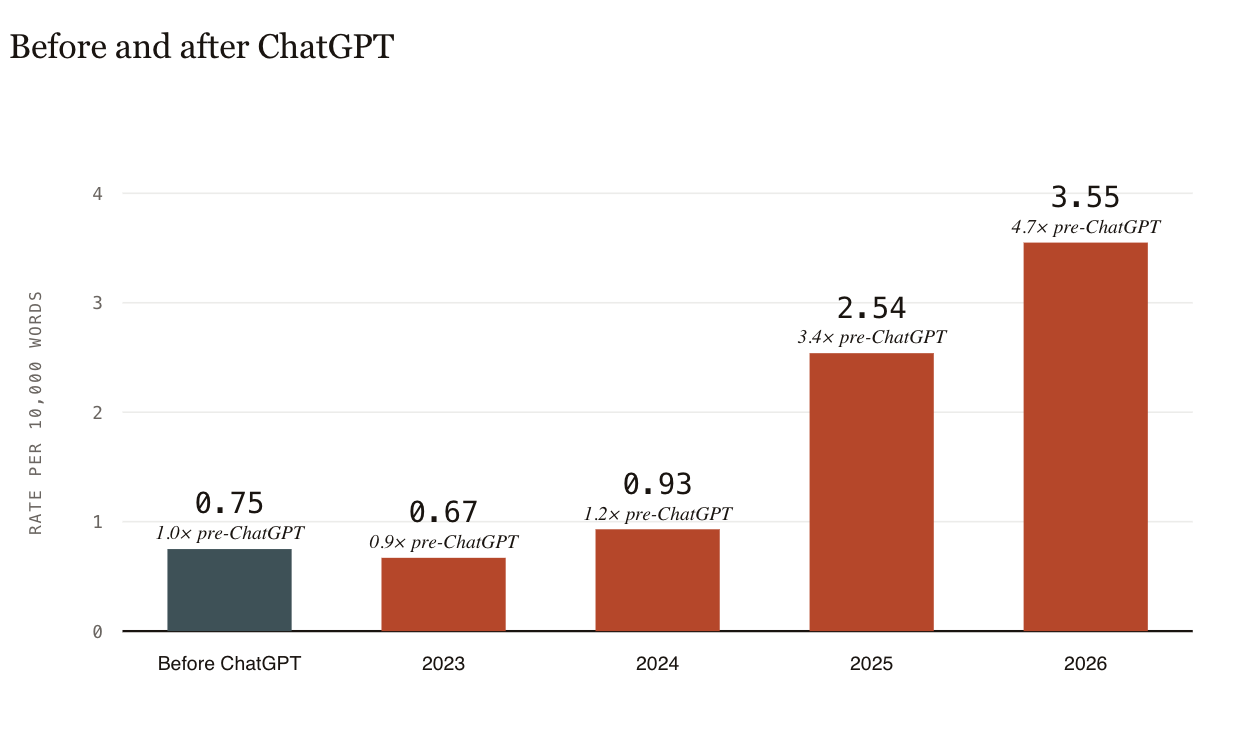
The timing also tells us something about AI tool adoption. Antithesis spread gradually through 2023 and took off in 2024, which suggests that’s roughly how long it takes a new tool and related habits to seep into everyday writing practice.
Where does it appear most?
While the rise of antithesis transcends newsletter age, size, and topical category, it does appear more in some places than in others.
Younger newsletters
Newsletters that launched after late 2022 use the construction more than twice as often as newsletters that were already publishing regularly before ChatGPT.
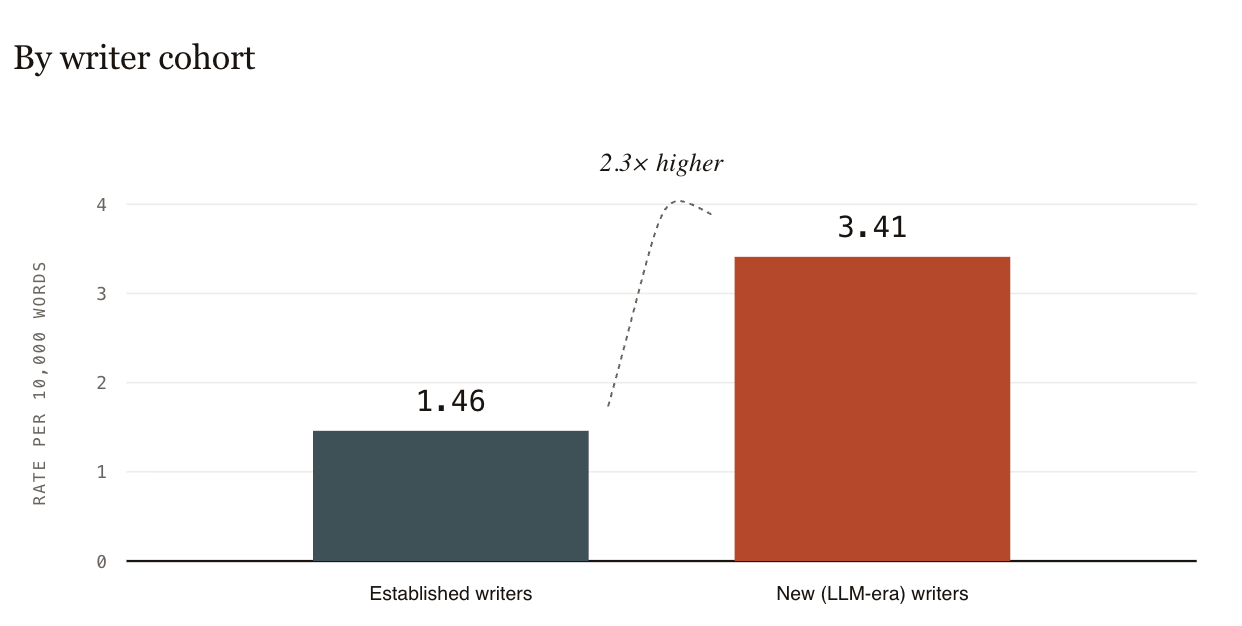
This year, new writers are on track to use antithesis roughly 6X more often than writers did before 2022.
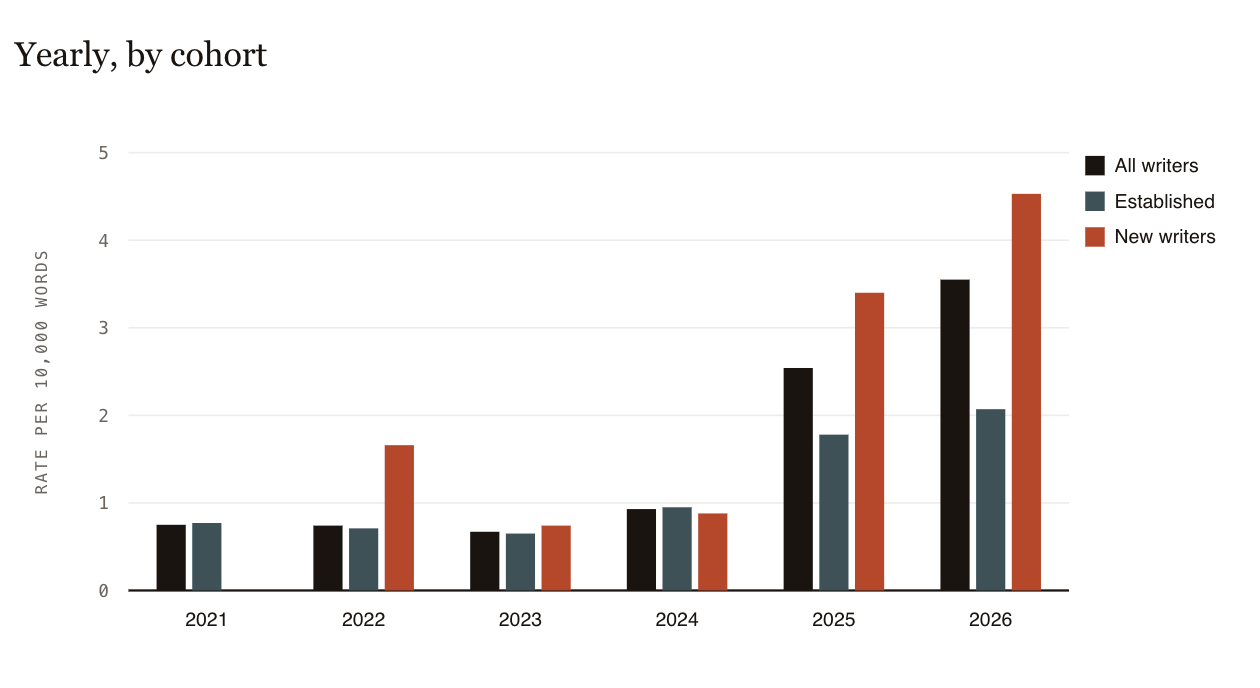
There are two possible explanations for this, and both may be true.
First, newer writers without an established writing routine may indeed be more likely to use AI in their writing process.
And second, newer writers may be using antithesis on their own simply because they see it all the time in other published writing. (More on this later.)
Smaller newsletters
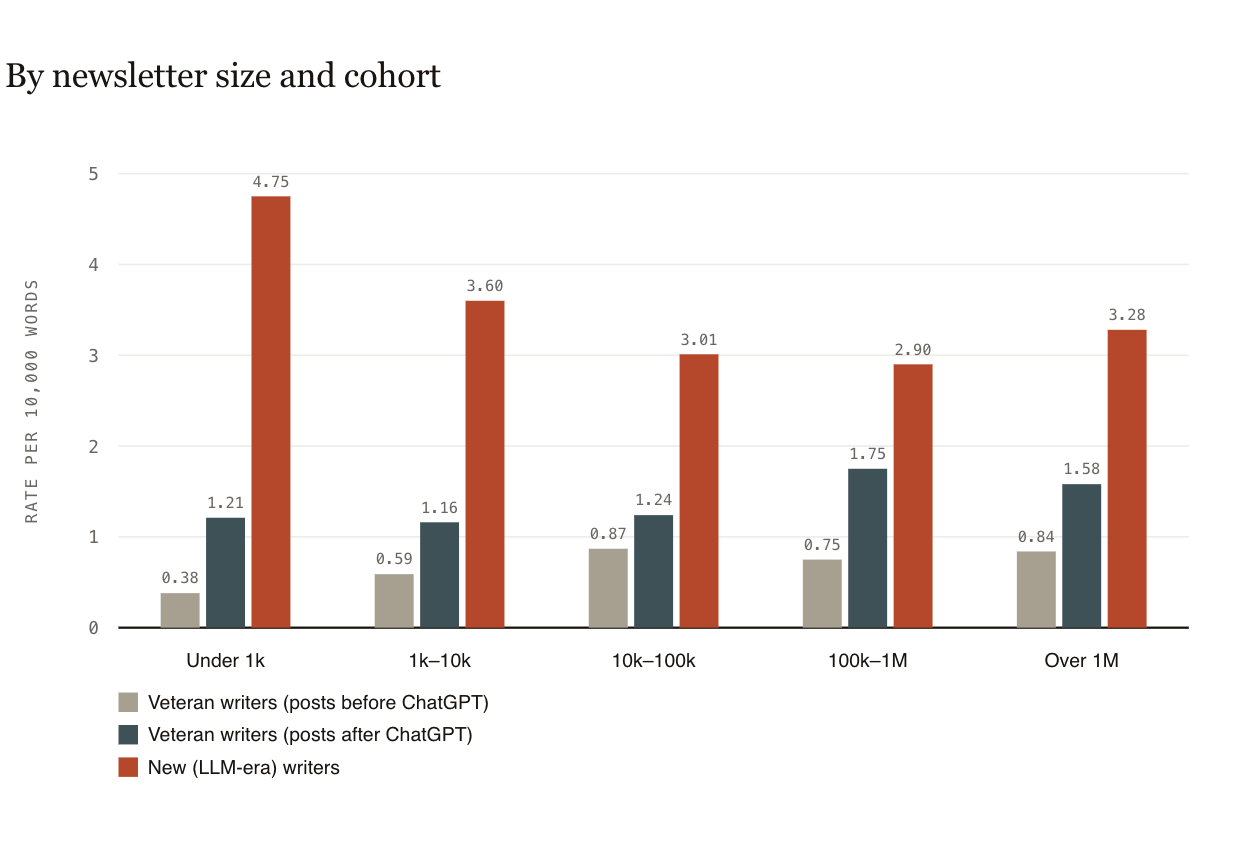
When I broke out the data by subscriber count, the highest rates of antithesis appeared in smaller newsletters that were also launched after generative AI. But, overall, the difference between pre- and post-LLM newsletters is much bigger than the difference between big and small.
Business and Education newsletters
Antithesis is also very prevalent in articles sourced from the Business and Education categories.
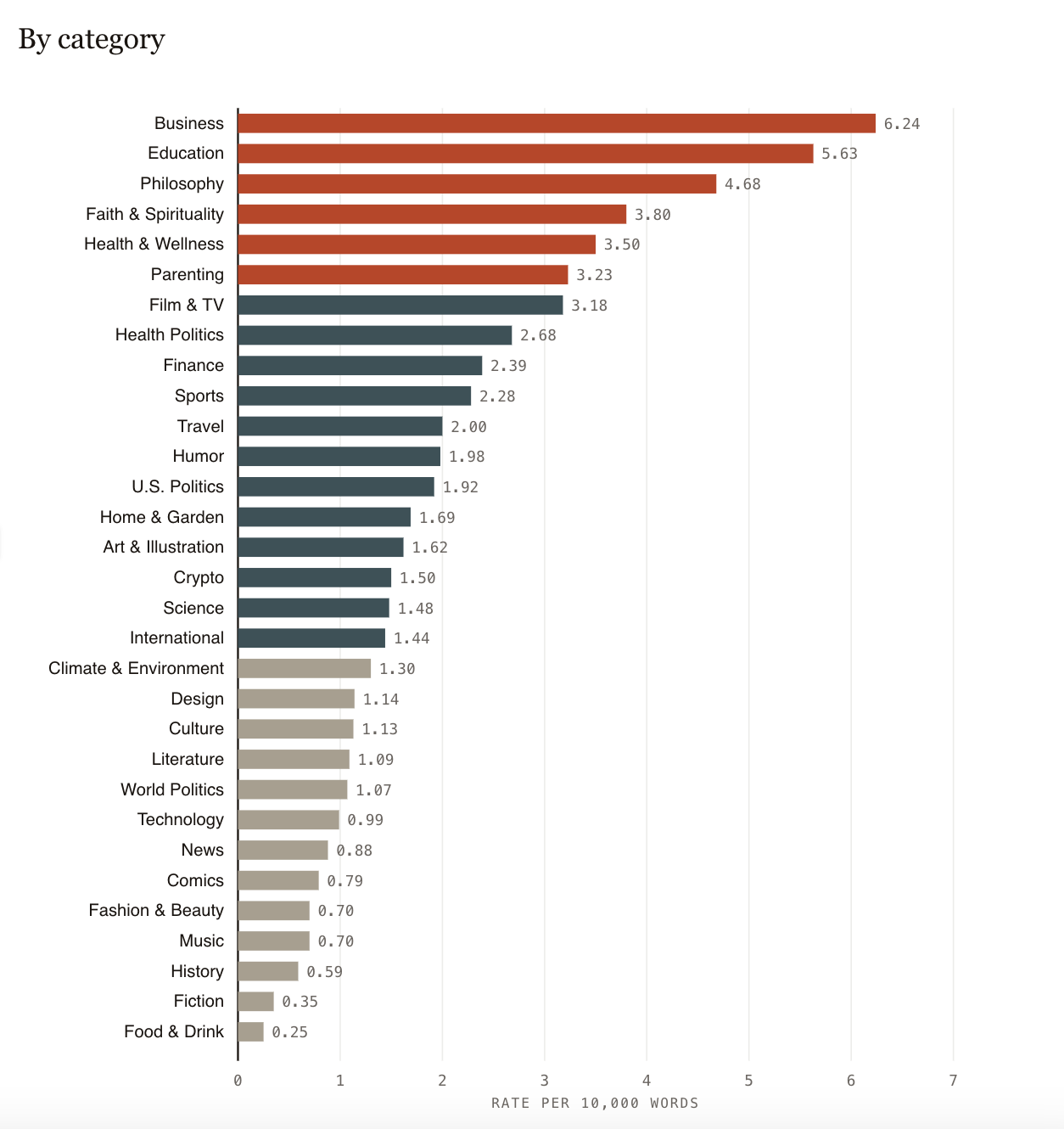
The Business result doesn’t surprise me, because newsletters focused on growth and marketing may be more likely both to reach for marketing language and use AI to write some or all of their posts.
The Education result is also plausible because the category includes a wide variety of newsletters (including mine for now) covering both business- and AI-adjacent topics. It’s plausible that writers in the space may be adopting AI to write or simply picking up the construction from the content they read.
Are people using AI to write or starting to write like AI?
Despite what AI detection software vendors may tell you, it’s not really possible to know for sure whether any given snippet of text was written by a person or AI.
But AI does have certain writing tics that, when they appear, can suggest possible AI authorship in large collections of writing, even when individual cases are ambiguous. One of them is sustained repetition. Basically, when AI uses one of its stock phrases like “it’s not this, it’s that,” it tends to use them multiple times in a passage or article. The more a phrase or pattern is used, the more repetitive it is.
I decided to analyze the Substack articles for repetition to get a rough idea of whether antithesis is spreading because people are adopting it or because they’re publishing more AI-assisted content.
After looking at 500- to 3,000-word posts that used “it’s not this, it’s that” constructions, I found that:
- Before 2025, articles using the construction usually only used it once.
- By 2026, more than half of articles sampled that used antithesis included it more than once, and 25% used it three or more times.
- Writing from newer Substack has the most repetition of all.
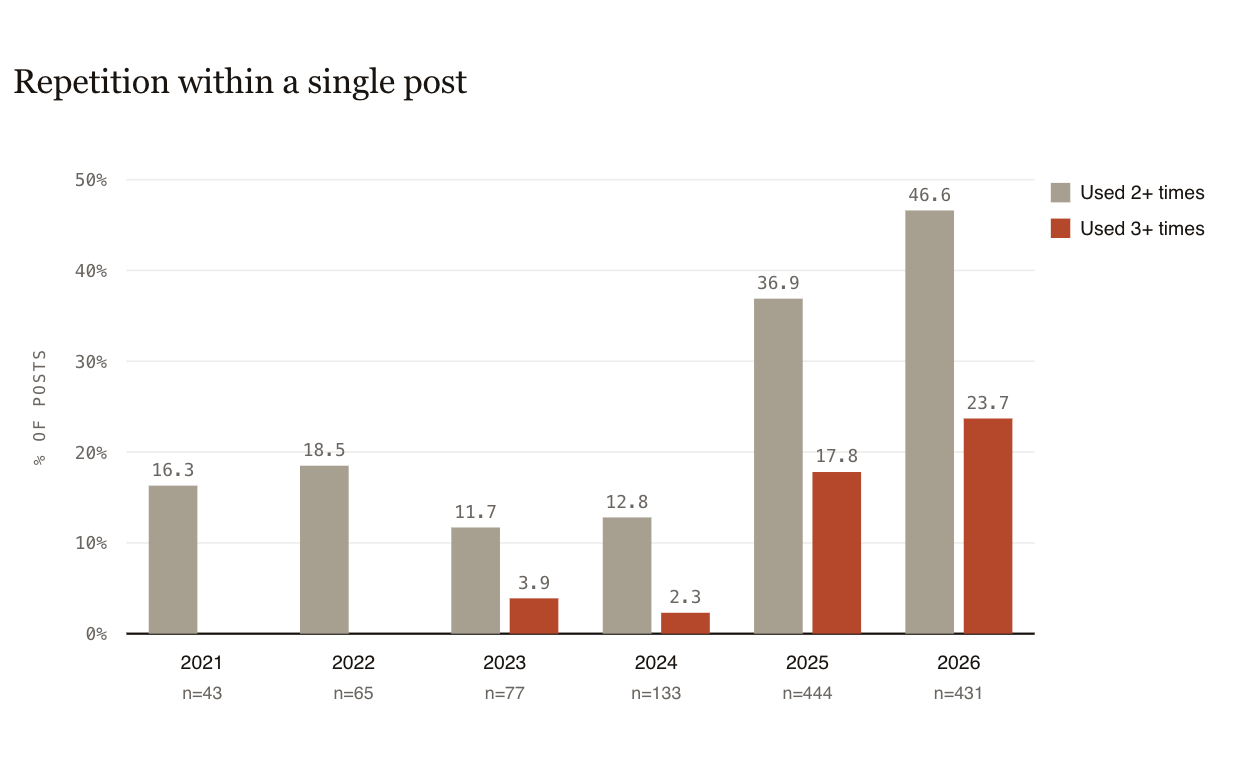
This broadly suggests that more of us are using AI to draft and publish our posts, even if I can’t draw specific conclusions about any particular article.
While some writers may be picking up the phrase organically, the dramatic increase in burstiness tips the scales towards writers using AI to generate drafts or partial drafts as the most likely explanation for the recent explosion of antithesis across Substack.
What it all means
If you feel like you’re seeing “it’s not this, it’s that” everywhere, you’re not imagining it.
The increasing popularity of AI chatbots has dramatically increased its prevalence, especially over the past year and a half. And it’s appearing in a way that suggests AI is generating meaningful portions of many writers’ drafts.
Also, new Substack newsletters founded after ChatGPT was introduced are much more likely to use this construction. (And many of us writing about AI are these new writers!)
The easiest conclusion to draw is that Substack, like many other parts of the web, is being overrun by slop. But when I spot-checked the articles where antithesis was used multiple times, I found that they weren’t universally bad. Some were full of valuable information, some expressed an interesting POV, and some were indeed AI-generated trash.
So, are we now seeing the inevitable growing pains that happen when people rapidly adopt a new tool, or the beginning of the end of what we currently think of as writing?
I can’t say for sure, and I’m planning another study.
Wow, you made it to the end!