What the Stanford AI+Education Summit revealed about process, AI, and the skills that last
By Jacob Carr
Published: 2026-02-25
URL: https://whatteachershavetosay.substack.com/p/the-product-is-lying
What happens when the product no longer proves the process? You’ve probably been sitting with that question too. Here’s what this piece digs into:
- Why generative AI has broken a long-standing assumption about how we assess learning
- What a study on programmers and insecure code tells us about students developing key skills
- What Wednesday morning might actually look like when you try to teach against these traps
- A book coming this spring that I think a lot of teachers have been waiting for
 \Generated with a prompt using Nano Banana Pro.\
On February 11, I sat with my teacher-bestie Nathan in a hall at Stanford University, in the middle of Silicon Valley, and listened to a room full of people say out loud what most of us have been thinking quietly for a while. For the third year in a row, I had a badge around my neck and a cup of coffee going cold in my hand, and the room was doing what it always does: making me think harder than I expected to.
The makeup of the room itself was worth noting: under 200 people ranging from classroom teachers, Stanford professors in Education, Music, Arts, Computer Sciences and more, industry leaders, PhD students, and founders, all in the same space, which doesn’t happen often. Even less often without someone performing.
It didn’t feel like anybody was trying to win the room. Everyone was trying to get something right, which is a different thing entirely, and rarer than it should be at education conferences.
The Stanford AI+Education Summit, hosted by the Stanford Accelerator for Learning and HAI, gathered on February 11. And if there was a single thread running through the day, it wasn’t “AI is amazing.” It was something closer to: we’ve been here before, and we made a mess of it. Several speakers circled back to social media. Not as a cliché, but as a live warning. We scaled something powerful before we understood its cultural and psychological consequences, and the people in that room had clearly been losing sleep over whether we were about to do it again.
In a session on creativity, one idea kept resurfacing. For a long time, we’ve assumed that a strong product signals strong learning. Homework. Essays. Problem sets. Projects.
That assumption is now unstable. As panelists noted, generative AI can produce impressive artifacts without the human struggle that used to sit behind them. Others sharpened the tension even further when they put it plainly: we are using AI to help learners consume knowledge while leaving the act of creation to the machine.
I’ve been turning that over ever since. Most teachers I talk to are worried about cheating, and they’re right to be. But also, underneath that, they’re worried about something harder to name, the slow disappearance of the friction that builds reasoning, discernment, creativity, judgment. The product can now exist without the process, and for most of the history of schooling, we never had to distinguish between the two because the product was the evidence of the process. That’s gone now, and I don’t think we’ve fully reckoned with what it will cost.
I also don’t think frameworks alone are going to get us there. I believe in tools like the AI Assessment Scale because they give teachers language for a conversation most of us are having in fragments, but language doesn’t restructure a school day, reduce a class size, or change what gets measured on a state assessment.
A teacher reading about levels of AI involvement on a Tuesday night still has to walk into 35 students on Wednesday morning inside a system that rewards the finished product and always has. Naming the problem more precisely is real work, and it just isn’t the same as solving it.
But something the summit kept returning to felt worth sitting with longer. It was the idea that students are not waiting for permission. While studies vary in their exact numbers, it seems that nearly half of generative AI users are under 25, and many are using it for homework and emotional support, which is already deep in territory most schools haven’t figured out how to address. **The question of whether to let the tool in has already been answered by students themselves.
What hasn’t been answered is whether we’re building the kind of judgment that makes any of this navigable.**
Along these lines, a progression emerged from the panels: teach what AI is, teach hallucinations and bias, teach verification, then teach advanced techniques like prompting. Treat it as a subject, not just a utility. Researchers at the summit called this epistemic vigilance, a new term for me, and one worth stealing.
The teachers I know who are doing this well are doing it in the margins, before the bell, after the bell, sideways through an existing unit, because there isn’t a sanctioned place for it yet.
Then, there’s a study that I keep thinking about, where trained programmers using AI produced less secure code while confidently believing it was more secure. The tool generated a false sense of fluency, and I think about that constantly in terms of students writing essays, solving problems, answering questions in domains where they can’t yet evaluate whether the output is any good.
The danger isn’t laziness, but the specific cognitive trap of feeling like you understand something you’ve only received. That’s harder to teach against than cheating, because it doesn’t feel like anything is going wrong. It’s kids thinking they can play guitar when really all they’ve ever played is Guitar Hero.
I worry that if we don’t deliberately teach against that trap, we will default to one of two main positions: blind trust, or blanket distrust. Both feel safe, and neither requires judgment. Both quietly surrender the very thing school is supposed to cultivate.
So what does teaching against that trap actually look like on a Wednesday morning? This is where practical structure matters. One of the reasons I lean on EduProtocols is that they force thinking into the open and slow cognition down just enough to make it visible. Take Walk the Line, an EduProtocol from my book. Students isolate an argument into its finite parts and examine the conditions of truth and logic. Is the claim accurate? Does the evidence actually support it? Does the line of reasoning hold?
If you, as a human, run that protocol on an AI-generated argument as the subject, the conversation shifts immediately. The question stops being “Did you use AI?” and becomes “Is this claim defensible?”
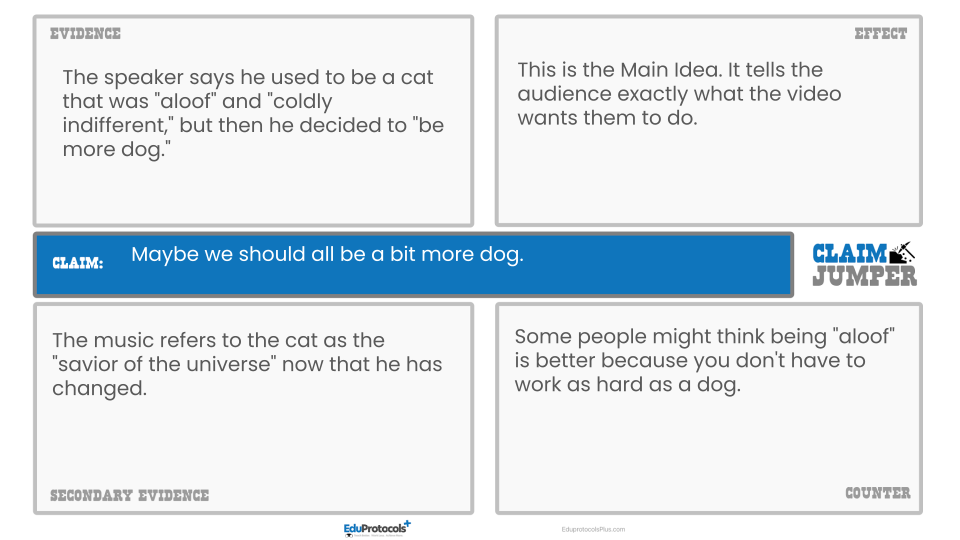 \An example of Claim Jumper using the O2 commercial “Be More Dog.” For the full example deck,click here.\
Another EduProtocol called Claim Jumper does something similar. Students mine a text for claims and evaluate the quality of the evidence provided. When the text is AI-generated, they are forced to confront the possibility that the evidence might be thin, circular, or fabricated. Even something as simple as a Frayer model can shift the posture. Define bias. Define hallucination. Define lateral reading. Name the warning signs before students encounter them in the wild.
And then there is a move I use often: generate an answer with AI in front of students, then ask only questions. Where might this be wrong? What sources would we need to check this? What perspective is missing?
Who benefits from this framing? It looks a lot like a Wicked Hydra EduProtocol, actually, with questions branching, no answers allowed yet. The energy in the room changes when students realize the tool is not the authority.
Two people thinking carefully about exactly this are Kate Meyer and Nicole Davis, who you might know as Two Maine Teachers. Kate and Nicole are fellow EduProtocols authors, and I’ve been getting to know their work better over the past year. I’m especially looking forward to having them join us at the EduProtocols Academy in Laguna Beach this July. Their upcoming book, The EduProtocols Field Guide: AI Literacy Edition, is coming out this spring, and it builds exactly the kind of classroom-ready structure around AI literacy that this moment needs, with protocols designed to teach students how to evaluate, question, and think alongside these tools rather than just consume what they produce.
You can find more information about their work at twomaineteachers.com.
The summit didn’t resolve any of this, and I’d be suspicious of any gathering that claimed to. What it did was put the right people in a room together, without hierarchy and without anyone performing certainty they don’t have, and let the actual shape of the problem become visible. That’s rarer than it sounds.
I left with more questions than I arrived with. That feels honest. It’s probably why it’s becoming my favorite yearly event.
If you’re wrestling with this in your own classroom, I’d love to hear what you’re trying. Where are your students drivers? Where are they passengers? Restack this if it helps you name the tension out loud. Or better yet, try one of these structures this week and tell me what happened. We’re not going to solve this in a single summit or a single post. But we can get better at noticing what we’re actually training when the product no longer proves the process.