On Writer’s Block, the Subconscious, and the Strange Origins of Ideas
By Ashley Evans
Published: 2026-09-23
URL: https://wannabewisdom.substack.com/p/waiting-for-frankenstein
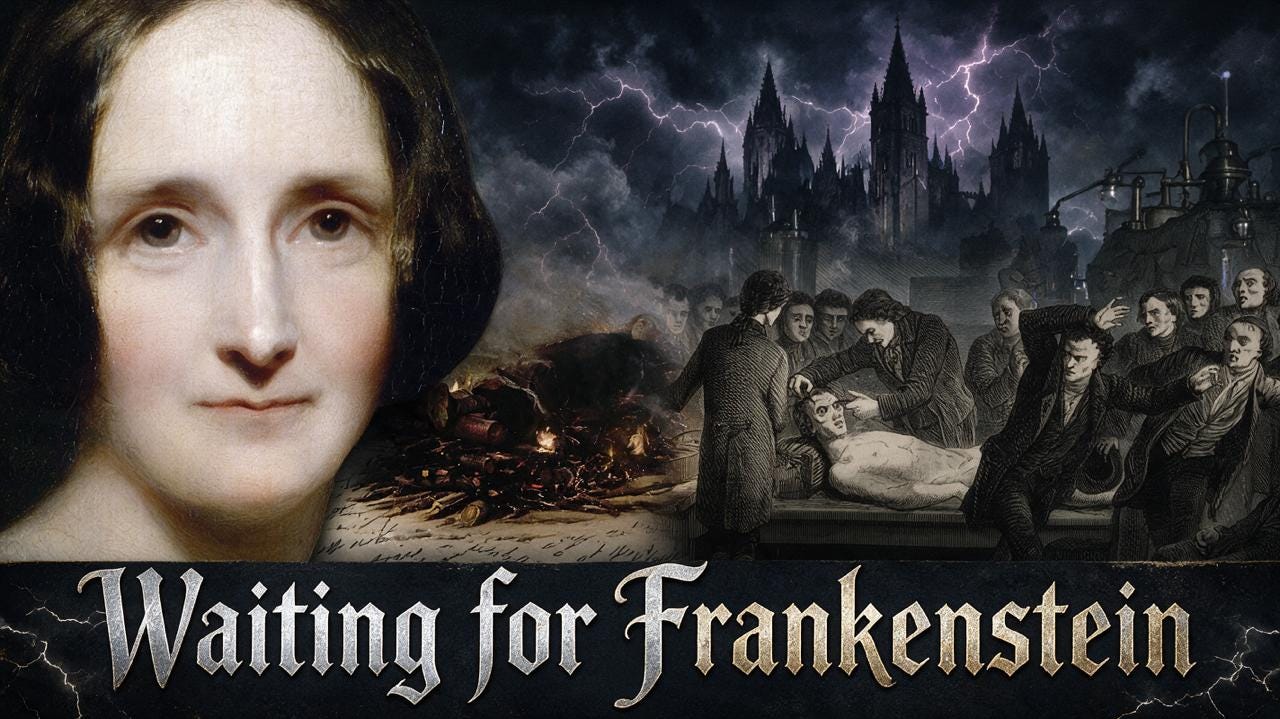
I’m not going to tell you the scandalous part of the story about Mary Shelley: how she ran away with the famous poet Percy Bysshe Shelley when she was sixteen and he was already married, or how Percy’s wife Harriet later drowned herself while pregnant, or how Mary became estranged from her family.
And I’m definitely not going to tell you how Percy eventually drowned in a shipwreck, or how, after his body was cremated, what was believed to be his heart remained unburned and was eventually given to Mary, who kept it wrapped in silk inside a copy of Adonais in her desk.
Because this isn’t about any of that.
This is about Mary Shelley having no idea what to write.
I first read Mary Shelley’s Frankenstein in a college pop-literature class where we compared nineteenth-century popular fiction to Stephen King’s Dolores Claiborne.
Dolores Claiborne is a fantastic read, and I still can’t get over how well Stephen King writes a particular kind of female rage that comes from having had enough.
But it was Frankenstein that stayed with me.
What I didn’t know was the story of how Frankenstein came into being.
Because before Frankenstein became Frankenstein, Mary Shelley was eighteen years old, spending the summer near Lake Geneva with Percy Shelley, Lord Byron, her stepsister Claire Clairmont, and Byron’s personal physician, John Polidori.
Can you imagine the conversations between these literary minds? A writer’s retreat at a mansion in Europe is on my bucket list. Please send me a DM if you have any leads.
Except their glamorous literary summer retreat was kind of terrible.
The year before, Mount Tambora had erupted in Indonesia. It was the largest volcanic eruption in recorded history, sending ash and debris high into the atmosphere and causing global temperatures to drop. It was a domino effect: crops failed and food prices rose. The Napoleonic Wars had also just ended after more than two decades of conflict.
A year later, material from the eruption was still disrupting weather thousands of miles away.
Mary and her pals had no idea that a volcano in Indonesia had anything to do with what was happening outside their windows. They only knew something was very wrong.
Suddenly, everybody was stuck inside.
Mary wrote that “an almost perpetual rain” kept them inside. The lake flooded. There was snow in June.
There is an eerie familiarity to all of this, isn’t there? I can’t help but think about COVID when I imagine these global events, although there is one enormous difference. We knew what was happening to us, or at least, we were given an explanation. We had scientists and charts and government announcements, plus Facebook relatives telling us the scientists and charts and government announcements were all lying.
Mary just had a summer that never came.
So they spent a lot of time inside.
Sometime in mid-June, Byron suggested they each write a ghost story.
Byron started one and eventually abandoned it. Percy started one based on experiences from his early life and abandoned that too. Polidori attempted a story involving a woman with a skull for a head and apparently couldn’t figure out where to go with it. He would later write The Vampyre, an early ancestor of Dracula and hugely influential in modern vampire fiction. So, he did fine.
Mary, meanwhile, couldn’t even start. She described it as a “blank incapability of invention,” which sounds a lot like what we would now call total writer’s block.
Except there was a lot going on beneath that blankness. 
A little over a year earlier, Mary had given birth prematurely to a baby girl who died within days. Six weeks later, she dreamed the baby had come back to life.
In her journal, Mary wrote:
“Dream that my little baby came to life again; that it had only been cold, and that we rubbed it before the fire, and it lived—I awake and find no baby—I think about the little thing all day.”
This was March 1815. More than a year before the ghost-story competition, Mary had already dreamed about bringing someone she loved back from the dead.
Years later, writing about the origins of Frankenstein, Mary described invention this way:
“Invention, it must be humbly admitted, does not consist in creating out of void, but out of chaos; the materials must, in the first place, be afforded: it can give form to dark, shapeless substances, but cannot bring into being the substance itself.”
And there were other materials.
At Lake Geneva, Mary listened to long conversations between Percy and Byron about the nature of life, the mysteriousness of the universe, and whether humans might ever discover the principle by which life itself was created.
She described herself as eavesdropping on these conversations, as a “devout but nearly silent listener.”
One of the scientific ideas circulating at the time was galvanism: experiments using electricity to cause movement in dead tissue.
Years earlier, an Italian scientist had performed an experiment in London on the corpse of an executed murderer, running electrical current through his body. His jaw reportedly quivered, his face contorted, one eye opened and his hand clenched. To the people watching, it looked disturbingly close to a dead man showing signs of life.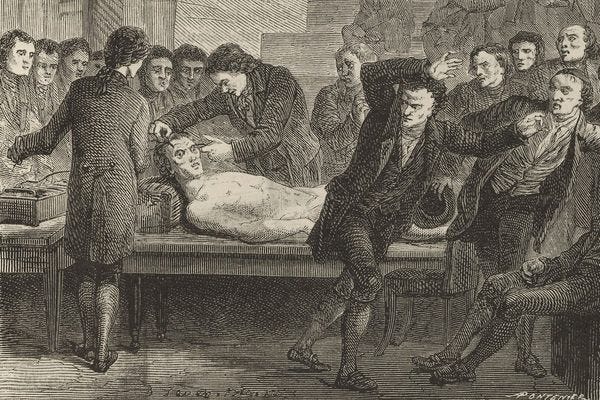 Illustration of an 1818 galvanic experiment on a criminal corpse. Photo credit: Kirstin Mills.
Put yourself back into your 18-year-old self and imagine yourself as Mary for a moment. She had a dream that her newborn baby was merely “cold” and that she could “warm it” back to life.
Additionally, she was listening to some of the greatest thinkers talk about whether life itself could be artificially created. She was hearing about scientific experiments that seemed to make dead bodies come alive momentarily. On top of this, the weather had gone completely berserk for reasons nobody understood.
And when her friends asked her every morning, “Have you thought of a story?” her answer was still no.
We tend to think about inspiration like it’s the moment we’re struck by a lightning bolt, and an idea arrives to us fully formed, and we have to just sit down to write it.
Maybe, sometimes, it works that way.
I loved reading the story in ’s book Big Magic: Creative Living Beyond Fear where Tom Waits is driving down the highway and suddenly he hears this beautiful melody in his head, and he doesn’t have anything to record it on: not a pen, paper, or recording device.
He pulls over to the side of the road and looks up into the sky:
“Excuse me, can you not see that I’m driving? Do I look like I can write down a song right now? If you really want [it] to exist, come back at a more opportune moment when I can take care of you. Otherwise, go bother somebody else today. Go bother Leonard Cohen.”
I wish this kind of divine inspiration for all of us.
But even Mary’s description suggests something more complicated than that: the idea that invention starts with some material, but we don’t necessarily know what it’s becoming when we’re living in it.
It makes me wonder what we are all carrying around, individually, right now, that hasn’t found its form yet. What other Frankensteins will be written in the next decade?
Between Two and Three in the Morning
Back to our story...
In the early hours of a dreary June day, after another long conversation between Percy and Byron about the nature of life and whether a corpse could possibly be reanimated, Mary went to bed and couldn’t sleep.
I had one of those nights thinking about this essay.
She later described what happened as a waking dream:
“When I placed my head on my pillow, I did not sleep, nor could I be said to think. My imagination, unbidden, possessed and guided me… I saw—with shut eyes, but acute mental vision—I saw the pale student of unhallowed arts kneeling beside the thing he had put together. I saw the hideous phantasm of a man stretched out, and then, on the working of some powerful engine, show signs of life, and stir with an uneasy, half vital motion.”
This is the point in Mary’s story where the hypnotherapist in me starts getting excited, because what she describes sounds remarkably close to a hypnagogic state: that strange threshold between waking and sleeping when the conscious mind has taken a back seat.
If you’ve ever been drifting off and suddenly had a bizarre image, idea, or realization arrive seemingly from nowhere—like, why are vampire penguins so cuddly?—you’ve been hanging around in that territory.
And somewhere in that territory, Mary saw a pale student kneeling beside a body he had put together, watching it show signs of life.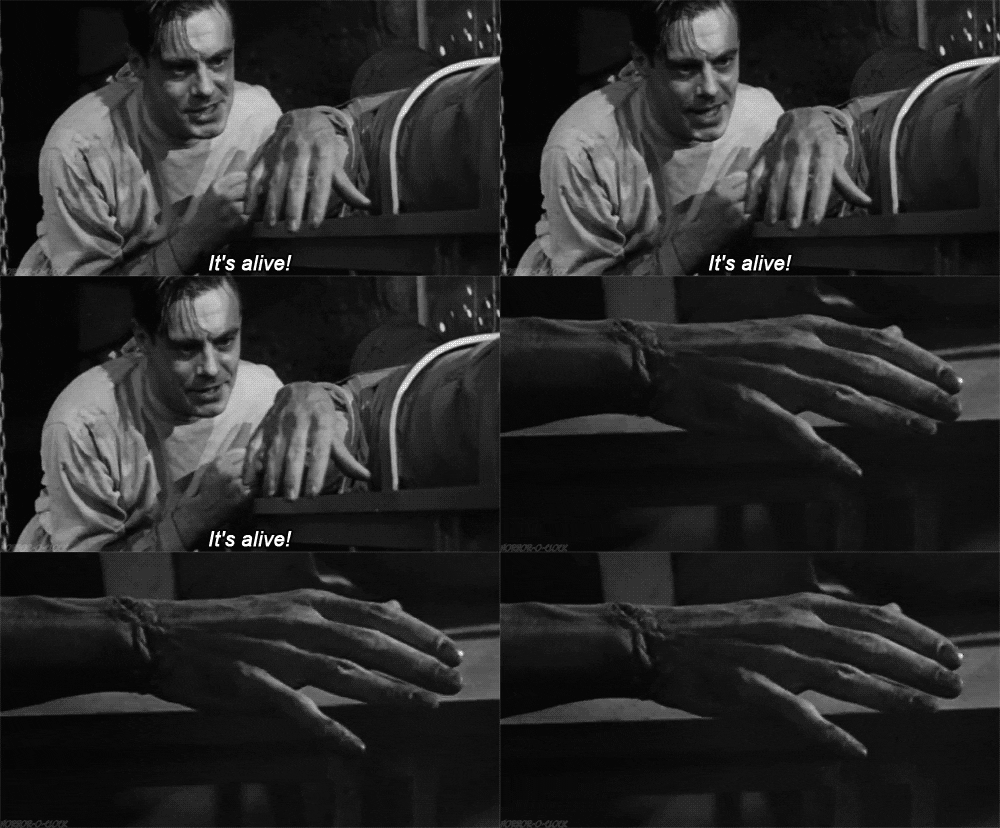
This is normally where the story of how Mary Shelley wrote Frankenstein ends, because it’s a fantastic ending: an eighteen-year-old girl, trapped inside during the year without a summer, has a terrifying waking dream in the middle of the night and wakes up with the idea for one of the most famous novels ever written.
Except Mary didn’t wake up with Frankenstein.
She woke up with an image.
She still had to figure out what the hell to do with it.
The Eleven Months After the Dream
Mary left Geneva at the end of August, and by September her journal starts recording the work.
Life, meanwhile, didn’t become any less complicated.
In October, her half-sister Fanny died by suicide. Mary continued writing. In December, she recorded that she had finished the fourth chapter. Later that month, news arrived that Percy’s wife, Harriet Shelley, had drowned, and by then Mary was somewhere around chapter twelve. On December 30, Mary and Percy married.
I said I wasn’t going to go into the scandal, and I’m not. This is a story about writing. Focus, Ashley. Focus.
By March 1817, Mary was living in Marlow, and in her journal she wrote, simply:
“Write every day.”
By April, the draft was finished. In May, she finished transcribing it. Frankenstein was published anonymously on January 1, 1818.
That’s almost eleven months between the famous waking dream and the completed manuscript, and I had never heard that part of the story.
The dream makes a much better origin story. An image arrives in the middle of the night and suddenly Frankenstein exists.
Except it didn’t.
Mary still had to sit down, day after day, while her life continued to be unbelievably complicated, and find out what that image was going to become.
Waiting for Frankenstein
I think that’s why I’m still obsessed with the story of how Frankenstein came to be. Mary Shelley thought she had nothing.
Meanwhile, she had a dream about bringing her baby back to life, conversations about the nature of life and creation, experiments that seemed to make dead bodies move, and a world outside her window behaving in ways nobody understood. All of these strange materials were accumulating before she knew they belonged together.
Then came an image.
And after the image came eleven months of work.
I wonder what that looks like for us now.
We’re all living through a wild moment in history as artificial intelligence becomes part of our daily lives. Climate change, wars and political issues weigh on us. At the same time, we’re constantly taking in other people’s opinions, podcast conversations, books, our own losses, and all the things we can’t stop thinking about.
We also have no idea what our minds might do with it.
Mary called invention the ability to give form to “dark, shapeless substances.”
Those dark, shapeless substances became Frankenstein.
Just imagine what you might create.
Evolving loudly.
With Love & Rebellion,❤️
Ashley
P.S. If you enjoyed this essay, please consider sharing my work. It goes a long way. 🙏
A Little Collective Solitude

Something I kept thinking about while writing this essay is how much of Mary’s creative life happened around other people. She listened to their conversations, read with them, argued about ideas with them, and then went away and did the actual writing alone.
Writers need other people. We also need a lot of time by ourselves. I’ve started thinking of that combination as collective solitude.
So twice a month, I’m opening a Co-Work room for paid subscribers. We’ll arrive, say hello and share what we’re working on in the chat if we want to, then disappear into our own work for an hour—alone, together.
There’s no promise that anyone will create Frankenstein. 😂
We’re just putting a shape around some time and seeing what comes of it.
👉 Details coming next week.
Don’t Miss My Next Author Talk: Emmett Tatter
“In prison, they call them count times. 5,523 times I was reminded I wasn’t a person…”

I cried more than twice reading ’s memoir.
At 22 years old, Emmett entered the Florida prison system, where he would spend the next ten years. What happened to him during that time could have been a nail in the coffin over and over again. Somehow, it wasn’t. And somehow he came out on the other side, more evolved, more passionate and with more love for humankind. I can’t wait to talk to Emmett.
Emmett is a 2026 Claymore Award finalist, a CounterPunch contributor and a certified yoga instructor.
Join us Friday, October 2nd at 8am PT / 11am ET.
Join with the link.