Why chronic procrastination is emotional avoidance, not laziness. Plus a drunk stuffed animal, a German clinic, and a free hypnotherapy recording
By Ashley Evans
Published: 2026-08-08
URL: https://wannabewisdom.substack.com/p/my-procrastination-paid-off-once
I am a procrastinator. Even after writing this newsletter for three years, I often begin writing only the day before my self-imposed deadline. And it’s only after a flurry of panic that I sit down and begin threatening myself for words. A tight fist forms in my stomach, squeezing: “We’re not getting up until you’ve put some kind of scribble down!”
So, naturally, I don’t start. And like the self-gratifying human that I am, I distract myself with pleasant things like dog videos.
See? So good.
In my last year of university, my professor assigned a paper worth 80 percent of my grade at the beginning of the term. I knew I needed to spend a little time every week working on it. I was genuinely curious about the topic: Noam Chomsky’s propaganda model. But as the weeks ticked by and the deadline neared, I couldn’t get myself to work on it. Something about the blank page made me really anxious, like its blankness was my blankness. A reflection that I truly had nothing worthwhile to say.
The deadline was months away, and the page was right there.
I push through it. I write a couple things down, yet I can’t get the feeling out of my body and the thought out of my head that this is rubbish, this is bad, this is rubbish, this is bad! You are rubbish. You are bad! You are boring! I’m so bored. This is boring.
See how quickly this turned!? I’m literally paralyzed!
Four sentences. That’s how long it took to get from the assignment to my inner critic shredding my character.
This is emotional abuse. I quit. I’d rather hang around the kitchen with other students, watch TV, or check out this new app called Messenger on something called Facebook. Who is this Amber and Daniel? Why is Kevin from grade 11 math sending me shirtless photos? Now I’m blocking messages from old friends and strangers.
I was playing Russian Roulette with my future.
Time is a vortex. The days and weeks whiz by. Two weeks out from the deadline, I plead with myself, “Come on, Ashley! Please, just throw a couple words down. For the love of our nervous system. I am begging you.”
This is beyond procrastination. This is self-sabotage. I’ll fail this class. A class I like. And my entire GPA will plummet. I was playing Russian Roulette with my future.
The night before the deadline, there is no way I can write this essay and put words and sentences together coherently enough to show I understood the material. So I lie on my single dorm bed staring at the ceiling, accepting my fate, frozen in the situation I've created. WHY DO I DO THIS TO MYSELF?
Suddenly I have an idea! I spring up from my bed, bolt out the door, down the hallway, past the cafeteria, up concrete stairs, and down three hallways, through the atrium, and up and down more concrete stairs, and finally through another hallway, to find myself in front of the library. I scurry to the Communications section and finger through an archive of books and CDs looking for anything by Noam Chomsky. Anything! Please, dear lord, give me something to work with.
And there it is:
A CD of Noam Chomsky talking about his propaganda model!
It couldn’t get better than this. I quickly check out the CD. My adrenaline pumps. Maybe I could pull this off? https://substackcdn.com/image/fetch/$s!gVGK!,fauto,qauto:good,flprogressive:steep/https%3A%2F%2Fsubstack-post-media.s3.amazonaws.com%2Fpublic%2Fimages%2Fbfe0000a-7ca3-46a4-9446-06a2e8218540_499x281.gif)
NEXT, I run to the audio-visual department, and shove the door open, swallowing the foam rising in my mouth. I bark: “DO YOU HAVE ANY CAMERAS TO RENT?” He nods slowly. THANK YOU! I cry. I rent the last video recorder.
I scurry back to my small dorm room, open my laptop and begin writing a script.
Three characters.
NOAM CHOMSKY — my teddy bear, who I’ve had since birth. A teeny Jack Daniel’s bottle and a cigarette I happened to have, glued to his fists. Dental floss tied to both arms.
DIANE CANDLESTICK — the reporter. A beautiful, pouty woman I’d drawn in charcoal on canvas, taken down off my wall, her square mouth cut out and pasted to a popsicle stick. High-pitched English accent.
CHIN — my chin. Eyes, nose and a mouth drawn on upside down. Filmed upside down. Contrarian.
I don’t question it. I’m in a flow state.
I orchestrate Teddy’s arm movement like a puppet. DIANE CANDLESTICK interviews CHOMSKY with special guest CHIN. Teddy/Chomsky gets drunker and drunker and more animated as they discuss his Propaganda Model.
I reshoot a couple flubs. I rewatch. I reshoot. Day has turned to night. It feels like minutes. I think I got it! I edit the interview, cutting back and forth between the three characters. I know that portraying Chomsky as a cigarette-smoking, over-sharing drinker is risky, but I am desperate.
This is where desperate creativity took me today.
The next morning I hand in the recording to my professor and ask to speak with him. I take a risk. I confide in him. I tell him about the self-sabotage, the procrastination, the freezing, the self-bashing, the anxiety. He’s compassionate but I’m still terrified. I could flunk. Compassion doesn’t always translate the way you want it to. I walk back to my dorm room.
Finally the relief comes. It’s done, and whatever fate is mine, I will face it. Perhaps there was also some relief in being seen.
Compassion doesn’t always translate the way you want it to.
A week later, my teacher asks if I can join him for a coffee. I’m so nervous. He tells me that I got an A-. That I deserve it. And it would have been an A+ but I didn’t follow the guidelines, so he had to dock me somewhere. He shrugs and flips his palms.
I can’t believe it. I feel so unworthy.
He asks me what I want to do with my life. I don’t know. I didn’t need to know at that moment. I was renewed.
An A minus.
I’ve always told it as a triumph. But it’s the worst lesson a procrastinator like me can receive.
Sadly, I don’t remember my professor’s name, but I still think about his kindness. I was in a sinking state and his compassion gave me some levity. Did he give me a pity pass? Only he will really know. He said I earned it. I’d like to believe I did.
I’ve told this story for years, and I’ve always told it as a triumph. But it’s the worst lesson a procrastinator like me can receive. I became my most creative self in my most desperate moment.
Since then, I’ve gotten way better at managing my impulse to procrastinate, but it’s still something I grapple with.
I’ve been chasing that A- for twenty years.
Somewhere in my body there is a record of a night when the panic worked. It produced a drunk teddy bear, a top grade, and a man being kind to me over coffee. And my nervous system filed all of it as evidence. Wait long enough, get scared enough, and something extraordinary springs out of you.
What Happens When We Procrastinate?
Psychologist Fuschia Sirois, PhD, defines procrastination as an “unnecessary” form of delay on a task that you intend to carry out. We do it anyway, knowing there’ll be consequences for ourselves or the people counting on us.1
“Unnecessary” is the word doing the work in that definition.
Procrastination isn’t laziness or poor time management skills. It’s a problem of emotion regulation. Which means the thing you’re avoiding was never the task.
There’s some kind of inner dialogue happening that’s causing you to feel bad. I shared with you my inner monologue, and it never fails. It always takes the form of something like:
-
This is boring.
-
This is bad.
-
This doesn’t even make sense.
-
Who wants to read this?
-
Who are you to write on this topic?
-
This is going to take forever.
-
Other people are so much better.
-
You suck.
What if you had a friend, a colleague, a boss, a spouse, or any kind of person in your life who talked to you like this? You wouldn’t hang out with them. You wouldn’t want to be around them. Yet, this is the voice that comes up in my head anytime I sit down to create. It’s no wonder I would rather watch YouTube videos on manifestation and TED Talks on procrastination than actually write my newsletter.
The dog videos are an anaesthetic, and they work, right up until they don’t.
Why the Dog Videos Stop Working
The worst part about avoiding the thing you said you’d do is that you can’t even enjoy those self-gratifying activities, because you feel so much guilt and shame! And it becomes this cycle of inner criticism and avoidance and shame and guilt. And our whole life becomes built around avoiding the things that trigger us.
Psychologists call this the Zeigarnik Effect: an unfinished task that stays active in your mind, while a finished one would stop running in the background. The thing you’re avoiding is depleting your energy without you knowing it.2
We don’t take procrastination seriously enough. We joke, “Oh, I struggle with procrastination too!” But it’s no joke. It’s incredibly debilitating.
Our whole life becomes built around avoiding the things that trigger us.
It turns out there are two types of procrastinators. The situational kind put things off from time to time, and it’s not overly harmful. You avoid booking the dentist for eight months, but you file your work on time.
Chronic procrastination is more like a personality trait. Roughly half of university students procrastinate to a degree that causes them real problems.3 I was one of them. Once we get into the work world, estimates for adults run anywhere from 15 to 25 percent. That’s a lot of professional people suffering silently with inner criticism.
Apparently, Germany has a booming culture of research around procrastination. We often think of Germans as efficient and punctual. It turns out they have programs for people like me.
The University of Münster has been researching procrastination since 2004 and runs a free outpatient clinic for students and staff whose procrastination has become a clinical problem. The German word for this outpatient clinic is Prokrastinationsambulanz, which arrives in English as procrastination ambulance.4
I need a procrastination ambulance.
What I Actually Do About It Now
It’s so small that you might groan.
When I don’t start something that I say I want to start, I ask what was just said to me (by me). What was the thought in my head? There is always a sentence. It’s usually about eight words long and it arrives so fast you don’t notice it. You just feel the result of “not being in the mood.”
So I write it down in the exact words. I try to stay away from how it’s making me feel (I’m anxious), but what are the actual words. You’re boring. This will take forever. Who are you to write about this?
You can’t work on a mood. You can work on a sentence.
And from there, I douse myself in compassion. I literally monologue with myself in a soft, kind, incredibly supportive voice, and I make my inner critic feel ridiculous. It sounds like this:
Why do you have to be so mean? She’s not trying to cure cancer. She’s just trying to write an essay that a couple people might read. Maybe someone will laugh, maybe someone will learn something. Is that such a crime? Oh, heaven forbid Ashley express herself. Heaven forbid Ashley have a thought. Heaven forbid Ashley try something new.
Or you can amplify the inner critic instead, which is a reverse-psychology thing, and honestly more fun:
Ohhh, I’m so not worthy! I couldn’t ever imagine having a thought and writing it down and putting it out for other people to read. How disgusting! How embarrassing for me!! How horrible that a woman might use her brain and feel something and put it into words… it’s so terrible.
A lot of this work is cognitive behavioural therapy or dialectical behaviour therapy if you want the fancy terms. But it’s really just getting in under the thoughts and feelings in our mind and body.
So, that’s the part I’m working with internally, but there’s also another really big part that I’ve been starting to work on, and that is creating systems that support me.
What I Built So I Don’t Have to Panic
A kinder inner voice doesn’t help much if the day still arrives as one undifferentiated pile. I’ve been working with AI tools that keep me accountable and basically every morning send me a daily brief of what I have on my to-do list. It lands at 5:30 a.m. It tells me: what’s in my inbox, calendar, what’s important or not, and what I need to do to get my bigger goals done over time. It spoon feeds me my own brain so I don’t get overwhelmed.
👉 If you’re interested, I built a system for auditing my Substack. It’s a real marketing audit, and I’ve run it on myself several times now. It has NOT been kind to me, but very helpful. 👇
My brain doesn’t get overwhelmed by work, but it gets overwhelmed by looming work.
Panic used to be my scheduling system. It sorted my day by whatever hurt most, which is how I ended up starting everything the night before.
So, that’s what I’m working with these days.
My teddy is still with me. He sits perched on my night table with a deep coffee stain on his stomach. I’m afraid if I wash him one more time, he’ll disintegrate into dust. He’s now missing one of his limbs. The one that held his cigarette in his fist on dental floss.
I got an A- for the worst night of my academic life. Twenty years later I’m still writing the day before, and still depending on the knotted feeling in my stomach to help me kick my butt into action. 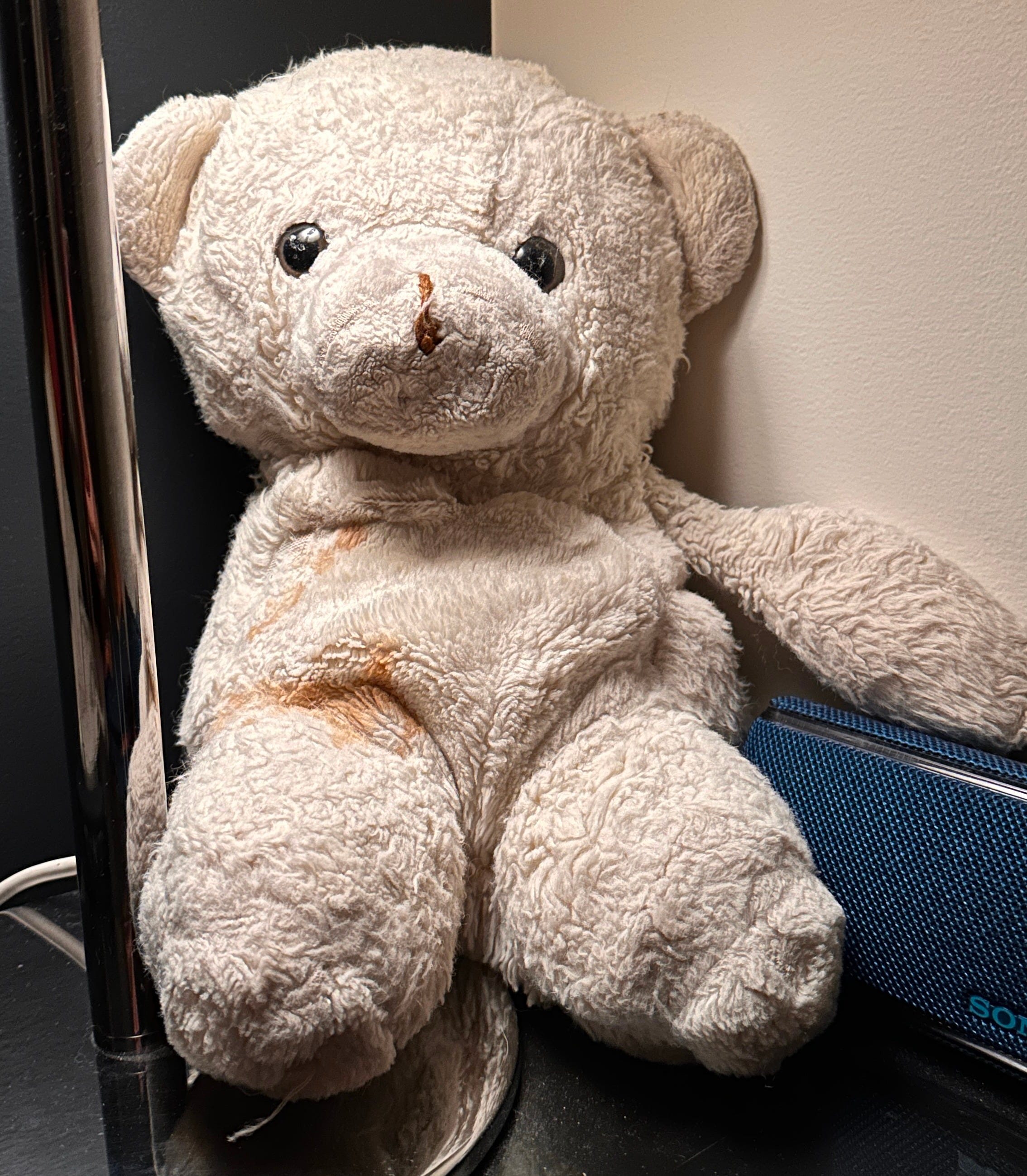
Tell me in the comments: when you don’t start, what was just said to you?
Evolving loudly. With Love & Rebellion,
Ashley aka Fake Guru
P.S. Brian, if that question resonated, I made you something for you. It’s a hypnotherapy recording for procrastination and a progressive relaxation that takes you down to a beach and works on your inner critic. Watch it free on YouTube:
👉 Paid subscribers get the ad-free, downloadable version, plus all past and future recordings in the member library, so you can download it and listen to it anywhere on repeat without an ads.
Footnotes 1
Fuschia Sirois, PhD, "Why we procrastinate and what to do about it," Speaking of Psychology, American Psychological Association. Sirois’s argument is that procrastination is an emotional regulation issue not a time-management issue. 2
I came across this one in “Your Brain Is Not a Filing Cabinet (Stop Treating It Like One)” by Clarity Reset. It’s worth reading if you have 10 open loops at any given time.3
Rozental & Carlbring (2013) put chronic procrastination at roughly half of students and 15–20% of adults; other estimates run as high as 25% depending on the study. 4
Prokrastinationsambulanz, University of Münster Procrastination Outpatient Clinic is a free treatment centre for students, built on cognitive behavioural approaches.