We are not hiring for AI anymore. We are hiring for responsibility.
By Michael J. Goldrich
Published: 2026-01-23
URL: https://vivander.substack.com/p/the-four-roles-that-will-define-the
 \The path forward isn't abandoning your expertise. It's letting it evolve.\
I have been sitting with a question for weeks now. Not “which AI tools should I learn?” or “how do I automate my workflow?” Those questions feel increasingly beside the point. The question that keeps surfacing is more foundational: What does it mean to be responsible for work that AI performs?
This is where the conversation about AI careers gets interesting to me. When people ask what skills they should develop, the honest answer is not a list of certifications or platforms. The honest answer is that we are entering an era where the most valuable professionals will be those who can take ownership of outcomes they did not personally produce.
That reframing changes everything.
The Shift Nobody Talks About
A recent piece in ZDNET caught my attention. Joe McKendrick interviewed Andie Dovgan from Creatio about four emerging roles in agentic AI. The roles themselves are worth knowing: AI leaders, agent operators, AI no-code creators, and workflow architects.
But what struck me was not the job titles. It was something Dovgan said about the thread connecting them all.
The common element across these roles is “ownership of outcomes, accountability for agent behavior, and continuous optimization as business conditions change.”
Read that again. Ownership. Accountability. Continuous optimization.
This is not a description of technical skills. This is a description of leadership responsibility.
What These Roles Actually Mean
Let me walk through each one, but not as a job description. Think of these as modes of responsibility that professionals will need to embody, regardless of their formal title.
AI Leaders: The Translators
An AI leader is someone who turns capability into value. They do not code agents. They do not optimize prompts. They figure out where AI creates meaningful business outcomes and then orchestrate the human and digital resources to get there.
This role does not have a defined path because it requires something you cannot certify: the ability to see across silos and connect technical possibility to business need. The people who will excel here are the ones who have always been good at translation work. Connecting engineering to marketing. Connecting operations to strategy. Connecting what is possible to what matters.
If you have spent your career building bridges between functions, this may be your moment.
Agent Operators: The Responsible Supervisors
Here is where things get philosophically interesting. An agent operator is essentially a human supervisor for automated workflows. They monitor, intervene, and ensure that what the AI does actually serves the intended purpose.
Think about what this implies. We are creating roles where the primary job is to watch AI work and take responsibility when it goes wrong. These professionals need deep domain expertise because they are not executing the work. They are ensuring the work gets done correctly.
This is a fundamentally different relationship with automation than anything we have had before. Previous automation replaced repetitive tasks. Agentic AI requires ongoing judgment about whether the automated judgment is trustworthy.
AI No-Code Creators: The Process Shapers
These are the people who design and deploy agents without writing code. They use platforms to shape what agents can do, what constraints they operate under, and what goals they pursue.
What fascinates me here is the skillset migration. These roles are emerging from business analysts, process owners, and digital transformation teams. People who understood how work should flow are now becoming the architects of how AI executes that work.
The no-code aspect is important. It democratizes agent creation in a way that shifts power from developers to domain experts. The person who understands the customer journey can now build the agent that manages it.
Workflow Architects: The System Thinkers
This is perhaps the most strategic role. Workflow architects take a holistic view of how humans and agents collaborate. They redesign work itself, not to replicate what humans did manually, but to optimize for a hybrid reality where both humans and AI contribute.
The trap here is obvious: using AI to automate bad processes. A workflow architect needs the business acumen to recognize when a process should be eliminated entirely rather than automated.
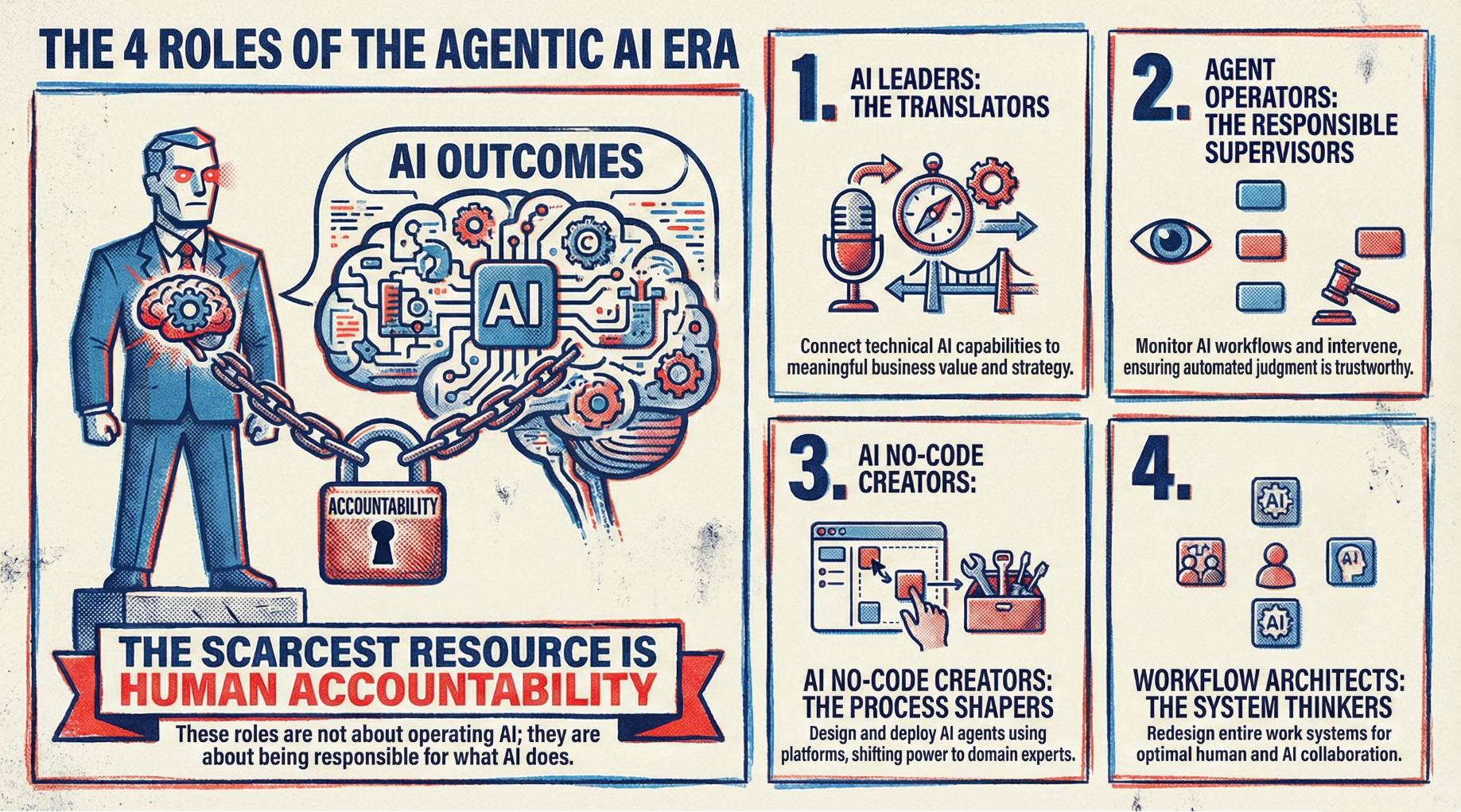 \The Four Roles of the Agentic Era\
What This Means for Your Career
Here is what I keep coming back to. None of these roles are about operating AI systems. They are about being responsible for what AI systems do.
That distinction matters because it points to something many people miss in the “upskill for AI” conversation. The scarcest resource in an agentic future is not technical capability. It is human accountability.
Every organization deploying AI agents will need people who can answer a simple question: “Who is responsible when this goes wrong?” The four roles outlined here are different ways of answering that question.
If you want to position yourself for the agentic era, stop asking “what AI tools should I learn?” Start asking “what kind of responsibility am I prepared to take?”
The Ecosystem Emerging Around These Roles
Dovgan made another observation worth sitting with. The support ecosystem for these roles is still forming. Right now, organizations need external help because internal teams have not yet developed the expertise. AI vendors are deploying engineers directly to work with customers. Consulting firms are building agentic practices. Boutique specialists are emerging around specific industries.
This is the messy, fluid phase before patterns solidify. If you want to learn by doing, this is the moment. The people who will lead these roles in five years are experimenting now, making mistakes now, building judgment now.
There are no playbooks because the playbooks do not exist yet. The people writing them are learning as they go.
What I Am Still Wrestling With
I will be honest about what I do not yet understand. These roles assume that humans remain in supervisory positions over AI agents. That agents will need ongoing oversight. That human judgment will continue to be essential.
But what happens when agents get good enough to supervise other agents? What happens when the “agent operator” role is itself a candidate for automation?
I do not have an answer. I suspect the real answer is that we keep finding new forms of responsibility to take as AI capabilities expand. The nature of the oversight changes, but the need for human accountability persists.
At least, that is what I am betting on.
The Deeper Insight
The four roles emerging in agentic AI are not really about AI at all. They are about a fundamental question that technology has always forced us to ask: what are humans for?
In an era where AI can execute work, humans become responsible for deciding whether the work should be done, ensuring the work is done well, and taking ownership when it fails.
That is not a diminished role. That is leadership.
Michael J. Goldrich is the founder of Vivander Advisors, where he helps organizations navigate AI transformation through AI Literacy, AI Discoverability, and AI Scaling. He writes about how AI is reshaping visibility, work, and leadership.
Frequently Asked Questions
What is an AI leader in the agentic AI context?
An AI leader translates technical AI capability into business value. They oversee how AI gets applied across an organization, define strategy for deploying agentic use cases, and combine human and digital talent to achieve outcomes. Unlike traditional tech leadership, this role requires the ability to see across organizational silos and connect what AI can do with what the business actually needs.
The path to this role is undefined because it draws on change management experience, strategic thinking, and a willingness to pioneer approaches that do not yet have established best practices.
What does an agent operator do?
An agent operator serves as the human supervisor for AI-powered workflows. They monitor what agents are doing, intervene when something goes wrong, and ensure accuracy, compliance, and business continuity.
This role requires deep domain expertise because the operator is not executing the work themselves. They are making judgment calls about whether automated judgment can be trusted. The role typically emerges from operations and business functions where people already understand the workflows being automated.
Do I need coding skills for these new AI roles?
Coding skills are not required for most of these emerging roles. AI no-code creators specifically design and deploy agents using platforms that require no programming. What matters more is understanding business processes, having strong analytical skills, and being able to think systematically about how work flows through an organization. The no-code movement is shifting power from developers to domain experts who understand what work should look like.
What is a workflow architect in the AI context?
A workflow architect takes a holistic view of how humans and AI agents collaborate to accomplish organizational goals. They redesign work itself, determining which tasks agents handle, which remain with humans, and how the handoffs work. This role requires strong business analysis skills because the goal is not to replicate existing processes but to optimize for a hybrid model. Without domain expertise, agents will optimize the wrong outcomes.
How do these roles differ from traditional IT jobs?
Traditional IT roles focused on building, maintaining, and supporting technical systems. These emerging roles focus on outcomes and accountability rather than technical operations. An AI leader is not managing servers or code deployments. They are ensuring AI creates business value. An agent operator is not fixing technical bugs. They are making judgment calls about business processes. The shift is from technical execution to outcome ownership.
Will external consultants or internal teams lead AI transformation?
The answer is evolving. Currently, most organizations need external expertise because internal teams are still developing capabilities. AI vendors are working hands-on with customers. Consulting firms are building agentic practices. Over time, the balance will shift toward internal teams as expertise develops. Dovgan predicts a “hybrid and fluid” ecosystem where vendors, global consultants, and specialized boutique firms all play roles depending on the specific need.
What background is best for transitioning into these roles?
Professionals with business analysis, operations, process improvement, or digital transformation experience are well-positioned. The common thread is understanding how work flows through organizations and what outcomes that work should produce. Technical skills help but are not essential. What matters more is the ability to take ownership of outcomes, think systematically, and operate in ambiguity where established playbooks do not exist.
How quickly are these roles emerging?
These roles are emerging now but will evolve from existing positions rather than appearing as net-new job titles overnight. Organizations are already hiring for some version of these capabilities under various titles. The explicit recognition of these as distinct roles will accelerate as agentic AI deployment becomes more common. Professionals who develop relevant skills now will have an advantage as the roles formalize.
What is the biggest challenge in these new AI roles?
The biggest challenge is taking responsibility for outcomes you did not personally produce. When AI executes work, humans must still be accountable for whether that work is correct, ethical, and aligned with business goals. This requires a different mindset than traditional roles where you controlled the execution. Learning to supervise and be responsible for automated systems represents a genuine shift in what work feels like.
How should organizations prepare for these role transitions?
Organizations should identify people who already understand critical workflows and invest in their AI literacy. The skills needed are not primarily technical. They are analytical, strategic, and judgment-based. Training should focus on how agentic AI systems work conceptually, how to evaluate their outputs, and how to design processes for human-AI collaboration. Building internal expertise now, even while relying on external help, will position organizations to lead rather than follow as these roles become standard.