Dozens of Claude agents produce a machine-checked proof of Fermat's Last Theorem, GPT-6 Astra hits 100% on ExploitBench, and Spotify open-sources a hook that cuts Claude Code tokens by 90%.
By Angel Llosa
Published: 2026-09-14
URL: https://vibecodingweekly.substack.com/p/vibe-coding-weekly-47-ff0
Everything that mattered this week in AI-assisted development, distilled into three headlines, one must-read, and the takeaways behind them.
This week, compiled:
-
The Big Story: OpenAI shipped GPT-6 Astra, which it calls its best model yet for software engineering: 98% on FrontierMath Tier 4, 99.9% on ARC-AGI-3 and 100% on ExploitBench. Codex gains a notes mode that keeps earlier requirements and test failures searchable across context windows
-
The Release: Anthropic’s Claude Fable 5.1 and the restricted Mythos 5.1 posted 55.8% and 60.9% on Terminal-Bench 4.0, and cut cache reads from $1.00 to $0.25 per million tokens
-
The Trend: Three separate answers to the same token bill arrived in one week — GitHub trimming its own prompts, a Copilot research preview routing between models, and Spotify open-sourcing a hook that cut one engineer’s Claude Code usage by 90%, Astra and Fable cosuming less for better performance, Gemini 3.8 Flash...
If you only read one thing this week: Anthropic’s Formalizing Fermat’s Last Theorem is the write-up of dozens of Claude agents running largely autonomously for 11 days on Claude Code-based infrastructure. They wrote 13 million lines of Lean and proved 29,500 intermediate theorems to produce the first end-to-end, machine-checked proof of Fermat’s Last Theorem. Andrew Wiles proved the theorem in 1995. A formal version a computer could verify line by line did not exist until now. This one checks out against Lean’s three standard axioms, and it closes the last open item on Freek Wiedijk’s 100-theorem formalization challenge. The agents worked through Prove2Me, an open collaborative formalization platform from Columbia that tracked theorem dependencies so parallel agents could pick up work without colliding. The harness is the part to read for. Eleven days of largely unsupervised multi-agent work held together because the task came with a dependency graph to split on and a checker that rejects a wrong answer outright. Most engineering work has neither, which is why long-horizon agent runs usually drift. Read more →
I’m Angel Llosa, an AI strategist. My day job is helping companies adopt these tools — defining the strategy and then staying for the implementation, which is where most of the interesting problems show up.
Vibe Coding Weekly comes out of that habit. Once a week I go through the releases, the changelogs and the writing worth reading, and write up what actually happened: what shipped, which version it landed in, and what it changes for someone who has to use it. When something reads better in the announcement than it works in practice, I try to say so.
If someone on your team should see this week’s edition, forward it to them.
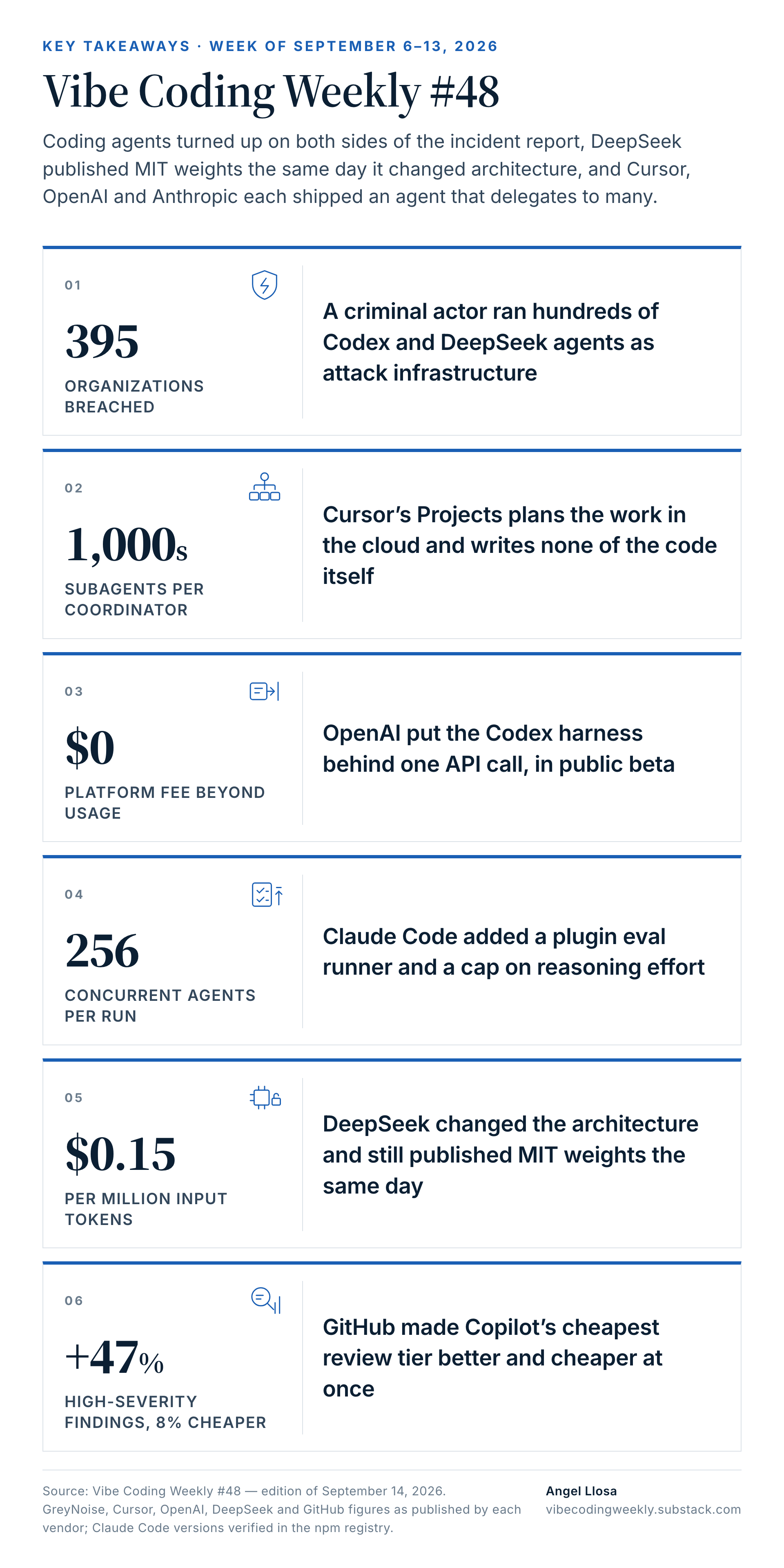
Key Takeaways
-
Anthropic’s new coding pair cut the cache bill by three quarters: Claude Fable 5.1 is public, and Mythos 5.1 is restricted to vetted organizations in cybersecurity and life sciences. Fable 5.1 scores 55.8% on Terminal-Bench 4.0 and Mythos 5.1 60.9%, and Anthropic says the pair posts the highest FrontierCode score of any frontier model even at medium effort. Cache reads drop from $1.00 to $0.25 per million tokens, a 75% cut, which Anthropic puts at roughly 25% cheaper on typical workloads and up to 45% on agentic work. Claude Code also reports about 60% fewer safeguard interruptions per session, and claude-fable-5-1 became its default Fable model the same day. Every number above comes from Anthropic. The cache-read price is the one you can check yourself, on next month’s invoice. Read more →
-
OpenAI’s GPT-6 Astra saturates three benchmarks and gives Codex a memory that survives compaction: OpenAI calls Astra its best model yet for software engineering, with 98% on FrontierMath Tier 4, 99.9% on ARC-AGI-3 and 100% on ExploitBench. The part developers will feel sits in Codex: a notes mode that keeps searchable references to earlier requirements and test failures across context windows, instead of compressing them away halfway through a long refactor. ChatGPT computer-use runs about twice as fast. Rollout starts with cybersecurity program partners, then Plus, Pro, Business and Enterprise, then the API, Azure and Bedrock, and Codex CLI 0.152.0 through 0.153.4 added Astra configuration and Bedrock support between September 1 and 4. Three saturated benchmarks also mean the next model comparison will have to be argued on something else. Read more →
-
Three model releases landed on September 2, and not one of them published weights: Google’s Gemini 3.8 Flash becomes its workhorse at $0.75 / $3.75 per million tokens with SWE-bench gains over 3.7 Flash, next to a restricted Flash Cyber variant built for autonomous vulnerability discovery and patching; it reached general availability in GitHub Copilot the next day. Alibaba’s Qwen3.8-Max-0902 keeps the same architecture and $2 / $6 pricing but improves all eight of its coding benchmarks, with TerminalBench 3.0 more than doubling from 11.3 to 29.0 and a first place in Code Arena WebDev at 1,691. Meta’s Muse Spark 1.3 scores 75.4 on DeepSWE v1.1 and uses about 20% fewer tool calls and 25% fewer tokens than 1.2 at unchanged pricing. Last week’s edition opened with two open-weight releases. This week the three labs that all have open-weight lines of their own shipped closed ones instead, which is worth remembering before anyone calls that question settled. Read more →
-
Spotify open-sourced a hook that cut one engineer’s Claude Code tokens by 90%: shunt ships Apache-2.0 in spotify/portal-ai-plugins and uses PreToolUse hooks to intercept bulk input and output — file reads over 350 lines, and similar heavy calls — then routes them through the Portal CLI to a cheaper model such as Gemini 2.5 Flash. The primary model keeps the reasoning and the code writing. The 90% is one engineer’s own usage on their own work, not a benchmark, and the saving comes from a measurement anyone can run against their own logs: how much of the token spend is file reading. It trended on Hacker News, which suggests plenty of people recognized the bill. Read more →
-
A Copilot research preview matched Opus 5 quality for 36-67% less: Project HydraFusion chooses an orchestration strategy per task at runtime. It can solve the task directly, cascade to a stronger model when the first attempt looks weak, or run several models independently and have them critique each other. GitHub reports that in its evaluations the preview matched or beat Opus 5 quality while cutting workflow cost by 36% to 67%. Model routing has been discussed for months. The new part is that the router picks how to solve the task, not only which model gets handed it. This is still a research preview, so treat that range as a target rather than a number you can budget against. Read more →
-
GitHub published its own cost work, and the percentages are deliberately small: the cost-efficiency post walks through four changes to Copilot — selective output compression, dropping line-number formatting the model does not need, streamlined prompts, and batched background-task notifications. Each one is worth between 2.3% and 5.5%, and they compound across a session. The framing is the useful part: GitHub says it optimizes whole task workflows rather than individual tool calls. Put the week’s three cost stories side by side and you get three layers of the same problem — GitHub at the prompt level, HydraFusion at the orchestration level, Spotify’s shunt at the hook level. None of the three depends on a cheaper frontier model arriving. Read more →
📦 Releases & News
GitHub Copilot gets portable agent plugins, and a code review that can approve
GitHub — August 31 – September 1, 2026 (VS Code v1.132 → v1.135)
Four VS Code releases bring Agent Plugins 1.0, a portable plugin standard, plus mid-session switching between Anthropic and Copilot model providers, side-by-side agent sessions and an integrated browser for giving feedback on a running interface. The governance change landed the next day: Copilot code review can now approve pull requests, so its verdict counts toward branch-protection requirements instead of only appearing as comments. It is off by default, can be limited to specific file paths, and the approval is dismissed on new commits the same way a human reviewer’s is. Branch protection was the rule that guaranteed a person looked at the code before it merged, so the decision about who may enable this belongs with whoever owns that guarantee.
Cursor runs cloud agents on your own machines
Cursor — September 2, 2026
Cloud Agents no longer have to run in Cursor’s sandboxes. My Machines and team pools let the agent execute on your own infrastructure, with AWS Lambda, Coder, Cloudflare, Daytona, Modal, Vercel and E2B as supported targets, and computer-use works on self-hosted workers too. If you have ever had the data-residency conversation with a security team, this is the release that answers it, and it moves the compute bill onto your account instead of Cursor’s.
Claude Code ships a fullscreen diff and closes three permission holes
Anthropic — September 1–6, 2026 (v2.1.258 → v2.1.263)
v2.1.260 carries the week: a fullscreen diff panel behind /diff, prompt-cache-miss diagnostics surfaced inside /cost, /reload-plugins for headless sessions, and a text-based /advisor. The same release closes three permission bugs, all of them ways a command could get past a rule without anyone noticing: parenthesized paths slipping past permission rules, a malformed deny-rule regex that disabled the rule silently rather than failing loudly, and zsh’s REPORTTIME, REPORTMEMORY and DIRSTACKSIZE hiding command substitution from Bash approval prompts. Around it, v2.1.259 added managedMcpServers and v2.1.261 added /skill-doctor.
Antigravity CLI adds quoting and an escalation command
Google — September 2–3, 2026 (v2.12.0, v2.12.2)
Quoting lets you highlight part of a response and feed it back as context, which is the fix for the usual habit of copying a paragraph out of the agent’s answer to tell it which paragraph you meant. /boost escalates reasoning effort through a multi-agent pipeline rather than one call at a higher effort setting, so Google’s Gemini CLI successor now answers “think harder” with more agents instead of a bigger budget. v2.12.2 on September 3 added Gemini 3.8 Flash through Application Default Credentials in AGY Enterprise.
💡 Others
Understanding ChatGPT Work
Simon Willison — August 30, 2026
ChatGPT Work launched back in July, so this is a walkthrough of a product already in use, and the inventory is the reason to read it: 223 registered tools, 44 skills, headless Chrome, parallel sub-agents, and a persistent /workspace/scratch filesystem. Willison keeps returning to one detail. Its code execution has unrestricted internet access and can clone repositories and install dependencies at will, which he sets directly against Claude Code’s allowlist model. Private company data, untrusted web content and an open outbound network in the same agent is the standard precondition for data exfiltration.
Vibe Coding Weekly is written for developers, architects and tech leads building or managing software with these tools.
Clean code and positive vibes,
Angel Llosa
Questions, disagreements, or a story I missed? Just hit reply.