Qwen’s open-weight Flash model beats Opus 4.6 on SWE-bench Pro, Replit makes model routing the default, and a prompt injection gets past Claude Code’s Auto Mode 80% of the time.
By Angel Llosa
Published: 2026-08-31
URL: https://vibecodingweekly.substack.com/p/vibe-coding-weekly-46
Everything that mattered this week in AI-assisted development, distilled into three headlines, one must-read, and the takeaways behind them.
This week, compiled:
-
The Big Story: Alibaba released Qwen3.8-Flash-Next, an open-weights model with 6B active parameters per token that scored 62.5% on SWE-bench Pro against 53.4% for Claude Opus 4.6 Max. Z.ai’s GLM-5.3-Flash landed the same day at a claimed tenth of GLM-5.2’s price
-
The Tool: Replit Agent now picks the model for you by default, balancing cost, speed and accuracy by sending hard reasoning to Claude Opus 4.7 and bulk generation to Gemini 3.1 Pro
-
The Trend: Security researcher Johann Rehberger got an indirect prompt injection past Claude Code’s Auto Mode about 80% of the time, in the same week Anthropic shipped a --restricted flag and closed three symlink and logging holes
If you only read one thing this week: Scott Fryxell’s The Harness Is The Thing argues that the model everyone argues about online is the commodity, and the scaffolding around it is the asset you actually own. He rotates three editors, Cursor, Claude and Pi, over a single harness he calls brayness, which carries standardized AGENTS.md files between them so switching tools costs him nothing. Underneath sits a staged workflow of exploration, planning, execution, criticism and promotion, where a frontier model handles planning and promotion while DeepSeek V4 Flash grinds through the implementation. That split cut his frontier-model usage by 75%. He is also honest about where it breaks: once a task has enough moving parts, the cheap model hits a ceiling and no harness rescues it. The line worth stealing is his definition of the thing itself, “the fulcrum from which my expectations meet the LLM’s capabilities.” Read it against the rest of this week and it stops being one developer’s setup. Replit shipped automatic routing, Anthropic shipped a cost profiler, and two open-weight models arrived that are exactly what a harness like his would route to. Read more →
The stories this week aren’t hard to find. What’s hard is knowing which ones actually matter before your team asks you on Monday.
In Vibe Coding Weekly I try to cut through that volume so you arrive at the week with context, not anxiety.
I’m Angel Llosa, and my day job is getting these tools adopted inside real companies — defining the strategy and then implementing it. I read this news wondering what survives contact with an actual engineering team.
If someone on your team should see this week’s edition, forward it to them.
Key Takeaways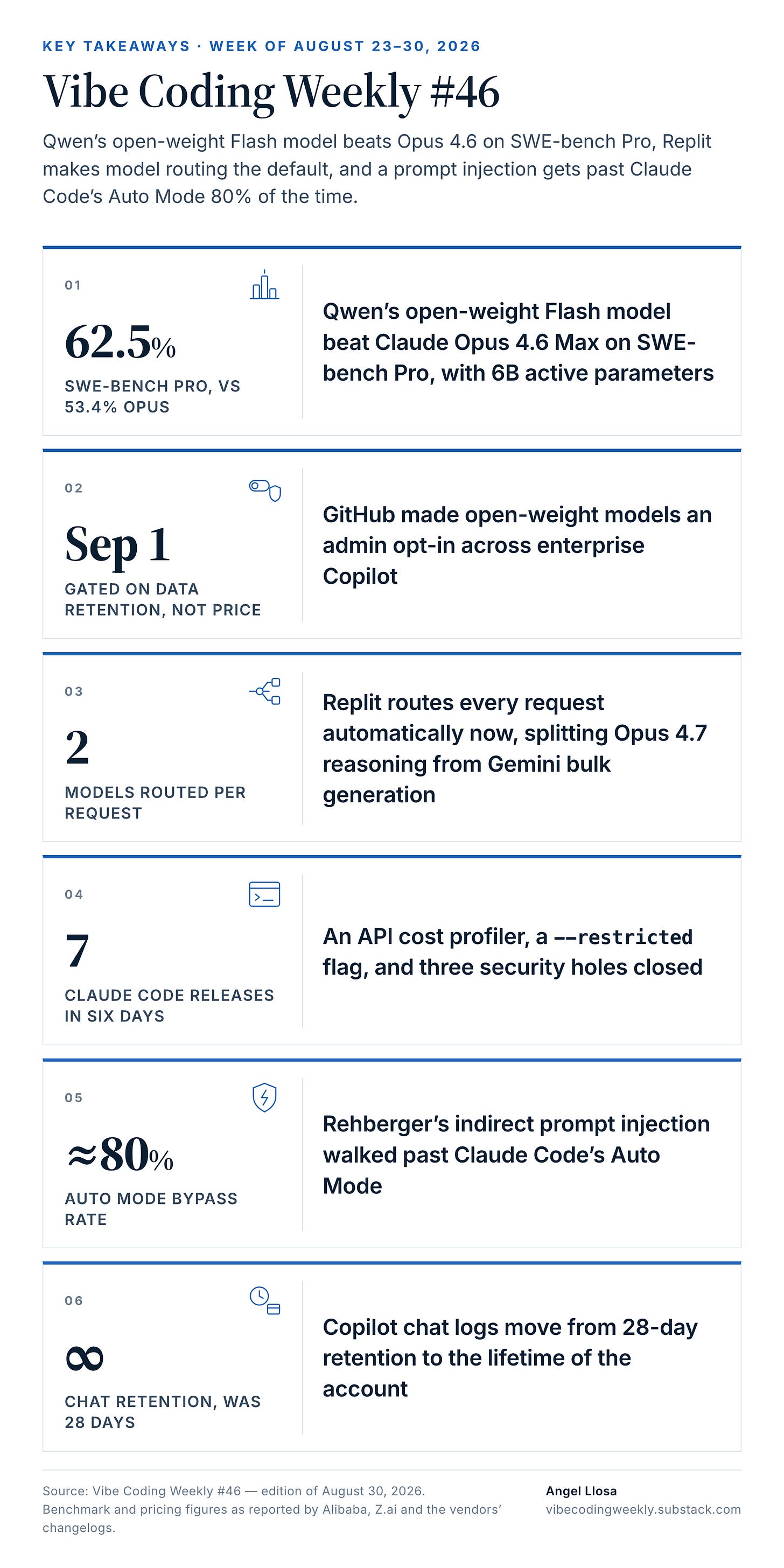
-
Two open-weight models landed on the same day, and one of them beat Opus on a coding benchmark: Alibaba’s Qwen3.8-Flash-Next is a 125B-parameter mixture-of-experts model that activates just 6B parameters per token, and it previews the Qwen4 architecture. It scored 62.5% on SWE-bench Pro and 73.9% on CoWorkBench, against 53.4% and 68.2% for Claude Opus 4.6 Max, with 262K native context extending to 1M through YaRN. Alibaba says it trained for roughly a ninth of what its predecessor cost. Hours later Z.ai released GLM-5.3-Flash, 320B parameters with 18B active, MIT-licensed weights on Hugging Face and a 1,048,576-token context, using a hybrid of sparse and linear attention to cut attention compute about 3x and shrink the KV cache 4x at long context. Z.ai claims it beats GLM-5.2 while costing a tenth as much. Benchmark numbers from a vendor are worth what you paid for them, but the direction has been consistent for months now, and the gap you are paying frontier prices to avoid keeps getting narrower. Read more →
-
GitHub turned those models off by default for enterprise Copilot the same week, and it got this right: the global model policy went generally available on August 26, rolling out through September 1. Previously-unconfigured models, and every new GA model from here on, now inherit a global policy state instead of arriving switched on. Open-weight models and anything that requires data retention are disabled unless an admin explicitly opts in. Admins can still override per model, or turn the policy off for orgs with different compliance needs. It would be easy to file this as procurement getting in the way of a cheaper model. Look at what the policy actually gates and you get a different picture: the trigger is data retention, not price. If you work under GDPR, or you handle other people’s client data, a newly released model quietly switching itself on across the whole org is precisely the event you cannot afford to discover afterwards. Defaulting to off puts that call in front of someone accountable for it. The cost case for open weights survives this intact; it just has to be argued out loud instead of arriving by default. Read more →
-
Replit stopped asking which model you want and started deciding: Auto mode is now the default in Replit Agent, routing each request on speed, cost and accuracy across a pair of models. Claude Opus 4.7 takes the harder logic and reasoning; Gemini 3.1 Pro handles bulk code generation and multimodal work. The manual selector survives for anyone who wants to force a choice per task. Routing has been the theory behind every token-economics post of the last six months, and Snowflake shipped it at the gateway layer a week ago. Replit is the first mainstream coding product to make it the behaviour you get without asking, which quietly changes what a “model choice” even means for the average user of the product. Read more →
-
Claude Code shipped a command that profiles your own API bill, then spent the week patching itself: seven releases between August 23 and 28 (v2.1.241 through v2.1.251). v2.1.247 added /claude-api cost-optimize, which profiles a project’s Claude API spend and walks you through the levers one measured change at a time: caching, token hygiene, batching, effort level, model choice. v2.1.248 brought --restricted, a flag that strips command execution, code execution and WebFetch while keeping in-directory file tools and refusing bypassPermissions outright, plus a per-agent experimental.cacheTtl and cross-session messaging between sessions on the same machine. Then v2.1.251 closed three genuine holes: file tools following a symlink swapped in after the permission check, plugin marketplace commands reaching outside the plugin directory, and project settings that could enable raw API body logging and bypass a pinned OTLP collector. A cost profiler inside the tool is the FinOps story; a symlink race after the permission check is the one your security team will ask about. Read more →
-
An indirect prompt injection walked past Auto Mode roughly 80% of the time: Johann Rehberger’s attack, written up by Simon Willison on August 27, starts with something as ordinary as asking the agent to summarize a web page. The malicious page persuades Claude Code to write its own decoder, importing base64 to unpack the payload, and Python module shadowing does the rest: a struct.py pulled in with a downloaded archive gets executed instead of the standard library module. In some runs Auto Mode’s own safety check then blocked the agent when it tried to kill the malicious process it had just started. Anthropic has positioned Auto Mode as the answer to prompt injection in autonomous coding; this is a careful demonstration that it is a speed bump, not a boundary, and it landed days after --restricted shipped. Read more →
-
Copilot chat logs go from 28 days to the lifetime of your account: GitHub bundled three changes into one August 28 notice, and the retention change is the one with consequences. When Copilot Chat on github.com and Mobile merges with the cloud agent into a single experience, no earlier than September 28, chat data retention extends from 28 days to the lifetime of the account to match what the cloud agent already does, and opting out means losing access to the merged experience. Alongside it: Business and Enterprise seat assignments now require upfront payment, from September 1 for new signups and October 1 for existing customers, with no prorated refund when a seat is revoked mid-cycle. Code review’s default effort level also moves from Lite to Balanced on September 28. Base subscription prices do not change, which is precisely why this will get filed as housekeeping and land on someone’s desk in October as a surprise. Read more →
You already have Change Management in Agentic AI Adoption — the framework for the conversation that always comes after “we should use AI more”: how to actually move an organization that didn’t ask to be moved. Anyone you forward this edition to gets the same thing the moment they subscribe.
📦 Releases & News
Cursor’s cloud agents no longer need a repository to start
Cursor — August 27, 2026
You can now prompt a Cursor Cloud Agent from nothing at all: no GitHub connection, no source-control provider, no existing project. Cursor generates an Origin repo behind the scenes, shows you the agent working in a live browser preview, and publishes a real URL through Vercel when it’s done. Convert that scratch repo into a permanent named one only if the thing turns out to be worth keeping. Following the Origin hosting launch and always-on agents covered here last week, this is the piece that moves Cursor’s agents out of the IDE model entirely and onto Lovable and v0’s turf.
Codex CLI deprecates its MCP server and lets extensions rewrite tool results
OpenAI — August 24–29, 2026 (v0.149.1, v0.150.0, v0.150.1, v0.151.0)
Anyone driving Codex from another harness has rewiring to do: v0.149.1 deprecated the codex mcp-server command in favour of the Codex app server, which includes the Claude Code plugin path. v0.150.0 is the release users will feel, with @ task mentions, a better /copy picker, auto-generated task titles, clickable Markdown links in capable terminals, and Interrupt hooks. The one worth watching is v0.151.0 on August 29: extensions can now inspect and replace MCP tool results before the model ever sees them, MCP tool-discovery grace periods became configurable, and two sandbox bugs got closed, including stale Guardian classifications surviving a permission change and /cd quietly weakening sandbox restrictions.
Amp gives one agent multiple repositories, and ships a phone app
Sourcegraph — August 23–28, 2026
The substantive change came on August 27: an Amp project can now span multiple repositories, so a single job can cross codebases instead of stopping at the repo boundary that most agent tooling still treats as the world. The TUI sidebar went away the same day. On August 28 Amp shipped native iOS and macOS apps carrying Threads, Orbs and Puck, and added a setting to choose the verified name and email Amp uses to author and sign commits, which finally kills the mailmap workaround. Earlier in the week: friendly hostnames for shared Orb portals, and Orb configuration before or after cloning without committing Amp-specific files to the repo.
OpenCode adds Azure sign-in without an API key
OpenCode — August 24–28, 2026 (v1.18.22 → v1.18.25)
Four patch releases, one useful addition: v1.18.24 lets you sign in through Azure Entra ID using the Azure CLI, so Azure-hosted models work with no API key in a config file anywhere. It also fixed a Bedrock reasoning-cache bug and kept V1 configs able to read newer V2 fields, with v1.18.25 following hours later to make that auth path work without requiring Bun. The rest of the week went to provider plumbing: textVerbosity being sent to providers that reject it, Bedrock compatibility, and Cloudflare AI Gateway routing for third-party providers including Anthropic model-slug conversion.
Antigravity CLI makes switching models a single command
Google — August 27, 2026
v1.1.22 adds a /model argument that takes a name, slug or label and sets the default in the same step, with inline ghost-text autocomplete for model IDs while you type. The /effort hint now completes dynamically against what you’ve typed, and startup and project-switching latency both came down again. Small week for Google’s Gemini CLI successor after the Gemini Enterprise integration and Remote Control, but the model switcher is the right thing to make frictionless in a tool whose whole premise is that you’ll be changing models often.
Kilo Code renders Mermaid diagrams inside JetBrains
Kilo Code — August 26–28, 2026 (jetbrains/v7.1.0, jetbrains/v7.1.1, v7.5.0–v7.5.6)
JetBrains v7.1.1 renders Mermaid diagrams directly in the chat panel, with a dedicated editor-tab view, zoom, pan, fit-to-view, a source view and copy-as-PNG. If you’ve been asking an agent to explain an unfamiliar service and getting back a wall of diagram syntax, that gap just closed on the JetBrains side. The same window brought clearer empty states for worktree sessions, while the VS Code line moved through v7.5.0 to v7.5.6 on stability work with no headline feature.
Every week, a new model drops. A new agent framework ships. A new “this changes everything” thread goes viral. And you still have actual code to write.
That’s what Vibe Coding Weekly is. For developers, architects, tech leads, and everyone building or managing software in the age of AI.
Clean code and positive vibes,
Angel Llosa
Questions, disagreements, or a story I missed? Just hit reply.