Six vendors agree on one plugin format for coding agents, SpaceX closes its 60B acquisition of Cursor, and Meta ships a 30B open-weight agent that runs on one GPU.
By Angel Llosa
Published: 2026-08-17
URL: https://vibecodingweekly.substack.com/p/vibe-coding-weekly-44
Everything that mattered this week in AI-assisted development, distilled into three headlines, one must-read, and the takeaways behind them.
This week, compiled:
-
The Big Story: Meta went back to open source. Muse Glimmer is a 30B-parameter Apache 2.0 model distilled from Muse Spark and tuned for always-on local coding agents — small enough for a single consumer GPU, and tested hands-on by Simon Willison for code exploration and tool use
-
The Money: SpaceX closed its 60B acquisition of Cursor, folding it in as a wholly owned subsidiary. Cursor’s own framing is about GPUs — access to “the largest fleet in the world” to train stronger and cheaper models
-
The Trend: Enterprises are buying model routers. Fortune reports 62% of organizations hit material budget surprises from agent usage and 40% escalated to the board, pushing routing platforms that cut spend by up to 30% into the procurement conversation
If you only read one thing this week: on August 12, GitHub shipped Agent Plugins 1.0 — and the news is not the format, it is the signatory list. AWS, Anysphere (Cursor), Microsoft, OpenAI, Vercel and Google co-maintain it, and it is governed independently of any single vendor. One installable plugin bundles agent skills and MCP servers together, and the same artifact runs across VS Code, Copilot CLI, the Copilot app and SDK, plus Kiro and Cursor per AWS’s own announcement. Build your internal agent tooling once, run it wherever your teams already are — that is the closest thing yet to making “which agent do we standardize on?” the wrong question. Read more →
The stories this week aren’t hard to find. What’s hard is knowing which ones actually matter before your team asks you on Monday.
In Vibe Coding Weekly I try to cut through that volume so you arrive at the week with context, not anxiety.
I’m Angel Llosa, and my day job is getting these tools adopted inside real companies — the technical wiring and the strategy around it. I read this news wondering what survives contact with an actual engineering team.
Key Takeaways
-
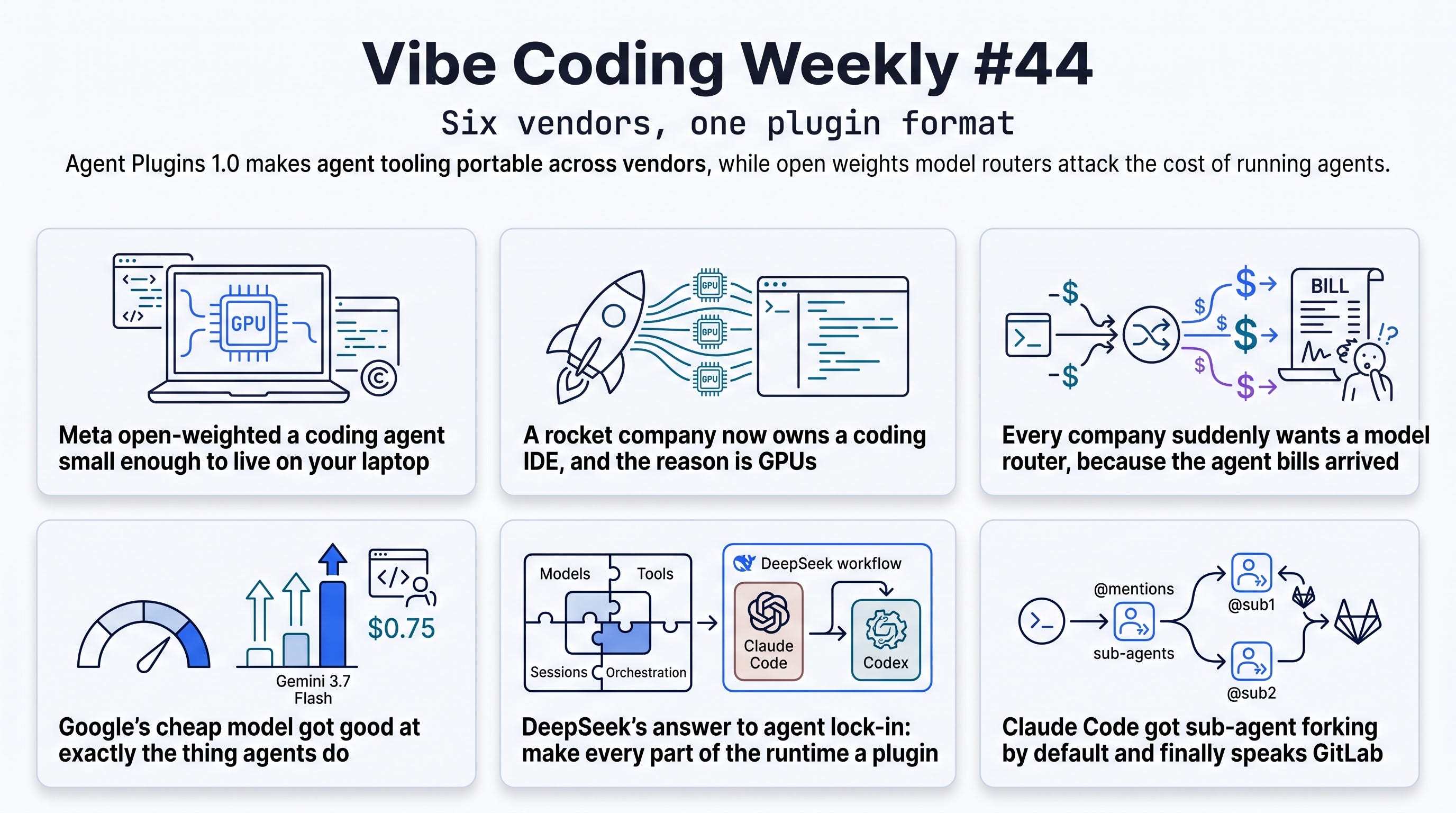
Meta open-weighted a coding agent small enough to live on your laptop: Muse Glimmer is a 30B-parameter model released under Apache 2.0, distilled from Muse Spark and explicitly optimized for local, always-on agentic coding — it fits on a single consumer GPU. Simon Willison put it through code exploration and tool use rather than benchmarks, which is the right test for a model whose whole pitch is that it can run continuously without a meter running. The licence is the part to sit with: a frontier lab shipping a genuinely permissive, locally-runnable agentic model changes what “we can’t send this code to an API” actually costs you. Read more →
-
A rocket company now owns a coding IDE, and the reason is GPUs: SpaceX completed its 60B acquisition of Cursor, taking it on as a wholly owned subsidiary via stock issuance. Cursor’s stated logic is compute — access to “the largest fleet of GPUs in the world” to build stronger and more economical models — and the deal is already operational rather than theoretical: Grok 4.6 arrived inside Cursor the same week, cited by Cursor as an early result of the relationship. Read it as the clearest sign yet that the constraint on coding tools is no longer talent or product, it is silicon, and that the companies with silicon are the ones doing the acquiring. Read more →
-
Every company suddenly wants a model router, because the agent bills arrived: Fortune’s numbers are the ones to bring to a budget meeting — 62% of organizations report material budget surprises from agent usage and 40% required board escalation. The response is routing: OpenRouter, Not Diamond and LiteLLM, now joined by Salesforce and Databricks entrants, sending each task to the cheapest model that can actually do it, for reductions of up to 30%. Long-running coding agents are what broke the forecast, so this lands squarely on engineering leadership rather than finance. Read more →
-
Google’s cheap model got good at exactly the thing agents do: Gemini 3.7 Flash jumped to 43.6% on FrontierCode 1.1 Main (from 34.4%) and 65.3% on DeepSWE v1.1 (from 49.0%), at an introductory 0.75 per 1M input tokens. It rolled out same-day across GitHub Copilot — Pro, Pro+, Max, Business and Enterprise, in VS Code, Copilot CLI, JetBrains, Xcode and Eclipse. A workhorse-tier model closing this much of the agentic-coding gap at that price is precisely the pressure that makes routing strategies pay off. Read more →
-
DeepSeek’s answer to agent lock-in: make every part of the runtime a plugin: Harness v0.1 entered developer preview under an MIT licence, built on the Cordis kernel with a single design rule — models, tools, sessions, sandboxes, the agent loop and orchestration are all swappable. The detail that shows what that buys you: Harness can call Claude Code or Codex as sub-agents inside a DeepSeek-orchestrated workflow. It is framed explicitly against Claude Cowork, and it is the second open interoperability play of the week from an entirely different direction. Read more →
-
Claude Code got sub-agent forking by default and finally speaks GitLab: v2.1.232 (August 13) turns subagent forking on by default and adds cross-session messaging through @mentions, so one session can reach another. v2.1.233 (August 14) adds GitLab merge-request support, configurable WebFetch cache TTL, and Windows path-validation fixes. The GitLab line is the one that unblocks real teams — a large share of enterprise repositories never lived on GitHub, and until this week the agent workflow stopped at the merge request. Read more →
Subscribers also get Change Management in Agentic AI Adoption — the framework for the conversation that always comes after “we should use AI more”: how to actually move an organization that didn’t ask to be moved. Included with every subscription.
📦 Releases & News
xAI ships Grok 4.6, built for agents that run for hours
xAI — August 12, 2026
The headline number is a tie: Grok 4.6 matches GPT-5.6 Sol at 61 on the Artificial Analysis Intelligence Index, one point behind Claude Fable 5. The target is long-running agentic work plus visual and interactive tasks, backed by a 500K-token context window and pricing of 2 per 1M input and 6 per 1M output tokens below 200K prompt tokens. It is available through the API, Grok Build, Cursor, and GitHub Copilot as of this week — a frontier-adjacent model at roughly workhorse pricing, arriving in the same seven days as Gemini 3.7 Flash.
GitHub Copilot gains persistent memory, local models via Ollama, and conversation controls
GitHub Changelog — August 10–11, 2026
Two changes that matter more than they sound. Copilot for JetBrains now keeps persistent memory across chat sessions, so context stops evaporating between conversations, and adds Ollama as a bring-your-own-key provider — local models as a first-class option inside the most widely deployed coding assistant, with server-managed enterprise controls on top. The same week, Copilot on github.com added conversation management: minimize and resume chats, jump back into recent conversations, and — the quiet one — token-spend indicators in the interface. Cost is becoming part of the UI, not just the invoice.
Cursor prebuilds Cloud Agent environments for roughly 3x faster startup
Cursor Changelog — August 13, 2026
The least glamorous fix with the most obvious payoff. Cloud Agents now prepare ready-to-use dev environments in the background — repository cloned, dependencies installed, install script already run — instead of doing all of it on demand, cutting agent startup time by about 3x. The second half is the resilience win: when an environment breaks, agents can resume from the last successful build rather than starting from nothing. Anyone running agents across many repositories has been paying that setup tax on every single invocation.
Kiro adds cloud sessions, voice mode, and nested AGENTS.md files
Kiro — August 11–13, 2026
AWS’s spec-driven IDE had a fast week. Cloud sessions landed in preview for both the IDE (v1.0.293) and CLI (v2.17.0) on August 11, so agents keep working after you close the laptop. The CLI then picked up voice mode via /voice with on-device transcription (v2.18.0, August 12), and IDE v1.0.309 (August 13) added nested, workspace-scoped AGENTS.md files plus lower idle resource use in long sessions. The nested instructions are the practically useful one: in a monorepo, per-package agent rules stop being a single overloaded file at the root.
Factory.ai’s Droid gets Opus 5 in Auto mode and recovers from failed tool calls
Factory.ai — August 11, 2026
Droid v0.193.0 upgrades the Auto model to Opus 5 and adds recovery from repeated or failed tool calls — the failure mode where an agent loops on a broken call until it burns the session. Rounding it out: lowercase proxy variable support, QA and CI fixes, and a new GitLab CI setup path. Small release, but the tool-call recovery is the kind of thing that decides whether an unattended agent finishes or quietly wastes an hour.
Every week, a new model drops. A new agent framework ships. A new “this changes everything” thread goes viral. And you still have actual code to write.
That’s what Vibe Coding Weekly is. For developers, architects, tech leads, and everyone building or managing software in the age of AI.
Clean code and positive vibes,
Angel Llosa
Questions, disagreements, or a story I missed? Just hit reply.