Kimi K3 lands at half of Opus's price, Bun's $165K AI rewrite ignites a code-review fight, and Claude Code, OpenCode, and Codex all ship agent guardrails in the same week.
By Vibe Coding Weekly
Published: 2026-07-20
URL: https://vibecodingweekly.substack.com/p/vibe-coding-weekly-39-b11
Everything that mattered this week in AI-assisted development, distilled into three headlines, one must-read, and the takeaways behind them.
This week, compiled:
-
The Money: Indian AI coding startup Emergent becomes a unicorn — $130M Series C at $1.5B, revenue up 70% in four months, selling “an engineering team in a box” to non-technical founders
-
The Fork: Claude Code’s /fork now spawns full autonomous background sessions instead of in-session subagents — one of seven releases the tool shipped in six days
-
The Privacy Scare: xAI open-sources Grok Build’s ~845K-line Rust codebase after users discovered it was uploading local directories — SSH keys included — to Google Cloud Storage by default
If you only read one thing this week: Moonshot AI shipped Kimi K3 with no keynote and no model card — just a quiet overnight flip of kimi.com to a 2.8-trillion-parameter model. Self-reported benchmarks put it ahead of Claude Opus 4.8 Max and GPT-5.5 High, at $3/$15 per Mtok — roughly half Opus 4.8’s per-task cost. Open weights land July 27, but the API is live now, and Moonshot is already calling it the first “open 3T-class model.” This is what the open-weight pressure on frontier pricing looks like when it stops being incremental. Read more →
Growing at 20% new subscribers per week.
The stories this week aren’t hard to find. What’s hard is knowing which ones actually matter before your team asks you on Monday.
That’s the only thing Vibe Coding Weekly does: cut through the volume so you arrive at the week with context, not anxiety.
Subscribers also get Change Management in Agentic AI Adoption — the framework for the conversation that always comes after “we should use AI more”: how to actually move an organization that didn’t ask to be moved. Included with every subscription.
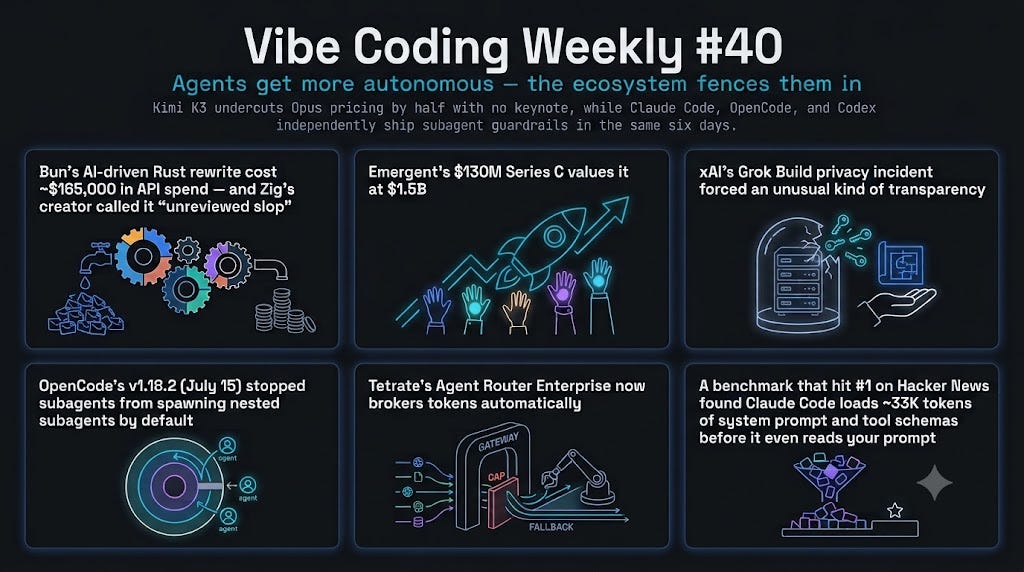
Key Takeaways
-
Bun’s AI-driven Rust rewrite cost ~$165,000 in API spend — and Zig’s creator called it “unreviewed slop”: Jarred Sumner ran up to ~64 parallel Claude Code instances over 11 days to port 535,496 lines of Zig into over 1,009,000 lines of Rust across 6,502 commits, versus an estimated 3 engineers working a full year unassisted. Andrew Kelley’s public rebuttal: “the tests pass” is not the same argument as reviewed. Read more →
-
Emergent’s $130M Series C values it at $1.5B just over a year after launch, with 200,000+ paying customers and annualized revenue up 70% in four months — proof that the market for non-technical “vibe coding” platforms is scaling as fast as the developer-facing tools. Read more →
-
xAI’s Grok Build privacy incident forced an unusual kind of transparency: after reports that the CLI uploaded entire local directories — including SSH keys and password databases — to Google Cloud Storage with retention on by default, xAI disabled the feature, flipped retention to off-by-default, and released the full ~845K-line Rust codebase under Apache 2.0. Read more →
-
OpenCode’s v1.18.2 (July 15) stopped subagents from spawning nested subagents by default, adding a configurable subagent_depth limit — the same week Claude Code capped subagent spawns per session and Codex tightened dangerous-command detection. Three unrelated tools independently reached for the same fix within days of each other.
-
Tetrate’s Agent Router Enterprise now brokers tokens automatically: set a budget cap once, and the gateway reroutes requests to an approved fallback model instead of failing the call when spend hits the ceiling. Tetrate’s own framing: “Agent token spend is the one line item the engineering organization can’t easily cap.” Read more →
-
A benchmark that hit #1 on Hacker News found Claude Code loads ~33K tokens of system prompt and tool schemas before it even reads your prompt — versus ~7K for OpenCode, and up to ~75K in a realistic MCP/plugin-heavy setup. The catch: Claude Code’s batching of tool calls can still make it cheaper overall on multi-step tasks, so the fixed overhead isn’t the whole cost picture. Read more →
📦 Releases & News
Codex CLI ships four releases (v0.144.2 → v0.144.6): security hardening and model-config fixes
OpenAI — July 13–18, 2026
Codex CLI’s week tracked the same theme running through Claude Code and OpenCode. v0.144.3 (July 13) added inline visualizations in Codex tasks, but the more consequential change came in v0.144.5 (July 16): improved dangerous-command detection, catching more forced rm forms and giving clearer rejection reasons when a command gets denied. v0.144.6 (July 18) closed out the week with refreshed bundled instructions for GPT-5.6 Sol, Terra, and Luna and corrected context windows (272,000 tokens). Four tools, one week, one instinct: tighten what the agent is allowed to do on its own.
Cursor in Slack adds plan-sharing, multi-repo support, and cross-channel messaging
Cursor — July 17, 2026
Cursor’s Slack integration now shares a plan before it starts working, so you can redirect it early instead of discovering the wrong approach after the fact, and updates its status as it moves through each step. It can operate across multiple repositories in a single workspace with a one-click switcher, and — perhaps the most useful addition — it can now read from and post to other Slack channels and threads, pulling context from across a workspace rather than staying boxed into one conversation.
Security reviews land in the GitHub Copilot app
GitHub Changelog — July 14, 2026
The new /security-review slash command, now in public preview, scans in-flight code changes for injection, XSS, insecure data handling, path traversal, and weak crypto — with severity-scored, actionable remediation suggestions delivered before the code is ever committed. Another entry in the week’s broader story: as agents write more code unsupervised, the tooling around catching what they get wrong is catching up.
GitHub Copilot in Visual Studio’s June update: usage tracking, MCP trust baselines, and in-IDE PR review
GitHub Changelog — July 14, 2026
Six changes bundled into one release: a refreshed usage-tracking window with proactive billing alerts, MCP server configurations now validated against a trusted baseline at startup (any change requires explicit approval), general availability for the C++/MSVC modernization agent, edit suggestions that span the whole active file instead of just the area near your cursor, PR references inline in Copilot Chat, and a full in-IDE PR review flow — browse, comment, approve, complete — without leaving Visual Studio.
GitHub Copilot CLI ships six releases (v1.0.71-1 → v1.0.72-1): plan-mode hardening and MCP config persistence
GitHub — July 14–17, 2026
Another tool, the same instinct as the rest of this week’s shipping cycle: plan mode now hard-blocks built-in tool calls that would edit files or run mutating shell commands, closing a gap where “just planning” could still touch the filesystem. Smaller but useful fixes rounded out the week — GitHub MCP toolset/tool configuration now persists via settings.json, disabled skills are flagged in copilot skill list, invalid settings.json values now surface a specific warning instead of failing silently, and a bug that hung autopilot mode during long-running background processes was fixed (v1.0.71, July 16).
Zed 1.11.3: dedicated Staged/Unstaged Changes views and Git Graph improvements
Zed — July 15, 2026
Zed’s latest stable release adds dedicated Staged Changes and Unstaged Changes multibuffers, letting you review, stage, unstage, or restore individual hunks without leaving the editor — opened directly via git: view staged changes / git: view unstaged changes. Git Graph gets configurable columns and commit messages rendered as Markdown, and the project symbols picker adds a preview pane, alongside 60+ other fixes.
This was the week the ecosystem quietly agreed that more autonomy needs more fencing. Claude Code capped how many subagents and web searches a session can spawn on its own and patched a run of permission-check bypasses in the same breath it shipped /fork for full background sessions. OpenCode, days later, stopped subagents from spawning their own subagents by default. Codex tightened what counts as a dangerous command, and GitHub Copilot CLI closed the gap where “plan mode” could still quietly edit files. Four tools, no coordination, the same fix — because agents that can now run unattended for longer need harder limits on what “unattended” is allowed to mean. And in case anyone needed the counterargument spelled out, Zig’s creator spent the week arguing publicly that Bun’s own million-line, $165,000, AI-generated Rust rewrite is exactly the kind of code those guardrails exist to catch — reviewed or not. Meanwhile Kimi K3 landed without ceremony at half of Opus’s price, Emergent proved the non-technical end of this market is scaling just as fast, and a privacy scare at xAI turned into the most detailed public look yet at what a frontier coding agent’s codebase actually contains.
Next week, the stack keeps moving. So does this newsletter. Fall behind one week, and you’ll spend the next three catching up.
Thanks for reading! Subscribe for free to receive new posts and support my work.
Every week, a new model drops. A new agent framework ships. A new “this changes everything” thread goes viral. And you still have actual code to write.
Every Monday, you open your inbox and already know what matters. You’ve skipped three viral threads that turned out to be nothing. You know why three unrelated coding agents all shipped subagent-spawn limits in the same six days, and you know Kimi K3 undercut Opus 4.8 pricing by half without so much as a press release. You didn’t spend your weekend reading to know this. We did.
That’s what Vibe Coding Weekly is. For developers, architects, tech leads, and everyone building or managing software in the age of AI.
Clean code and positive vibes,
The Vibe Coding Team.