The week AI dev tooling started feeling like regulated infrastructure
By Vibe Coding Weekly
Published: 2026-06-29
URL: https://vibecodingweekly.substack.com/p/vibe-coding-weekly-37
This week in one satisfying refactor:
-
The Big Story: Anthropic launches Claude Tag — a persistent AI teammate inside Slack that 65% of Anthropic’s own product team uses to write code, with multiplayer collaboration, async task delegation, and admin-controlled tool access.
-
The Release: Claude Code shipped five versions in one week, cutting streaming CPU usage by 37%, adding /rewind to undo a /clear, and routing all shell commands through auto-mode classification.
-
The Efficiency Win: GitHub’s Copilot agentic harness, benchmarked against Claude, GPT-5.4, and GPT-5.5 on five industry benchmarks, matches model-vendor harnesses on task completion while consuming fewer tokens — the platform layer is quietly becoming the competitive moat.
If you only read one thing this week: OpenAI previewed GPT-5.6 — three models named Sol, Terra, and Luna — but almost nobody can use them yet. For the first time, a US executive order required OpenAI to coordinate with the federal government before releasing a frontier AI model to the public. Only ~20 trusted partner organizations have access. Sol handles complex coding and security research; Terra does the same work as GPT-5.5 at half the cost; Luna is the fastest and cheapest for everyday tasks. The restriction isn’t just a regulatory footnote — it’s the first time the US government has formally inserted itself into the frontier model release cycle. Read more →
The stories this week aren’t hard to find. What’s hard is knowing which ones actually matter before your team asks you on Monday.
That’s the only thing Vibe Coding Weekly does: cut through the volume so you arrive at the week with context, not anxiety.
Subscribers also get Change Management in Agentic AI Adoption — the framework for the conversation that always comes after “we should use AI more”: how to actually move an organization that didn’t ask to be moved. Included with every subscription.
Key Takeaways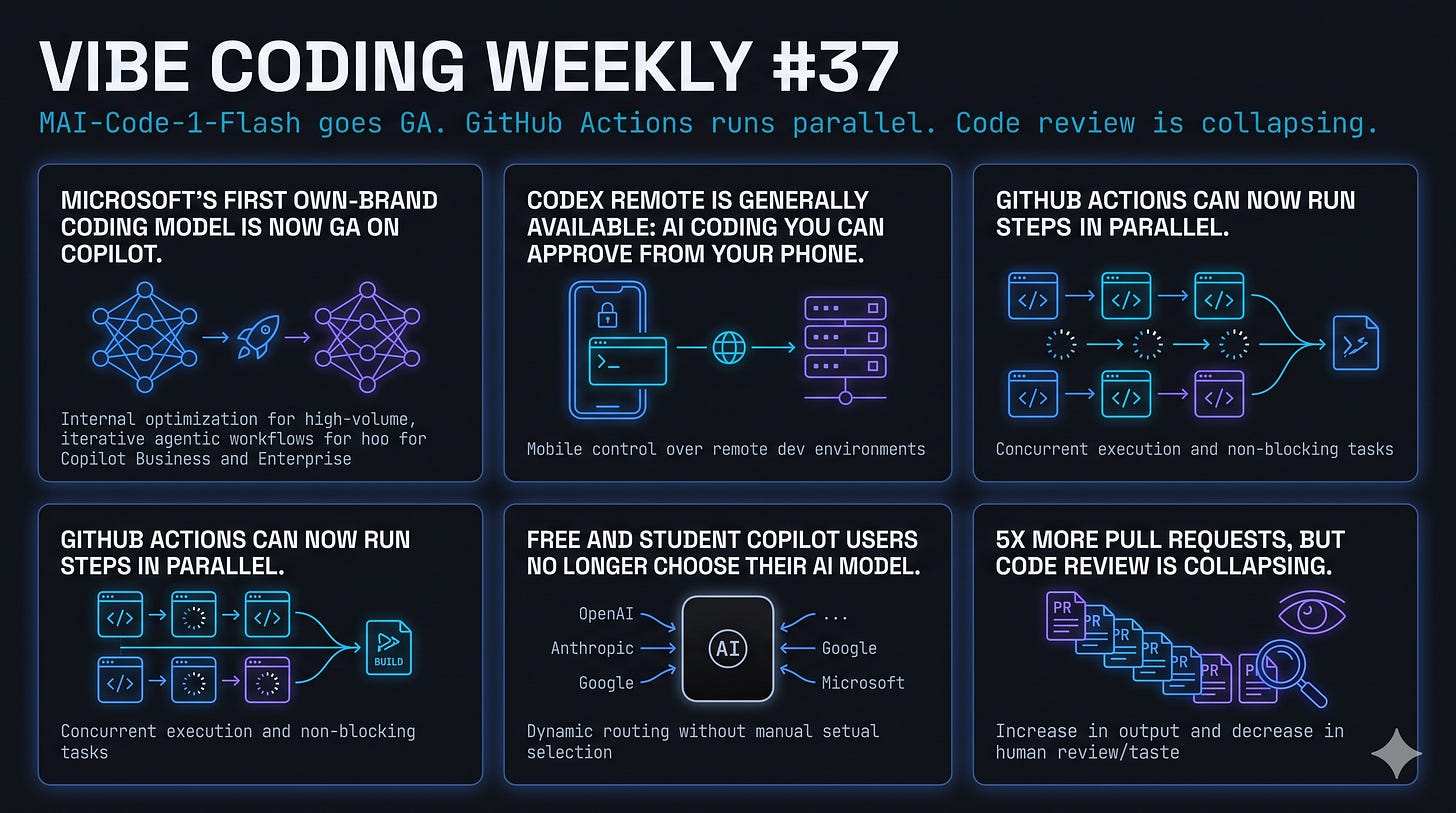
-
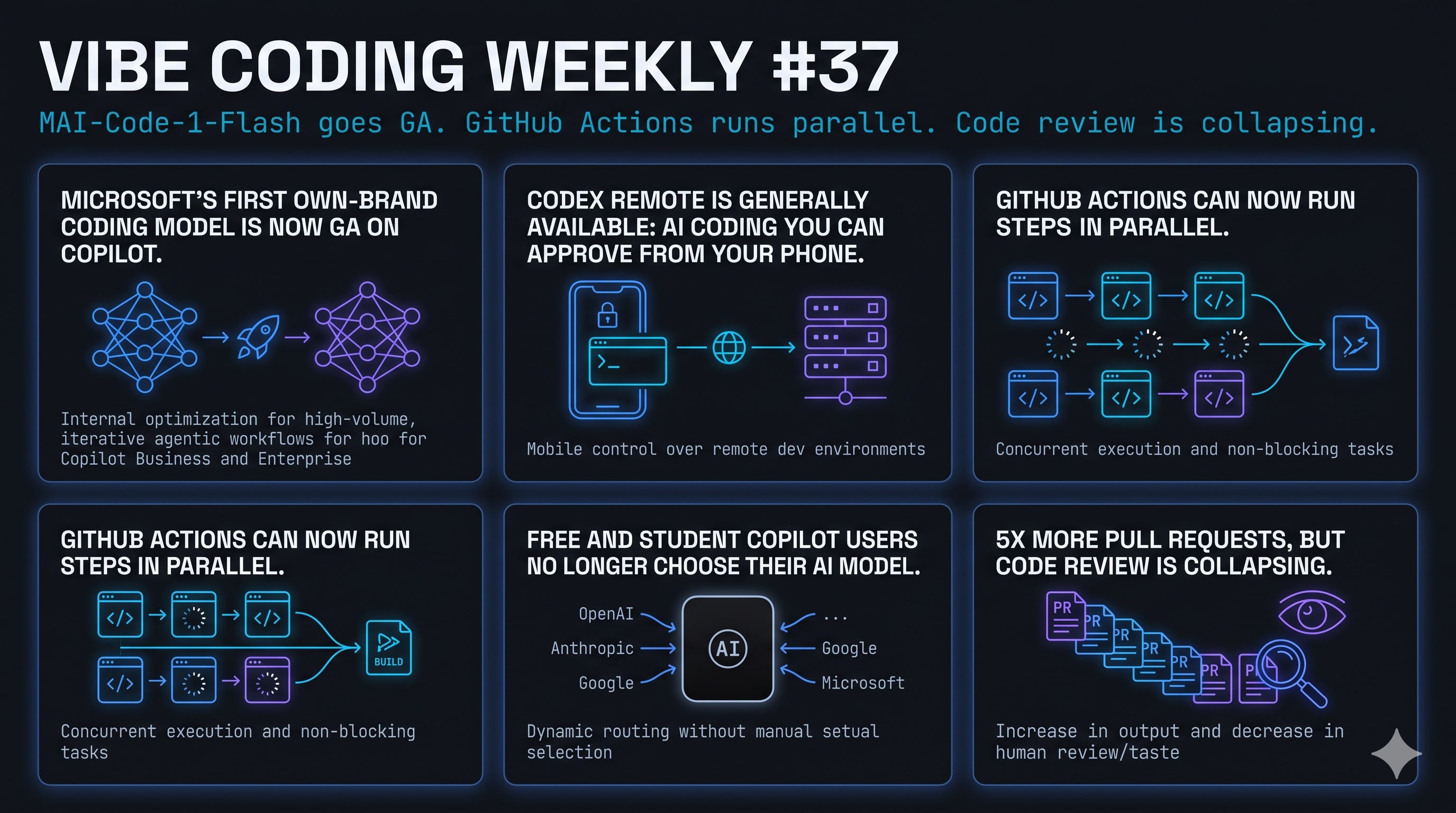
Microsoft’s first own-brand coding model is now GA on Copilot. MAI-Code-1-Flash, built entirely in-house by Microsoft AI, became generally available for Copilot Business and Enterprise on June 26. It’s optimized for high-volume iterative agentic workflows — fast and low-latency by design, billed at usage-based rates. Admins need to manually enable the policy. This marks Microsoft’s first step from model reseller to model maker inside its own developer platform. Read more →
-
Codex Remote is generally available: AI coding you can approve from your phone. As of June 25, developers can start or continue Codex sessions on a connected Mac or Windows host and monitor and approve actions from an iOS or Android device. The release adds authenticated QR pairing between mobile device and host, and ships a new DigitalOcean plugin that provisions a cloud Droplet as a remote workspace from inside the Codex app. Read more →
-
GitHub Actions can now run steps in parallel. Four new keywords landed on June 25: background: true starts a step asynchronously; wait/wait-all blocks until specific background steps finish; cancel gracefully stops a background step; and parallel wraps multiple steps in concurrent execution with automatic waiting. Common use cases include running parallel builds, spinning up services while other steps proceed, and non-blocking telemetry uploads. Read more →
-
Free and Student Copilot users can no longer choose their AI model. Starting June 24, GitHub replaced manual model selection on Free and Student Copilot plans with automatic routing only. “Auto” dynamically picks the best available model per task from across the OpenAI, Anthropic, Google, and Microsoft model families — but which models are in the pool can change without notice. GitHub also retired the “(Preview)” label from all Microsoft-released models as part of the same update. Read more →
-
5x more pull requests, but code review is collapsing. The Pragmatic Engineer’s Gergely Orosz published a June 23 analysis of what AI productivity data actually means at scale. Teams using agents ship 5x more PRs and generate 2.5x more code per developer than two years ago — but Cursor’s own data shows AI-generated code is increasingly being merged without any human review, a trend that accelerated sharply in February 2026. Meta reallocated engineers from security and quality to AI training tasks, then suffered a high-profile breach. Orosz’s conclusion: as output volume becomes cheap and automatic, “taste” — deliberate human judgment about what to ship — becomes the scarcest skill in the room. Read more →
Thanks for reading! Subscribe for free to receive new posts and support my work.
📦 Releases & News
GitHub Desktop 3.6: Worktrees and Deeper Copilot Integration
GitHub Desktop 3.6, released June 26, adds native Git worktree support so developers can work across multiple branches simultaneously without stashing or re-cloning — a change that matters most when running parallel AI agent sessions on the same repository. Copilot now generates commit messages that respect custom instructions from .github/copilot-instructions.md and AGENTS.md, and provides AI-assisted merge conflict resolution. A model picker lets users choose from all Copilot-accessible models or bring their own key.
GitHub Copilot for Jira Is Now Generally Available
Copilot for Jira exited public preview on June 25 with three GA additions: real-time progress monitoring of the coding agent directly inside a Jira issue, the ability to give follow-up instructions in the Jira chat panel after the agent creates a draft PR (so it keeps refining the same PR instead of creating a new one), and streamlined setup requiring fewer configuration steps. Preview-phase features — model selection, Confluence context via MCP, custom agents, space-level guidance, and review request notifications — are all now generally available too.
Claude as Agent Provider in JetBrains IDEs — Public Preview
As of June 22, JetBrains IDE users can select Claude as their Copilot agent provider by pointing the IDE to the Claude Code CLI path. Important caveat for the preview: Claude currently runs in bypass permissions mode, meaning all file edits and tool calls are auto-approved without confirmation. Configurable permissions are on the roadmap. The release also ships organization and enterprise agent support, a model picker, and a per-turn AI credits indicator.
Cursor 3.9: Customize Page, Plugin Marketplace, and Team Workspaces
Cursor 3.9 landed on June 22 with a new Customize page that centralizes management of plugins, skills, MCPs, subagents, rules, commands, and hooks across user, team, and workspace scopes. A marketplace leaderboard surfaces the most-used extensions across your team for one-click installation. Plugin canvases ship prebuilt templates: Hex Canvas for data visualizations, Atlassian Canvas for real-time project visibility. Team Marketplaces now import plugin repositories from GitLab, Bitbucket, and Azure DevOps — not just GitHub.
OpenCode v1.17.11: Session Snapshots and Revert Controls
OpenCode’s June 25 release adds the ability to roll a session back to any earlier message, including all associated file changes — a safety net that makes it easier to experiment aggressively and recover cleanly. Desktop improvements add Chrome-style tab cycling and draggable tabs. Bug fixes cover prompt draft attachment persistence and titlebar tab consistency. This brings session-level undo to what has been a rapid release cadence from the sst/opencode team.
OpenCode v1.17.10: MCP Server Instructions and Managed Provider Integration
The June 24 OpenCode release injects MCP server instructions directly into the session context, giving the model visibility into what each connected MCP server can do without requiring a separate lookup. It also adds support for Opencode-managed provider integrations, a configurable keybind for the diff viewer, mobile bottom navigation in desktop mode, and collapsible server sections in the sidebar.
The week’s theme is consolidation under pressure. GPT-5.6 lands behind a government gate. Claude Tag turns AI into a team member with a Slack handle. GitHub ships its own model. Harnesses are being benchmarked like infrastructure. And Orosz reminds us that the PRs-per-developer metric, taken alone, is a trap. The tools are genuinely getting better. The question of who’s watching the output isn’t going away.
Next week, the stack keeps moving. So does this newsletter. Fall behind one week, and you’ll spend the next three catching up.
Every week, a new model drops. A new agent framework ships. A new “this changes everything” thread goes viral. And you still have actual code to write.
Every Monday, you open your inbox and already know what matters. You’ve skipped three viral threads that turned out to be nothing. You know GPT-5.6 exists but why almost nobody can use it yet, and you understand why a week with five Claude Code releases and a new Microsoft model actually matters for how your team works. You didn’t spend your weekend reading to know this. We did.
That’s what Vibe Coding Weekly is. For developers, architects, tech leads, and everyone building or managing software in the age of AI.
Clean code and positive vibes,
The Vibe Coding Team.