Karpathy called the paradigm shift. Four tools shipped to prove him right in the same week.
By Vibe Coding Weekly
Published: 2026-05-04
URL: https://vibecodingweekly.substack.com/p/vibe-coding-weekly-31
This week in one satisfying refactor:
- The Infrastructure: Cursor released a TypeScript SDK that turns its agent runtime into programmable infrastructure — CI/CD pipelines and backend services can now invoke the full Cursor agent harness, with sandboxed cloud VMs that keep running after your laptop closes.
- The Model: Mistral shipped Medium 3.5 — a 128B dense model that merges reasoning, instruction-following, and code into one set of weights — alongside async cloud coding agents that run in parallel without blocking developers.
- The Shift: Lovable launched on iOS and Android with 100K+ Play Store downloads in its first days — and on iOS, Apple’s enforcement rules forced generated apps into the browser rather than running natively. Vibe coding just hit its first platform wall.
If you only read one thing this week: On April 30, Andrej Karpathy published his notes from Sequoia’s AI Ascent 2026, where he declared the era of vibe coding over and “agentic engineering” officially begun. He frames Software 3.0 as a paradigm where humans program LLMs through prompts, context, tools, and memory — and the context window is the program. The key inflection he identified: December 2025, when he went from writing 80% of his code manually to delegating 80% to agents. His sharpest insight isn’t about tools at all — it’s about taste: LLMs automate what you can verify; human judgment remains irreplaceable for deciding what’s worth building in the first place. Read more →
Growing at 20% new subscribers per week.
The stories this week aren’t hard to find. What’s hard is knowing which ones actually matter before your team asks you on Monday.
That’s the only thing Vibe Coding Weekly does: cut through the volume so you arrive at the week with context, not anxiety.
Subscribers also get Change Management in Agentic AI Adoption — the framework for the conversation that always comes after “we should use AI more”: how to actually move an organization that didn’t ask to be moved. Included with every subscription.
Key Takeaways
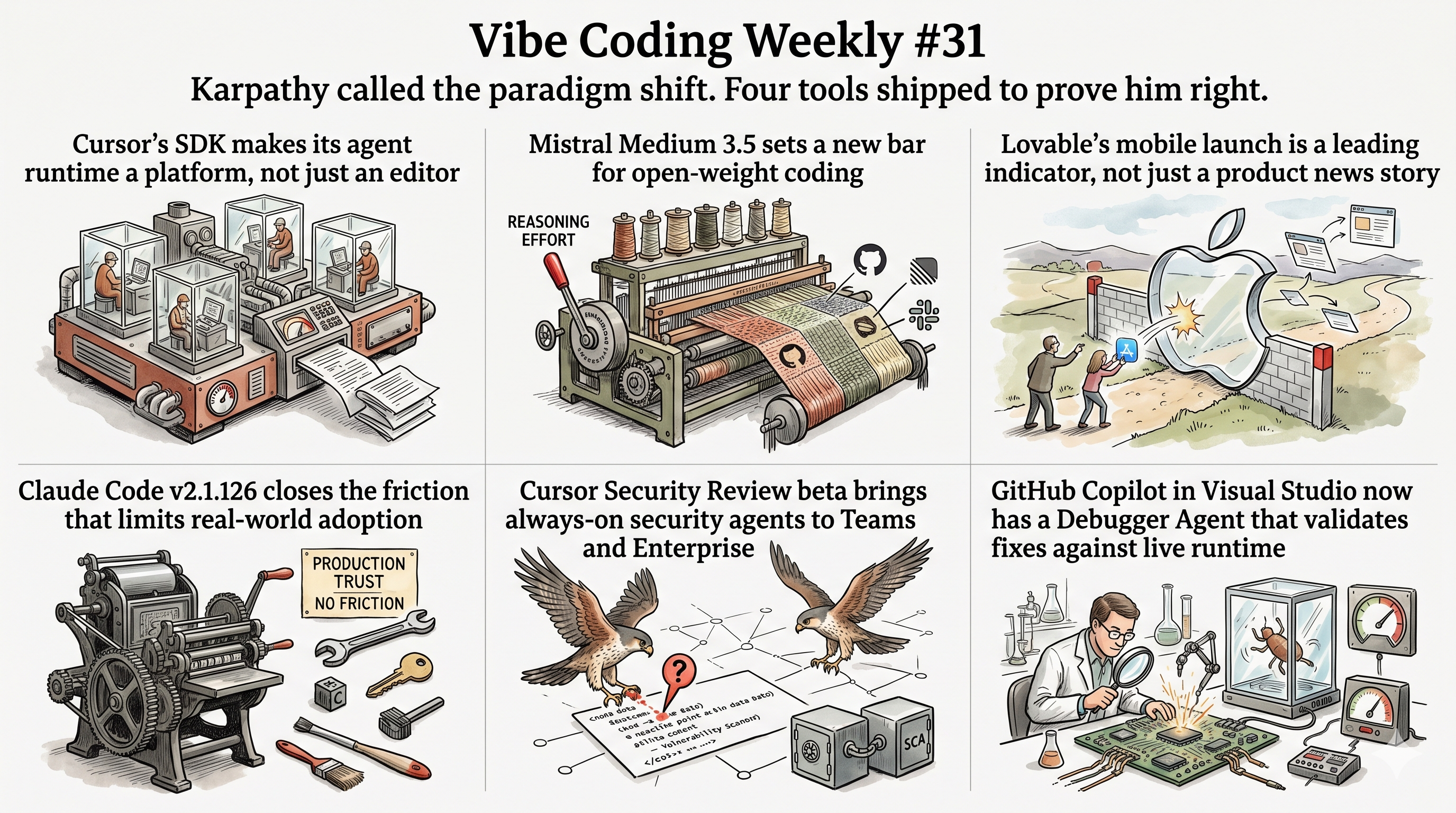
- Cursor’s SDK makes its agent runtime a platform, not just an editor: The April 29 TypeScript SDK release gives developers programmatic access to the same harness powering Cursor’s desktop app, CLI, and web interface — including codebase indexing, MCP servers, hooks, and subagent delegation. Agents run on dedicated sandboxed VMs; early production adopters include Rippling, Notion, and Faire. The most common use case in early deployments: CI/CD pipelines that trigger agents to summarize changes, identify root causes for test failures, and open PRs autonomously. Read more →
- Mistral Medium 3.5 sets a new bar for open-weight coding: Released April 29, the 128B dense model scores 77.6% on SWE-Bench Verified — competitive with Claude Sonnet 4.6’s 79.6% — and runs self-hosted on as few as four GPUs at $1.50/M input tokens. The
reasoning\_efforttoggle lets agents dial in heavier computation only when needed. Paired with Vibe cloud coding agents, teams can launch async sessions from the CLI, run jobs in parallel, and receive finished PRs as output — integrated with GitHub, Linear, Jira, and Slack. Read more →
- Lovable’s mobile launch is a leading indicator, not just a product news story: The iOS and Android app shipped April 28 with 100K+ Play Store downloads on day one — and on iOS, generated apps preview in browsers rather than run natively, a direct consequence of Apple’s enforcement against vibe-coding platforms. This constraint reveals the emerging regulatory boundary: Apple is actively shaping what AI-assisted app creation is allowed to look like on its platform, and every vibe-coding tool is now navigating that boundary. Read more →
- Claude Code v2.1.126 closes the friction that limits real-world adoption: The May 1 release introduced
claude project purgefor full state cleanup, terminal-pasted OAuth for WSL2 and SSH environments where browser callbacks fail, and fixed CJK text rendering on Windows. These are not headline features — they are exactly the class of fixes that separate a tool developers trust for production work from one they use carefully in controlled conditions. Read more →
- Cursor Security Review beta brings always-on security agents to Teams and Enterprise: The April 30 beta launch introduces two new agent types: a Security Reviewer that checks every PR for vulnerabilities, auth regressions, prompt injection risks, and agent tool auto-approvals (inline comments at the exact diff location); and a Vulnerability Scanner that runs scheduled codebase sweeps and posts findings to Slack. Both agents integrate with existing SAST, SCA, and secrets scanning tools via MCP. The timing is notable: security agents arriving in the same week that Cursor opened its runtime to external developers via the SDK. Read more →
- GitHub Copilot in Visual Studio now has a Debugger Agent that validates fixes against live runtime: The April 30 Visual Studio update goes beyond agentic code generation to introduce a Debugger Agent that reproduces bugs autonomously, forms hypotheses, instruments the code, and validates the fix through actual execution — not just static analysis. Cloud agent sessions also launch directly from the IDE, offloading remote work while developers continue locally. User-level custom agent definitions now travel across projects without repository commits. Read more →
- GitHub Copilot’s shift to token-based billing signals the end of flat-rate AI tooling: Effective June 1, 2026, GitHub is replacing Premium Request Units with GitHub AI Credits ($0.01 each) — pricing based on token consumption rather than request count. Base prices stay the same (Pro at $10/month, Pro+ at $39/month), but the economics change fundamentally: Copilot Chat, CLI, cloud agents, and code review now draw from a monthly credit pool, with no rollover and no fallback to cheaper models when credits run out. GitHub’s CPO framed the core issue plainly: “Today, a quick chat question and a multi-hour autonomous coding session can cost the user the same amount.” Developer reaction was blunt — 707 downvotes vs. 15 upvotes in the community thread — with the sharpest concern being that agentic sessions using Opus 4.7 (now at a 27x token multiplier) can burn through a monthly plan in a single afternoon. The broader implication: AI coding tools are converging toward cloud-style metered infrastructure, and developers will need to manage AI spend the same way they manage AWS bills. Read more →
Thanks for reading! Subscribe for free to receive new posts and support my work.
📦 Releases & News
Windsurf 2.1.29 — Devin for Terminal and Devin Local Agent
April 28’s release brought Devin to the command line for all Windsurf subscribers — no separate Cognition account required. The terminal agent runs locally with full codebase access and can hand off to Devin’s cloud VM (with its own machine, test runner, and video recording) mid-session.
A new Devin Local variant in the editor uses the same agent harness and is claimed to be 30% more token-efficient than Cascade. Multi-model support includes Opus 4.7, GPT-5.5, and SWE-1.6, positioning it as a drop-in harness rather than a single-model tool.
Cursor Team Marketplace Now Requires No Repository to Set Up
The May 1 update lets admins create team marketplaces without first connecting a repository, and adds direct management of first-party plugin install behavior — Default Off, Default On, or Required. Small infrastructure change, but it removes the last organizational barrier to teams standardizing on a shared plugin stack without a code review process.
OpenCode v1.14.26–1.14.33 — Zed Support, Mistral Medium 3.5, Session Recovery
OpenCode shipped seven releases in the April 26–May 2 window. Highlights: Zed editor selection support for editor context (Apr 26), configurable default shell for agent commands (Apr 27), Mistral Medium 3.5 integration with reasoning (Apr 29), desktop session recovery for path mismatch issues (Apr 29), Azure resource configuration persistence (May 1), and a fix for custom agents in plugins not loading (May 2).
The project crossed 150K GitHub stars and is used by over 6.5 million developers monthly.
Claude Code v2.1.122 — Bedrock Service Tier Selection and PR Resume by URL
The April 28 release adds the ANTHROPIC\BEDROCK\SERVICE\_TIER environment variable (default, flex, or priority) for teams running Claude Code on AWS Bedrock who need predictable throughput. The /resume command can now locate sessions by PR URL — across GitHub, GitHub Enterprise, GitLab, and Bitbucket — rather than requiring a session ID lookup.
📚 Tutorials and Resources
Gemini CLI v0.40.0 — Offline Search, Four-Tier Memory, and Voice Mode Preview
The April 28 stable release bundles ripgrep binaries into the single executable so gemini can search codebases without internet access — a critical improvement for air-gapped environments and CI runners.
The memory system was fully overhauled: the legacy MemoryManagerAgent is replaced by a prompt-driven four-tier system that handles context more predictably across long sessions. A new gemini gemma command simplifies local Gemma model setup, and GitHub-style colorblind themes ship by default.
The concurrent preview release (v0.41.0-preview.0) adds real-time voice mode with cloud and local backends — the first signal of where the Gemini CLI UI is heading.
Next week, the stack keeps moving. So does this newsletter. Fall behind one week, and you’ll spend the next three catching up.
Every week, a new model drops. A new agent framework ships. A new “this changes everything” thread goes viral. And you still have actual code to write.
Every Monday, you open your inbox and already know what matters. You know that Cursor’s SDK just made its agent runtime programmable infrastructure — and that Mistral’s async cloud agents can run your refactors in parallel while you sleep. You know that GitHub Copilot is moving to token-based billing on June 1 and exactly what that means for your team’s spend before anyone else asks you. You didn’t spend your weekend reading to know this. I did.
That’s what Vibe Coding Weekly is. For developers, architects, tech leads, and everyone building or managing software in the age of AI.
Clean code and positive vibes, Angel.