The week AI replaced a design team, fixed a security flaw by declaring it a feature, and made SWE-bench nearly obsolete.
By Vibe Coding Weekly
Published: 2026-04-20
URL: https://vibecodingweekly.substack.com/p/vibe-coding-weekly-29
This week in one satisfying refactor:
- The Security Story: OX Security disclosed an architectural RCE flaw in MCP affecting 200,000 servers and 150M+ downloads — Anthropic confirmed it’s working as designed and declined to patch it
- The Workforce Story: Snap cut 1,000 jobs (16% of headcount) because AI now generates 65% of its new code — the most explicit use of AI coding productivity as a direct justification for workforce reduction
- The Model Story: Claude Opus 4.7 ships with a new
xhigheffort level, 10–14% better task success rates in enterprise testing, and higher-resolution vision for computer-use agents
If you only read one thing this week: Anthropic launched Claude Design on April 17 — a product that turns Opus 4.7 into a design collaborator capable of building interactive prototypes, pitch decks, and full design systems from your codebase. Designs hand off directly to Claude Code for implementation. Figma’s stock dropped the day it launched. This is the first product from a major AI lab that explicitly bridges the designer-developer gap through an agent rather than a tool. Read more →
Key Takeaways
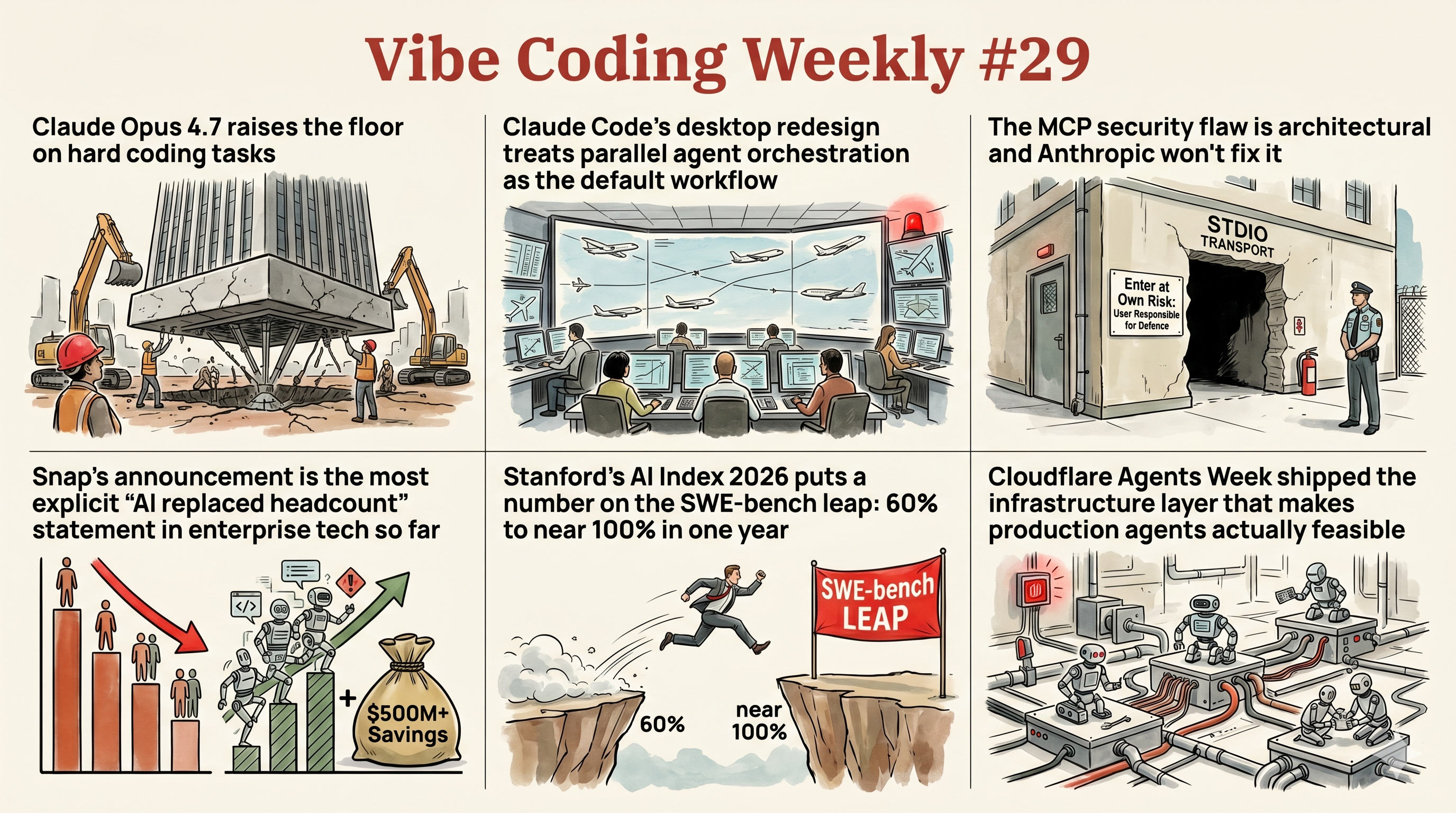
- Claude Opus 4.7 raises the floor on hard coding tasks: Anthropic’s new flagship model shows meaningful improvements specifically on the most difficult software engineering tasks, with enterprise testers reporting 10–14% better task success rates and fewer tool errors in complex multi-step workflows. The new
xhigheffort level gives developers finer control over the reasoning-vs-latency tradeoff, and Claude Code defaults to it automatically. Read more →
- Claude Code’s desktop redesign treats parallel agent orchestration as the default workflow: The new app adds a multi-session sidebar for managing concurrent tasks across multiple repos, drag-and-drop pane layout, an integrated terminal, and a built-in diff viewer — but the bigger shift is Routines: scheduled, API-triggered, and webhook-based automations that run on Anthropic’s infrastructure, not your laptop. Pro users get 5/day, Max 15, Team/Enterprise 25. This is Claude Code becoming a persistent infrastructure layer, not just a terminal tool. Read more →
- The MCP security flaw is architectural and Anthropic won’t fix it: OX Security researchers found that MCP’s STDIO transport mechanism allows arbitrary OS command execution — not a bug, but a deliberate design decision affecting every MCP SDK across Python, TypeScript, Java, and Rust. Anthropic’s response: sanitization is the developer’s responsibility. With 200,000 vulnerable server instances and attack vectors through Cursor, Claude Code, and Windsurf, this places a significant undisclosed burden on every team shipping MCP-connected tools. Read more →
- Snap’s announcement is the most explicit “AI replaced headcount” statement in enterprise tech so far: 1,000 jobs gone, 16% of workforce, $500M+ in annual savings — explicitly because AI generates 65% of new code, handles 1M+ monthly support questions, and flags 7,500+ bugs via a code-review agent. This is no longer a speculative future; it’s a current-quarter earnings call justification. Read more →
- Stanford’s AI Index 2026 puts a number on the SWE-bench leap: 60% to near 100% in one year: The 423-page report published April 14 documents the fastest single-year capability gain on any standardized software engineering benchmark on record. AI-driven developer productivity gains average 26% per MIT research cited in the report. Entry-level developer employment for ages 22–25 has declined ~20% since 2022. The benchmark improvement and the employment data are not unrelated trends. Read more →
- Cloudflare Agents Week shipped the infrastructure layer that makes production agents actually feasible: Dynamic Workers (100x faster than containers), Sandboxes GA (persistent isolated Linux environments), Cloudflare Mesh (private agent networking), and AI Gateway (unified access to 70+ models) were all released during the April 13–17 event. The Think framework for long-running multi-step tasks in the Agents SDK is the piece most directly useful for developers building stateful coding agents. Read more →
Growing at 20% new subscribers per week.
The stories this week aren’t hard to find. What’s hard is knowing which ones actually matter before your team asks you on Monday.
That’s the only thing Vibe Coding Weekly does: cut through the volume so you arrive at the week with context, not anxiety.
Subscribers also get Change Management in Agentic AI Adoption — the framework for the conversation that always comes after “we should use AI more”: how to actually move an organization that didn’t ask to be moved. Included with every subscription.
📦 Releases & News
GitHub Launches gh skill: Agent Skill Management for the CLI
GitHub launched gh skill, a new CLI command for discovering, installing, version-pinning, and publishing agent skills across Copilot, Claude Code, Cursor, Codex, and Gemini CLI. The tool includes content-addressed change detection that tracks git tree SHA values to identify genuine content changes — a direct supply chain safeguard designed for the era of agent-executed code. Skills can be locked to a specific tag or commit SHA with --pin. Requires GitHub CLI 2.90.0+; available now in public preview.
GitHub Copilot CLI Gets Auto Model Selection (10% Discount Included)
Copilot CLI’s auto model selection is now generally available for all Copilot plans, dynamically routing requests to GPT-5.4, GPT-5.3-Codex, Sonnet 4.6, and Haiku 4.5 based on the task and subscription tier. The model chosen is shown transparently in the CLI output so developers can verify routing. Paid subscribers receive a 10% discount on model multipliers when using auto — a direct incentive to let Copilot decide rather than pinning to a specific model.
GitHub Copilot: Model Selection Now Available for Claude and Codex Agents
When assigning tasks to the Claude or Codex coding agents on github.com, you can now choose which underlying model powers the session. Claude options include Sonnet 4.6, Opus 4.6, Sonnet 4.5, and Opus 4.5; Codex options include GPT-5.2-Codex, GPT-5.3-Codex, and GPT-5.4. This gives teams the ability to route budget-sensitive tasks to faster models while reserving the most capable ones for complex multi-file refactors. Access is included with existing Copilot subscriptions.
OpenAI Codex Gets Computer Use, 90+ Plugins, and Persistent Memory
OpenAI released a major update to Codex on April 16 that expands it well beyond a coding assistant. Computer use lets Codex operate macOS apps natively — seeing, clicking, and typing with its own cursor — for running tests and GUI-based workflows without leaving the coding context.
The update also ships persistent memory (Codex now retains preferences and context across sessions), an in-app browser for previewing and requesting changes based on rendered output, and over 90 new plugins covering Atlassian, GitLab, CircleCI, and the Microsoft Suite. CLI v0.121.0, released the same day, adds a codex marketplace command, parallel MCP tool calls, and a bubblewrap-based secure devcontainer profile. Reaching more than 3 million weekly developers, this is the most direct feature-for-feature challenge OpenAI has mounted against Claude Code’s expanding desktop footprint.
OpenAI Agents SDK: Sandboxing and Durable Execution for Production Agents
OpenAI’s updated Agents SDK adds two capabilities that move it meaningfully closer to production-grade infrastructure. Sandboxing isolates agent operations in controlled compute environments, keeping credentials out of the execution space where model-generated code runs. Snapshotting and rehydration enable durable execution — if a sandbox container fails or expires mid-task, the SDK restores agent state in a fresh container and continues from the last checkpoint. Launching first in Python; TypeScript support planned.
Available to all API customers at standard pricing.
OpenCode v1.4.7–v1.14.17: LLM Gateway, Azure Prompt Caching, and Opus 4.7 xhigh
OpenCode shipped eight releases between April 15 and 19, with the substantive additions concentrated in v1.4.7–v1.4.9 (April 16-17). LLM Gateway is now a supported provider, with per-model usage reporting surfaced directly in the UI. Azure prompt caching ships with per-session cache keys by default — meaningful for teams running long sessions against Azure-hosted models. Claude Opus 4.7’s xhigh adaptive reasoning is enabled.
The v1.4.5 release adds OTEL telemetry export to any OTLP trace backend, giving teams observability over agent runs without custom instrumentation. For teams evaluating open-source coding agents, OpenCode is moving at a notably faster cadence than either Claude Code or Codex on provider breadth and infrastructure integration.
Gemini CLI v0.38.1: Subagents, Chapters, and Context Compression
Google shipped Gemini CLI v0.38.1 on April 15 with three structural improvements to how the agent handles long-running tasks. Subagents — previewed in a Google Developers Blog post the same day — now run with isolated context windows, custom system instructions, and their own tool sets; the primary agent delegates to a generalist, a cli\help specialist, or a codebase\investigator, and results collapse back into a single response to avoid context overflow. Chapters group tool calls into topic-labeled segments so sessions with dozens of steps remain navigable.
A new context compression service distills conversation history automatically when approaching token limits. The preview release (v0.39.0-preview.0, April 14) adds a /memory inbox for reviewing agent-extracted skills and skill patching — the first step toward a persistent, session-to-session learning loop in Gemini CLI.
Qwen3.6-35B-A3B: Open-Weight Agentic Coding at 73.4% SWE-Bench
Alibaba’s Qwen team released Qwen3.6-35B-A3B, an open-weight mixture-of-experts model (35B parameters, 3B active at inference) optimized for agentic coding. It scores 73.4% on SWE-bench Verified and 86.0% on GPQA, with a 262K native context window extensible to 1M tokens.
The model includes always-on chain-of-thought reasoning, native tool-use via the Chat Completions API, and MCP support. It integrates with Qwen Code, the team’s open-source terminal-based coding agent — making this the most capable open-weight model currently available for self-hosted agentic coding workflows.
Thanks for reading! Subscribe for free to receive new posts and support my work.
📚 Tutorials and Resources
Cursor 3’s Agent-First Interface: What Actually Changed for Developers (InfoQ Deep-Dive)
InfoQ’s April 16 analysis synthesizes two weeks of developer reactions to Cursor 3’s Agents Window. The new /worktree command creates isolated git worktrees so agent changes happen separately from your main branch; /best-of-n runs the same task simultaneously across multiple models and compares outcomes.
For teams evaluating whether to adopt the new interface: the piece concludes that Cursor 3 is less a productivity enhancement to the existing IDE and more an early prototype of a development model where the developer role is agent selection, prompting, and review — not code authoring.
Vibe Coding in Practice: First Academic Grey Literature Review (ICSE 2026)
Presented April 15 at ICSE 2026 in Rio de Janeiro, this paper is the first systematic academic review of vibe coding practices drawn from 101 practitioner sources and 518 firsthand behavioral accounts.
The central finding: vibe coders are motivated by speed and accessibility, but QA practices are consistently skipped — many developers delegate testing back to the AI that generated the code, creating a closed loop with no external verification.
The authors argue that the key missing tooling is not better code generation, but better automated guardrails that activate when QA steps are bypassed. Worth reading for team leads assessing vibe coding adoption risk.
💡 Others
MIT Technology Review: What the Stanford AI Index Actually Means for Developers
MIT Technology Review’s April 13 summary of the Stanford AI Index 2026 focuses on the numbers most relevant to software teams. AI-related GitHub projects have surged to 5.58 million — roughly a fivefold increase since 2020 — signaling grassroots developer adoption well beyond enterprise mandates.
The benchmarks measuring AI progress are, in the report’s own words, “struggling to keep up” with actual capability gains. The article argues this benchmark lag is the real governance problem: the tools outpace the metrics we use to decide whether they’re ready.
This week delivered what the past six months have been building toward: a model that can be trusted with your hardest coding tasks (Opus 4.7), an infrastructure layer that makes running those agents persistently practical (Cloudflare, Claude Code Routines), and the first tool from a major AI lab that targets the designer-developer boundary directly (Claude Design).
At the same time, the MCP security flaw disclosure — and Anthropic’s response — revealed a governance model for agentic infrastructure that places the entire burden on developers. The capability curve and the accountability curve are not moving at the same speed.
Next week, the stack keeps moving. So does this newsletter. Fall behind one week, and you’ll spend the next three catching up.
Every week, a new model drops. A new agent framework ships. A new “this changes everything” thread goes viral. And you still have actual code to write.
Every Monday, you open your inbox and already know what matters. You’ve skipped three viral threads that turned out to be nothing. You know that Claude Routines are not a feature — they’re a new execution model. You know why Anthropic’s “by design” response to the MCP flaw is actually the more alarming answer. You didn’t spend your weekend reading to know this. We did.
That’s what Vibe Coding Weekly is. For developers, architects, tech leads, and everyone building or managing software in the age of AI.
Clean code and positive vibes, Angel.