Vibe Coding Weekly is your definitive source for staying current with the latest trends, tools, and techniques that are transforming the development landscape.
By Vibe Coding Weekly
Published: 2026-03-09
URL: https://vibecodingweekly.substack.com/p/vibe-coding-weekly-23
Happy Monday!
Welcome to edition #23 of Vibe Coding Weekly.
This week in one satisfying refactor:
- The Big Launch: OpenAI released GPT-5.4 — 1M token context, top marks on every coding benchmark, and a surprising focus on spreadsheets and presentations that hints at where “coding” is headed next
- The Platform Play: Cursor broke out of its own IDE (JetBrains via ACP) and added Automations — always-on background agents triggered by Slack, PagerDuty, and webhooks. It’s no longer an editor. It’s an agent platform.
- The $1,100 Proof of Concept: One Cloudflare engineer used an AI model to rebuild Next.js from scratch in a week. The result ships 4x faster, produces 57% smaller bundles — and forces a hard question: which software abstractions exist because they’re necessary, and which ones just existed because humans needed help?
Free for new subscribers:
Change Management in Agentic AI Adoption — A practical framework for making AI adoption actually work inside your team. Plus every week: curated tools, articles, and insights on AI-powered software development.
This was the week the coding agent war went multi-front. OpenAI shipped GPT-5.4 with a million-token context window and — more interesting than the benchmarks — a laser focus on structured document tasks that signal what “coding” means when it includes every spreadsheet and deck in the enterprise. Cursor made two moves that redefined its scope: Automations turns it into an always-on agent platform (think CI/CD, but for cognition), and the JetBrains ACP release means you no longer need the Cursor editor to use Cursor. Windsurf responded by making SWE-1.5 free for everyone and shipping multi-agent parallel sessions in Wave 13.
But the fight for hearts and minds extended beyond IDEs. Both OpenAI and Anthropic are now offering six months of free premium access to open-source maintainers — a recognition that whoever wins the OSS community wins the developer surface. Codex Security entered research preview as a context-aware vulnerability hunter that validated findings in sandboxed environments before reporting them — bringing the false-positive rate down 50%.
And Liquid AI released LocalCowork, an open-source desktop agent running entirely on-device with 75 MCP tools, proving that the agentic future doesn’t have to route through the cloud.
Meanwhile, two very different stories captured the deeper tensions: Claude Code was used for a “clean room” rewrite of the chardet library from LGPL to MIT, sparking a fierce licensing debate. And Donald Knuth published a paper crediting Claude Opus 4.6 with solving an open mathematical problem he’d been working on for weeks — calling it “a dramatic advance in automatic deduction.” When the greatest living computer scientist publicly acknowledges that the machine just outthought him on his own problem, the profession takes notice.
And then there was the story that made you stop scrolling: one Cloudflare engineer spent a week and $1,100 in API tokens to rebuild Next.js from scratch. The result — vinext — builds 4x faster, produces 57% smaller bundles, and already runs in production. The author’s conclusion lands harder than the benchmarks: most software abstractions exist because humans needed layers to manage complexity. AI doesn’t. “The layers we’ve built up over the years aren’t all going to make it.”
Key Takeaways
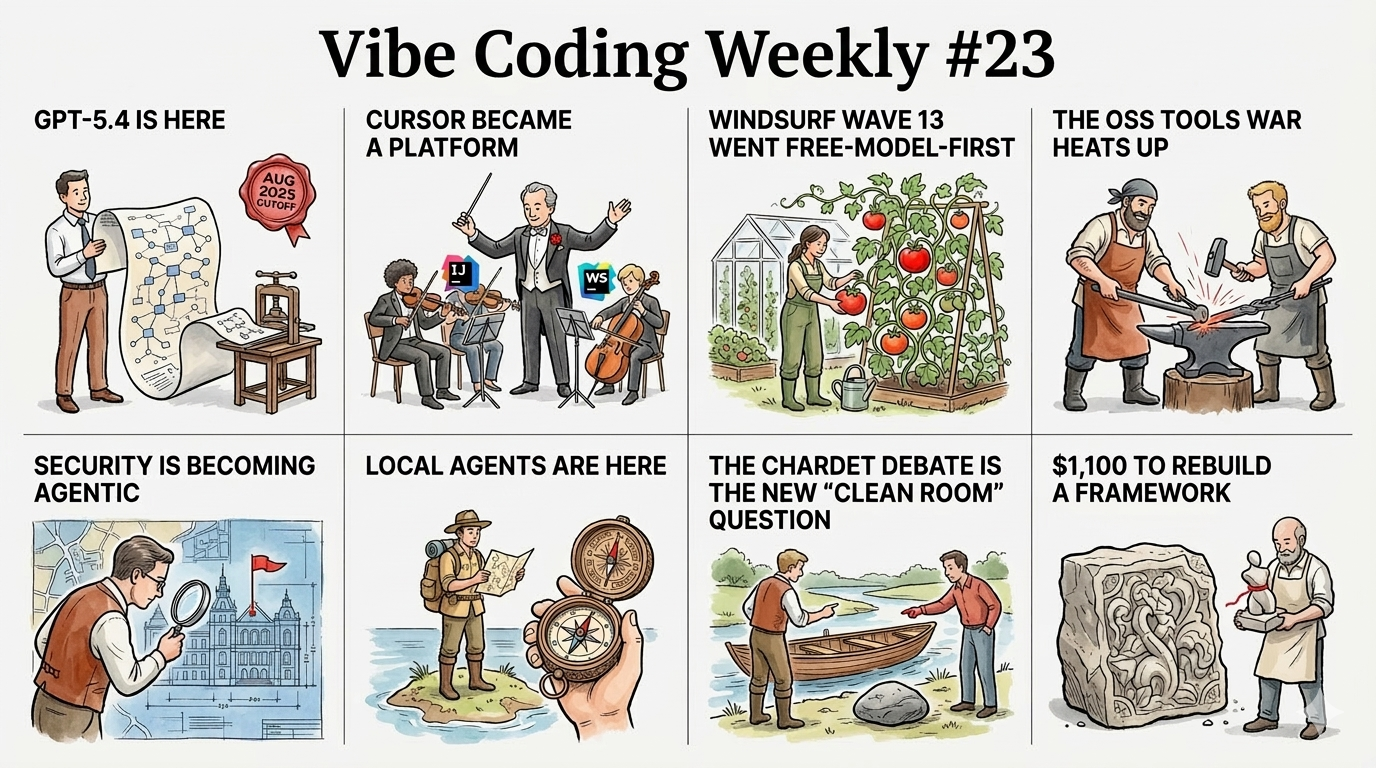
- GPT-5.4 is here: 1M token context, August 2025 cutoff, and dominance on coding benchmarks — but its focus on spreadsheets and presentations (87.3% on IB analyst tasks) signals that “AI coding” is expanding to structured enterprise documents
- Cursor became a platform: Automations brings always-on background agents triggered by Slack, Linear, GitHub, and PagerDuty; the JetBrains ACP release means Cursor now runs in IntelliJ, PyCharm, and WebStorm — the editor is optional
- Windsurf Wave 13 went free-model-first: SWE-1.5 is free for all users for three months, plus multi-agent parallel sessions, Git worktrees, and enterprise-grade system-level Rules via MDM
- The OSS tools war heats up: OpenAI launched Codex for Open Source (free ChatGPT Pro for maintainers), matching Anthropic’s Claude Max offer from the previous week. Both are betting that OSS adoption drives enterprise adoption
- Security is becoming agentic: OpenAI’s Codex Security — now in research preview — builds project-specific threat models, validates vulnerabilities in sandboxes, and proposes patches. Noise down 84%, false positives down 50%
- Local agents are here: Liquid AI’s LocalCowork runs a 24B-parameter model (2B active) with 75 MCP tools entirely on-device, fitting in ~14.5GB RAM. Privacy-first agentic workflows without the cloud
- The chardet debate is the new “clean room” question: Claude Code rewrote an LGPL library as MIT. JPlag says 1.29% similarity. The original author disagrees. This will set legal precedent
- $1,100 to rebuild a framework: One Cloudflare engineer spent a week and $1,100 in Claude API tokens to rewrite Next.js from scratch — 4x faster builds, 57% smaller bundles, already in production. The real insight: most software abstractions exist because humans needed help managing complexity. AI doesn’t.
Thanks for reading! Subscribe for free to receive new posts and support my work.
📦 Releases & News
OpenAI Introduces GPT-5.4
OpenAI launched GPT-5.4 on March 5 — two new API models (gpt-5.4 and gpt-5.4-pro) with a 1M token context window and an August 2025 knowledge cutoff. The model beats GPT-5.3-Codex on all coding benchmarks, but the most revealing number is 87.3% on an internal IB analyst benchmark (versus 68.4% for GPT-5.2), signaling that OpenAI is targeting structured document workflows — spreadsheets, presentations, financial models — as the next frontier for “coding” models. Pricing runs slightly above the GPT-5.2 family, with a notable bump above 272K tokens.
OpenAI also released gpt-5.4-pro, a higher-intelligence variant for complex tasks.
Cursor Launches Automations: Always-On Background Agents
Cursor’s most significant architectural shift yet. Automations are always-on agents triggered by Slack messages, Linear tickets, GitHub events, PagerDuty alerts, webhooks, or cron schedules. Each automation spins up a cloud sandbox, follows a set of instructions with access to MCPs, and learns from past runs via a persistent memory tool. Use cases already running internally at Cursor include: security review on every push, agentic codeowners that classify PRs and route them, incident response via PagerDuty+Datadog, automatic test coverage for untested files, bug report triage from GitHub Issues, and weekly changelog summaries from Linear.
This is Cursor declaring itself an agent platform, not an editor.
Cursor Arrives in JetBrains IDEs via Agent Client Protocol (ACP)
You no longer need the Cursor editor to use Cursor. The Agent Client Protocol (ACP) brings Cursor’s full agent capabilities — codebase indexing, semantic search, and frontier model access — to IntelliJ IDEA, PyCharm, WebStorm, and other JetBrains IDEs. Developers get access to models from OpenAI, Anthropic, Google, and Cursor’s own models, all within the JetBrains environment.
The plugin is free for all paid Cursor subscribers. Combined with Automations, Cursor is decoupling its intelligence layer from its editor — a strategic move that competes directly with GitHub Copilot’s cross-IDE presence.
Windsurf Wave 13: SWE-1.5 Free, Multi-Agent Sessions, and Enterprise Controls
Windsurf’s biggest update in months. SWE-1.5 is now free for all users for three months — a bold pricing move that eliminates the model-access barrier entirely. New features include: first-class Git worktree support, Multi-Cascade panes and tabs for running multiple agent sessions side-by-side, a Cascade Dedicated Terminal (beta), a context window indicator showing real-time token usage, Cascade Hooks for pre/post auditing, and system-level Rules & Workflows configurable via MDM policies for enterprise deployments.
When your competitor makes their frontier model free, the war has moved from model quality to surface area.
Gemini CLI v0.32: Plan Mode, Generalist Agent, and Interactive Shell
A significant release for Google’s terminal-based coding agent. Plan Mode now supports opening and editing plans in an external editor, with multi-select for complex tasks. The generalist agent is enabled by default for improved task delegation. New features include interactive shell autocompletion, model steering in workspace configuration, parallel extension loading, and robust A2A streaming reassembly for Agent-to-Agent communication.
The release also introduces Kind.Agent for sub-agent classification, bringing structure to multi-agent orchestration inside the CLI.
Claude Code v2.1.71: /loop Command and 20+ Fixes
Anthropic shipped four Claude Code releases in four days (v2.1.68 through v2.1.71). The headline feature: /loop — a command that runs a prompt or slash command on a recurring interval (e.g., /loop 5m check the deploy), plus cron scheduling tools for recurring tasks within a session. Other additions include a rebindable push-to-talk keybinding for voice mode and over 20 bug fixes addressing stdin freezes, 5–8 second startup delays on system wake, forked conversations sharing plan files, and plugin installations lost across multiple instances.
Claude Code’s velocity signals how seriously Anthropic takes the terminal-based agent surface.
OpenAI Codex Security Enters Research Preview
Security becomes agentic. Codex Security is a three-stage context-aware agent: it builds a project-specific threat model, performs vulnerability discovery with sandbox validation (no blind static analysis), and proposes validated remediation patches. Beta results: noise reduced 84%, false positives down 50%, and 1.2M+ commits scanned with 792 critical findings across Enterprise customers. Rolling out to ChatGPT Enterprise, Business, and Edu users via the Codex web interface.
This is the closest anyone has come to a security agent that actually works in context.
OpenAI Codex for Open Source: Free ChatGPT Pro for Maintainers
The developer tools arms race now extends to open-source sponsorship. OpenAI launched the Codex Open Source Fund — six months of free ChatGPT Pro ($200/month value) with Codex and conditional Codex Security access for core open-source maintainers.
The offer matches Anthropic’s Claude Max for OSS from the previous week. Unlike Anthropic, OpenAI doesn’t specify minimum star counts, asking instead that applicants explain their project’s importance to the ecosystem. Part of a $1M fund.
When two AI companies compete to win OSS maintainers, the real bet is on bottom-up enterprise adoption.
Google Launches Gemini 3.1 Flash-Lite
Google’s cheapest Gemini 3 model dropped on March 3: $0.25 per million input tokens and $1.50 per million output. It’s 2.5X faster in time-to-first-token and 45% faster in output generation versus Gemini 2.5 Flash. Supports thinking levels. Elo 1432 on Arena.ai, with 86.9% on GPQA Diamond — outperforming 2.5 Flash on most reasoning benchmarks. Available now in preview in AI Studio and Vertex AI. Ideal for high-volume workloads like translation, content moderation, and coding assistance where cost per token matters most.
Liquid AI Releases LocalCowork: Privacy-First Local Agent with MCP
The agentic future doesn’t have to route through the cloud. LocalCowork is an open-source desktop agent running Liquid AI’s LFM2-24B-A2B model (24B parameters, ~~2B active per token via MoE architecture) entirely on-device.
It fits in \\~~14.5GB RAM\\ with Q4 quantization, achieves ~385ms per tool-selection on Apple M4 Max, and connects to 75 MCP tools across 14 servers. Benchmarks: 80% single-step accuracy, 26% multi-step chains.
For developers and organizations where data sovereignty is non-negotiable, this is the first credible local alternative to cloud-hosted coding agents.
📚 Tutorials & Resources
Simon Willison’s Agentic Engineering Patterns (New Chapters)
Simon Willison continued publishing new chapters in his growing guide to working effectively with coding agents. This week’s additions include: interactive explanations (managing the cognitive debt that comes from AI-generated code), agentic manual testing (using agents named Showboat and Rodney for demo walkthroughs and narrated testing), and anti-patterns (why you should never let agents file unreviewed PRs).
Each chapter is practical, experience-based, and focused on patterns that separate “vibe coding” from professional agentic engineering. Essential reading for any team adopting coding agents.
Chardet 7.0 and the AI “Clean Room” Relicensing Debate
A story that may set legal precedent. Claude Code was used to perform a “clean room” rewrite of the chardet Python library — originally LGPL — and relicense the result as MIT under chardet 7.0. Original author Mark Pilgrim challenged the relicensing, arguing that AI models trained on the original code can’t produce a genuine clean-room implementation. Maintainer Dan Blanchard countered with JPlag similarity analysis showing just 1.29% overlap with the original code.
The debate cuts to the heart of open-source licensing in the AI era: can an LLM produce code that’s legally independent of its training data? Expect this to become a reference case.
Donald Knuth on Claude Opus 4.6: “Claude’s Cycles”
Donald Knuth — widely regarded as the greatest living computer scientist — published a paper acknowledging that Claude Opus 4.6 solved an open combinatorial problem he had been working on for weeks.
The problem involved cycle structures in combinatorial algorithms, and Knuth described Claude’s solution as “a dramatic advance in automatic deduction and creative problem solving.” When the author of The Art of Computer Programming publicly credits an AI model with outperforming him on his own problem, the profession takes notice. Context via Simon Willison.
Building Claude Code with Boris Cherny — The Pragmatic Engineer
Gergely Orosz sat down with Boris Cherny — creator of Claude Code at Anthropic, ex-Meta Principal Engineer — for the most concrete look yet at what agentic development actually does to how you work. Boris’s daily routine is already a preview of what’s coming: 20–30 PRs a day with 5 parallel Claude instances, his own role shifting from deep-focus coder to something closer to a conductor managing parallel workstreams — “It’s not about deep work anymore. It’s about how good I am at context switching.” On the tooling side: codebase search is just glob and grep (RAG and vector DBs lost the benchmark), PRDs have been replaced by working prototypes, and a clean well-typed codebase doubles AI productivity — a direct counterargument to the “just ship it” crowd.
💡 Others
One Engineer, One Week, One Next.js Replacement: Cloudflare’s vinext
One Cloudflare engineer spent roughly a week with an AI model and $1,100 in Claude API tokens to rebuild Next.js from scratch. The result — vinext — is a drop-in replacement built on Vite that deploys to Cloudflare Workers: 4x faster builds, 57% smaller client bundles, and 94% of the Next.js API surface covered. It’s already running in production.
But the more important part of this post is the final section, “What this means for software”: the author’s conclusion is that most software abstractions exist because humans needed layers to manage complexity they couldn’t hold in their heads. AI doesn’t have that limitation. “The layers we’ve built up over the years aren’t all going to make it.” Worth reading as a case study in how agentic workflows change what’s economically viable to build — and what it means for the frameworks we’ve relied on.
Qwen Team Departures Raise Concerns for Open-Weight AI
High-profile departures from Alibaba’s Qwen team — multiple key researchers leaving within 24 hours — have raised concerns about the future of the Qwen 3.5 family of open-weight models. Qwen 3.5 was remarkable: 1M token context, competitive with frontier closed models, and fully open-weight. Some observers worry the family may be the team’s “swan song.” For developers and organizations relying on Qwen models as alternatives to GPT and Claude, this is a watch-carefully moment.
Replit Introduces Vibe Code Videos
Replit added a new Animation build type that lets users create motion-style launch videos directly in their workspace — the same environment where they build apps. What started as an internal design hackathon became a viral launch video for Replit’s Fast Mode. The feature reflects Replit’s mobile-first strategy, with 1,800+ builders joining from a recent mobile buildathon. It’s a niche update, but it signals Replit’s bet that the next generation of developers think in demos, not docs.
That’s a wrap for this week. The coding agent war has entered its platform phase. Models aren’t enough — you need triggers, integrations, IDE surfaces, and developer loyalty. Cursor became an agent platform. Windsurf made its model free. OpenAI and Anthropic are competing to win open-source maintainers. And somewhere in Stanford, Donald Knuth is writing papers about what the machine just taught him.
Whether you’re building with these agents or building against them, the velocity isn’t slowing down.
Stay tuned for next week’s edition.
Vibe Coding Weekly is your definitive source for staying current with the latest trends, tools, and techniques that are transforming the development landscape.
In each update, you’ll receive:
- Deep dives into new technologies and emerging frameworks
- Optimized code patterns that enhance both efficiency and readability
- Curated tools and resources that will supercharge your workflow
- Community insights that are defining the future of development
Our goal is to provide you with concise, relevant, and actionable information that you can immediately apply to your projects.
Clean code and positive vibes,
The Vibe Coding Team