Claude Code, GitHub Copilot CLI, and Gemini CLI converged on similar architectures while TailwindLabs lost 80% revenue to AI, showcasing both the emerging consensus on the ai disruption.
By Vibe Coding Weekly
Published: 2026-01-12
URL: https://vibecodingweekly.substack.com/p/vibe-coding-weekly-15
The CLI wars have entered a new phase. While we’ve been tracking Cursor and Replit’s agent-first platforms, something remarkable happened behind the scenes: the three major terminal-based AI coding tools converged on nearly identical architectures.
Claude Code, GitHub Copilot CLI, and Google’s Gemini CLI all shipped major updates in the same two-week window, each introducing agent skills systems, enhanced security frameworks, and hooks for extensibility. This isn’t coincidence—it’s the market finding consensus on how autonomous coding agents should actually work.
But there’s a darker subplot: Tailwind Labs laid off 75% of their engineering team as AI decimated their documentation business. Traffic down 40%, revenue down 80%.
At the same time, a Google Principal Engineer casually mentioned recreating a year-long project in one hour with Claude Code. Could be we’re watching creative destruction in real-time?
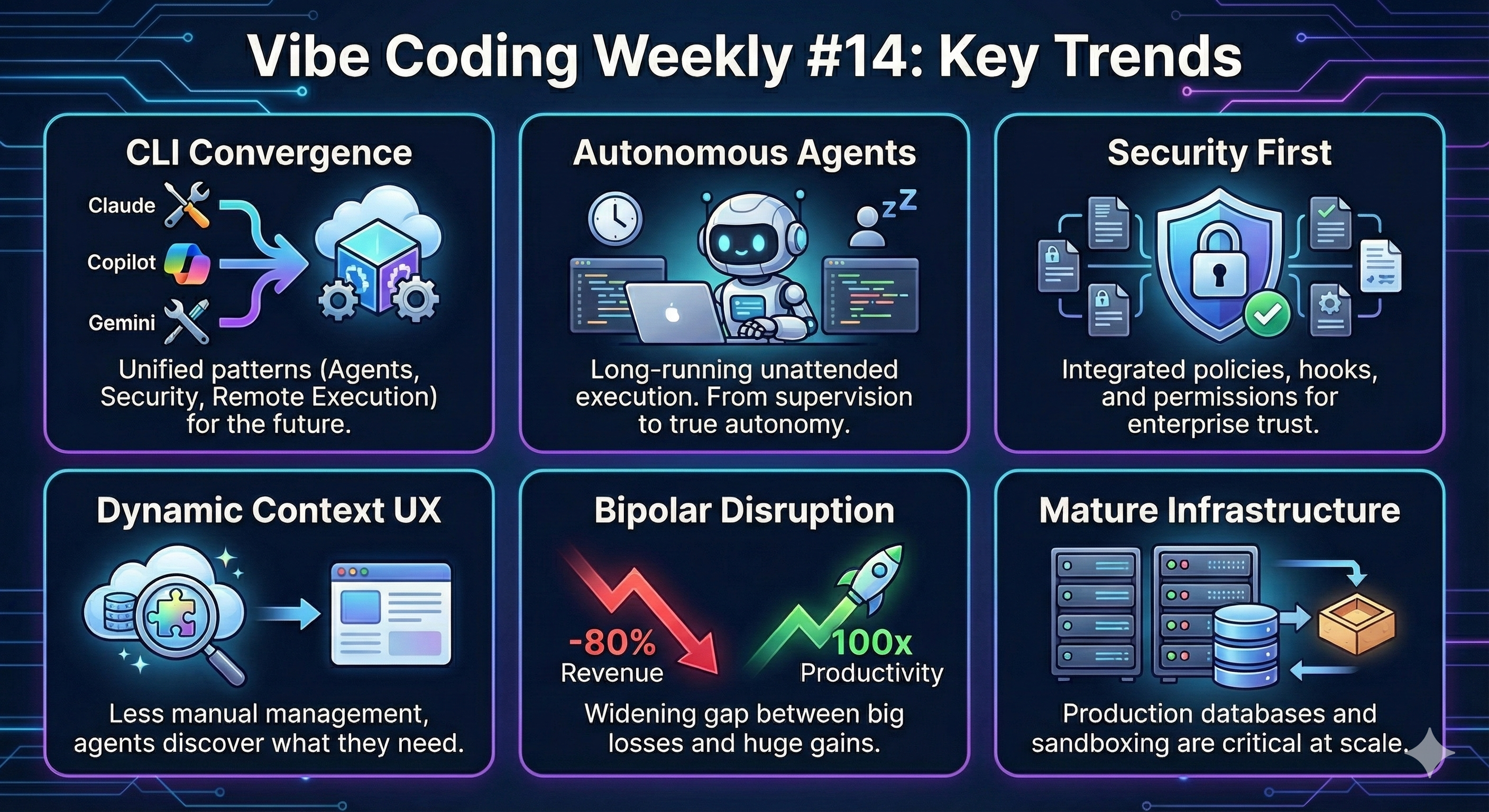
Key Takeaways
- CLI architecture convergence: Claude Code, Copilot CLI, and Gemini CLI independently arrived at the same pattern—skills/agents, security policies, hooks, and remote execution. This suggests these patterns are fundamental to how autonomous coding agents will work going forward.
- Autonomous patterns emerging: The “Ralph Wiggum” pattern demonstrates hours-long unattended agent execution is now practical. Developers are moving beyond supervised agents to truly autonomous workflows.
- Security becomes first-class: All three CLIs shipped major security enhancements—Policy Engine in Gemini, hooks in Claude, permission controls in Copilot. Enterprise adoption requires trust, and the industry is responding.
- Dynamic context is the new UX: Cursor’s shift to “fewer upfront details” reflects growing confidence in agents’ ability to discover what they need. Less manual context management, more intelligent retrieval.
- AI disruption is bipolar: Tailwind’s -80% revenue shows how brutally AI can disrupt even successful companies. Yet the same tools enable 100x productivity gains. The gap between winners and losers is widening.
- Infrastructure matters: Production databases, sandboxing, and automated migrations are becoming critical as agents operate at scale. The tooling is maturing beyond toy demos.
Thanks for reading! Subscribe for free to receive new posts and support my work.
📦 Releases & News
Claude Code 2.1.0 - Skills & Agent Evolution
Claude Code’s 2.1.0 release is packed with features that push autonomous coding forward. Automatic skill hot-reload means skills you create or modify become immediately available without restarting—critical for rapid iteration. Forked sub-agent contexts let you spin up parallel agents without polluting the main conversation. Hooks in frontmatter allow skills to define their own lifecycle events.
And unified Ctrl+B backgrounding means you can send both bash commands and agents to the background simultaneously. The security fix for sensitive data in debug logs is also crucial for enterprise users. Perhaps most importantly, MCP list\_changed notifications now allow servers to dynamically update available tools without reconnection—enabling a more fluid, reactive agent environment.
GitHub Copilot CLI 0.0.375 - Reasoning & Built-in Agents
GitHub Copilot CLI has shipped reasoning summaries (Ctrl+T toggle), built-in subagents for exploration and task management, and auto-compaction at 95% token limits. The addition of a built-in web\_fetch tool is particularly interesting—it signals GitHub’s recognition that coding agents need to pull information from documentation, Stack Overflow, and GitHub issues during execution.
The --share and --share-gist flags for session sharing also point toward a future where developer-to-agent conversations become shareable artifacts, similar to how we share code snippets today. These aren’t flashy features, but they’re the kind of practical improvements that make daily agent use more productive.
Gemini CLI 0.24.0 - Agent Skills & Policy Engine
Google’s Gemini CLI introduces an Agent Skills system with tiered discovery and autonomous activation—agents can now dynamically enable skills based on context. The unified Policy Engine replaces legacy confirmation settings with granular shell command allowlisting, addressing enterprise security concerns head-on. Support for remote agents via TOML configuration and automatic /model persistence across sessions round out a release that positions Gemini CLI as a serious enterprise tool.
The experimental in-CLI extension install/uninstall feature suggests Google is thinking about a plugin marketplace model similar to VS Code. The CLI wars are heating up, and Google just dropped a feature-complete contender.
Cursor: Dynamic Context Discovery
Cursor has fundamentally changed how its agent interacts with codebases. Instead of requiring developers to manually specify context upfront, the agent now dynamically pulls what it needs during execution. This represents a significant philosophical shift: as models become better agents, the UX should get out of the way rather than adding more configuration.
In practice, this means fewer @ mentions and file selections—the agent just figures it out. The change reflects growing confidence in agents’ ability to navigate large codebases intelligently, which has important implications for how we think about IDE design in an AI-native world.
Graphite Acquired by Cursor
Cursor has acquired Graphite, the PR workflow tool beloved by developers who use stacked diffs. This acquisition signals Cursor’s ambition to own the entire code review and collaboration workflow, not just the generation step. Graphite’s core strength is making incremental code changes reviewable in smaller, logical chunks—exactly what AI-generated code needs.
When agents can produce hundreds of lines of changes in seconds, traditional monolithic PRs break down. Cursor is betting that AI-native development requires AI-native review workflows, and Graphite is the foundation for that vision.
LangSmith Agent Builder (Public Beta)
LangChain has launched Agent Builder, a no-code platform for creating production-ready agents through conversation. You describe what you want, and Agent Builder guides you through prompt creation, tool selection, and subagent configuration—then deploys it.
This represents LangChain’s bet that agent development will increasingly happen at a higher abstraction layer, where developers specify intent rather than implementation. For teams without deep LLM expertise, this could dramatically lower the barrier to deploying useful agents.
The key question is whether the no-code approach can handle the complexity of real production use cases, or whether it’s limited to simpler scenarios.
Claude Opus 4.5
Claude Opus 4.5 remains the gold standard for coding tasks, with dramatically improved token efficiency making it practical for everyday development work. The model’s strength is its balance: strong enough for complex reasoning, efficient enough for rapid iteration.
For developers building with Claude’s API or using Claude Code, Opus 4.5 is the model that makes long-running agent workflows economically viable. The efficiency improvements mean you can afford to let the agent explore multiple approaches without burning through your token budget.
📚 Tutorials and Resources
Ralph Wiggum: Claude Code Autonomous Agent Pattern
Joe Njenga has documented a pattern for running Claude Code autonomously for hours without supervision or drama. This is significant because most agent workflows still require human intervention every few minutes—either for permissions, course corrections, or dealing with errors.
The “Ralph Wiggum” pattern (named after the Simpsons character) demonstrates techniques for building resilient, self-recovering agents that can work independently on complex tasks. As agents get more reliable, the ability to delegate and walk away becomes practical.
This pattern represents where the industry is heading: less babysitting, more actual autonomy.
Cursor: 39% Productivity Impact Study
A University of Chicago study found that companies merge 39% more PRs after adopting Cursor’s agent as the default. This is the kind of rigorous, academic validation that moves AI coding tools from “interesting experiment” to “obvious ROI.” The 39% figure is remarkable because it represents real organizational impact, not cherry-picked examples.
For engineering leaders evaluating whether to invest in AI coding tools, this study provides hard evidence. It also suggests that the productivity gains from AI coding agents are large enough to show up in company-wide metrics, even with the noise of different teams, codebases, and workflows.
Production Databases with Automated Migrations
Replit tackles a thorny problem: how do you handle database schema changes when AI agents are making modifications on behalf of users who may not understand migrations? Their solution involves automated migration detection, preview environments, and rollback capabilities.
This is infrastructure work that doesn’t get much attention but is critical for agents operating at production scale. When agents can modify schemas, create tables, and change data structures, you need robust safety rails. Replit’s approach shows what production-grade agent infrastructure actually looks like—not sexy, but essential.
A Field Guide to Sandboxes for AI
Luis Cardoso provides a comprehensive comparison of sandboxing approaches for AI-generated code: containers, microVMs, gVisor, and WebAssembly. As agents run more code autonomously, sandboxing becomes critical—you need to execute untrusted AI-generated code safely without compromising your system.
The guide breaks down the security, performance, and isolation tradeoffs of each approach. For anyone building agent platforms or evaluating tools, understanding these sandboxing primitives is increasingly important.
The post is technical but accessible, and makes a strong case that WebAssembly might be the future for AI code execution.
💡 Others
Tailwind Labs: 75% Engineering Layoffs
The brutal reality of AI disruption: Tailwind Labs laid off 75% of their engineering team after AI decimated their documentation business. Traffic down 40%, revenue down 80%—despite Tailwind CSS being more popular than ever.
The culprit? Developers are asking Claude and GPT for Tailwind patterns instead of reading docs. This is a cautionary tale about how AI doesn’t just compete with products—it can eliminate entire business models overnight. Documentation, tutorials, and educational content are being unbundled from the tools themselves. If your business model relies on developers needing to learn complex APIs, you’re in the crosshairs.
Google Engineer: Claude Code’s 1-Hour Miracle
Jaana Dogan, a Principal Engineer at Google, shared that Claude Code recreated a year-long project in one hour from a three-paragraph description. Let that sink in: one year → one hour. This isn’t a toy demo or a marketing claim—it’s a working engineer at one of the world’s top tech companies casually dropping this into conversation.
The anecdote encapsulates both the promise and the terror of AI coding agents. The productivity gains are real and staggering. But if one person can now do the work of 50, what happens to the other 49?
The Tailwind story and the Jaana story are two sides of the same coin: massive value creation and massive disruption happening simultaneously.
Next Week: We’ll be watching for model releases (rumors of GPT-5.3 and Gemini 3.5 Pro), and tracking how the CLI convergence affects developer workflows. Are hooks becoming the standard extension point? Will we see cross-tool skill compatibility?
What did we miss? Reply with links to articles, releases, or discussions we should cover next week.
Vibe Coding Weekly is your definitive source for staying current with the latest trends, tools, and techniques that are transforming the development landscape.
In each update, you’ll receive:
- Deep dives into new technologies and emerging frameworks
- Optimized code patterns that enhance both efficiency and readability
- Curated tools and resources that will supercharge your workflow
- Community insights that are defining the future of development
Our goal is to provide you with concise, relevant, and actionable information that you can immediately apply to your projects.
Clean code and positive vibes,
The Vibe Coding Team