From external offers to internal promotions, learn how to maximize your total compensation
By Janine Rosado
Published: 2026-08-05
URL: https://uxjobs.substack.com/p/how-to-negotiate-a-job-offer
 Rosado, J. (2026). Job candidate reviewing a recipe for the right job offer, illustrating total compensation as a recipe for career success. Created with DALL·E.
It happened. All that preparation, applying, networking, and interviewing has finally paid off. You received a job offer. Congratulations! Whether you’re currently employed or eager to start your next chapter, it can be tempting to accept right away. But… before you do, take time to evaluate the entire offer and think about what matters most to you. Once you accept, your negotiating leverage drops significantly, making it much more difficult to revisit compensation or other agreed-upon terms. Salary gets most people’s attention. Total compensation determines your quality of life. And those small perks can make a difference, like discounted lunch, a company credit card, or a laundry service. Yet, Restricted Stock Units (RSUs) can create value long after your first paycheck.
The initial offer is often the beginning of a conversation, not the final word. You’ve probably already discussed a few parts of the offer throughout the interview process, including salary expectations, PTO, benefits, or workplace flexibility. Some parts of an offer are easier to negotiate than others. Salary, sign-on bonuses, paid time off, start dates, and hybrid or remote work arrangements often have more flexibility. Other benefits, such as health insurance plans, 401(k) matching, and company-wide leave policies, are typically standardized across employees and governed by HR policies, making them much less negotiable. Understanding where companies have flexibility, and where they do not, will help you focus your negotiation on the areas that can have the greatest impact on your overall compensation and long-term career.
This Substack is reader-supported. To receive new posts and support my work, consider becoming a free or paid subscriber.
In this article, we’ll cover:
-
Overview of total compensation (TC)
-
Understanding What’s Negotiable
-
Managing the Offer Timeline
-
Navigating Multiple Offers
-
Negotiating During Major Life Events
-
What to Watch For
-
What Hiring Managers Are Thinking
-
A Cautionary Tale: Salary Bands
Overview of Total Compensation (TC)
First, let’s talk about total compensation (TC). Many people focus almost exclusively on salary, but your base pay is only one piece of the overall offer. In some cases, other benefits can be just as valuable, or even help make up the difference if the salary is lower than you hoped. Total compensation includes everything the company offers you as part of your employment package.
This includes your salary, bonus structure, equity or Restricted Stock Units (RSU), retirement benefits, healthcare, paid time off, flexible work arrangements, professional development, and other company perks. As you review your offer, be thorough. You may be surprised by the value of benefits that are easy to overlook. For example, a Health Savings Account (HSA) can be a powerful retirement investment. Contributions are tax-advantaged, the money can grow over time, and the account stays with you even if you leave the company.
Understanding What’s Negotiable
Always get negotiated terms in writing, especially additional benefits or work-location arrangements. If it is not in writing, it is not part of the offer. It is a nice conversation you once had. A hiring manager may verbally agree to 3 days in the office, only for you to discover a month later that the expectation is 5 days. Confirm remote, hybrid, or relocation requirements early in the interview process, as job postings and verbal conversations do not always reflect the company’s final expectations. Workplace arrangements affect your commute, childcare, pet care, and overall quality of life, so do not leave them to assumption.
Not every part of an offer has the same level of flexibility. Salary, sign-on bonuses, PTO, start dates, additional severance, and home office stipends are often the easiest to negotiate because hiring managers typically have some discretion or budget flexibility. Equity, title changes, bonus targets, hybrid schedules, reporting structures, team placement, and travel expectations may be negotiable but usually require approval from HR, Finance, or senior leadership. Company-wide benefits, such as health insurance, 401(k) matching, and leave policies, are rarely negotiable because they are designed to maintain consistency, fairness, and legal compliance.
Salary is often one of the easiest elements to negotiate, but there are limits. Reaching or exceeding the top of a salary band can affect future raises, promotions, and internal equity. This is typically more relevant for manager-level and above positions, where compensation, title, and responsibilities are expected to remain closely aligned. Later in this article, we’ll explore the long-term implications of negotiating above the salary band.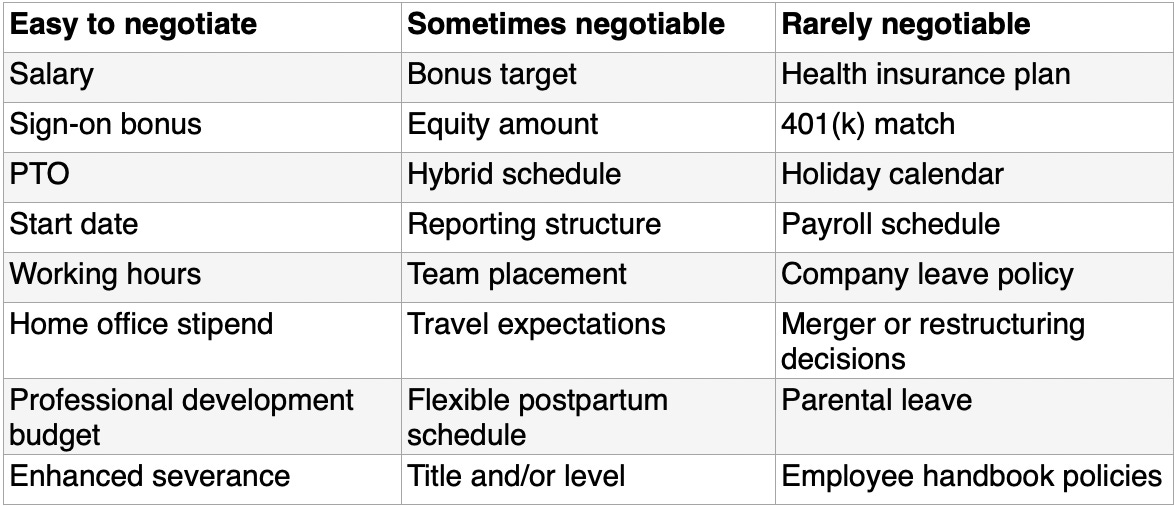 J. Rosado (2026) Chart showing easy, sometimes, and rarely negotiable benefits.
Wild Card Benefit - Thought Leadership: If the company regularly publishes articles, hosts webinars, sponsors conference speaking opportunities, or encourages employees to build their professional brand, those opportunities can also be part of the conversation.
Managing the Offer Timeline
Most companies expect candidates to take time to review an offer. If you need an extra day or two to evaluate the package, discuss it with your family or friends, or compare it with another opportunity, it is perfectly reasonable to ask. The key is to communicate early rather than waiting until the deadline has passed. At the same time, avoid unnecessarily stretching the process. Hiring managers and recruiters are balancing hiring timelines, budgets, other candidates, and their daily workload. If you know you intend to negotiate, review the entire offer, prepare your priorities, and respond in one conversation rather than making multiple requests over several days. Be thoughtful, organized, professional, and respect other people’s time.
Navigating Multiple Offers
Let’s be honest, receiving multiple job offers is exciting. It can feel like one of those rare career moments when everything finally comes together, and the stars align. Enjoy it, but don’t let the excitement rush your decision. Receiving multiple job offers puts you in a stronger negotiating position, but how you handle the situation matters. If you have another offer with a deadline, let the recruiter know early rather than waiting until the last minute. Most recruiters appreciate transparency and may be able to accelerate the hiring process or provide additional information to help you make a decision.
Be honest about your situation. Do not invent competing offers or exaggerate compensation in an attempt to gain leverage. Hiring managers and recruiters have seen these tactics before. If your claims cannot be supported, you risk damaging your credibility before you have even started. Once broken, trust is difficult to rebuild. If you decide to use another offer as leverage, focus on sharing information rather than issuing ultimatums. Explain that you are fortunate to have another opportunity and would like to understand whether the compensation package or timeline is flexible. You want to keep the conversation collaborative rather than confrontational while demonstrating that you are making an informed career decision. You don’t want to come off as someone simply trying to drive up the highest offer.
Negotiating During Major Life Events
If you’re expecting a child or planning to start a family, your priorities during a negotiation may be very different. It is easy to focus almost entirely on parental leave, especially when you know your due date is approaching and those benefits become a top priority. However, focusing solely on leave can cause you to overlook other policies that may have an equally significant impact on your long-term experience with the organization.
Beyond salary, review paid parental leave, short-term disability, healthcare coverage, flexible work arrangements, childcare assistance, prenatal appointment policies, and return-to-work support. Pay close attention to eligibility requirements and waiting periods. Some benefits may not take effect immediately, while certain leave policies may require employees to work for the company for a specific period before they qualify.
Questions to ask include:
-
Will I qualify for parental leave based on my start date?
-
Is there a waiting period before benefits begin?
-
How does short-term disability work?
-
Does the company provide flexibility for prenatal appointments?
-
What support is available when employees return from leave?
-
Can the start date be adjusted if it affects benefit eligibility?
These details can vary by employer, location, and individual policy, so review the written benefits information carefully rather than relying on a general summary from a recruiter. Parental leave may be the first thing on your mind. Still, healthcare costs, eligibility dates, schedule flexibility, and return-to-work expectations may ultimately have just as much influence on whether the role is right for you.
When Negotiation May Be Limited
Negotiation is a normal part of the hiring process, but not every offer has the same level of flexibility. Before negotiating, remember that not every employer has the same level of flexibility. Some organizations have room to adjust an offer, while established compensation policies bind others. Government agencies, unionized workplaces, and many nonprofit organizations, for example, often follow fixed salary bands that leave little room for negotiation. Company compensation policies may also constrain internal transfers and promotions. Before pushing for additional compensation, try to understand how much discretion the hiring team actually has.
If a recruiter or hiring manager tells you the offer is their best and final, don’t assume the conversation is over. Instead, ask whether there is flexibility elsewhere in the package. This is often where negotiations shift from salary to total compensation. A sign-on bonus, additional paid time off, flexible work arrangements, a professional development budget, or an earlier compensation review may still be available, even when base salary is not. The same principle applies to internal promotions and transfers. While salary increases may be constrained by company policy, these moments can be opportunities to discuss additional responsibilities, a title change, flexible work arrangements, professional development, conference attendance, or greater visibility within the organization.
If your company regularly publishes articles, hosts webinars, sponsors conference speaking opportunities, or encourages employees to build their professional brand, those opportunities can also be part of the conversation. They may not increase your paycheck today, but they can accelerate your career. Greater visibility builds your professional reputation, expands your network, and grows your digital presence. But most importantly, they can open doors to future opportunities both within your current company and beyond.
What to Watch For
Benefits can reveal how a company values and supports its employees. Limited vacation, delayed benefit eligibility, weak healthcare coverage, unclear 401(k) matching, lengthy vesting schedules, vague parental leave policies, or forfeited unused PTO can all reduce the true value of an offer. Unlimited PTO also deserves a closer look. Without clear expectations and manager support, employees may take less time off than they need, while inconsistent use across teams can create frustration and resentment.
Ask how much vacation employees actually take, whether unused PTO is paid out, and how time-off requests are handled. It is also worth understanding your manager’s expectations, including whether routine appointments require PTO or if flexible scheduling is encouraged. A benefit you cannot realistically use is just marketing copy. It may look great on an offer letter, but it has little value if employees are discouraged from using it. If recruiters or hiring managers avoid questions, refuse to provide details in writing, or repeatedly say policies are “still changing,” consider that a warning sign. One weak benefit may not be a dealbreaker, but several can point to poor transparency, cost-cutting, or a culture that shifts risk onto employees.
What Hiring Managers Are Thinking
Many candidates worry that negotiating an offer will make them look difficult. In reality, most hiring managers expect some level of negotiation, especially for experienced and senior-level professionals. The key is to be prepared, reasonable, and negotiate once. Identify your priorities, research the market, review the entire offer, and approach the conversation collaboratively. Present all your requests at once rather than returning for multiple rounds of negotiations.
Behind the scenes, hiring managers and Human Resources often work within a compensation range already approved by leadership and Finance. In many cases, they discuss your salary expectations before a formal offer is extended. If you are asked about your compensation expectations during the interview process, communicate the salary you truly want. Waiting until after the official offer to increase your request significantly may require reopening approvals that have already been finalized, and that is not always possible. If the company cannot move on salary, shift the conversation to other parts of your total compensation.
A Cautionary Tale: Salary Bands
Negotiating a higher salary is usually a positive outcome, but earning at or above the top of a salary band can create long-term challenges that are rarely discussed. While companies will sometimes stretch their compensation range to hire the right person, doing so can affect future raises, promotions, and career progression.
One common misconception is that accepting a below-level title with an above-market salary is a shortcut to a quick promotion. You may be told your title will be reviewed in six months or after your first performance review. While those intentions may be genuine, circumstances change. Hiring managers leave, organizations reorganize, budgets shift, and priorities evolve. The manager who made those commitments may no longer be there, leaving you without the advocate who supported the original agreement. At the same time, being at the top or above the salary band may limit future merit increases and make promotions more difficult because your compensation already overlaps with the next level.
Role alignment can create another challenge. You may find yourself performing work one or even two levels above your official title because those skills were one of the primary reasons the company hired you. When your responsibilities, title, and compensation are no longer aligned, promotion discussions become more complicated because work at the next level can gradually become viewed as “just part of your job.”
High compensation also attracts greater scrutiny during leadership changes, reorganizations, mergers, or layoffs. A new manager may inherit a team they did not build and may not understand the business case for your salary or the scope of your contributions. Without a strong advocate and documented results, a highly compensated employee may face greater scrutiny during budget reviews. If your negotiated salary places you significantly above the established range for the role, ask whether the position itself should be leveled differently.
A higher-level title may better reflect your responsibilities while providing room for future salary growth. It also strengthens your long-term career, as recruiters and hiring managers often notice your title before they review your accomplishments. Ideally, your title, responsibilities, and compensation should remain aligned. Being paid at one level while holding a title one or two levels lower can make future raises, promotions, and external job searches more difficult.
Conclusion
Before maximizing your base salary, consider the long-term picture. A sign-on bonus, additional equity, enhanced severance, more paid time off, a higher bonus target, flexible work arrangements, or a six-month compensation review may provide greater value while preserving room for future growth. Also ask how often salary bands are reviewed, how promotions are determined, and what happens when employees reach the top of their compensation range. The goal is not simply to negotiate the best offer today, but to position yourself for continued growth over the next several years.
This Substack is reader-supported. To receive new posts and support my work, consider becoming a free or paid subscriber.