New product development is all about new market acquisition.
By UX Woman
Published: 2026-10-08
URL: https://uxdesigncourses.substack.com/p/ux-challenge-6-pov-hinge-the-dating
Your POV and challenge for today: Hinge, the dating app, hired you to tap into new product development as a UX designer. And usually new product development at large corporations targets new market acquisition….or acquiring users who traditionally would not opt for the main Hinge dating app. Fair warning… this post gets a little absurd, inspired by Soren Iverson, an absurdist designer I follow :)
Welcome back to UX Challenge #6 UX psychology behind everyday brands. I share my experiences working for brands like Disney+, Hulu, Marvel and more where we believed in sharing our craziest ideas and making them even crazier. So let’s go!
So Hinge, is it unhinged to design a few kinky poly-amorous dating features into your app? In this economy, I don’t think one partner is enough. It feels very practical to me to have a mortgage and living expenses and chores split four to six different ways. But that’s just me and it’s also good girl math.
Let’s break down the design process to design intentional polyamorous and kinky dating features into Hinge. Let’s get started!
First a quick competitor analysis– We’ve come a long way since Tinder first came out and changed online dating forever, eliminating the fear of rejection between two matches. This also resulted in negative consequences— aggressive texts, lack of safety measures, con artists.
Next came Bumble, placing the controls with women– and opting for a system where women made the first move. However, this approach led to lawsuits with men’s rights activists. And finally Hinge– focused on intentional dating experiences. New apps on the market like Feeld have moved in the direction of kink-based connections
Next, some quick research! I got a summary of the Ethical Slut, Topping, and Bottoming by Dossie Easton and Janet Hardy, two psychologists who have already conducted a lot of research interviews in this space. Key problems to solve in poly and kink dating in an app include: (1) communication of kinks and preferences, (2) scheduling between partners, and (3) agreements on shared resources.
I started by writing out and sketching ideas– Poly-specific Hinge prompts to describe kinks and preferences, a shared scheduler to understand 1-on-1 time versus events or overlapping hangouts, preferences communicated before matching, while chatting and while meeting.
And then I got to designing using templates created by others in the Figma community. Here are some of the final results! So are these absurd or futuristic towards where dating is going?
Living in ideation space is a strange space where the good, the bad, and the ugly all collide– but somewhere in the mess of untangling a new idea, a really good idea can emerge if we are patient enough.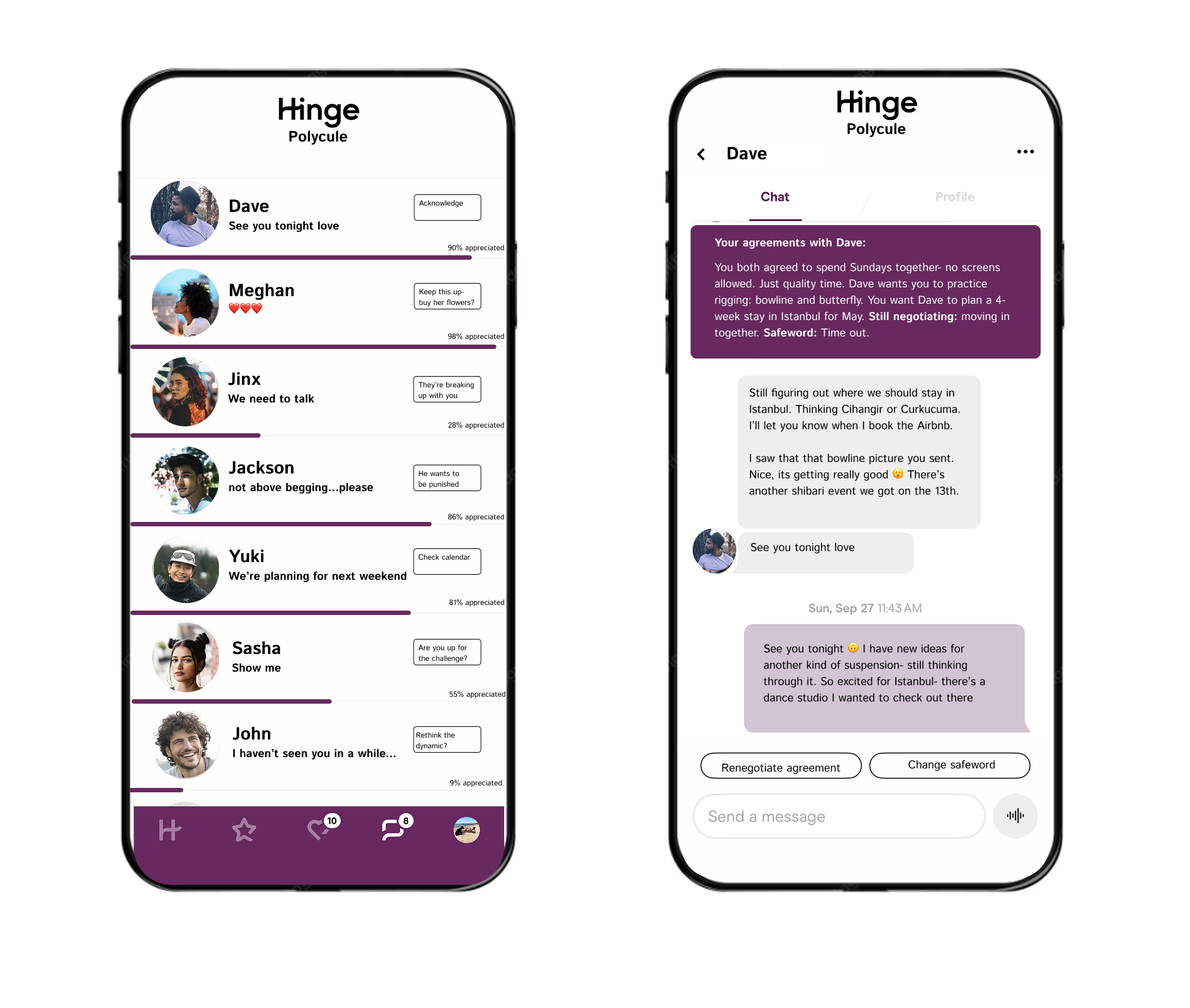
In this concept, I chose to add to Hinge’s existing AI features of guiding profile prompt writing. I like the idea of AI running a sentiment analysis on texts and providing a thoughtful or actionable insight that keeps the conversation productive.
I also like the idea of AI mediating real-human conversations and tracking agreements, wants, needs and negotiations between 2 partners. I think this is a balanced way to use AI without it taking over the entire app design and creating AI slop….not what we need! It’s a delicate balance.
I also like the idea of creating dating app experiences that are consent driven— documenting consent as relationships build, ebb and flow. Another consideration was exposing the give-and-take of partnership, nudging partners in a dynamic to clearly define their agreements, while also giving them the space to evolve those agreements towards more connection.
My question to YOU is: what would you change or add to these initial concepts? What do you find helpful in these concepts? What do you find confusing?
In our 7-Month UX Design Accelerator, our cohort members often spend over 2 months really gathering quality context about their target audience and build a business model around the key problem they are trying to solve with their startup MVP idea.
At the same time, they are ideating on as many as 20-50 different concepts, playing with options and gradually narrowing them with both quantitative and qualitative UX methods. Here are three mindsets that our UX cohort members develop that help them land six-figure UX jobs at Fortune 500 companies after graduating.
-
They aren’t afraid to play! And NO they don’t just offload ideation to AI to get a bunch of superficial results. The process of playing with a variety of different ideas requires coming up with good ones, bad ones, absurd ones…and sometimes getting stuck along the way. It forces us to start discerning what elements of each of our ideas are worth moving forward with, versus what elements of our ideas are worth throwing away. Our cohort members build this discernment and decision-making skillset, not being afraid to prioritize some ideas while discarding others.
-
They aren’t afraid of ideas being rejected. Part of the ideation process is to think through all your absurd or bad ideas as well! And this means confronting the part of yourself that doesn’t always have the right answers. It means working through uncertainty and insecurity. And it means reasoning through why some ideas are better than others, backed by qualitative and quantitative data. This process helps our cohort members build a detachment towards ALL their creations, not judging their outputs, but simply testing each of them for proof of impact.
-
Their confidence comes from their flexibility in thinking. During UX interviews, our cohort members are able to effortlessly walk through their unique design process and how they think through the problem and the solution. Their mindsets and flexibility in thinking come across as favorable characteristics during the interview and this helps them land six-figure UX jobs.
Our 7-Month UX Design Accelerator ($7,450) provides 4 months of 0-1 product design curriculum and 3 months of 1-on-1 UX career coaching to help you learn the end-to-end design process, build a portfolio of 3-5 relevant UX case studies, re-write your UX resume and Linkedin profile, learn UX interview techniques and salary negotiation techniques. You can connect 1-on-1 with our alumni to hear about their experiences firsthand!
Our SPRING 2027 cohort starts on Sunday, February 20th and class runs LIVE on Zoom from 3 pm ET to 6 pm ET. The early bird deadline to register for the SPRING 2027 cohort is Thursday, February 11 to get the early bird tuition rate. If you wait for the early-bird deadline, the course price increases by $900.
In the past, UX cohort members of our fall and spring programs have paid the remainder of their tuition post-registration in one lump sum ($6960), as part of a 4-month payment plan ($1740 per month), or as part of a 7-month payment plan ($994 per month). Book a 20-minute call with us to talk through your budget and financing options.
For folks looking for a more affordable learning option, our self-paced UX Design Accelerator ($4950) provides fully online modules and 14 1-on-1 mentorship sessions. You have the option to ENROLL NOW and pay one lump sum of $4950 or 3 monthly payments of $1650. Set up a call with Samaya after you enroll to get onboarded for your mentorship sessions!
As always, rooting for your success!
Samaya, your UX Woman.
P.S. We have posted over 90+ entry level UX jobs (0-3 years experience) this past week! Check out our UX job board to get access.
P.P.S. Register for the Spring 2027 Live UX cohort because seats run out FAST. Or you can ENROLL NOW in our Self-Paced UX Accelerator.