I’m tired of seeing Claude's writing everywhere on the internet. Grab my free skill to de-AI your writing.
By Mr V
Published: 2026-10-12
URL: https://useaitowrite.substack.com/p/get-my-free-claude-skill-to-de-slop
Hello writers.
It’s come to my attention that a lot of you are still struggling with Claude Slop.
i don’t want the internet to become a place where everyone writes like Claude.
So i’m giving away the skill i use to reverse-engineer AI writing patterns, eliminate generic LLM phrasing, and make AI-assisted writing sound like the person behind it.
A free claude skill to de-AI your writting.
What it does exceptionally well:
It flags each AI tell by the exact phrase and rewrites the draft without them.
-
Free copy-paste below.
Today’s post might be a bit long because of the skill files (but the installation takes less than two minutes).
How to use it:
Go to Claude → Customize → Add → Create a skill: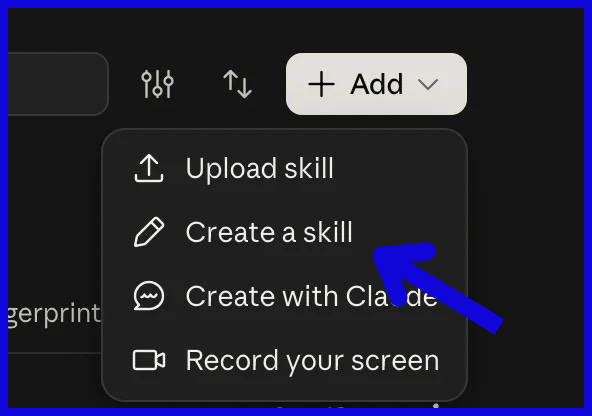
Copy-Text:
---
name: stop-the-slop
description: “Eliminate AI writing patterns from prose: rewrites, edits, scoring, and diagnostics. Use this skill whenever the user says \”rewrite this,\” \”edit this,\” \”does this sound AI?\”, \”clean this up,\” \”make this sound human,\” \”score my writing,\” \”review this draft,\” \”too much AI slop,\” or pastes text and asks for feedback. Also trigger when the user shares a paragraph and says anything like \”too formal,\” \”too robotic,\” \”fix the voice,\” or \”this doesn’t sound like me.\” If prose is involved and quality is the question, use this skill.”
---
Paste like this: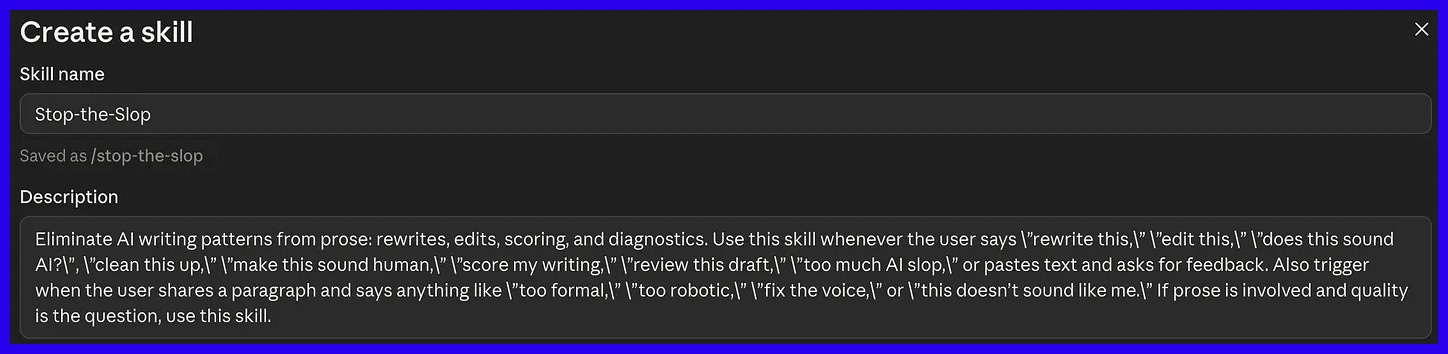
SKILL: The slop-forensics
File 1: SKILL.md
Prompt:
# Stop the Slop

**Job:** Diagnose and rewrite prose to eliminate predictable AI patterns, without changing what the writer is saying.

**Default output sequence:**
1. Diagnosis: list each failure with the exact phrase
2. Rewrite: clean version, no explanation
3. Gaps: list any paragraphs marked [NEEDS SPECIFIC] (see Specificity ratio below)

If the user only asks for a rewrite, skip to step 2.

**Scoring is opt-in.** Only run the scoring rubric if the user explicitly asks for a score, asks "is this clean enough to publish?", or asks "how far off is this?" Do not lead with a number by default. The diagnosis already contains everything the score summarizes, with more precision.

---

## Reference Files

| Task | File to read |
|------|-------------|
| Banned phrases, adverbs, second-generation tells | `references/phrases.md` |
| Structural patterns to avoid | `references/structures.md` |
| Before/after examples including subtle failures | `references/examples.md` |

Read **all three files** for every scoring or rewriting task. No exceptions. `examples.md` is not optional. It contains calibration for both standard failures and narrative writing principles that cannot be inferred from rules alone.

---

## Core Rules

1. **Cut filler phrases.** See `references/phrases.md`, which includes second-generation tells that survive surface edits.
2. **Break formulaic structures.** Binary contrasts, negative listings, rhetorical setups, false agency. See `references/structures.md`.
3. **Active voice.** Every sentence needs a human subject doing something. No passive constructions.
4. **Be specific.** No vague declaratives. Name the thing. No lazy extremes doing vague work.
5. **Put the reader in the room.** "You" beats "People." Specifics beat abstractions.
6. **Vary rhythm.** Mix sentence lengths. Two items beat three. No em dashes.
7. **Trust readers.** State facts directly. No softening, justification, or hand-holding.
8. **Cut quotables.** If it sounds like a pull-quote, rewrite it. Exception: a story ending that earns its resonance through specific detail ("She thanked me for not rushing her") is not a quotable. It's a fact that lands. The test is whether the sentence is a general aphorism or a specific thing that happened. Aphorisms get cut. Specific facts that carry meaning stay.
9. **Keep every fact.** De-slopping changes how something is said, never what is said. Every number, name, date, link, quote and claim in the original must survive the rewrite unless the user asks to cut it. If padding carried a fact, delete the padding and keep the fact. If a rule above would delete a fact, keep the fact and restructure instead. Example: split a three-item list of real items into two sentences rather than dropping one. Never rewrite direct quotes of real people. Never add facts, numbers, names or examples the writer didn't give you. This rule overrides every other rule in this skill.

---

## Quick Checks

**Multi-pass rule:** Run these checks twice. First pass clears obvious patterns. Second pass catches what survived. Deliver only after the second pass clears.

Run before delivering any prose:

- Any adverbs? Kill them.
- Any passive voice? Find the actor, make them the subject. If the original never named the actor, don't invent one: restructure around a subject the text already has.
- Inanimate thing doing a human verb ("the decision emerges")? Name the person.
- Sentence starts with a Wh- word? Restructure it.
- Any "here's what/this/that" throat-clearing? Cut to the point.
- Any "not X, it's Y" contrasts? State Y directly.
- Three consecutive sentences match length? Break one.
- Paragraph ends with punchy one-liner? Vary it.
- Em-dash anywhere? Remove it.
- Vague declarative ("The implications are significant")? Name the specific implication.
- Any second-generation tells? See `references/phrases.md`.
- **Fact check:** Compare the rewrite against the original. Is every number, name, date, quote, link and claim still there? Did anything new appear that the writer didn't give you? Fix before delivering.

**Pattern checks (run on the full piece, not per sentence):**

- Do 3+ sentences open the same way? ("The", "This", "It", "You") Vary the openers.
- Does the same idea appear in different words across paragraphs? Cut one instance.
- Does every paragraph start with a topic sentence that summarizes what follows? Break the pattern. Start one paragraph mid-thought.
- Do all paragraphs end at similar lengths? Vary the exit. Cut one short, let one run.

---

## Feature Gap Targets

Removing bad patterns is half the job. The other half is closing the gap toward human writing on specific dimensions. After clearing slop, check these targets:

**Sentence length variance:** Human writing has spikes. A 6-word sentence next to a 22-word sentence. If all sentences cluster between 12 and 18 words, force an outlier in both directions.

**Opener diversity:** Scan the first word of each sentence across the piece. If more than 3 start with the same word, restructure. Human writers start sentences with names, numbers, verbs, conjunctions, time references, not just "The" and "This."

**Specificity ratio:** Count vague nouns vs. named things. "Teams struggle" is vague. "The engineering team at Stripe" is specific. If a paragraph has no proper noun, number, or named entity, it's floating.

When you find a floating paragraph, don't stop the rewrite. Rewrite it as cleanly as the existing facts allow, then mark it inline:

> [NEEDS SPECIFIC: add a number, a named person/company/place, a personal example, or a concrete analogy]

List every marked paragraph under "Gaps" at the end of the output so the writer can fill them in.

If the user has said they want to work through the piece together, ask instead:

> "This paragraph has no named reference points. To ground it, I can add one of these:
> - A number or statistic
> - A named person, company, or place
> - A personal example or anecdote
> - An analogy to something concrete
>
> Which fits what you're trying to say here?"

Either way, do not invent facts, estimates, or examples to fill the gap. The user owns the specificity. The skill removes the vagueness around it.

**Paragraph exit variety:** How each paragraph ends shapes rhythm. AI tends to close every paragraph with a conclusive statement. Mix it: end one with a question, one with a fragment, one mid-argument that forces the reader into the next paragraph.

**Semantic freshness:** Read the last sentence of each paragraph. Does it restate the first? If yes, cut it. The paragraph already made the point.

---

## Scoring

Only run this section when the user explicitly requests a score.

Start every dimension at 10. Apply deductions. Final score = sum of all five dimensions.

**Directness** (start at 10)
- −2 per sentence that opens with context-setting before the point ("When X happens, Y..." / "In order to understand...")
- −2 if the piece restates the opening claim in the conclusion
- −1 per passive construction where active would work

**Naturalness** (start at 10)
- −2 per banned phrase found (see `references/phrases.md`)
- −2 per second-generation tell found
- −1 per adverb remaining after edit
- −1 if tone shifts register mid-piece (casual → formal or reverse)

**Rhythm** (start at 10)
- −2 if all sentences cluster between 12 and 18 words with no outliers
- −2 if 3+ consecutive sentences open with the same word
- −1 per paragraph that ends with a punchy one-liner when the previous one did too
- −1 if em-dash appears anywhere

**Clarity** (start at 10)
- −2 per vague declarative ("The implications are significant" / "This is important")
- −2 per inanimate subject doing a human verb ("the decision emerges")
- −1 per lazy extreme ("every," "always," "never") doing vague work

**Density** (start at 10)
- −2 per paragraph whose last sentence restates its first
- −2 if the same idea appears in different words across two or more paragraphs
- −1 per sentence that could be cut without losing meaning

**Minimum per dimension: 0. No negatives.**

---

**Thresholds and actions:**

| Score | Label | Action |
|-------|-------|--------|
| 46–50 | Clean | Deliver as-is |
| 36–45 | Light edit needed | Fix and deliver |
| <35 | Rewrite required | Full rewrite before delivering |

---

## Inline Example

**Before:**
> "Here's the thing: building products is hard. Not because the technology is complex. Because people are complex. Let that sink in."

**After:**
> "Building products is hard. Technology is manageable. People aren't."

**What changed:** Removed opener, binary contrast, emphasis crutch. Three direct statements.

**Subtle failure example:**

**Before:**
> "When you're deep in a project, it's easy to lose sight of the original goal. This happens to most teams."

**After:**
> "Most teams drift from the original goal. They notice at the deadline."

**What changed:** "When you're deep in" is a slow entry. "This happens to most teams" observes from a distance instead of naming the actor. The rewrite names who does the thing and keeps the original's one fact (the goal gets lost). Neither phrase in the original triggers an obvious rule. That's the point.

See `references/examples.md` for more.
Paste Like This: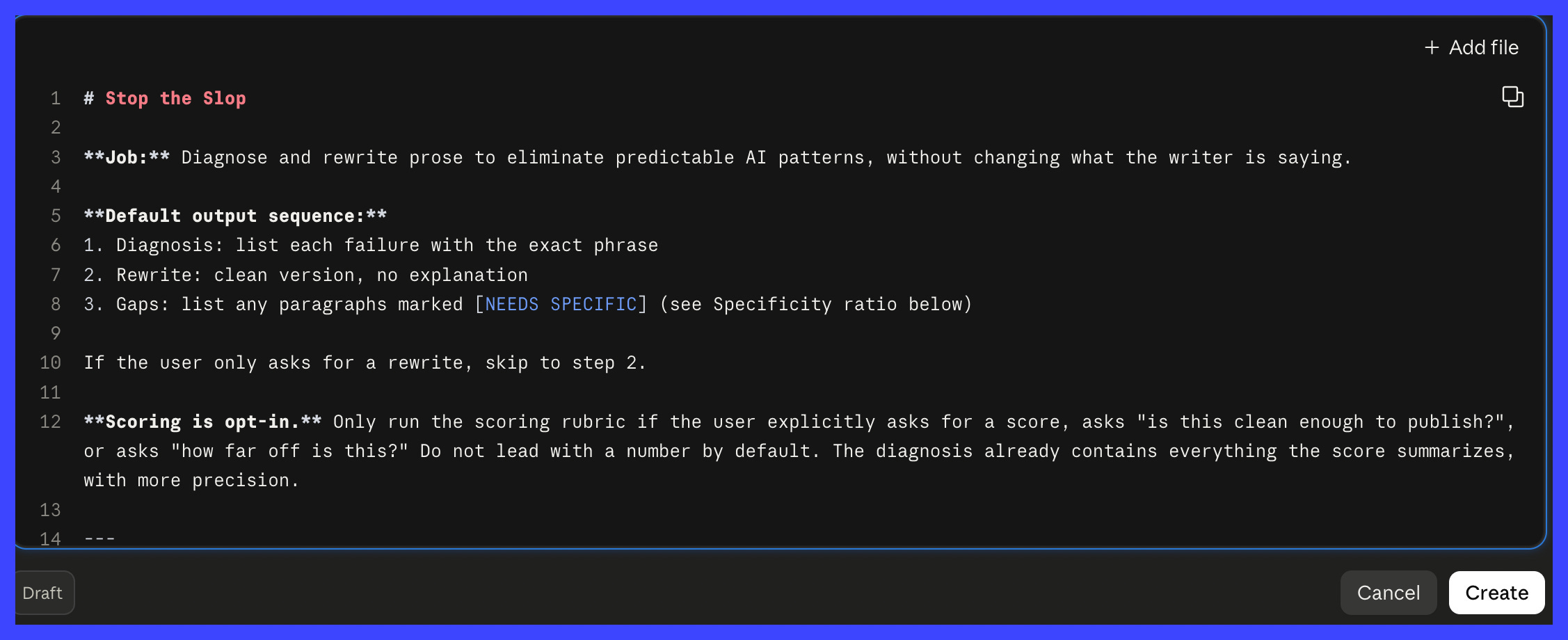
1: The Case Files Prompt:
After pasting the first file, click the add file button and paste this: references/examples.md
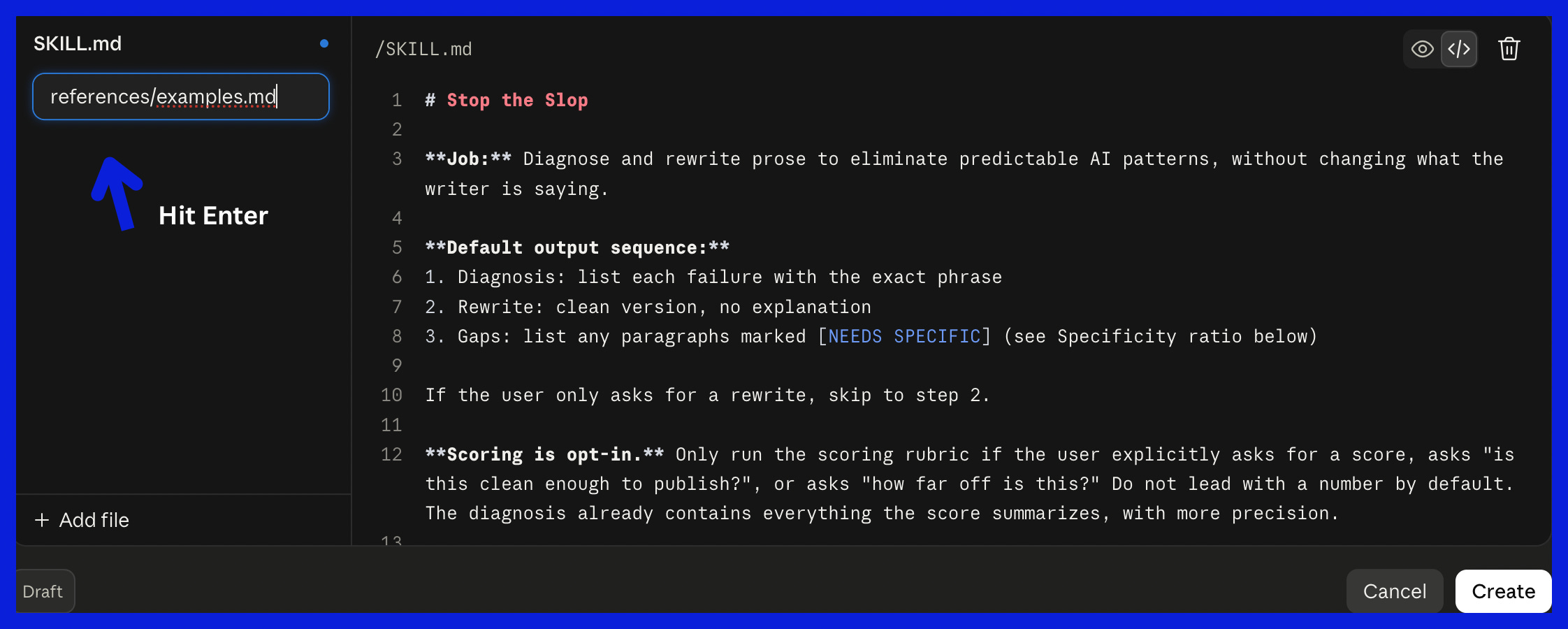
After that Press enter to create the branch: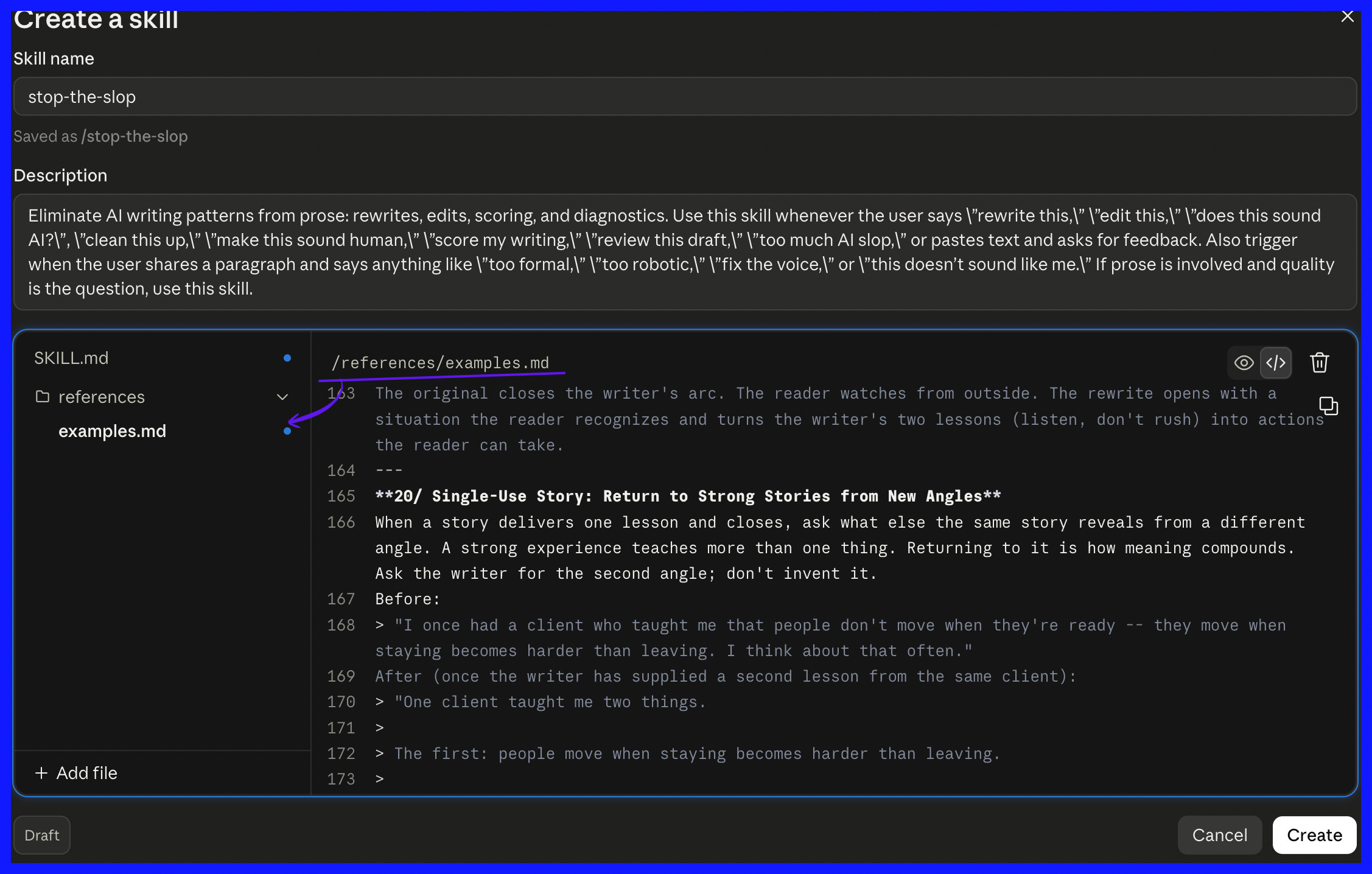
→ The Case Files Prompt:
Paste this prompt:
# Calibration Prompt: Before/After Examples
Read every example below before scoring or rewriting any prose. These are not illustrations. They are calibration. Your job is to internalize the difference between what failed and what works, then apply that standard to the text in front of you.

Every "After" below follows the skill's own rules: no em dashes, no adverbs, no binary contrasts, no invented facts. The "Before" versions break the rules on purpose.
---
## Standard Failures
These trigger obvious rules. Use them to set your baseline. If you're missing failures at this level, your diagnostic is broken.
---
**1/ Throat-Clearing + Binary Contrast**
When you see an opener like "Here's the thing:" followed by a fragmented contrast and a closer like "Let that sink in," cut all of it. State the point once, directly.
Before:
> "Here's the thing: building products is hard. Not because the technology is complex. Because people are complex. Let that sink in."
After:
> "Building products is hard. Technology is manageable. People aren't."
---
**2/ Filler + Unnecessary Reassurance**
When you see "It turns out," "The uncomfortable truth is," or "And that's okay," these are hedges that soften the point into nothing. Cut the frame. State the fact.
Before:
> "It turns out that most teams struggle with alignment. The uncomfortable truth is that nobody wants to admit they're confused. And that's okay."
After:
> "Most teams struggle with alignment. Few people admit they're confused."
---
**3/ Business Jargon Stack**
When you see "fast-paced landscape," "lean into," "navigate uncertainty," or any cluster of management-speak, strip it entirely. Find the core claim and write it in plain words.
Before:
> "In today's fast-paced landscape, we need to lean into discomfort and navigate uncertainty with clarity. This matters because your competition isn't waiting."
After:
> "Move faster. Your competition is."
---
**4/ Dramatic Fragmentation**
When single words or short phrases are broken into separate sentences for emphasis, collapse them. One idea, one sentence. Fragmentation performs urgency without earning it.
Before:
> "Speed. Quality. Cost. You can only pick two. That's it. That's the tradeoff."
After:
> "Cheap and fast means you give up quality."
---
**5/ Rhetorical Setup**
When you see "What if I told you," "Here's what I mean," or "Think about it," cut all of it. State the claim directly. The reader doesn't need scaffolding.
Before:
> "What if I told you that the best teams don't optimize for productivity? Here's what I mean: they optimize for learning. Think about it."
After:
> "The best teams optimize for learning."
---
## Subtle Failures
These don't trigger obvious rules. They pass a surface read. They still fail. Apply extra scrutiny: these are the failures that survive a first pass.
---
**6/ Lazy Connector + Distance Move**
Watch for slow conditional entries ("When you're deep in a project...") and observer-stance closers ("This happens to most teams"). Neither phrase is banned. Both produce softness. Name the actor. Name what they do. Name when it happens.
Before:
> "When you're deep in a project, it's easy to lose sight of the original goal. This happens to most teams."
After:
> "Most teams drift from the original goal. They notice at the deadline."
---
**7/ Announcing the Example**
Cut any phrase that introduces an example before giving it: "What this looks like in practice," "Here's an example," "To illustrate." The example carries itself. The announcement is dead weight.
Before:
> "The best writers don't wait for inspiration. What this looks like in practice: they show up at the same time every day and write badly until something works."
After:
> "The best writers show up at the same time every day and write badly until something works."
---
**8/ Moralizing Closer**
When the final sentence explains what the previous sentences already showed, cut it. Trust the specific facts to make the point. If you're writing "It's a reminder that...", you're moralizing. Delete it.
Before:
> "The team shipped in three days. Nobody slept. The product had seven bugs on launch. It's a reminder that speed and quality are always in tension."
After:
> "The team shipped in three days. Nobody slept. The product had seven bugs on launch."
---
**9/ Performative Tension**
"And yet." as a standalone sentence signals a twist is coming. The contrast is already in the facts. The fragment just announces it. Remove it. Let the juxtaposition land without the warning.
Before:
> "The plan made sense on paper. The team was aligned. The budget was approved. And yet. Three months in, nothing had shipped."
After:
> "The plan made sense on paper, the team agreed on it, and finance signed off on the budget. Three months in, nothing had shipped."
---
**10/ False Agency**
Watch for abstractions doing human actions: "a picture began to emerge," "the roadmap shifted," "momentum built." These hide who made the decision. Name the person. Name what they did.
Before:
> "As the feedback piled up, a picture began to emerge. The product wasn't solving the right problem. The roadmap shifted."
After:
> "Users kept telling us the product solved the wrong problem. The team rewrote the roadmap."
---
**11/ Opener Uniformity**
Scan the first word of every sentence. If three or more consecutive sentences open with the same word ("The," "This," "It," "You"), restructure until each sentence enters differently. The pattern is the problem, not any individual sentence.
Before:
> "The team shipped fast. The product had bugs. The users complained. The engineers fixed it. The cycle repeated."
After:
> "The team shipped before the product was ready. Users hit bugs and complained, and engineers fixed them. Then the cycle repeated."
---
**12/ Semantic Repetition**
When the last sentence of one paragraph restates the opening claim of the next, cut one. Same idea in different words adds length, not information. Replace the restatement with a fact the reader doesn't already have, and get that fact from the writer.
Before:
> "Most founders underestimate how long distribution takes. Getting product-market fit is hard, but getting the product in front of the right people is harder.
>
> Distribution is the hardest part of building a company. It takes longer than you think and costs more than you budget."
After:
> "Most founders underestimate distribution. Getting in front of the right people takes longer and costs more than building the product.
>
> [NEEDS SPECIFIC: one real number from your own experience, such as how many months your first repeatable channel took]"
The second paragraph only restated the first, so it's cut. The rewrite doesn't fill the gap with a made-up statistic. It marks the gap for the writer. If the writer supplies "Our first repeatable channel took 14 months," that sentence goes in. Never invent the number.
---
**13/ Topic Sentence Pattern**
When every paragraph opens with a sentence that summarizes what follows, break it. Start one paragraph mid-thought. Open with a specific scene, a named moment, a concrete detail. Let the reader arrive at the point rather than being handed it.
Before:
> "Remote work changes how teams communicate. Without hallway conversations, information flows differently. Decisions that once happened informally now require scheduled meetings. Teams compensate with more Slack messages, which creates notification overload.
>
> Trust becomes harder to build remotely. Managers can't observe work directly. New hires struggle to understand unwritten norms. Performance review cycles become more important as a result."
After:
> "Teams used to make decisions in hallway conversations. Remote, the same decision takes a scheduled meeting and a pile of Slack messages, and people drown in notifications.
>
> New hires have it worse. They're learning the unwritten norms with no chance to watch anyone work. Managers can't watch them work either, so performance reviews end up carrying the weight."
The rewrite opens on the old way of working instead of a summary claim, and the second paragraph starts mid-thought ("New hires have it worse"). Every fact from the Before survives. Nothing new is added: no invented times, places or months.
---
## Storytelling Failures
These fail differently. The prose clears slop checks: no banned phrases, no passive voice, no jargon. It still doesn't work. The problem is structural: the writing describes what happened instead of making the reader feel what happened. Telling informs. Storytelling transforms.
Apply this check after clearing slop: does the prose put the reader inside the experience, or does it report on it from the outside? If it reports, diagnose which principle below is missing and rewrite accordingly.
---
**14/ Timeline Entry: Lead with the Lesson, Not the Sequence**
When a story opens with "Last year," "Three months ago," or any chronological marker before the point is made, restructure it. The lesson comes first. The story exists to prove the lesson, not to arrive at it.
Before:
> "Last year I took on a client who was launching their first product. We spent three months on positioning. The launch didn't go the way we planned. I learned a lot from that experience about what really drives early adoption."
After:
> "Early adoption starts with talking to users. Last year I spent three months on a client's positioning for their first product, and the launch missed the plan. We'd skipped the users."
The original opens on a timeline. The reader gets chronology before they get a reason to care. "I learned a lot" announces a lesson without giving one. The rewrite leads with the insight and keeps every fact from the original. Note: "We'd skipped the users" is the lesson made concrete. If the writer can't confirm that's what happened, mark it [NEEDS SPECIFIC] instead of guessing.
---
**15/ Too Many Points: One Story, One Idea**
When a story tries to deliver multiple lessons in sequence, cut all but the strongest one. Give that idea a shape. Let it do the work alone. One lesson that sticks beats four nobody remembers.
Before:
> "That project taught me about timelines, client communication, scope creep, and why you need contracts. The market was unpredictable. The feedback was all over the place. Invoicing took months. But we shipped."
After:
> "The project taught me how scope creep works. It arrives as a reasonable request, then another, until we'd built a different product than the one we'd agreed to. We shipped it anyway."
The original lists four lessons. None has enough weight. The rewrite picks one, gives it a shape (arrives quietly, then compounds), and lets that shape carry the meaning. This is the one case where cutting content is the job: the writer asked for one story, one idea. Confirm with the writer which lesson to keep if it isn't obvious.
---
**16/ Emotional Reporting: Reflection, Not Feeling**
When prose reports how the writer felt ("I felt terrible," "I didn't know what to say," "it was so stressful"), strip it. Replace with what the moment revealed. Emotion reported as a state asks for sympathy. Reflection turned into insight gives the reader something to use.
Before:
> "I felt terrible when we missed the deadline. I didn't know what to say to the client. It was really stressful. I was embarrassed and just wanted it to be over."
After:
> "Missing the deadline showed me I'd been tracking tasks instead of progress. A team can finish every task while the project falls behind. I sat on that call with nothing to say to the client."
The original names four emotional states. None gives the reader anything to carry. The rewrite names a specific insight and keeps the one concrete moment (nothing to say to the client). The insight itself has to come from the writer. Ask what they learned if they haven't said.
---
**17/ Performed Drama: Contrast, Not Drama**
When intensity is claimed through volume ("it was heartbreaking," "I genuinely didn't know," "the whole thing felt impossible"), the drama is performed, not shown. Replace stacked intensity claims with the gap between what was expected and what was true. That gap carries more weight than any emotional descriptor.
Before:
> "She was in tears every time we spoke. It was heartbreaking. I genuinely didn't know if we were going to make it through. The whole thing felt impossible."
After:
> "She cried on every call. I spent each one wondering whether we'd make it to closing."
The original tells the reader how intense it was. The rewrite keeps the two real facts (she cried every time, he doubted they'd make it) and drops the descriptors that only claimed intensity.
---
**18/ Excess Detail: Less Detail, More Meaning**
When a sentence or paragraph loads in details that don't do work (name, age, address, date, property specs), cut them. Keep only the details that change how the reader understands the person or situation. If removing a detail changes nothing, it's furniture.
Before:
> "My client Sarah, a 47-year-old retired teacher from Portland who'd inherited the house from her mother in 2019, called me on a Thursday afternoon about listing the three-bedroom, two-bath craftsman on Maple Street she'd lived in for eleven years."
After:
> "A client called about selling the house she'd inherited from her mother. She'd lived in it for eleven years."
The original uses ten details. The rewrite keeps the two that carry weight: it was her mother's, and she'd lived there a long time. Nothing is added. This is the other case where cutting content is the job: the writer is telling a story, and furniture slows it. In factual writing (a bio, a listing, a report), keep the details.
---
**19/ Writer as Hero: Make the Reader the Hero**
When a story ends by celebrating the writer's growth ("I became a better listener," "that's what made me the advisor I am today"), restructure it. The lesson should land as something the reader can use, not a trophy the writer gets to keep. Put the reader inside a situation they recognize. Give them the instruction. Let the story become a tool.
Before:
> "That experience changed how I work with every client. I became a better listener. I stopped rushing people. Now I understand that this job is about more than transactions -- it's about trust. That's what made me the advisor I am today."
After:
> "If a client hesitates, slow down and listen. They're deciding whether to trust you."
The original closes the writer's arc. The reader watches from outside. The rewrite opens with a situation the reader recognizes and turns the writer's two lessons (listen, don't rush) into actions the reader can take.
---
**20/ Single-Use Story: Return to Strong Stories from New Angles**
When a story delivers one lesson and closes, ask what else the same story reveals from a different angle. A strong experience teaches more than one thing. Returning to it is how meaning compounds. Ask the writer for the second angle; don't invent it.
Before:
> "I once had a client who taught me that people don't move when they're ready -- they move when staying becomes harder than leaving. I think about that often."
After (once the writer has supplied a second lesson from the same client):
> "One client taught me two things.
>
> The first: people move when staying becomes harder than leaving.
>
> The second: the slowest clients refer the most. They remember how you treated them when you had nothing to gain from patience."
The original uses the experience once and files it away. The rewrite returns to the same client twice, and each pass surfaces a separate insight the reader can use. The second lesson came from the writer. If they don't have one, the single-lesson version stands.
Why this works: The case files show how real people write sentences differently from AI. So when the model rewrites your text, it draws on actual examples of human writing instead of guessing what sounds human.
2/ The fingerprints Prompt:
Next, click the add file button and paste this: references/phrases.md
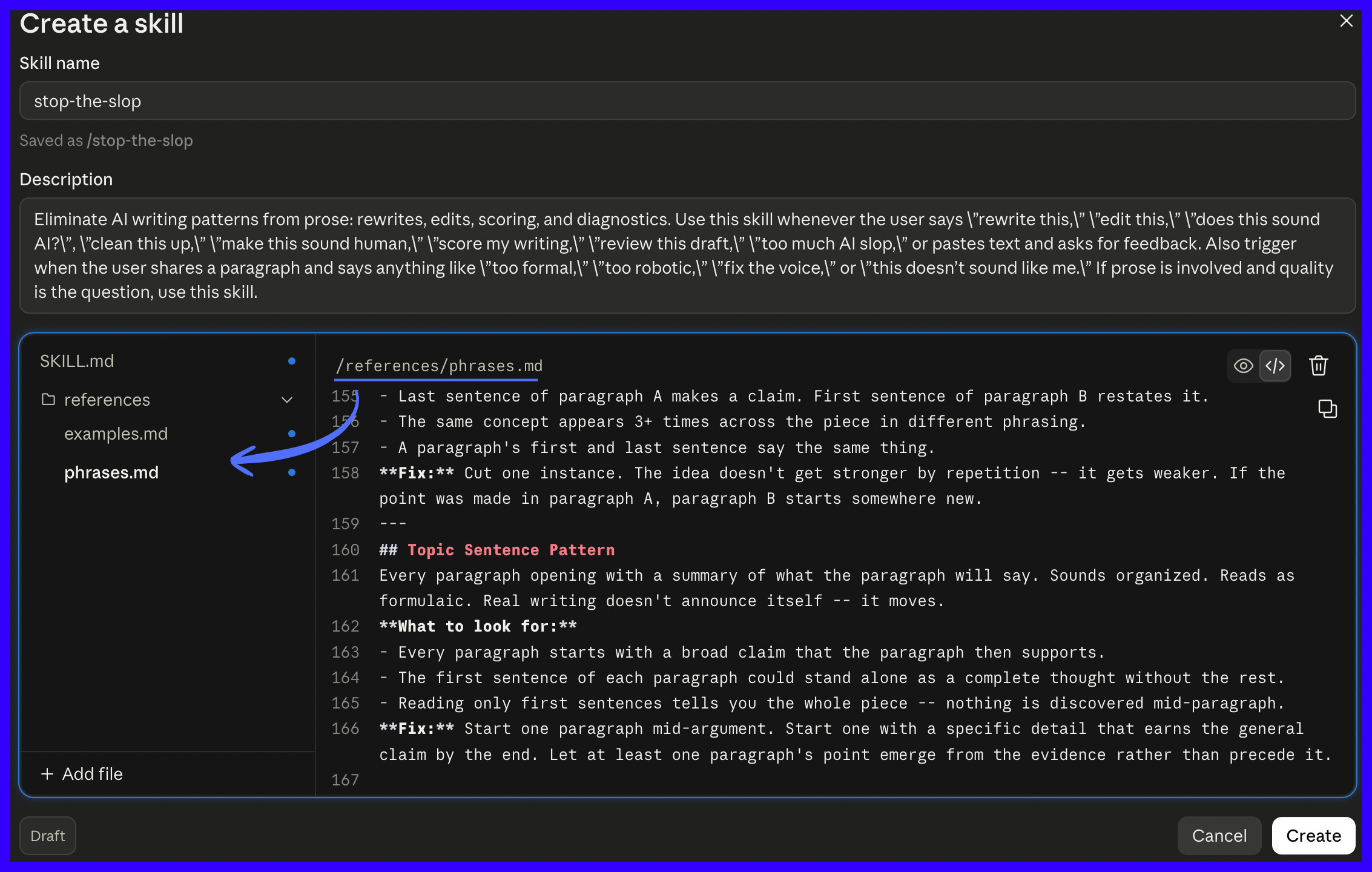
Prompt:
# Phrases to Remove
## Throat-Clearing Openers
Remove these announcement phrases. State the content directly.
- "Here's the thing:"
- "Here's what [X]"
- "Here's this [X]"
- "Here's that [X]"
- "Here's why [X]"
- "The uncomfortable truth is"
- "It turns out"
- "The real [X] is"
- "Let me be clear"
- "The truth is,"
- "I'll say it again:"
- "I'm going to be honest"
- "Can we talk about"
- "Here's what I find interesting"
- "Here's the problem though"
Any "here's what/this/that" construction is throat-clearing before the point. Cut it and state the point.
---
## Emphasis Crutches
These add no meaning. Delete them.
- "Full stop." / "Period."
- "Let that sink in."
- "This matters because"
- "Make no mistake"
- "Here's why that matters"
---
## Business Jargon
Replace with plain language.
| Avoid | Use instead |
|-------|-------------|
| Navigate (challenges) | Handle, address |
| Unpack (analysis) | Explain, examine |
| Lean into | Accept, embrace |
| Landscape (context) | Situation, field |
| Game-changer | Significant, important |
| Double down | Commit, increase |
| Deep dive | Analysis, examination |
| Take a step back | Reconsider |
| Moving forward | Next, from now |
| Circle back | Return to, revisit |
| On the same page | Aligned, agreed |
---
## Adverbs
Kill all adverbs. No -ly words. No softeners, no intensifiers, no hedges.
Specific offenders:
- "really"
- "just"
- "literally"
- "genuinely"
- "honestly"
- "simply"
- "actually"
- "deeply"
- "truly"
- "fundamentally"
- "inherently"
- "inevitably"
- "interestingly"
- "importantly"
- "crucially"
Also cut these filler phrases:
- "At its core"
- "In today's [X]"
- "It's worth noting"
- "At the end of the day"
- "When it comes to"
- "In a world where"
- "The reality is"
---
## Meta-Commentary
Remove self-referential asides. The essay should move, not announce its own structure.
- "Hint:"
- "Plot twist:" / "Spoiler:"
- "You already know this, but"
- "But that's another post"
- "X is a feature, not a bug"
- "Dressed up as"
- "The rest of this essay explains..."
- "Let me walk you through..."
- "In this section, we'll..."
- "As we'll see..."
- "I want to explore..."
---
## Performative Emphasis
False intimacy or manufactured sincerity:
- "creeps in"
- "I promise"
- "They exist, I promise"
---
## Telling Instead of Showing
Announcing difficulty or significance rather than demonstrating it:
- "This is genuinely hard"
- "This is what leadership actually looks like"
- "This is what X actually looks like"
- "actually matters"
---
## Vague Declaratives
Sentences that announce importance without naming the specific thing. Kill these.
- "The reasons are structural"
- "The implications are significant"
- "This is the deepest problem"
- "The stakes are high"
- "The consequences are real"
If a sentence says something is important/deep/structural without showing the specific thing, cut it or replace it with the specific thing.
---
## Second-Generation Tells
These survive the first pass because they don't appear on standard lists. They're subtler than obvious slop but produce the same distance and drift. Look for these after clearing the obvious patterns.
**Lazy connectors** - the writer didn't earn the transition:
- "This means that..."
- "This creates a situation where..."
- "This leads to..."
- "Which means..."
**Conditional filler** - sounds thoughtful, reads as stall:
- "When you X, you Y" (as an opener)
- "If you've ever X, you know Y"
- "For many people..."
- "In many ways..."
**Circling instead of landing:**
- "There's something about X that..."
- "What makes X interesting is..."
- "Part of what makes X work is..."
**Announcing the example instead of giving it:**
- "What this looks like in practice..."
- "Here's an example of that:"
- "To illustrate this point..."
**Moralizing closers:**
- "It's a reminder that..."
- "That's worth remembering."
- "That's the lesson here."
**Performative tension:**
- "And yet."
- "But here's the thing."
- "Except."
(as standalone sentences for dramatic effect)
**Rhetorical pause before stating the obvious:**
- "The result?"
- "The answer?"
- "Why?"
**Generative rule:** These patterns exist because the model is buying time before committing to a specific claim. Any sentence that announces, circles, or pauses before the point is doing this. The fix is always the same: delete the setup and open with the claim.
---
## Opener Uniformity
Scan the first word of every sentence in the piece. If 3+ sentences open with the same word, the writing is patterned. AI defaults to "The", "This", "It", "You", "There" -- rotating through a small set.
**What to look for:**
- 3+ sentences starting with "The"
- 3+ sentences starting with "This"
- Every paragraph opening with "It is" or "There is"
- Consecutive sentences starting with the same word
**Fix:** Restructure openers to start with: a name, a number, a verb, a time reference, a place, a conjunction used intentionally ("But three weeks later..."). Human writers vary entry points. The first word of a sentence is a choice -- make it different each time.
---
## Semantic Repetition
The same idea appearing in different words across paragraphs. AI fills space by restating. A paragraph ends with a conclusion; the next paragraph opens by restating that conclusion as a premise.
**What to look for:**
- Last sentence of paragraph A makes a claim. First sentence of paragraph B restates it.
- The same concept appears 3+ times across the piece in different phrasing.
- A paragraph's first and last sentence say the same thing.
**Fix:** Cut one instance. The idea doesn't get stronger by repetition -- it gets weaker. If the point was made in paragraph A, paragraph B starts somewhere new.
---
## Topic Sentence Pattern
Every paragraph opening with a summary of what the paragraph will say. Sounds organized. Reads as formulaic. Real writing doesn't announce itself -- it moves.
**What to look for:**
- Every paragraph starts with a broad claim that the paragraph then supports.
- The first sentence of each paragraph could stand alone as a complete thought without the rest.
- Reading only first sentences tells you the whole piece -- nothing is discovered mid-paragraph.
**Fix:** Start one paragraph mid-argument. Start one with a specific detail that earns the general claim by the end. Let at least one paragraph's point emerge from the evidence rather than precede it.
Why it works: The fingerprint prompt helps Claude identify its own writing patterns, recurring phrases, and sentence structures, then explicitly tells it to avoid them when rewriting your text.
3. The Blueprints.
This is the last file to copy and paste: references/structures.md
The Last File: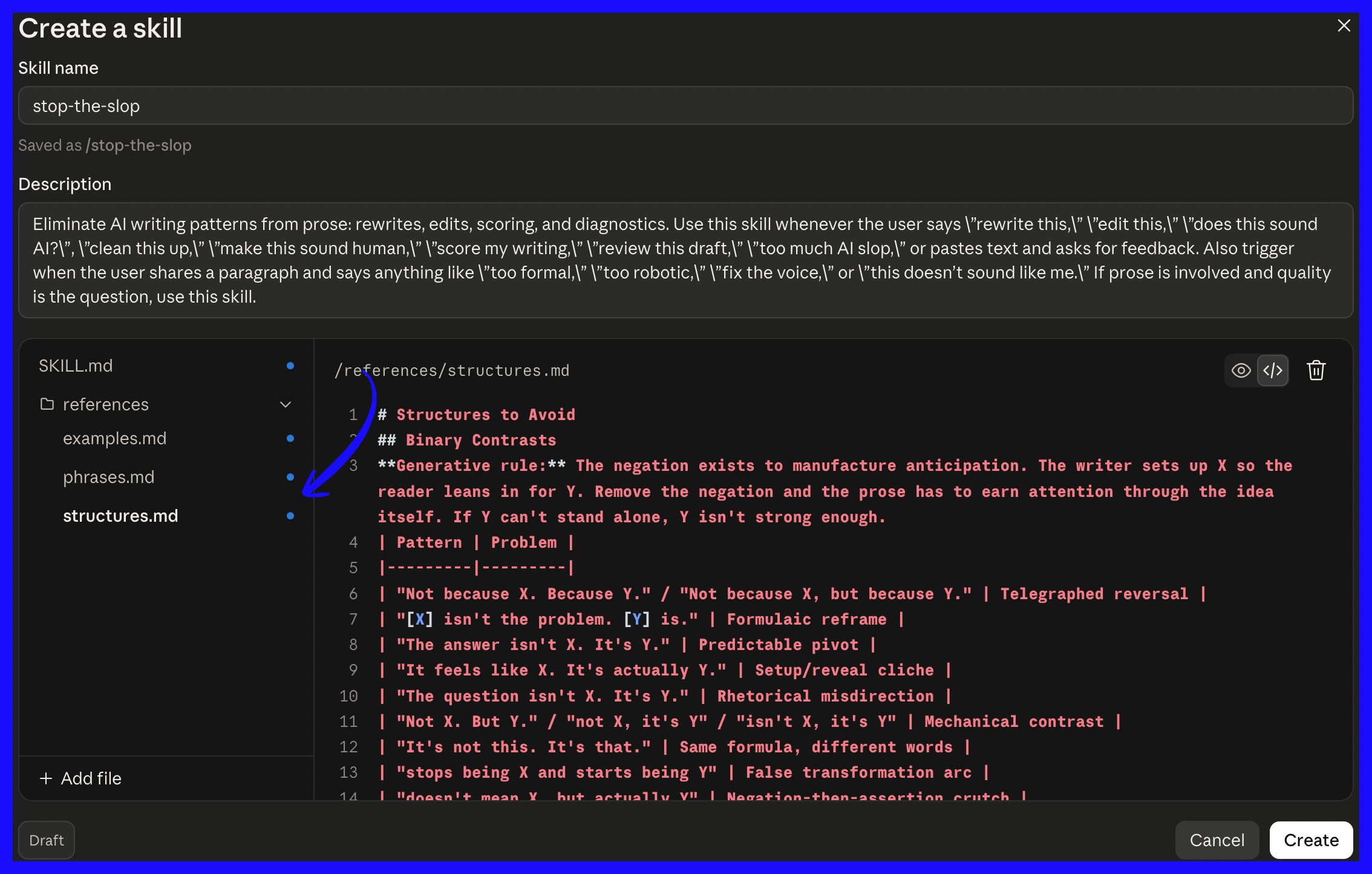
Copy-paste prompt:
# Structures to Avoid
## Binary Contrasts
**Generative rule:** The negation exists to manufacture anticipation. The writer sets up X so the reader leans in for Y. Remove the negation and the prose has to earn attention through the idea itself. If Y can't stand alone, Y isn't strong enough.
| Pattern | Problem |
|---------|---------|
| "Not because X. Because Y." / "Not because X, but because Y." | Telegraphed reversal |
| "[X] isn't the problem. [Y] is." | Formulaic reframe |
| "The answer isn't X. It's Y." | Predictable pivot |
| "It feels like X. It's actually Y." | Setup/reveal cliche |
| "The question isn't X. It's Y." | Rhetorical misdirection |
| "Not X. But Y." / "not X, it's Y" / "isn't X, it's Y" | Mechanical contrast |
| "It's not this. It's that." | Same formula, different words |
| "stops being X and starts being Y" | False transformation arc |
| "doesn't mean X, but actually Y" | Negation-then-assertion crutch |
| "is about X but not Y" | False distinction |
| "not just X but also Y" | Additive hedge |
**Fix:** State Y directly. "The problem is Y." Drop the negation entirely.
---
### Exception: Earned Narrative Contrast
Not all contrast is hollow. The rules above target contrast used as a substitute for content -- where the structure is the point. When contrast reveals a genuine shift in understanding, it earns its place.
**The test:** Remove the negation. Does Y still stand on its own as a real claim?
- Hollow: "Not because the tech is complex. Because people are complex." Remove the negation: "People are complex." That's a generic assertion. Nothing was revealed. The contrast was the whole move.
- Earned: "I used to think my job was to sell houses. Now I know I'm selling peace of mind." Remove the before: "I'm selling peace of mind." That's a real, specific reframe. The before makes it land harder, but the insight exists without it.
**What makes contrast earned:**
- The "before" contains a real prior belief the writer actually held, not a straw man set up to be knocked down
- The "after" is specific enough to stand alone -- it's not just "the opposite of the before"
- The contrast reveals a shift in understanding, not just a rhetorical shape
- The writer could name the moment or experience that caused the shift
**Before/after structure in narrative writing** -- showing how something changed -- is a different category than binary contrast. "I used to X. Then Y happened. Now I Z." is a timeline with meaning attached. It is not the same as "Not X. It's Y." The first moves through time. The second just negates.
**Flag hollow contrast. Pass earned contrast.**
---
## Negative Listing
**Generative rule:** Listing what something is not is a rhetorical striptease -- the writer builds suspense through withholding. It feels clever. It reads as stall. The reader doesn't need the runway. Give them Z.
| Pattern | Problem |
|---------|---------|
| "Not a X... Not a Y... A Z." | Dramatic buildup through negation |
| "It wasn't X. It wasn't Y. It was Z." | Same structure, past tense |
**Fix:** State Z. Cut everything before it.
---
## Dramatic Fragmentation
**Generative rule:** Fragments signal the writer believes the presentation of an idea is more interesting than the idea itself. It's a substitute for substance. Complete sentences force the claim to carry its own weight.
| Pattern | Problem |
|---------|---------|
| "[Noun]. That's it. That's the [thing]." | Performative simplicity |
| "X. And Y. And Z." | Staccato drama |
| "This unlocks something. [Word]." | Artificial revelation |
**Fix:** Complete sentences. Trust content over presentation.
---
## Rhetorical Setups
**Generative rule:** These announce insight rather than deliver it. The model is performing the shape of a smart thought -- the pause, the pivot, the reveal -- without committing to the thought. Any sentence that tells the reader how to feel about what's coming is doing this.
| Pattern | Problem |
|---------|---------|
| "What if [reframe]?" | Socratic posturing |
| "Here's what I mean:" | Redundant preview |
| "Think about it:" | Condescending prompt |
| "And that's okay." | Unnecessary permission |
**Fix:** Make the point. Let readers draw conclusions.
---
## Formulaic Constructions
| Pattern | Problem |
|---------|---------|
| "By the time X, I was Y." | Narrative template |
| "X that isn't Y" | Indirect. Say "X is broken" |
---
## False Agency
**Generative rule:** AI avoids naming actors because naming requires commitment. "The decision emerged" implicates nobody. "Sarah decided on Friday" implicates someone. Vague subjects feel safer. Any time an inanimate thing performs a human action, a person has been hidden. Find them.
| Pattern | Problem |
|---------|---------|
| "a complaint becomes a fix" | The complaint did nothing. Someone fixed it. |
| "a bet lives or dies in days" | Bets don't have lifespans. Someone kills the project or ships it. |
| "the decision emerges" | Decisions don't emerge. Someone decides. |
| "the culture shifts" | Cultures don't shift on their own. People change behavior. |
| "the conversation moves toward" | Conversations don't move. Someone steers. |
| "the data tells us" | Data sits there. Someone reads it and draws a conclusion. |
| "the market rewards" | Markets don't reward. Buyers pay for things. |
**Fix:** Name the human. "The team fixed it that week" beats "the complaint becomes a fix." If no specific person fits, use "you" to put the reader in the seat.
---
## Narrator-from-a-Distance
**Generative rule:** The model floats above the scene because specificity requires commitment to a particular vantage point. "Nobody designed this" sounds observational and wise. It's actually evasion -- the writer refuses to put anyone, including the reader, in the room. Specificity collapses distance.
| Pattern | Problem |
|---------|---------|
| "Nobody designed this." | Disembodied observation |
| "This happens because..." | Lecturer voice |
| "This is why..." | Same |
| "People tend to..." | Armchair sociologist |
**Fix:** Put the reader in the room. "You don't sit down one day and decide to..." beats "Nobody designed this."
---
## Passive Voice
**Generative rule:** Passive voice hides the actor and drains energy. Every sentence needs a subject doing something. The actor belongs at the front.
| Pattern | Fix |
|---------|-----|
| "X was created" | Name who created it |
| "It is believed that" | Name who believes it |
| "Mistakes were made" | Name who made them |
| "The decision was reached" | Name who decided |
---
## Sentence Starters to Avoid
| Pattern | Fix |
|---------|-----|
| Sentences starting with What, When, Where, Which, Who, Why, How | Restructure. Lead with the subject or the verb. |
| Paragraphs starting with "So" | Start with content |
| Sentences starting with "Look," | Remove |
Wh- openers become a crutch. "What makes this hard is..." becomes "The constraint is..." or better, name the specific constraint.
---
## Rhythm Patterns
| Pattern | Fix |
|---------|-----|
| Three-item lists | Use two items or one |
| Questions answered immediately | Let questions breathe or cut them |
| Every paragraph ends punchily | Vary endings |
| Em-dashes | Remove. Use commas or periods. No em dashes at all. |
| Staccato fragmentation | Don't stack short punchy sentences |
| "Not always. Not perfectly." | Hedging disguised as reassurance |
---
## Word Patterns
| Pattern | Problem |
|---------|---------|
| Lazy extremes (every, always, never, everyone, everybody, nobody) | False authority. Use specifics instead of sweeping claims. |
| All adverbs (-ly words, "really," "just," "literally," "genuinely," "honestly," "simply," "actually") | Empty emphasis. See phrases.md for full list. |
Why it works: The blueprint prompt targets generic AI writing patterns, not just tone or voice. It tells Claude to avoid predictable LLM structures like “not X, but Y,” repetitive sentence patterns, and other writing habits that make AI-generated text sound robotic.
Whats Next:
Once you’re done, hit the create button.
Now, whenever you want Claude to rewrite something, just type ‘rewrite this’ and let the skill do its thing.
P.S. let me know if you’re interested in adding your brand DNA to the skill.
Hope this helps.
Mr.V