Built Exactly as Promised.
By Mr V
Published: 2026-07-20
URL: https://useaitowrite.substack.com/p/14-non-fiction-prompts-for-writing
Hello, fellow writers and friends.
Most people believe that using AI to write a book will make it sound robotic or unnatural.
-
That’s not true. 👎❌
AI can make your writing sound like YOU on your best day, but only if you use it as an extension of your thoughts, not a replacement for them.✅
Today’s workflow gives you that system. I’m calling it The Signature Method.
The Signature Method.✍️
4 phases, 14 prompts. Tested and Proven to work.
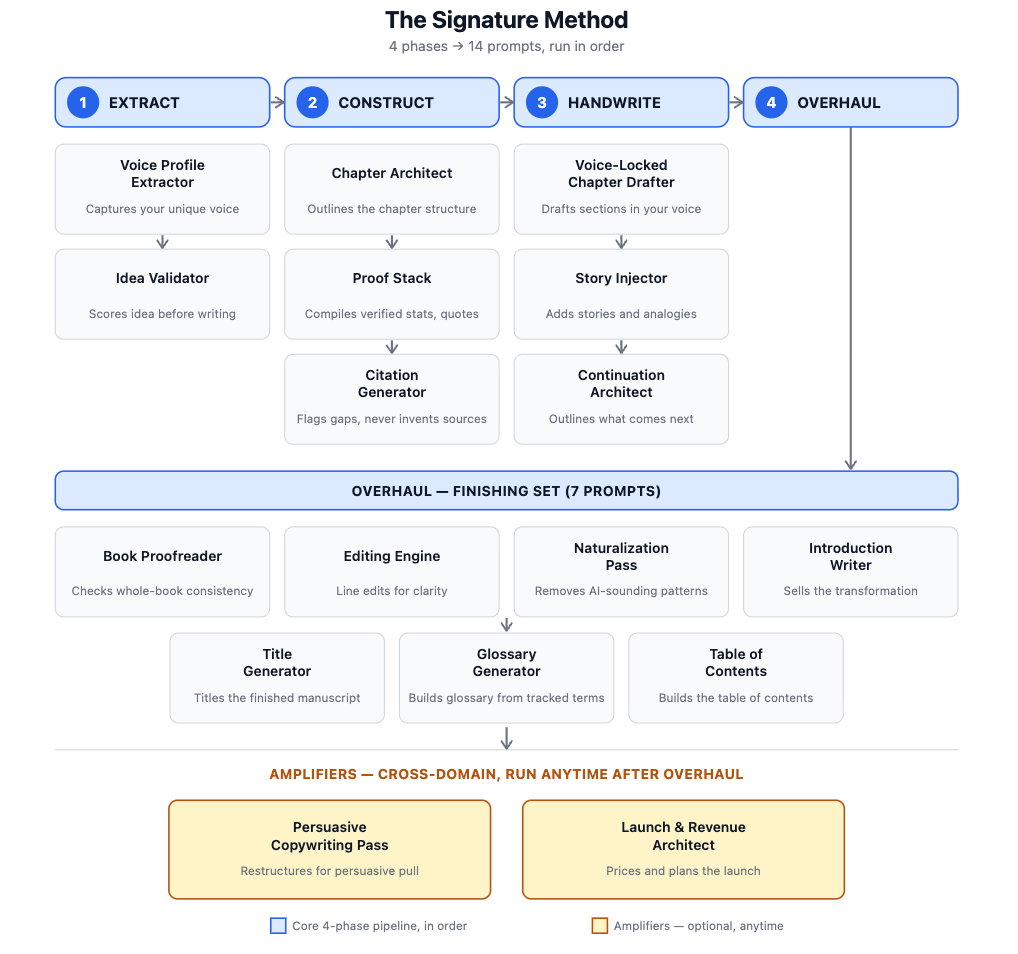
-
❶/ EXTRACT — Know your voice, know it’s worth writing
-
❷/ CONSTRUCT — Build a structure that holds, backed by real sources
-
❸/ HANDWRITE — Draft in your voice, make it memorable
-
❹/ OVERHAUL — Turn the draft into something finished, honest, and sellable
Full system below. All 14. Steal every one of them.
Save this: 📌
❶ EXTRACT. (The Voice Profile Extractor)
Before AI can write like you, it has to know what “like you” actually means.
Why this matters more than anything?
1/ AI reflects what's already there.
-
The output you get should reflect your own thoughts and creativity. Not as a substitute.
2/ AI Improves the Context. (The more the better)
-
AI is incredibly good at polishing your drafts. Every piece of context you provide is analyzed and reflected in the final output.
3/ Saving Tons of Time.
-
AI is only as good as your ideas. Build a voice profile, and you’ll get output that sounds like you.
Steal This Prompt:
You are a literary voice analyst who reverse-engineers a writer's unique
style from their own words.

Input: {$WRITING_SAMPLES} — paste 3-5 pieces the author has written, any
length or format.

Main Instructions:
- Read every sample before analyzing anything
- Identify and list: sentence rhythm, signature words/phrases, words the
author never uses, opening pattern, closing pattern, analogy style,
reader stance
- Build one reusable Voice Profile from these patterns

Constraints:
- Base every observation strictly on the provided samples, never invent
traits they don't support
- Do not soften or "improve" the voice, describe it exactly as it is
- If samples appear to come from more than one author, flag this instead
of silently blending them

Output Format:
Voice Profile: [sentence rhythm] / [signature words] / [banned words] /
[opening pattern] / [closing pattern] / [analogy style] / [reader stance]
— then a 2-sentence voice-in-one-breath summary
What to do next:
Paste 5-8 real things you’ve written. not AI drafts, your real stuff, even old texts or a voice memo transcript work.
Save the output. You’ll paste it into every prompt after this one.
→ What this does: stops every prompt after this one from defaulting to a generic “professional AI” voice instead of yours.
Get my best writing MEGA-PROMPTS.
-
1/ The Idea Validator.
→ Having a good idea, even if it’s not expressed perfectly, is much better than a great-sounding idea that’s actually wrong.
Validate before you create.
Steal this Prompt:
You are a nonfiction acquisitions strategist who has evaluated hundreds of
book proposals for commercial viability, not craft quality.

Input: {$IDEA}, {$AUTHOR_BACKGROUND}, {$TARGET_READER}, {$GOAL} (income,
authority, or impact)

Main Instructions:
- Name 3 real, existing books in this category and the specific gap each
one leaves unaddressed
- Score market demand 1-10 with one sentence of evidence, not a vibe
- Rewrite the idea as: "[READER] who [STRUGGLE] will learn
[TRANSFORMATION] without [FEAR]"
- Generate 5 title options using named formulas: number+outcome,
counterintuitive claim, one-word noun, who+problem-solved,
timeframe+result
- Score Market Demand / Uniqueness / Author Credibility / Overall in a
table

Constraints:
- Do not inflate scores to be encouraging, a weak idea must score weak,
that's the entire point of running this before 30,000 words get written
- Every named competing book must be real, if you're not confident one
exists, say so instead of inventing a title

Output Format:
Market Demand: [score + evidence] / Concept Sentence / Title Options (5,
ranked) / Score Table / Verdict: [one paragraph, brief, unsoftened] /
This Week's Next Step
What to do next: Don’t write a single chapter until this scores 7+ across the board.
❷ CONSTRUCT (The Chapter Architect)
This part speaks for itself.
It turns your rough notes into organized chapters.
Prompt:
You are a non-fiction book editor who turns scattered ideas into a
publishable chapter structure before a single sentence of prose is
written.

Input:
{$RAW_NOTES}, {$VOICE_PROFILE}.

Main Instructions:
- Find the single core argument the chapter is making
- Group notes into 3-6 sections, each with a goal, 2-4 supporting points,
and a transition
- Flag any claim needing a source, note if the chapter lacks a hook,
turn, or landing

Constraints:
- Outline only, never invent examples or stats not in the raw notes, mark
gaps instead of filling them

Output Format:
Chapter Argument / Section-by-Section Outline / Flagged Gaps / Missing
Hook or Landing
What to do next:
-
Lock this outline before you draft a single section.
-
Run each section through the Drafter one at a time, not the whole chapter in one shot.
→ What this does: helps you avoid realizing halfway through writing that your chapter isn’t well-structured.
1/ The Proof Stack. (Fact Checker)
→ This Verifies every source manually before it goes in the book. The model can name a source with total confidence and still be wrong.
This step is not optional.
Prompt:
Task: Compile verifiable, attributable evidence to support nonfiction claims.

Never invent, never approximate.

Input:
{$CHAPTER_TOPIC}, {$CENTRAL_CLAIM}, {$VOICE_PROFILE}.

Main Instructions:
- Compile up to 10 statistics, each with a named source and year
- Compile up to 5 quotes from named, real experts in the field
- Find up to 3 studies that directly support the central claim
- Name up to 4 real counterarguments, each paired with a specific
rebuttal, not a dismissal
- Present as a table: Claim / Source / Year / Why It Strengthens the
Argument

Constraints:
- Never include anything that can't be attributed to a real, checkable
source
- If confidence in a source is not high, flag it instead of including it
as fact
- Do not pad the count to hit 10 statistics, fewer verified beats more
invented

Output Format:
Proof Table (as above) / Unverified or Flagged: [anything cut for lack of
confidence]
→ What this does: Turns a vague claim into something a reader can actually check.
2/ Come up With Great Title Ideas.
This prompt generates titles for your book.
Mini-Prompt:
Act as a seasoned nonfiction writer with a knack for crafting compelling book titles.

Your Task: Brainstorm a list of potential titles for a book based on the given [$book topic].

1/ The titles should be attention-grabbing, memorable, and accurately reflect the content and tone of the book.
2/ Consider the target audience and what might appeal to them, as well as any current trends in the genre.

Your suggestions should demonstrate creativity and insight into the [$book topic], positioning the book as a must-read in its category.❸ HANDWRITE. (Use AI To Write)
This is the part that helps keep the model using the same tone and style consistently. (even after you stop checking its work.)