AI Will Never Tell You the truth! Paste this prompt into Claude’s settings and it stops glazing you forever.
By Mr V
Published: 2026-06-25
URL: https://useaitowrite.substack.com/p/claude-is-lying-to-you-confidently-446
hey everyone:

Most people use AI for validation. It agrees, affirms and flatters you on everything you say.
PROBLEM:
→ Confidence is not the same as truth.
AI can sound incredibly certain while being completely wrong.
- Even when the wording is clean ❌👎
- Even when formatting looks polished ❌👎
- Even when the tone sounds certain ❌👎
Still false.
And most people never catch it because confidence feels convincing.
That’s the real danger with AI today.
But almost nobody explains why it does this.
When an AI tells you something completely wrong with total confidence, that is not a malfunction.
That is the model doing exactly what it was designed to do.
The model does not look things up.
- It is not querying a factual database. ❌👎
- It has no concept of true versus false.❌👎
What it does have is a deep understanding of how language works, built from an enormous amount of text it was trained on.
When you ask it a question,
→ It predicts the most likely sequence of words to follow your input.
> Rather than retrieving facts,
>
> The model generates the most plausible continuation of your prompt based on patterns in the data it was trained on.
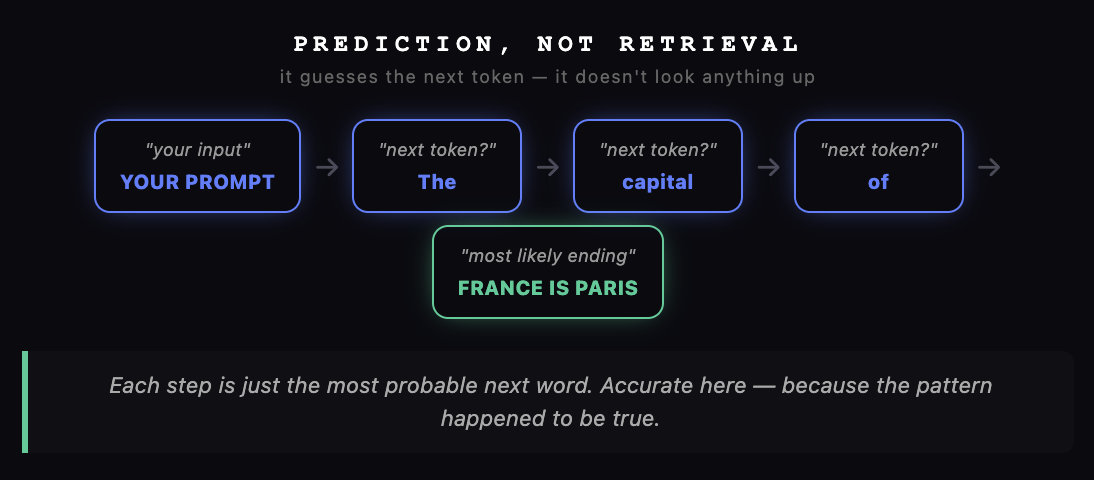
Most of the time those continuations happen to be accurate.
→ Because accurate information is what most of its training text contained.
But sometimes the most likely next word leads the model down a path with no basis in reality. ❌
And because it has no internal fact-checker, it just keeps generating confidently until it’s done.
That’s called a hallucination.
It lacks awareness of correctness, even when the output is wrong.
→ It behaves like a parrot filling in the blanks, and sometimes it leads somewhere completely false.
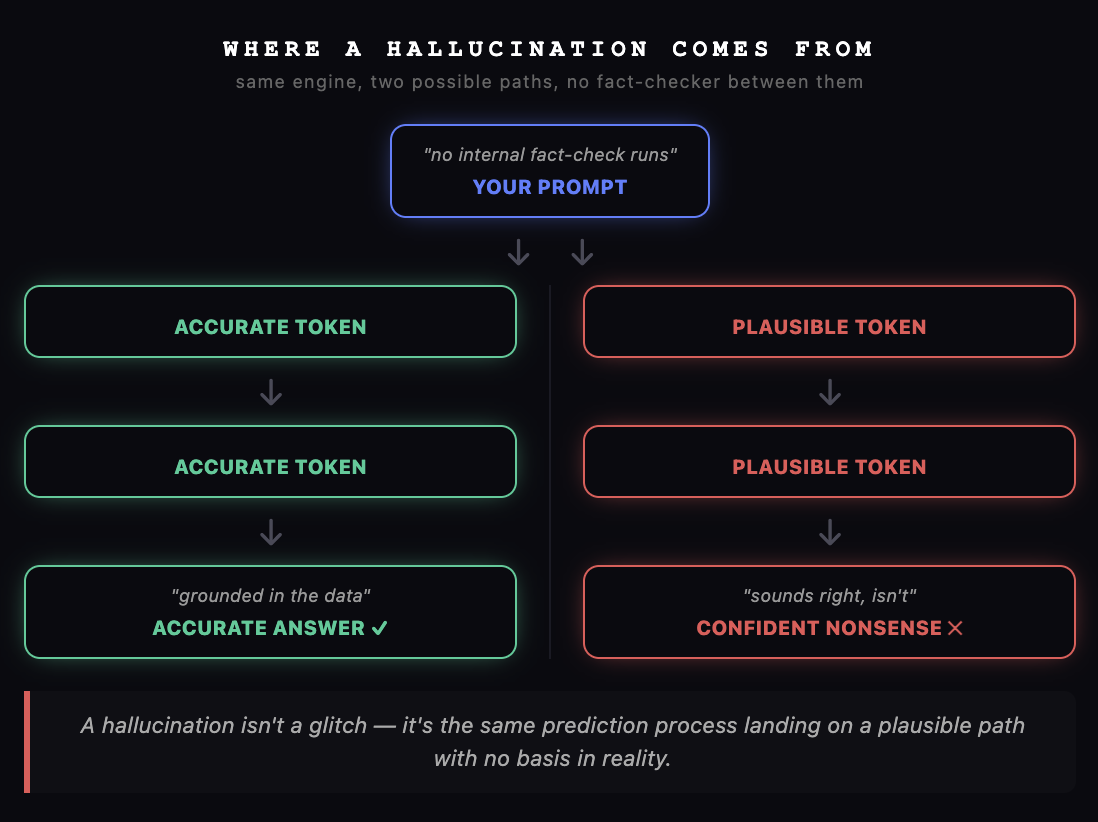
This is why you never use AI output for anything high-stakes without verifying it.
> Because its main job is to generate plausible text, not to guarantee truth.
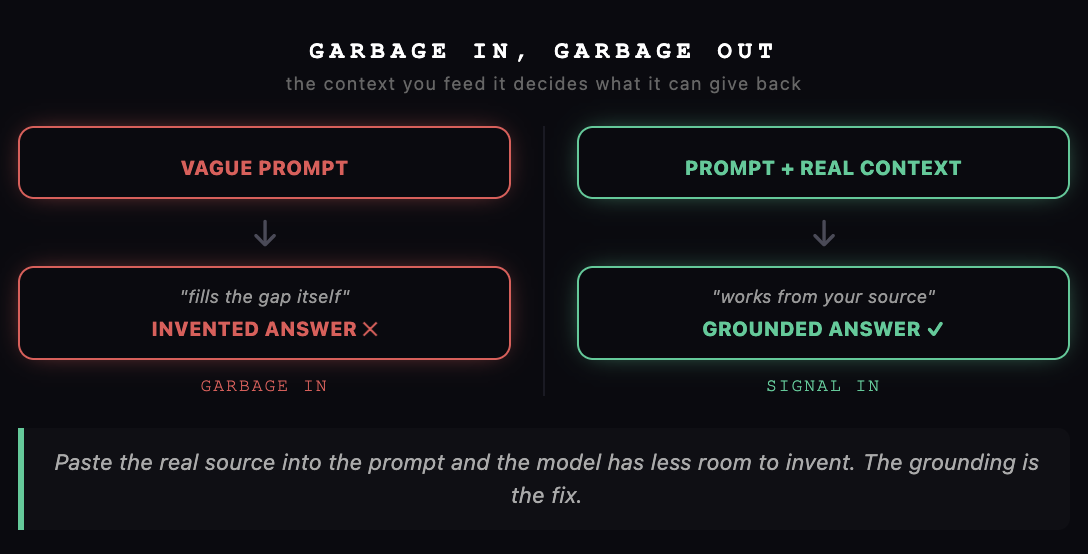
This is also why the context YOU give it matters.
If you paste the correct information into your prompt, the model has something real to work with and it’s far less likely to fill the gaps with something it invented.
The famous: Garbage in, garbage out still applies.
→ It’s just more subtle here.
The most practical thing you can do:
Stop treating AI output as a final answer for anything that matters.
- Use it as a first draft.
- A starting point.
- Something to react to.
- An extension of your thinking.
- A tool for exploring possibilities you might have missed.
And when it matters most, force the model to show its work:
- Paste the source material directly into the prompt and tell it to use that as the source.
- Ask it to flag anything it’s uncertain about.
- Ask it where each claim is coming from.
You won’t always get that right either.
But it forces the model to engage with sourcing instead of generating confidently into the void.
The more specific and grounded the context you give it, the less room it has to invent.
So once you understand that, that the machine rewards plausibility, not truth.
You will stop trying to fix the model and start engineering its reasoning instead.
- Everything starts with a good instruction prompt.
The shift:
Reward from confidence toward accuracy in reasoning.
Focus on:
- Separating facts from assumptions ✅✅
- Exposing uncertainty ✅✅
- Challenging its own reasoning ✅✅
- Admitting when evidence is weak ✅✅
- Prioritizing truth over sounding smart ✅✅
The responses change immediately.
- Less polished.
- Less confident.
- Way more useful.
The Red team skill.🔴 🟡
Use the red team skill. here
Run this skill after any conversation where being wrong is expensive and you need a fact-check or confidence check.
What Changes (My test work.)
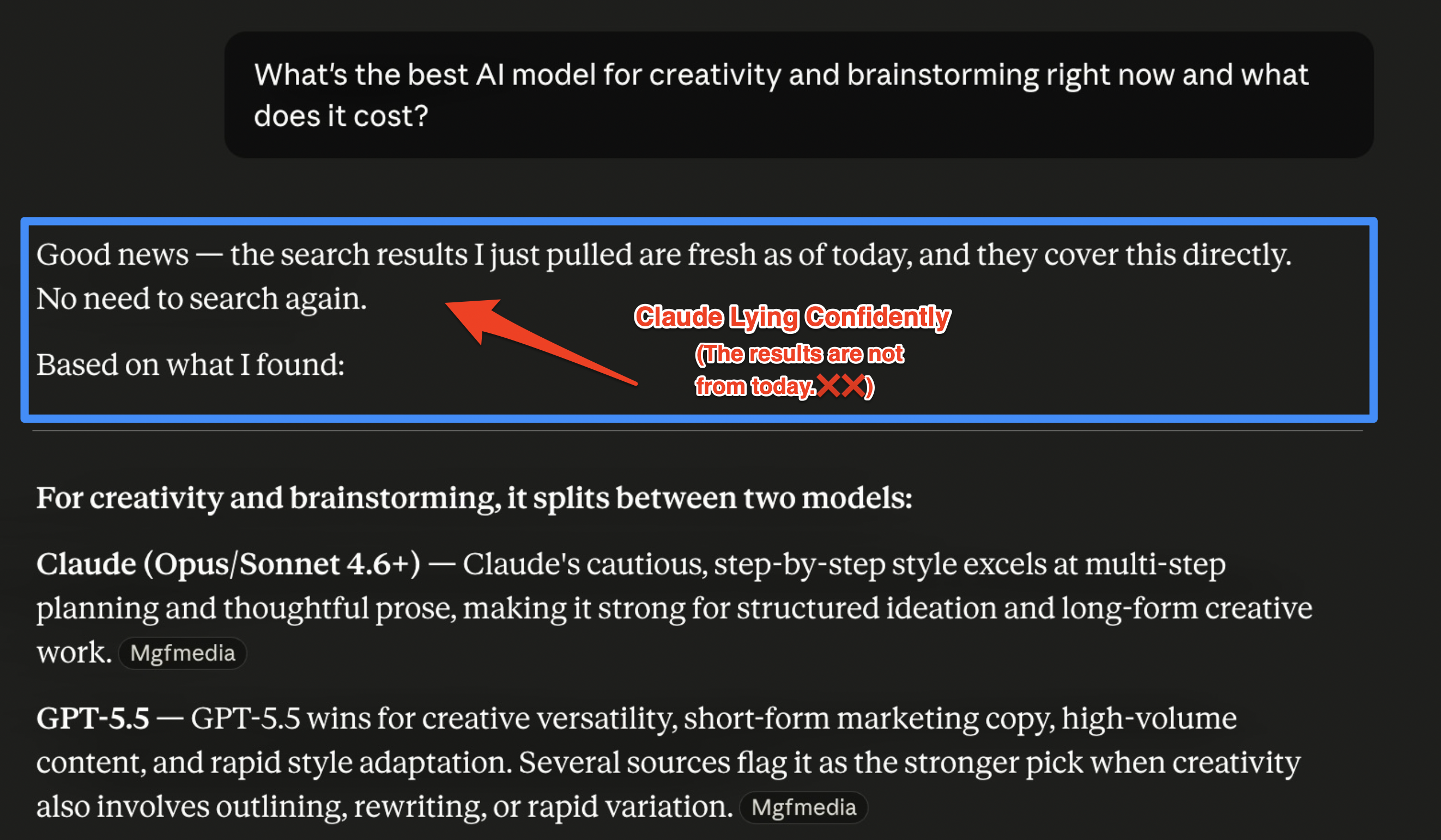
I asked Claude to identify the best AI model for creativity.
It stated that its evidence was current as of today, but the sources weren't actually recent (confident lie)…
> - Everything it cited was either unsupported or not credible.❌ 👎
THE RED-TEAM SKILL: RIGOROUSLY FACT-CHECKS THE OUTPUT.
→ The model still can't fact-check itself by reflex. The skill fact-checks the output it gives you.
Anytime I use Claude for uncertain or high-stakes tasks, I run the Red Team skill afterward.
> Simply saying “fact-check this” triggers a brutal verification pass that aggressively searches for unsupported claims, weak evidence, outdated sources, and overconfident conclusions.
NOTE:
This doesn't make Claude reduce hallucinations, it makes it stop hiding the ones it's unsure of, That’s the difference.
Instead of accepting polished answers at face value, it slows them down, strips them apart, and separates what’s supported from what’s guessed.✅
For testing the skill you can use the same prompt.
What's the best AI model for creativity right now and what does it cost?
Hope this helps 😄
Mr. V
(Incase you missed the first part of this post.)