Twelve skills, one enterprise workflow, and the evidence to show you can deploy it responsibly.
By Youssef Hosni
Published: 2026-10-24
URL: https://todatabeyond.substack.com/p/a-practical-roadmap-to-forward-deployed
Forward Deployed Engineering is becoming a more visible career path in enterprise AI, with companies such as OpenAI, Anthropic, Palantir, and Cursor hiring for the role.
As businesses move from AI experiments to production deployments, they need engineers who can understand customer problems, integrate models with existing systems, and make those solutions reliable enough for everyday use.
This article explains what the role involves and how to start building the skills it requires. It covers twelve areas through a practical roadmap, with suggested resources and a running project that connects customer discovery, implementation, evaluation, and operational handoff.
Table of Contents:
-
Why enterprises need Forward Deployed Engineers now
-
Define the workflow and the acceptance criteria
-
Preserve identity and data permissions throughout the workflow
-
Make integrations and approvals safe to resume
-
Fit deployment and inference to the customer
-
Demonstrate value and transfer operational ownership
Check out my latest book, Prompt Engineering 2.0 is out. Learn to prompt agents, build agent skills, and build reliable agent loops.
50% Discount for To Data & Beyond paid subscribers.
1. Why enterprises need Forward Deployed Engineers now
If I were building a career in enterprise AI, I’d take Forward Deployed Engineering seriously. An enterprise can have access to a capable model and still need substantial engineering work before it can use that model in a business process. Someone has to understand the workflow, connect the relevant systems, define permissions, evaluate the results, and help the customer operate what gets built.
That combination of customer-facing work and implementation is central to the FDE role. OpenAI’s description places discovery, technical scoping, system design, development, and production rollout within the same position. The engineer works with customer engineering and domain teams, then feeds lessons from deployments back into the product organization. This gives the role responsibility across the path from an initial problem to a working deployment.
Why the role matters now. For an enterprise evaluating agents, the work extends beyond generating a useful answer. An invoice-review assistant needs access to purchase orders, a reliable interpretation of procurement rules, and a way to stop when evidence is missing. If it can update a business system, it also needs authorization checks, approval flows, and recovery from failed or ambiguous writes. These are the deployment requirements we will use throughout this roadmap.
Current hiring descriptions reflect that emphasis on implementation. Anthropic’s FDE listing includes building production applications within customer systems and delivering artifacts such as MCP servers, sub-agents, and agent skills. Palantir’s Forward Deployed AI Engineer listing similarly combines customer AI strategy with implementing workflows and taking them into production. My reading of these descriptions is that employers want engineers who can make technical choices in the context of a customer’s actual operating constraints.
There is also a concrete investment in developing these skills. On 2 October 2026, Anthropic announced Claude Frontier Academy, committing $100 million with the goal of training 10,000 engineers by the end of 2027. Its program includes simulated enterprise deployment and a residency on a project inside the participant’s organization. That is an announced training target, not a count of available jobs, but it shows how the company is approaching the implementation skills gap.
Related titles to search for. Job titles vary, and I would read the responsibilities before deciding whether a position fits this career direction. Useful search terms include Forward Deployed Engineer, Forward Deployed AI Engineer, Applied AI Engineer, AI Adoption Engineer, Field Engineer, and Solutions Architect. Some positions emphasize production coding; others place more weight on architecture, technical enablement, or helping teams adopt a product.
“AI Adoption Engineer” is a documented title: Langdock’s published role description combines use-case discovery, implementation, integrations, and customer enablement. I would use “adoption” in a job search rather than assume “adaptation engineer” is a standard equivalent. This Langdock listing is an example of the terminology, not a verified current vacancy. Meanwhile, Anthropic’s careers page lists Applied AI Engineer and Applied AI Architect positions, and Cursor’s careers page separates FDE, Field Engineer, Solutions Architect, and AI Deployment Manager roles.
The following official employer pages listed openings when checked. Availability can change, so use the linked posting to confirm the role and location before applying.
-
OpenAI — Forward Deployed Engineer, San Francisco: Own customer deployments from discovery through rollout, with success tied to adoption and workflow impact.
-
Anthropic — Forward Deployed Engineer, London: Build Claude applications within customer environments and contribute reusable deployment patterns.
-
Palantir — Forward Deployed AI Engineer, London: Work directly with customers on generative AI strategy and production workflows.
-
Cursor — Forward Deployed Engineer and related roles: The careers page lists FDE openings in locations including London, San Francisco, and New York, alongside Field Engineer and AI Deployment Manager positions.
These examples establish that companies are recruiting for this work; they do not establish a market-wide growth rate or guarantee employment. For a candidate, I would look for roles that let you own implementation, work directly with users, and measure what happens after deployment. Ask how much time goes into coding, customer discovery, enablement, travel, and ongoing support, because similar titles can lead to very different working weeks.
Build evidence that you can take a customer workflow from discovery to a reliable, adopted deployment; use job titles as search terms and responsibilities as the selection criteria.
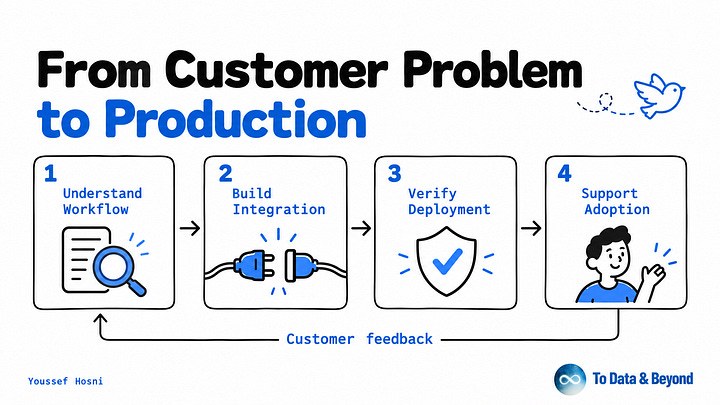 Figure 1 — FDE work connects customer discovery, implementation, verification, and adoption. Feedback from a deployed workflow informs the next iteration.
Suggested readings and resources
-
OpenAI — Forward Deployed Engineer role — Use the responsibilities as a checklist for the delivery experience your portfolio should demonstrate.
-
Anthropic — Claude Frontier Academy announcement — Read how the program connects deployment practice, assessment, and a project within an organization.
-
Cursor — Careers — Compare the titles and team placements of FDE, field engineering, solutions architecture, and deployment roles before choosing a specialization.
I would organize the learning around one project: an invoice-review assistant that checks invoice details against purchase orders, retrieves relevant procurement policies, and prepares an action for an authorized reviewer. This is a proposed portfolio project, not a report of a completed deployment. Its purpose is to expose the engineering decisions behind the twelve skills in this roadmap.
The stages below are a learning sequence, not a requirement to master every technology before starting. I assume you can already build and test a small application, work with a database, and use version control. Begin with a read-only workflow and deepen the implementation as its requirements become clearer; use synthetic documents until you have explicit permission to use customer data.
2. Define the workflow and the acceptance criteria
Start by observing how an invoice moves through the organization: who receives it, which system holds the purchase order, how discrepancies are investigated, and who can authorize the next action; interview both the process owner and the person handling exceptions. Ask for examples of successful cases, rejected cases, and cases that required someone to work outside the documented process.
Turn those observations into a bounded first release. For this project, I would propose extracting invoice fields, finding the corresponding purchase order, and showing discrepancies with supporting evidence. Keep payment execution outside the initial scope. Write down the input, permitted outputs, responsible reviewer, fallback path, and the conditions under which the assistant must stop and ask for help.
Measure the current workflow before promising an improvement. Separate hands-on review time from elapsed time spent waiting for information or approval, and record how often cases need correction. If the customer’s main delay comes from missing purchase orders, faster text generation may have little effect on completion time. The scope should explain which part of the delay the proposed system can influence.
Evaluations on customer data. Build the acceptance set during discovery, while the customer can still clarify what a correct outcome means. Include ordinary invoices, poor scans, missing references, contradictory policies, and users with different access permissions. Keep a separate held-out set for evaluating changes, and avoid placing near-duplicate documents from the same case on both sides of the split.
Use deterministic checks for amounts, identifiers, required fields, and prohibited actions. Reserve model-based grading for judgments such as whether an explanation is supported by the available evidence, and compare those grades with expert reviewers. Anthropic’s evaluation guidance describes the different roles of code-based, model-based, and human graders, including the need to calibrate model judgments against human assessments.
Agree on rollout criteria before optimizing the system. I would report extraction errors, supported-answer quality, appropriate escalations, and authorization failures separately, rather than hide them inside one accuracy score. Treat an observed unauthorized disclosure or write as a release blocker for this project; passing the test suite is evidence about the cases tested, not proof that every possible failure has been eliminated.
Define the evidence needed for rollout during discovery, while the customer is helping you decide what success means.
AI Courses Bundle with 40% Discount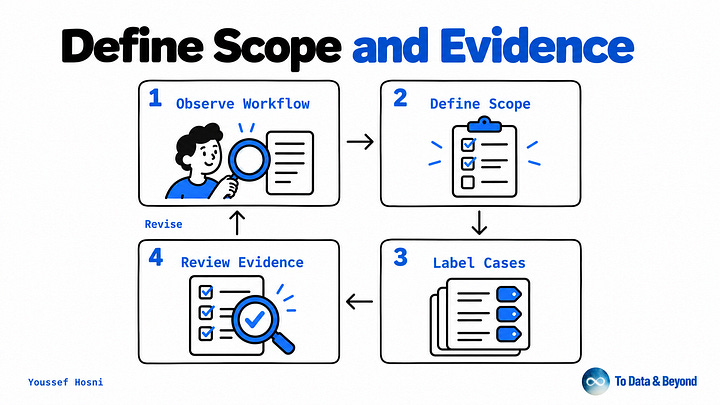 Figure 2. Discovery should produce both a bounded workflow and the evidence used to decide whether it is ready for rollout.
Deliverable and readiness check. Produce a short deployment brief, a labeled evaluation set, and a baseline measurement plan. You should be able to explain which user benefits, what the system is allowed to do, and how a reviewer will determine whether it worked. If those answers change depending on who you ask, resolve the disagreement before expanding the implementation.
Suggested readings and resources
-
GOV.UK — How the discovery phase works — Start here for problem framing, understanding users and constraints, and deciding whether a project should proceed.
-
Anthropic — Demystifying evals for AI agents — Use the sections on evaluation structure and graders to turn customer examples into test cases with explicit success criteria.
-
Microsoft — AI agent orchestration patterns — Read “Start with the right level of complexity” before deciding whether the workflow needs a direct model call, a single agent, or multiple agents.
3. Preserve identity and data permissions throughout the workflow
Next, learn the responsibilities behind OAuth 2.0, OIDC, SAML, SCIM, RBAC, and tenant isolation before choosing an identity integration. OIDC adds end-user authentication on top of OAuth 2.0, while SCIM defines operations for managing identity resources such as users and groups. Federation, provisioning, and application authorization need to fit together, but solve different parts of the workflow.
For the capstone, integrate with a test identity provider such as Okta or Microsoft Entra ID, then enforce permissions in the backend. Derive the user and tenant from validated identity context, and check access for every protected resource and action. Test a user who can view an invoice but cannot approve it, a user from another tenant, and a user whose access has been removed.
Build a document pipeline that preserves the original invoice, extracted values, and the location of the supporting text. Learn OCR, parsing, database connectors, schema validation, and incremental ingestion. Validate required fields, currency, identifiers, and arithmetic against the business rules you agreed with the customer; route unresolved extraction failures to review instead of allowing them to become plausible-looking downstream inputs.
Extraction confidence can help prioritize review, but it needs validation on the documents you expect to receive. Microsoft’s Document Intelligence guidance describes confidence at different extraction levels and its use in review decisions. Test poor scans and unfamiliar layouts explicitly, and retain enough provenance for the reviewer to compare an extracted value with the source.
For Secure RAG, you will need to learn hybrid retrieval, document permissions, citations, and abstention together. When an invoice reviewer asks which policy applies, retrieve only evidence they are authorized to access before sending it to any external reranker or model. Keep tenant and document permissions attached to chunks, and define how permission changes invalidate cached results and derived answers.
Azure AI Search’s security-filter pattern illustrates filtering documents using principal identifiers. Its documentation also makes an important distinction: the filter compares strings; it does not authenticate the caller. Build filters from trusted backend identity context, deny access when required permission metadata is missing, and test whether citations or cached answers expose documents that a user cannot open.
For Data protection and guardrails, work on minimizing what enters model requests, then inspect what reaches outputs, traces, and logs. Add PII detection and redaction where appropriate, but measure missed detections using representative examples. Presidio explicitly warns that automated detection cannot find all sensitive information, so detection should complement access controls, retention rules, and limits on the data collected in the first place.
If you use reversible tokens to preserve relationships between records, protect the mapping separately and restrict who can restore the original values. Keep that mapping out of model context and routine debug logs. Validate generated outputs against the application schema and business rules, and test documents containing instructions that attempt to redirect the assistant or trigger an unauthorized tool call.
Carry permissions and provenance through every transformation, from the original document to chunks, caches, model inputs, and displayed answers.
AI Books Bundle at a 40% discount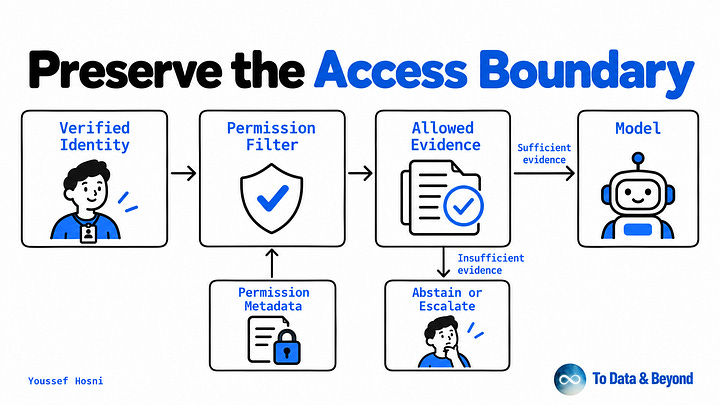 Figure 3. Construct retrieval filters from trusted identity context and send only authorized evidence to the model. Insufficient evidence should trigger abstention or review.
Deliverable and readiness check. Produce an access-control matrix, a validated document dataset, and a permission-aware retrieval path. Demonstrate both a successful authorized query and denied cross-tenant access, then revoke access and repeat the query. Record what happens to existing sessions, cached results, citations, and pending approvals so the security behavior can be reviewed directly.
Suggested readings and resources
-
Microsoft — OpenID Connect on the Microsoft identity platform — Start with the sign-in flow, discovery endpoints, and ID-token validation for the identity integration.
-
Microsoft — Security filters for Azure AI Search — Follow the principal-based filtering example and pay attention to the distinction between a filter and authentication.
-
Microsoft — Document Intelligence accuracy and confidence — Use this when designing field-level extraction checks and deciding which document results need human review.
-
Presidio — Documentation and samples — Explore PII recognizers and de-identification options, then build tests for sensitive information that your configuration misses.
4. Make integrations and approvals safe to resume
Next is to learn system integration and MCP. You will need to learn the business system’s API contract before putting an agent in front of it. REST and SOAP integrations require attention to authentication, validation, pagination, rate limits, timeouts, and error handling. Start with narrowly scoped operations such as reading a purchase order or submitting a review request, and keep credentials in a managed secret store rather than prompts or source files.
MCP can expose these capabilities through a shared interface, but the underlying authorization decisions still require implementation. The MCP security guidance covers risks including confused deputies and token passthrough. For the capstone, retain the identity of the requesting user, validate token audience where applicable, and enforce the business operation’s permissions at the backend boundary.
Test integration failures as deliberately as successful calls. A read request may be safe to retry, while a timed-out write may already have succeeded remotely. Use bounded retry policies that respect the service’s limits, and distinguish retryable transport failures from validation failures. An agent should receive a clear outcome such as rejected, completed, or requiring reconciliation instead of being encouraged to repeat an ambiguous action.
Once the integration is in place, learn how to build human-in-the-loop workflows. You will need to model the review process with explicit persistent states: proposed, awaiting approval, approved, executing, completed, rejected, and requiring reconciliation. The approval must refer to a particular action and payload version. If the invoice amount, destination, or requested operation changes, require a fresh approval; verify that the approver still has the relevant authority when execution begins.
Store enough information to resume after a restart without losing the decision history: workflow identifier, tenant, requester, proposed operation, payload version, approver, and execution status. Use atomic state transitions to prevent competing workers from acting on the same approval. The review interface should show the evidence and proposed consequences, along with a clear way to reject or request changes.
Durable execution helps preserve progress, but duplicate side effects require separate attention. Temporal documents at-least-once execution and recommends idempotent handlers. If the downstream system supports idempotency keys, use a stable key for the approved operation and understand its retention rules. If it does not, use reconciliation and explicit exception handling; a local completion flag cannot by itself resolve a remote write that succeeded just before a crash.
Persist approval for a specific action version, and reconcile ambiguous writes before deciding whether to retry them.
AI Courses Bundle with 40% Discount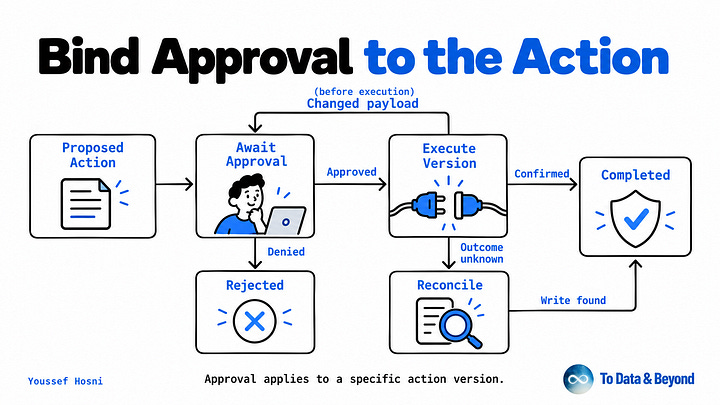 Figure 4. Approval is tied to a particular action version. An unknown write outcome enters reconciliation instead of immediately repeating the operation; this is a simplified view of the full workflow.
Deliverable and readiness check. Connect the workflow to a sandbox business system and demonstrate rejection, approval, restart, and duplicate submission. Inject a timeout after the remote write succeeds and show how the workflow discovers the result. Also change the proposed payload after approval and verify that the earlier decision can no longer authorize execution.
Suggested readings and resources
-
Temporal — Workflow Execution overview — Start with durable execution, replay, and state transitions to understand how a workflow can resume after interruption.
-
MCP — Security best practices — Focus on token audience validation, confused-deputy risks, and prohibited token passthrough; this is evolving draft guidance.
-
Stripe — Idempotent requests — Study a concrete API implementation of idempotency keys and retry behavior; verify the equivalent contract in the business system you integrate.
5. Fit deployment and inference to the customer
Next, learn how to work with private and restricted deployments. You will need to learn Docker, infrastructure as code with Terraform, network controls, and Kubernetes when the deployment requires it. Begin with a dependency map covering identity, document storage, databases, inference, telemetry, package downloads, and operational access. For each dependency, record the data it receives, who operates it, and which network connections it requires.
Distinguish a private network from restricted egress and an air-gapped environment. AWS documents that a public NAT gateway can let instances in private subnets access the internet. For the capstone, explicitly allow required destinations and test blocked paths. Include telemetry exporters, model downloads, and fallback endpoints in that test rather than checking only the main inference request.
Explore air-gapped operation only when it is part of the target requirements. Plan how model weights, container images, dependencies, updates, and diagnostics enter or leave that environment through approved processes. Write down what breaks when external connectivity disappears and how operators recover it. Treat data residency and provider processing requirements as inputs to the design that need confirmation with the customer’s responsible teams.
You should also learn how to evaluate local inference. You can use a tool such as Ollama for initial local experiments or vLLM when evaluating a serving configuration, then measure your own workload. Learn quantization, GPU memory planning, concurrency, and model licensing. vLLM’s quantization documentation describes the precision–memory trade-off and hardware compatibility; verify support for the particular model format and device you intend to use.
Compare a local model and a permitted hosted alternative on the same held-out cases, prompts, and task requirements. Record quality, end-to-end latency, throughput under expected concurrency, and failure behavior. Include model weights, KV cache, and runtime overhead in memory planning, and repeat quality checks after changing quantization or context length. Label every result with the configuration that produced it.
For cost, compare total operating effort and infrastructure with the hosted service’s measured usage. Record the assumed traffic level and how much infrastructure sits idle, then include the human review burden caused by each model’s errors. Avoid promising that local inference is inherently cheaper or more private: describe the actual data paths, access controls, utilization assumptions, and maintenance responsibilities of the proposed deployment.
Choose deployment and inference from explicit customer constraints and measurements on the intended workload.
AI Books Bundle at a 40% discount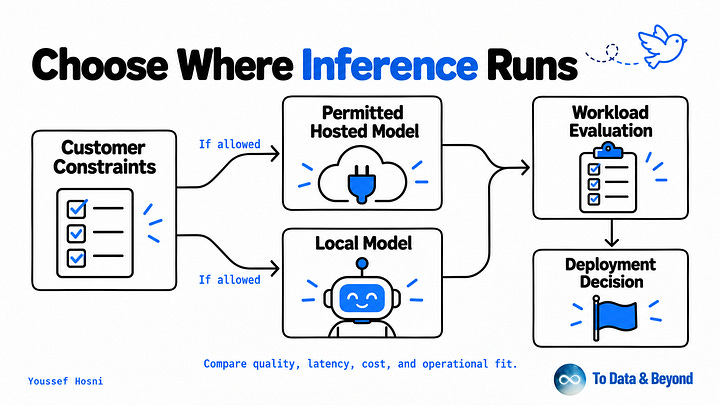 Figure 5. Evaluate permitted hosting options against the same quality and workload requirements. Local inference remains a measured design choice rather than a universal prerequisite.
Deliverable and readiness check. Produce a reproducible deployment definition, a network dependency map, and an inference comparison with its assumptions. Recreate the environment from your documentation and verify its allowed and denied connections. If local inference does not meet the quality requirement, document that outcome and the next design decision rather than changing the acceptance criteria to fit the model.
Suggested readings and resources
-
HashiCorp — Terraform tutorials for AWS — Use the tutorial sequence to practice creating, changing, and destroying infrastructure from configuration.
-
AWS — VPC NAT gateways — Read this alongside your network map to understand how private-subnet workloads can still reach external services.
-
vLLM — Quickstart — Follow the inference and online-serving examples as a starting point for the local side of your model comparison.
-
vLLM — Quantization — Check supported formats and hardware compatibility before choosing a quantized checkpoint or sizing the deployment.
6. Demonstrate value and transfer operational ownership
The next step is to learn observability and how to measure business value. You will need to instrument the workflow so you can trace an invoice from ingestion through retrieval, review, and the downstream operation. OpenTelemetry distinguishes traces, metrics, and logs, giving you complementary ways to inspect request paths, measurements, and events. Record the relevant configuration versions and decision metadata while applying the data-minimization rules established earlier.
Build a dashboard around outcomes the process owner recognizes: eligible cases, completed reviews, unresolved exceptions, corrections, human handling time, and operating cost. Separate elapsed workflow time from model latency and human effort. Define denominators explicitly, particularly when difficult cases are escalated; a high success rate among accepted cases can coexist with low coverage of the overall workload.
Estimate time savings against the baseline from discovery, counting review and rework in the assisted workflow. Treat the estimate as a measurement with assumptions rather than a guaranteed financial return. In a pilot, inspect whether users adopt the system, whether the mix of invoices has changed, and whether apparent improvements survive those differences before attributing them to the assistant.
Finally, learn how to handle handoff and ongoing operations. You will need to prepare runbooks, access-management procedures, configuration guidance, rollback steps, and an incident ownership map. Define who maintains identity mappings, connectors, retrieval permissions, evaluation sets, model versions, and deployment dependencies. Google’s SRE guidance on being on call provides useful context for operational responsibility and preparedness; adapt the practices to the team that will support this workflow.
Make handoff a practical exercise. Ask another engineer to investigate a failed invoice, pause new writes, inspect a pending approval, rotate a test credential, and recover from a simulated downstream outage using the documentation. Record where they need your help, then improve the tooling or instructions. For a portfolio, a peer can play the operator and give you a concrete record of what remained unclear.
Validate handoff by having another person diagnose and recover the workflow using the tools and documentation you provide.
AI Courses Bundle with 40% Discount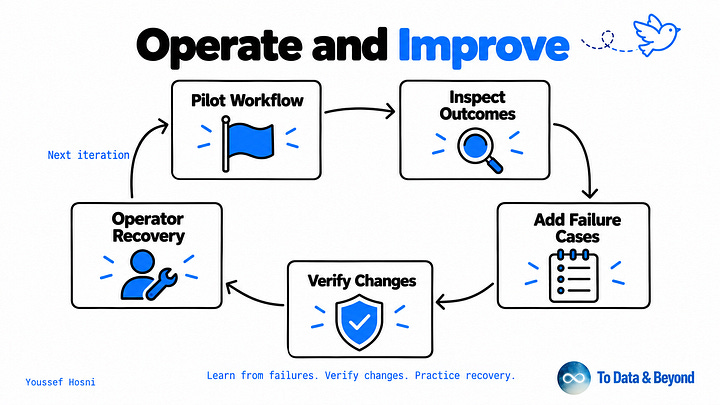 Figure 6. Use pilot failures to strengthen evaluations and include operator recovery in the improvement cycle so the deployment remains maintainable after handoff.
I would build the capstone in increments, keeping the acceptance set active throughout. Each increment should add a capability and a corresponding demonstration of its failure handling. This makes the project reviewable before it contains every component, and lets you choose the next skill from a limitation you have observed.
-
Read-only review: Extract invoice fields, compare them with a purchase order, and report discrepancies with source evidence.
-
Authorized evidence: Add identity, tenant isolation, policy retrieval, and tests for revoked or missing permissions.
-
Controlled writes: Add a sandbox integration, version-bound approvals, duplicate protection, and reconciliation after ambiguous failures.
-
Deployment comparison: Recreate the environment with explicit network controls and evaluate a local model against a permitted hosted alternative.
-
Operational exercise: Run a monitored pilot or clearly labeled simulation, report quality and costs, and have a peer complete the recovery runbook.
Publish the deployment brief, architecture decisions, evaluation report, and failure demonstrations alongside the repository. Mark synthetic data, simulated services, and untested assumptions clearly. Give the reviewer enough evidence to inspect a denied request, an escalated document, and a recovered write, then identify the next unresolved requirement you would take back to the customer.
Suggested readings and resources
-
OpenTelemetry — Signals — Start with traces, metrics, and logs, then choose what each should reveal about the invoice workflow.
-
Google SRE Workbook — Implementing SLOs — Use the examples to define user-relevant reliability indicators and objectives for the service.
-
Google SRE — Being On-Call — Read this when assigning operational responsibility and preparing the team to diagnose and respond to failures.
AI Books Bundle at a 40% discount
The value of a Forward Deployed Engineer comes from carrying a customer problem through to a working deployment. That requires understanding the workflow, preserving access boundaries, integrating business systems, and measuring whether the result improves how people work. It also requires preparing for the cases where data is incomplete, an action needs approval, or a downstream system fails.
You do not need to master every tool in this roadmap before starting. Build one bounded workflow, define its acceptance criteria, and add capabilities as its requirements become clear. Start with read-only access, introduce controlled writes, compare permitted deployment options, and test whether another person can operate and recover the system using your documentation.
For your portfolio, show the decisions and evidence behind the implementation. A denied request, a correctly escalated case, a reconciled write, and a tested recovery procedure help demonstrate your engineering judgment. Together, they show that you can build AI systems customers can use, trust, and maintain.