Five reliability patterns from a repository with 170K+ GitHub stars in its first week
By Youssef Hosni
Published: 2026-08-24
URL: https://todatabeyond.substack.com/p/inside-deepseeks-170k-stars-open
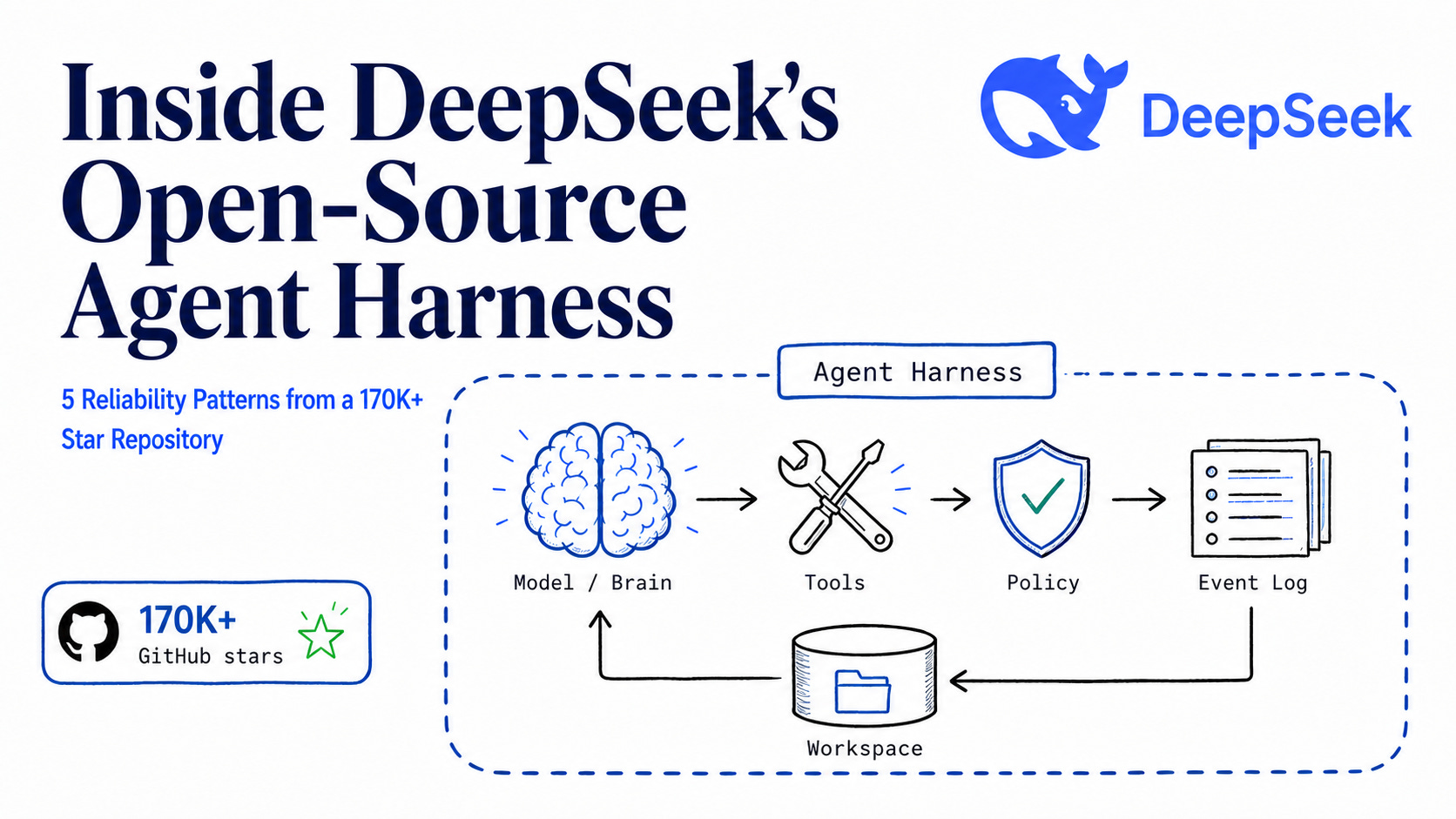
DeepSeek released its open-source agent harness, dsh, on August 13, 2026. By August 20, it had gained more than 172k stars in the first week. That number explains the attention, but not why the repository is useful to engineers building agents.
The more instructive part is how the harness handles ordinary failure modes: request state diverging from telemetry, repeated tool calls, incomplete search results, policy checks hidden behind code execution, and context windows that become liabilities during long tasks. I inspected the current repository to trace 5 important patterns through the architecture and identify where the implementation has already evolved.
This blog follows one running example: a repository-maintenance agent that must locate deprecated API calls, edit only approved files, run tests, and continue across several reasoning rounds. The central lesson is that reliability comes from aligning four boundaries: what the model sees, what the system records, what tools disclose, and what execution policy permits.
The five patterns are concrete: derive requests from a durable log, interrupt exact repetition with advisory feedback, disclose and preserve omitted tool output, route programmatic calls through the native permission pipeline, and move long-running work between fresh contexts through workspace artifacts and typed handoffs.
A capable model cannot compensate for a harness that gives it an incomplete view of state or an unrecorded path around policy.
Get all my 10 AI Courses with 60% off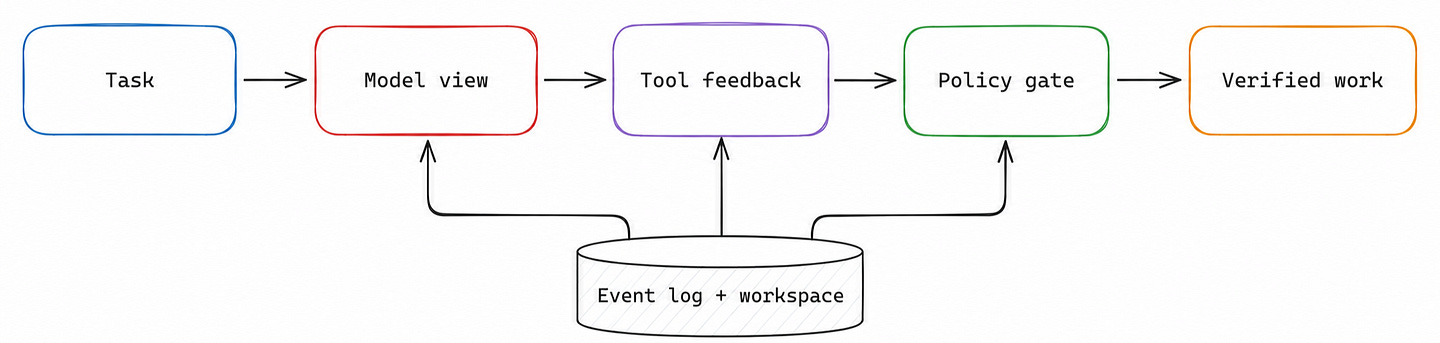
Figure 1. The model is only one component of an agent. Reliable execution depends on the boundaries that construct its context, report tool outcomes, enforce policy, and preserve durable work
My new live cohort: Claude Agent Engineering. Six 3-hour live sessions, six office hours, and one agent system you build layer by layer.
There are only 20 seats, starting 1 November. Founding rate: $320 instead of $400 until Sunday, 27 September, 23:59 Helsinki time. Use code CLAUDECOURSE20
Claude Agent Engineering Live Course
Pattern 1: Make the Event Log the Source of Model Context
Many agent implementations maintain two representations of the same run. A mutable message array becomes the next model request, while a telemetry pipeline records what the application believes it sent. A middleware layer can modify one without modifying the other, leaving the engineer to debug a request from a trace that describes a different request.
DeepSeek Harness uses an append-only session event log as the durable source. The architecture documentation states the rule directly: anything visible to the model must be reconstructable from the log. User messages, assistant messages, tool calls, tool results, and injected context become durable events; deriveMessages() projects the conversation sent on the next step.
The implementation checks more than message history. An optional agent-loop invariant independently reconstructs the messages and folds the recorded request header. It then compares the derived request with the outgoing model, system prompt, temperature, token limit, stop sequences, and tool schemas. A mismatch fails with log-reconstruction desync instead of silently corrupting the trace.
The portable implementation pattern is append first, derive second, and validate before dispatch. The following standalone example models that sequence for the maintenance agent.
Get All My 9 Books With 60% Off
# event_log_request.py
from copy import deepcopy
from typing import Any

Event = dict[str, Any]
def append(events: list[Event], event_type: str, **data: Any) -> None:
events.append({”type”: event_type, **data})
def derive_request(events: list[Event]) -> dict[str, Any]:
system, tools, messages = [], [], []
for event in events:
if event[”type”] == “system”:
system.append(event[”text”])
elif event[”type”] == “tool_schema”:
tools.append(event[”schema”])
elif event[”type”] in {”user”, “assistant”}:
messages.append({”role”: event[”type”], “content”: event[”text”]})
return {”system”: “\n”.join(system), “tools”: tools,
“messages”: messages, “temperature”: 0}
def assert_reconstructable(request: dict[str, Any], events: list[Event]) -> None:
if request != derive_request(events):
raise RuntimeError(”outgoing request differs from the event log”)
events: list[Event] = []
append(events, “system”, text=”Inspect the repository before editing it.”)
append(events, “tool_schema”,
schema={”name”: “search_files”, “parameters”: {”query”: “string”}})
append(events, “user”, text=”Find every deprecated API call.”)
request = derive_request(events)
assert_reconstructable(request, events)
print(f”validated: {len(request[’messages’])} message, “
f”{len(request[’tools’])} tool schema”)
desynchronized = deepcopy(request)
desynchronized[”messages”].append(
{”role”: “user”, “content”: “Unlogged runtime instruction”})
try:
assert_reconstructable(desynchronized, events)
except RuntimeError as error:
print(f”rejected: {error}”)
Captured output:
validated: 1 message, 1 tool schema
rejected: outgoing request differs from the event log
This design improves replay, inspection, and persistence because each view is a projection of the same event stream. It also imposes discipline: every new model-visible input needs a recorded event and a deterministic projection. That additional schema work is worthwhile when exact reconstruction matters, but it is more machinery than a short-lived stateless assistant needs.
If a value can affect the model’s next decision, it should either be in the durable event stream or be excluded from the request.
Get all my 10 AI Courses with 60% off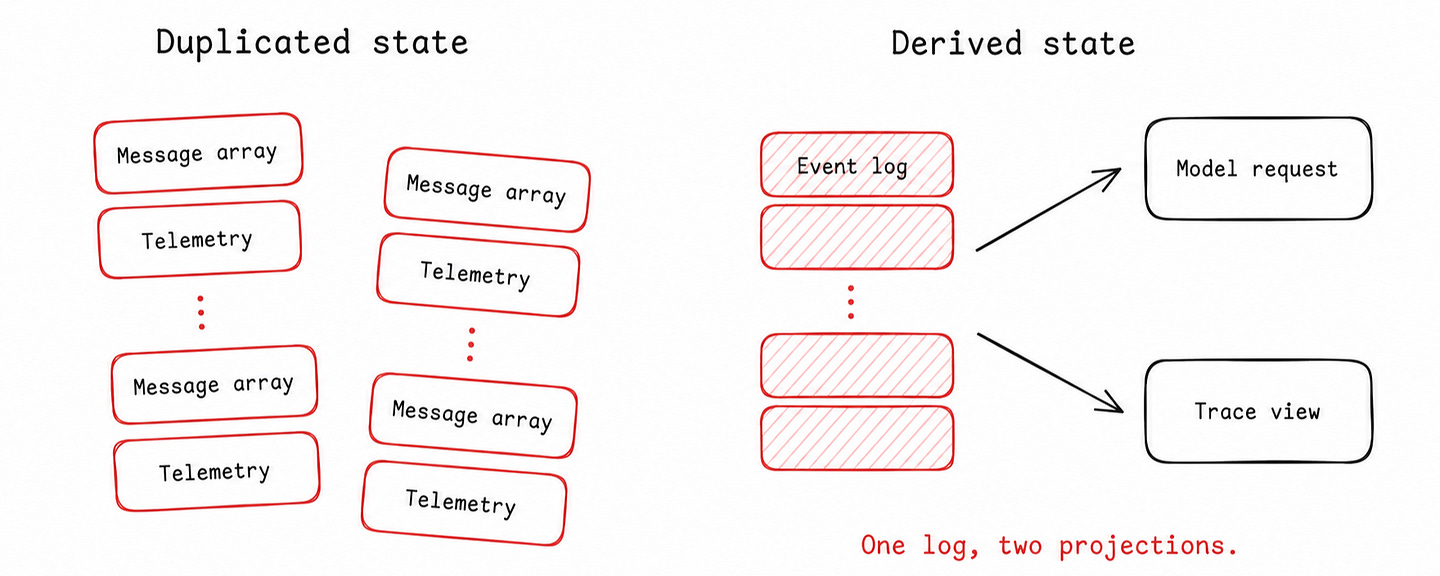
Figure 2. Reconstructing requests and traces from one event stream removes a synchronization problem. The invariant turns any unlogged model-visible input into an explicit failure.
Patterns 2 and 3: Treat Tool Feedback as Part of the Control System
The maintenance agent can fail without throwing an exception. It may call the same search repeatedly, or receive 100 paths and infer that the repository contains only 100 matching files. Both failures originate in feedback: the harness either fails to identify no progress or fails to describe the limits of an observation.
Pattern 2 — Interrupt exact repetition without blocking it.
Get all my 10 AI Courses with 60% off
DeepSeek’s repeat-tool reminder watches each agent independently. It canonicalizes JSON arguments by sorting object keys, counts consecutive calls with the same tool name and arguments, and injects reminders at the default thresholds of 3, 5, and 8. The reminder is advisory. It asks the model to inspect the previous result, change its arguments or approach, or finish if enough evidence exists.
Several details keep the detector useful. Excluded bookkeeping calls are transparent, so glob → todo_write → glob can still count as repetition. Denied attempts count because repeatedly requesting a prohibited action is a real loop. A user message resets that agent’s chain, and counters do not leak between a parent and its subagent. The limitation is equally important: exact matching cannot detect a loop that changes whitespace or alternates between two equivalent queries, while legitimate polling can still trigger a warning.
Pattern 3 — Tell the model what the tool omitted.
Search results use the same principle of actionable disclosure. The current glob implementation returns at most 100 paths by default. It supports two explicit over-cap policies: keep the modification-time head, or sample round-robin across top-level entries.
The shipped base profile currently selects the modification-time head, so the original post’s sampling behavior is available but no longer the default. In both modes, the result states that it was capped, saves the complete sorted list through the spill store when possible, and tells the model how to retrieve it.
The repository also distinguishes output truncation, process failure, and policy denial. The bash tool contract emits separate markers for exit codes, timeouts, signals, sandbox denials, and truncated output. When possible, truncated output includes the full spill-file path. A sandbox denial permits one sanctioned path: retry the exact command with a strictly wider mode and a justification, which routes through user approval. The model is instructed to stop after rejection rather than inventing a workaround.
For another harness, every tool result should answer three operational questions: Was this observation complete? Can the omitted data be recovered? Would retrying the same action change the outcome? These fields belong in the tool contract because the model cannot infer them reliably from an arbitrary string.
Truncation without a recovery path is hidden state; a retryable error without retry guidance is an invitation to loop.
Get All My 9 Books With 60% Off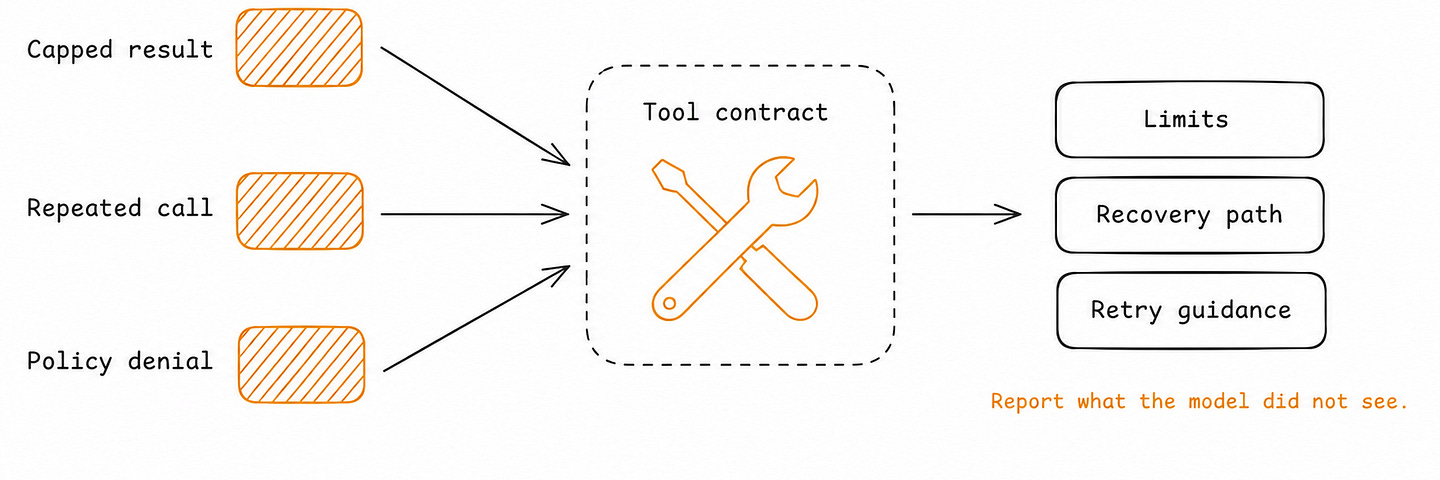
Figure 3. A useful tool result reports both data and control information. Result caps, recovery locations, retry conditions, and policy outcomes change what the agent should do next.
Pattern 4: Preserve the Permission Pipeline Inside Code Mode
Native function calling usually makes the model issue one tool call at a time. A repository audit may require dozens of reads, filters, and small transformations, each producing another model round trip and another block of retained context. Code Mode changes the interface: the model receives one run_code tool plus a generated SDK, writes a short TypeScript or Python program, and invokes the other tools from that program.
The efficiency comes from controlling what returns to the model. Intermediate canonical values stay inside the runtime; only values printed or returned by the program enter the outer run_code result. The agent can therefore read 50 files, extract only deprecated calls, and return a compact list rather than adding 50 full tool results to its conversation.
The security-relevant part is the dispatch bridge. DeepSeek’s tool registry documentation says that each SDK binding re-enters the complete native pipeline: pre-execution policy, monotonic guards, execution wrappers, the tool body, post-execution policy, finalization, and result observation. A denied sub-call rejects inside the program as a catchable ToolCallError. Started sub-calls produce durable tool/code-dispatch-start and tool/code-dispatch events, so the trajectory can show what the program attempted even though those intermediate values do not enter model context.
This separation creates a useful invariant: batching changes presentation and round-trip cost, but it does not create a second authorization route. Code Mode still has meaningful limits. Tool side effects are not transactional and are not rolled back if the program later fails. Intermediate values have no per-binding byte cap.
The default worker-thread runtime provides a fresh isolate, empty environment, heap limit, and termination budgets, but its documentation explicitly calls it containment rather than a security boundary.
When evaluating any programmatic tool interface, trace one nested call end to end. Confirm where its identity is logged, where approval happens, what error reaches the program, what reaches the model, and whether cancellation drains outstanding work. The performance benefit is secondary if any nested path bypasses the policy used by native calls.
Code Mode is safe to adopt only when batching changes the model interface without changing the authority of the underlying tools.
Get all my 10 AI Courses with 60% off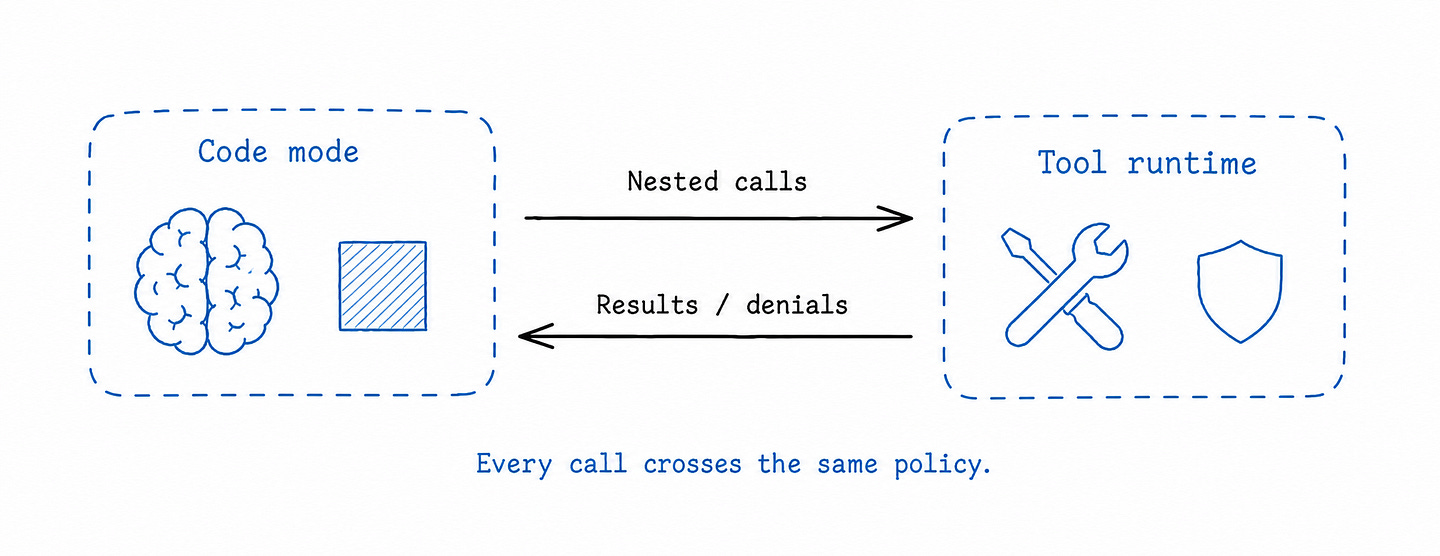
Figure 4. Each SDK call inside run_code traverses the ordinary tool pipeline and receives a durable dispatch record. The program can curate its final output without hiding its actions from policy or observability.
Pattern 5: Restart Reasoning While Keeping Durable Work
Long tasks create a state-placement problem. Keeping every observation in the transcript eventually makes each model request expensive and distracts the model with obsolete hypotheses. Discarding the conversation creates the opposite risk: the next agent may repeat work or lose the evidence needed to finish.
DeepSeek’s ralph tool treats a fresh context as a normal workflow boundary. One immutable objective is passed through a sequence of new child agents. Each child receives the objective, its round number and cap, the shared workspace, and one bounded structured handoff from the previous child. It receives neither the parent conversation nor the previous child session.
The handoff has five fields: status, summary, evidence, next steps, and blocker. The schema requires continue, complete, or blocked; validates the fields against that status; and rejects an oversized report rather than silently truncating it.
The default ceiling is 16,384 serialized characters. Files and test artifacts remain the long-term source of truth, while the handoff tells the next worker where to inspect and what still needs verification.
The current repository separates this fresh-agent workflow from its same-session goal system. Ralph permits a worker to report a concrete blocker in any round and does not independently certify completion.
The goal tools, by contrast, default to requiring the same blocker for three consecutive autonomous goal rounds before the model may mark a goal blocked. Direct human authority can stop or alter a goal immediately. This distinction corrects the common interpretation that the three-round rule belongs to Ralph itself.
For the maintenance agent, durable state should include the changed files, a machine-readable list of findings, test output, and any unresolved failures. The handoff should point to those artifacts rather than reproducing them.
Completion still needs an external acceptance check because Ralph currently trusts the worker’s report; the repository lists independent evaluation, token budgets, cost budgets, and elapsed-time budgets as deferred work.
A practical adoption order follows from these dependencies. Start by making tool limits and denials explicit, because that immediately improves decisions. Add repeated-call reminders next.
Introduce event-derived requests when replay and audit accuracy matter, then Code Mode after every nested call can traverse the native policy path. Use fresh-agent rounds only when the workspace and completion criteria are durable enough that losing conversational reasoning is acceptable.
Get All My 9 Books With 60% Off
A restart is reliable when the workspace contains the evidence and the handoff contains pointers and next actions, not when the previous transcript is compressed into another long prompt.
Get all my 10 AI Courses with 60% off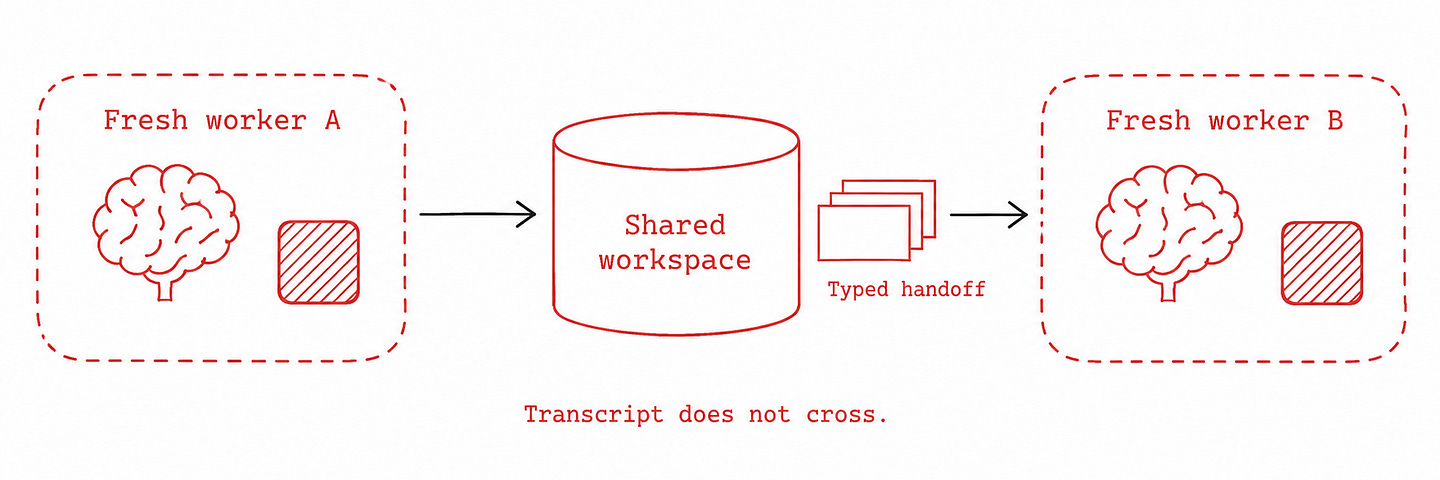
Figure 5. Each worker starts with a clean reasoning context, while files and verification artifacts persist in the workspace. Only a bounded, validated report crosses the conversational boundary.
DeepSeek Harness is still in developer preview and warns that compatibility-breaking changes are expected. Its patterns are therefore more useful as design references than as universal defaults. Event sourcing adds schema cost, exact-match reminders miss semantic loops, Code Mode does not roll back side effects, and fresh-agent completion remains a worker assertion without an independent verifier.
The repository is nevertheless valuable because these limitations are visible at the same boundaries as the mechanisms. The harness records what the model sees, tells it what tools are omitted, routes programmatic calls through ordinary policy, and gives durable artifacts precedence over conversational memory. Those are portable engineering decisions even for teams that never adopt dsh.
My new live cohort: Claude Agent Engineering. Six 3-hour live sessions, six office hours, and one agent system you build layer by layer.
There are only 20 seats, starting 1 November. Founding rate: $320 instead of $400 until Sunday, 27 September, 23:59 Helsinki time. Use code CLAUDECOURSE20
Claude Agent Engineering Live Course
Sources and further reading
-
DeepSeek AI, “DeepSeek Harness,” GitHub repository, accessed August 20, 2026 — repository, installation instructions, license, and developer-preview status.
-
DeepSeek AI, “DeepSeek Harness Architecture”, current commit August 19, 2026 — plugin structure, turn flow, session log, and capability seams.
-
DeepSeek AI, dsh-agent-loop reconstruction invariant, current commit August 19, 2026 — request reconstruction and desynchronization checks.
-
DeepSeek AI, repeat-tool reminder, current commit August 19, 2026 — canonical call detection, thresholds, reminder delivery, and limitations.
-
DeepSeek AI, filesystem glob tool, current commit August 19, 2026 — configurable over-cap presentation and complete-result spill behavior.
-
DeepSeek AI, tool registry and Code Mode, current commit August 19, 2026 — SDK bindings, nested dispatch, logging, policy, and result semantics.
-
DeepSeek AI, Ralph workflow tool, current commit August 19, 2026 — fresh-agent rounds, structured handoffs, and deferred evaluation.
-
Shubham Saboo, “5 Patterns to Learn from DeepSeek’s Open-Source Agent Harness”, August 17, 2026 — the original five-pattern framing that prompted this source-level review.
To Data & Beyond is a reader-supported publication. To receive new posts and support my work, consider becoming a free or paid subscriber.