Steal the framework that brought me $1,300 so your first launch doesn’t end in crickets
By Timo Mason🤠
Published: 2026-10-21
URL: https://timomason.substack.com/p/your-first-digital-product-launch-sequence
Howdy, Wealth Writers🤠
The greatest product you’ve ever built won’t sell a single copy if your launch sequence sucks (or doesn’t even exist).
I spent 5 weeks building my first digital product. Fueled by instant coffee, shaky Bali wifi, and the deep belief that I was basically the next Steve Jobs.
Then came launch day.
I wrote the announcement mail. Read it 14 times. Fixed a comma. Un-fixed the comma. Fixed it again.
My mouse hovered over “Send” like a bomb expert over the red wire. Fingers trembling. Heart pounding. Sweat beaded on my forehead, and not just from the Southeast Asian heat.
I knew the second I hit that button, my life would change forever.
Sales notifications would crash my phone. I’d need an accountant. Maybe two. I was already googling “Lamborghini dealership in my area” and practicing how to tell my family I’m rich without sounding arrogant.
I hit send.
Then I opened my sales dashboard.
Nothing. Fine. People need time to open their emails.
Refresh…
Refresh…
Refresh…
I refreshed that dashboard like it owed me money. In the morning. At lunch. On the toilet. At 2 a.m. under the blanket with my screen brightness turned all the way down so nobody would see the desperation on my face.
For 3 days straight.
And then… DING. 💰
A SALE!
From the super nice lady who bought it to support my one-way-ticket-to-Bali journey. (Bless her. She’s officially in my will. Which is now worth exactly one sale.)
But besides that…
🦗Crickets🦗
If you’re launching the same way right now, your product sits behind one forgotten announcement every day.
(Half of you just thought: “But if I send five sales mails in a row, my subscribers will hate me.”)
Readers who would have bought never move from “maybe” to “yes,” and you never notice the loss, cause nobody writes back to tell you they almost bought.
This article is 2 things at once.
-
A full digital product launch sequence masterclass
-
A case study of my own launch (so everything I teach is backed up by my numbers)
My Article Architect costs $7, and it has brought in $1,300 so far.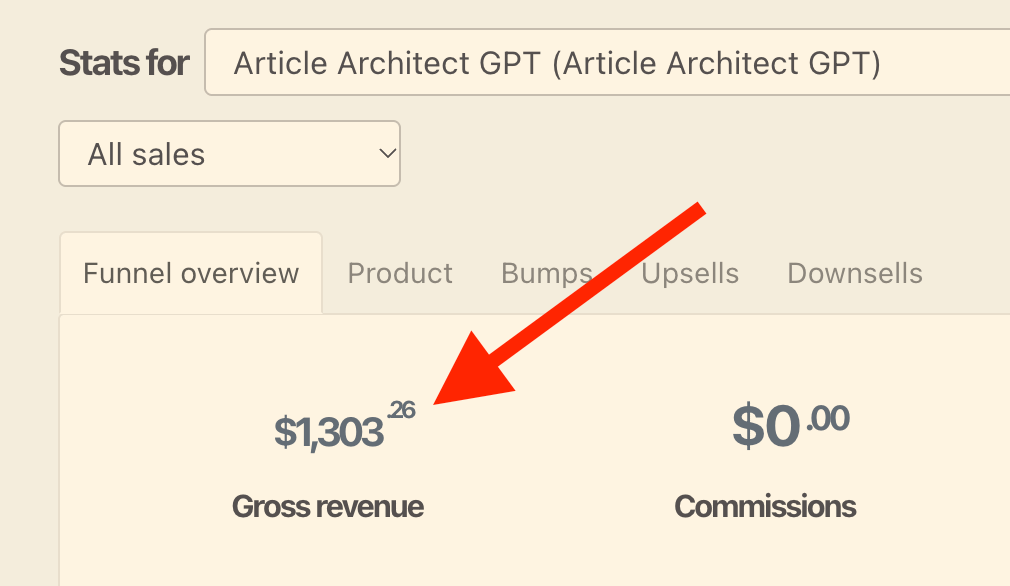
Its launch sequence consists of five mails, each with one specific job, and I'm showing you every single one today.
What you'll learn in this article:
✓ Why one announcement mail almost never sells a paid product
✓ How many mails your launch needs for your price
✓ The exact 5 mails that sold my AI Tool, word for word, including how brown rice and eggs ended up in a sales mail
✓ The 5 types of urgency that stop your readers from postponing forever
✓ What to use as proof when you haven’t sold a single copy yet
✓ The two AI tools I wrote my whole sequence with
✓ How to send your launch and turn it into a sequence that sells to every new subscriber on autopilot
Let's goo! 🤠
Your Paid Product Needs a Sequence Instead Of An Announcement
Free products barely need convincing. If your freebie is positioned well on Substack, your readers will grab it cause there's nothing to lose.
Paid products, on the other hand, need convincing & urgency.
Your reader needs a reason to buy now instead of “maybe sometime later” because, in no-bullshit terms, “maybe sometime later” means “NEVER,” and an urgency-based mail launch sequence is designed to prevent that.
Each mail builds on the last and slowly raises the urgency, so your launch gains momentum and moves the reader toward a buying decision.
Higher price = More mails
The more someone pays, the more trust you need to build first, so use this estimate👇
$7–$20: 3 mails
$20–$100: 4–6 mails
Premium products: 7+ mails
Why my $7 product got 5 mails anyway
By that table, my Article Architect should have gotten 3 mails, and I sent 5.
It still sold, which shows the table is a guide, not a law.
Nobody stops buying your product cause your launch had two more mails than some random 23-year-old Substack guru preached. ;)
The estimate exists to stop you from selling a $500 course with one mail, not to stop you from telling your story.
"But won't five sales mails in a row annoy my subscribers?"
They only annoy people when all 5 just say "buy my thing", and four of my five mails opened with a story or a lesson before the product showed up, so each one was worth reading even for people who never purchased.
A paid product needs a reason to buy today, so match your number of mails to the trust your price needs, but never let a rule stop you from telling the story you believe in.
Knowing how many mails to send is only half of it, so the next section walks you through the one job every mail has, using my five Article Architect mails, so you can copy the structure for your own product.
The 3-Step Journey Of A Launch Sequence That Sells
Your sequence moves your reader through this 3-step journey:
"Interesting"
↓
"Maybe I need this"
↓
"I should buy this today"
Each mail removes one more objection, so by the final mail, buying feels like the obvious next step.
In my 5-mail launch, mail 1 made readers curious, mails 2 and 3 built desire, and mails 4 and 5 asked for the sale.
Below are all five of my Article Architect launch mails word for word, so you can see how each one does its job.
Mail 1: "Article Architect" (Interesting)
Job: introduce the problem, the opportunity and some curiosity, with no pressure.
I told the story of how I worked my way from tweets to threads to mails, why articles became the "final boss", and how Article Architect fixes articles that feel like climbing Mount Everest.
Howdy, Wealth Writers 🤠
First I learned tweets.
Then long-form Twitter threads.
Then, how to write engaging emails.
Each one felt like leveling up in a video game.
But there was always one more boss waiting at the end...
Articles.
(Let's exclude books for now; maybe I will figure that out in 10 years or so)
Articles are the kind of deep, meaty content that builds real authority.
The stuff people bookmark, share, and actually remember you for.
For months, I avoided it.
"Too long and too much work."
Then I discovered Substack, and I saw the massive growth potential sitting right there in front of me.
Here's what clicked:
On Substack, you farm email subscribers the same way you farm followers on 𝕏.
Except email subscribers are 20x more valuable.
You own the relationship and no algorithm can take them away.
But here's the thing about Substack:
It's built for articles.
That's the content format that wins there.
So I had no other choice.
I had to figure out how to write good ones...
So little Timo went to work. :D
I went deep into the article-writing trenches for the last months.
Of course, I'm nowhere near "mastery" but I'm doing okay, and it shows in my subscriber growth.
[subscriber growth screenshot]
I realized the simple truth behind my success.
"If you want consistent growth, you need consistent content output."
Of course, we all know that.
But here's the specific problem most creators have:
They know articles are powerful, but they treat each one like climbing Everest.
One hour of ideation.
Another two of wrestling with structure.
Then, spending endless hours with the content itself.
At the end, they publish and already feel the burnout creeping in.
That's not a system, that's torture.
So I spent the last month building something different.
A way to use AI that doesn't just "write for you" (that stuff always sounds robotic, especially in articles).
Instead, it also helps you think through the article (structure, flow, insights) so you're writing 10x faster without losing your voice.
I call it Article Architect.
It's the same system that's fueling my Substack right now.
Consistent articles and growth without the burnout.
If articles still feel like a grind every single time...
This is your shortcut.
See ya tomorrow
Timo Mason🤠
Mail 2: "rice and egg" (Maybe I Need This)
Job: build desire through a story, so the product feels like the natural answer to a lesson.
I told readers I'd been eating brown rice and eggs every single day in Bangkok, turned it into a lesson about overcomplicating your content, and then showed Article Architect as the "rice and eggs" for long-form content.
Howdy, Wealth Writers 🤠
So I need to confess something kinda weird.
I've been in Bangkok for 2 weeks now.
Not staying in some bougie Airbnb or trendy co-working hostel.
Nope.
I'm living in a real apartment.
The kind where only locals live.
Long-term contracts. One year minimum.
But somehow I convinced the landlady to give me 3 months.
(I think she just liked my profile picture)
Here's the weird part...
I have a full kitchen.
Like, a REAL kitchen.
Stove. Pots. Pans. The whole setup.
And you know what I make every single day?
Brown rice and eggs.
That's it.
Every. Single. Day.
Brown rice. Eggs. Top-tier Chinese soy sauce.
No variety. No "trying new recipes." No meal prep Sunday content for Instagram.
Just rice and eggs.
And here's the thing that blows my mind...
I'm completely fine with it.
Like, genuinely happy.
No boredom or cravings for something different.
Just... rice and eggs.
You'd think I'd get sick of it, right?
You'd think after day 5 I'd be Googling "Thai restaurants near me" or watching street food videos like some kind of culinary masochist.
But nope.
Rice. Eggs. Repeat.
And it works.
Now, why am I telling you about my boring-ass diet?
Because you're doing the exact opposite with your content and it's destroying your growth.
Most creators are overwhelmed.
They think they need:
• 6 different content formats
• Posting on 4 platforms
• A new "strategy" every week
• The latest AI tool, growth hack, or viral trend
So they spread themselves thin.
They're writing Twitter threads on Monday, filming TikToks on Tuesday, designing carousels on Wednesday, and having an existential crisis by Thursday because nothing is working.
They're exhausted.
Burned out.
And they haven't even hit 1,000 followers yet.
Here's the truth nobody wants to hear:
Overcomplication is killing your growth.
You don't need to be on every platform.
You don't need to reinvent your content every week.
You need to do what I do with my meals:
Find your rice and eggs. Then eat it every day.
What does that mean for content?
It means you pick ONE format that works for you.
Maybe it's:
• Twitter threads
• LinkedIn posts
• Daily Email
• Substack articles
Doesn't matter which one.
What matters is you pick ONE, strip it down to the essentials, and repeat it until it prints money.
My rice and eggs are Substack articles and daily emails
I'm not jumping on TikTok. I'm not launching a podcast. I'm not designing infographics.
I write articles. I send emails. + I repurpose this content into Substack notes.
That's it.
Simple. Repeatable. Effective.
And it's built everything I have.
The creators who struggle?
They're out here trying to cook a 7-course meal every day when all they needed was rice and eggs.
So here's what you do:
Step 1: Pick ONE platform. (My recommendation is Substack, that's the place to grow right now)
Step 2: Pick ONE content format on that platform. (For Substack it would be articles)
Step 3: Strip down your creation process, make it so simple a tired, hungover version of you could execute it. (AI helps)
Step 4: Do it every day. (Or every week. Just stick to it.)
That's your rice and eggs.
And if you're thinking "But Timo, I don't know what my format should be" or "I don't know how to structure my articles"...
That's exactly why I made Article Architect GPT
It's literally your rice and eggs for long-form content.
You plug in your idea, and it gives you a proven structure that works every single time.
No overthinking or writer's block.
Just a simple, repeatable system that cranks out high-quality articles.
Your rice and eggs. Ready to go.
Stop trying to cook a Michelin-star meal every day.
Find your rice and eggs.
And watch what happens.
See ya soon :)
Timo Mason 🤠
P.S. Seriously. Brown rice and eggs. Every day. I'm living proof you don't need variety to be happy. You just need something that works.
Mail 3: "writing articles takes too much time" (Maybe I Need This)
Job: take your reader's biggest objection and answer it head-on.
The subject line is literally the objection, the mail shows why publishing more often brings more readers, then positions Article Architect as the way to do it without spending 4+ hours on every article.
Howdy, Wealth Writers 🤠
Your newsletter has more potential readers than you think.
Most writers publish 1-2 articles per month.
That means most of their potential audience never sees their work.
Because they're not online when you publish.
Or they haven't discovered you yet.
Or they need to see a few pieces before they subscribe.
The simple truth is:
More frequent publishing = More readers finding you.
But here's the problem:
Writing quality articles takes time.
A lot of time.
So you're stuck between wanting to publish more and not having enough hours in the day.
This is why I built Article Architect GPT.
It's the tool that creates outlines and full drafts in under 3 minutes,
So you can publish weekly (or even more) without spending 4+ hours per article.
It takes five minutes to start using (a ChatGPT account is all you need),
And it lets you produce as many articles as you want, each one bringing new readers to your newsletter.
The more you publish, the more subscribers you get.
The more subscribers you get, the more paying customers you will have.
The kind that opens every email, shares your work, and actually pays for your rent.
Click Here To Access Article Architect
See ya soon :)
Timo Mason🤠
Mail 4: "The GPT that writes your next 20 articles" (Buy Today)
Job: the full pitch, with what the product is, how it works, what the reader gets, and an FAQ that answers every last question, including the price.
This is the longest mail of the sequence, so I've cut the FAQ below, which answered nine questions, from "How is Article Architect different from just using ChatGPT normally?" all the way to the price, $7 for lifetime access.
Howdy, Wealth Writers 🤠
Article Architect GPT
The GPT that writes your next 20 articles
A skilled architect doesn't just design one building.
They use the same principles to create different designs for different clients.
Architects don't reinvent everything each time.
They adapt what works.
This matters when you sit down to write and stare at a blank screen.
It's not that you don't have ideas.
It's that you don't know how to structure them into articles that readers actually engage with.
And like an architect with blueprints...
You're one clear outline away from turning your ideas into articles that grow you a paying audience.
What architects do for buildings, The Article Architect does for your articles:
- He asks about your topic and key points.
- Creates a complete outline with hook, sections, and takeaway.
- Drafts your article section by section until it's ready to publish.
Every time you need to write.
Let's say you want to write about productivity.
You see a blank page and an idea title in your Notion database.
The Article Architect turns that into:
✓ A clear structure with 5-7 strategic sections, so every paragraph pulls readers deeper into your content.
✓ A strong hook and promise that grabs attention and makes readers can't help but click and read to the end.
✓ A Polished draft written section by section, that gets shared and builds you a paying audience.
✓ Quick revision options for each section so every word sounds exactly like you, only better. ;)
You end up with a complete, ready-to-publish article in under 3 minutes.
The kind of article that turns casual readers into loyal subscribers, and builds the paying readership that creates real financial freedom.
(Use him again whenever you need to write. He'll help you outline and draft as many articles as you want).
The Article Architect turns blank screens into articles that build your paying audience.
[Full Product FAQ]
Click Here To Access Article Architect
See ya soon :)
Timo Mason🤠
Mail 5: "last reminder" (Buy Today)
Job: maximum urgency and the strongest CTA, so the reader decides instead of postponing.
I told the story of sitting in the military barracks, choosing between extending my contract and booking a one-way ticket to Bali, and turned it into two paths for the reader, keep doing what they're doing or get Article Architect.
Howdy, Wealth Writers 🤠
Let's go back in time...
Six months before my military contract ended, I was sitting in the barracks.
Laptop open.
Checking my Stripe account for the 25th time that week.
And it's... not impressive.
Like, "definitely can't pay rent with this" not impressive.
My commanding officer had already asked me twice: "Mason, you extending your contract or what?"
Extending would've been the smart move.
Two more years.
Stable paycheck.
Health insurance.
No risk.
No uncertainty.
No waking up at 3 AM wondering if I just made the dumbest decision of my life.
But there was this other path...
The one that scared the hell out of me.
Let the contract end.
Don't extend.
Book a one-way ticket to Bali.
Go all-in on the business that wasn't even paying me yet.
And I remember standing at that fork in the road thinking:
"If I play it safe now, I'll never know what could've happened."
So I chose.
I let the contract end.
Bought the ticket.
And it ended up being the best decision of my life.
Why I'm telling you this:
Some decisions don't come back around.
You either take them when they show up, or you spend the rest of your life wondering "what if?"
Right now, you're standing at your own fork in the road with your Substack.
This is your last chance to make the call.
Because after this email, I'm moving on to other projects and won't remind you of the Article Architect GPT.
So here are your two paths:
[fork in the road image]
Choice 1: Keep doing what you're doing
Keep staring at the blank page every week, wondering what to write.
Keep second-guessing every article idea.
Keep hoping the algorithm gods smile on you.
Six months from now you'll still be stuck at the same subscriber count.
Maybe you'll have published a few articles.
Maybe you'll have gained 20 subscribers.
But nothing will have fundamentally changed.
You'll still be wondering why growth feels so damn hard.
Choice 2: Get Article Architect GPT
Stop guessing.
Start publishing consistent, high-quality articles that actually resonate with your audience.
Get proven article frameworks and writing that works.
Six months from now you'll have cracked 1,000 subscribers.
You'll have a backlog of published articles.
You'll have consistent engagement.
You'll actually feel like you're building something real.
Your Substack will be growing while you sleep.
I'm focusing on other projects soon.
So this is your last reminder.
The fork in the road moment is right now.
Not next week when you "feel ready."
Not next month when you "have more time."
Now.
Everything you want from your Substack could be lying at the end of one of these paths.
Hope you make the right decision.
See ya soon :)
Timo Mason🤠
P.S. That moment in the barracks... I was terrified. But I knew if I didn't take the risk, I'd regret it forever. Don't let hesitation steal your growth.
Every mail has 1 job.
The first makes readers curious, the middle ones make them want it, and the last ones make buying today the obvious choice.
Mail 5 is where most launches go soft, so the next section shows you how to add real urgency so your readers stop postponing and actually decide.
The 5 Urgency Types That Sell
A launch sequence needs urgency.
Without it, people postpone buying forever, cause there's always a better day to decide than today.
You've got 4 practical ways to create urgency:
1. Launch Week
Your special price only runs during the launch, like "This special pricing ends Friday."
2. Limited Quantity
Only a set number of copies exist, like "Only 10 copies available", and later in the sequence, "Only 3 copies remaining."
3. Early Bird Pricing
The first buyers get a lower price, and everyone after them pays more once the price goes up.
4. Limited Availability
You tell readers you're not sure when you'll offer the product again, or that this is the last time you'll mention it.
Gumroad Flash Sale Copies
You don’t have to pick just one of these, and the practical urgency I teach my coaching clients to use with their first digital product on Gumroad mixes two of them:
Flash sale copies.
They combine Limited Quantity and Early Bird Pricing, cause only a set number of copies get the discount, like 50% off for the next 5 buyers, and everyone after them pays full price.
Gumroad makes it easy to set up, and it’s 100% transparent cause it’s built right into the platform.
Your readers see on your landing page how many flash sale copies are left, and that number drops every time someone buys.
That turns “Only 5 discounted copies left” into something your readers can see for themselves, which is exactly what makes it work in your launch mails.
See how to set up these flash-sale copies step by step in THE Gumroad Game Plan
My launch used psychological urgency
All 4 options above are practical urgency: something actually runs out, the copies, the deadline or the lower price.
Article Architect never went off sale and the price never increased, so I used the 5. Type of urgency:
Psychological urgency.
I show the reader what waiting will cost them, cause every week they don’t decide is another week of wasted time and fewer results.
Mail 5 does this with a fork in the road:
“Choice 1: Keep doing what you’re doing”, where six months from now they’re “still stuck at the same subscriber count”, or…
“Choice 2: Get Article Architect GPT”, where six months from now they “have cracked 1,000 subscribers.”
Nothing runs out, but staying stuck gets more expensive the longer they wait, and that’s the real reason to buy today.
Practical urgency makes the offer run out & psychological urgency makes waiting feel costly.
Without a reason to decide now, people postpone forever, so use practical urgency if something really runs out, and psychological urgency if the only thing they lose by waiting is time and results.
Urgency gets readers to decide, but proof decides which way they go, so the next section shows you what to use as proof, even if you haven't sold a single copy yet.
Proof Sells Better Than Copy
Social proof makes selling easier, cause the stronger your proof, the less copy you need to convince anyone.
If you already have results, use them:
✓ Gumroad reviews
✓ Audience growth
✓ Customer results
✓ Testimonials
✓ Revenue
No customers yet: use these instead
Every product launches without customers the first time, so lean on what you already have:
✓ Beta testers
✓ Case studies
✓ Personal experience
✓ Career achievements
✓ Before-and-after examples
Recruit beta testers before you launch
Give a handful of people free access with a 100% discount link, and ask each beta tester to leave a testimonial in exchange.
Those testimonials become the social-proof backbone of your launch mails, cause nothing sells a product better than customers talking about their own success.
Before you can hand out that link, you need people who want to test your product, and the easiest place to find them is Substack.
I break down the whole workflow for making your Substack friends in my free mini-book 👉 How to Win Substack Friends and Influence Readers.
My launch used my own growth as proof
Mail 1 didn't include a single testimonial.
It had a screenshot of my own subscriber growth and one line: "It's the same system that's fueling my Substack growth right now."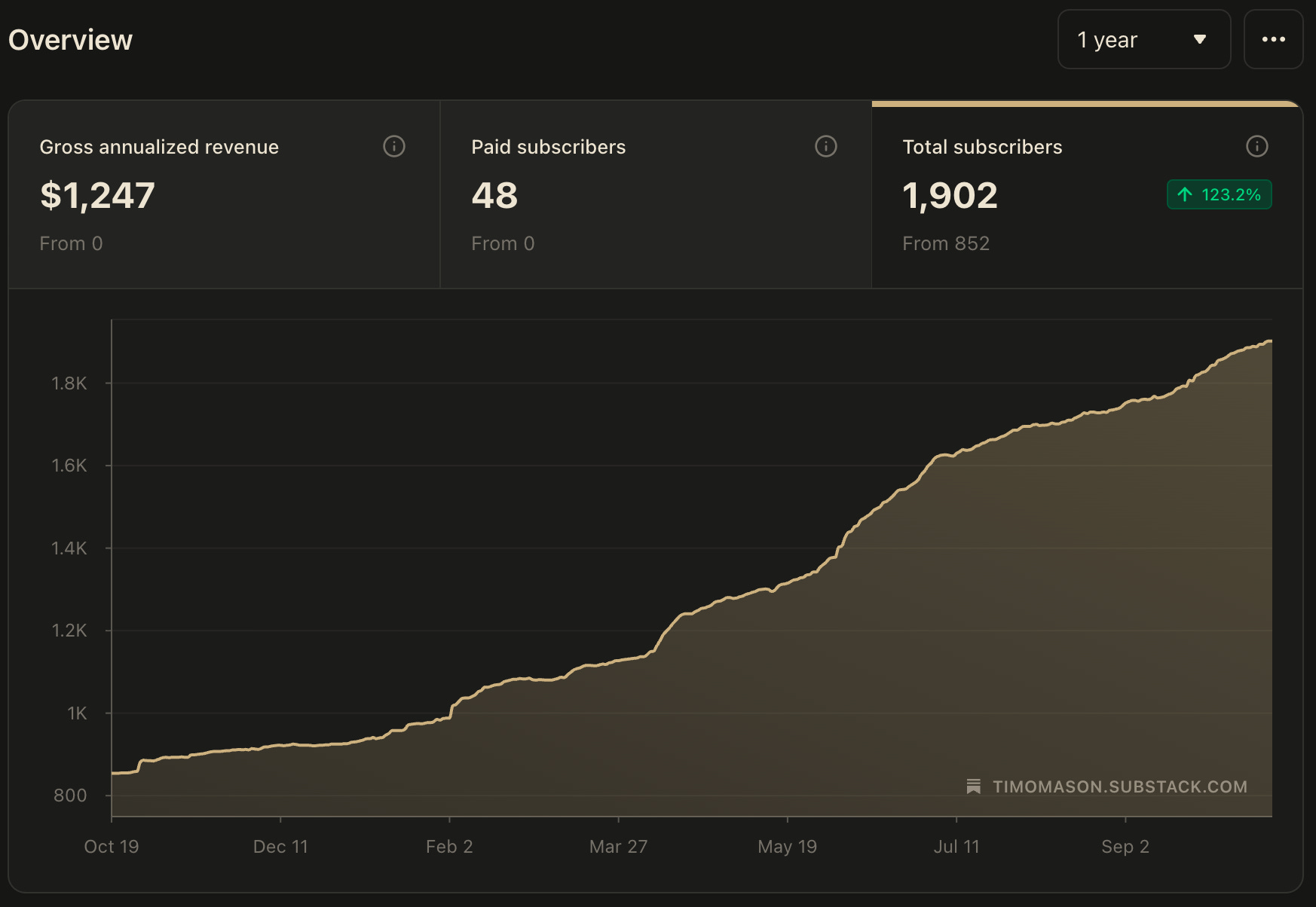 The growth dashboard screenshot I used as social proof
When you get results with your own product, you're your own first case study, so show it.
The stronger your proof, the less copy you need, so collect testimonials before you launch, and if you have none yet, let your own results do the talking.
With your proof ready, you can write the mails yourself, and the next section shows the two-tool AI workflow I used to write my whole sequence, so you never have to start from a blank page.
Write It With AI: Strategy First, Copy Second
I used 2 AI tools for my Article Architect launch sequence: one for strategy and one for copy.
Step 1: Email Launch Strategist
You give it your product, your audience, and your price, and it builds a strategic launch sequence outline.
This step is all about the high-level plan, so you don’t write a single word of copy yet. You just ensure the day-to-day flow of your sequence is smooth:
-
What each day covers
-
How one mail connects to the next
-
How the urgency builds until the last mail
Once that structure makes sense from Day 1 to the final mail, Step 2 is about the actual words you put into each one.
Step 2: Copy Emulator
You feed this AI tool your launch outline (from Step 1) and a launch sequence you admire.
It turns your outline into mails for your own product while following a sales structure that already works, so instead of writing five sales mails from scratch, you adapt a proven framework.
You don’t have to go looking for that sequence either, cause you just read all 5 of my Article Architect mails above, and you’re more than welcome to steal them. :)
Your inbox is full of options too.
Sales mails from bigger creators are proven to sell, cause they’ve tested what works, so they make a great base for your own launch.
Use them as a starting point, then make them your own by giving The Copy Emulator your product details, stories, and voice.
The Launch Sequence Skills
Writing the sequence itself is the make-or-break point between getting 1 pity sale or turning this into a $1,000+ killer launch! :D
So your paid-sub bonus today is the 2 AI tools I used to create the Article Architect launch sequence, which helped me turn this $7 AI tool into $1,300 in revenue. :)
-
The Email Launch Strategist
-
The Copy Emulator
Both are ready-to-use skills, so you can build your killer launch sequence in one evening instead of a week.
Paid subs see the Email Launch Strategist & the Copy Emulator here. Upgrade now to get full access.
Build the strategy first and the copy second, and adapt a sequence that already works instead of writing five sales mails from a blank page.
Once you've written your emails, you need to deliver them to your audience, so the next section shows you how to send your launch and turn it into a sequence that automatically sells to every new subscriber.
Send It, Then Let It Sell Forever
Write every mail before Mail 1 goes out
Always finish the whole sequence before you send the first mail, cause writing your strongest pitch under launch pressure is how launches fall apart.
Then send them on consecutive days, Day 1, Day 2, Day 3 and so on, cause daily mails build momentum and keep your product top of mind for the whole launch.
Substack Newbies: send it as email-only posts
I sent my launch through Kit, but it’s an advanced paid tool.
Keep it simple for your first time and send it through Substack, as email-only posts, so your subscribers get every mail while your website stays clean of promo content.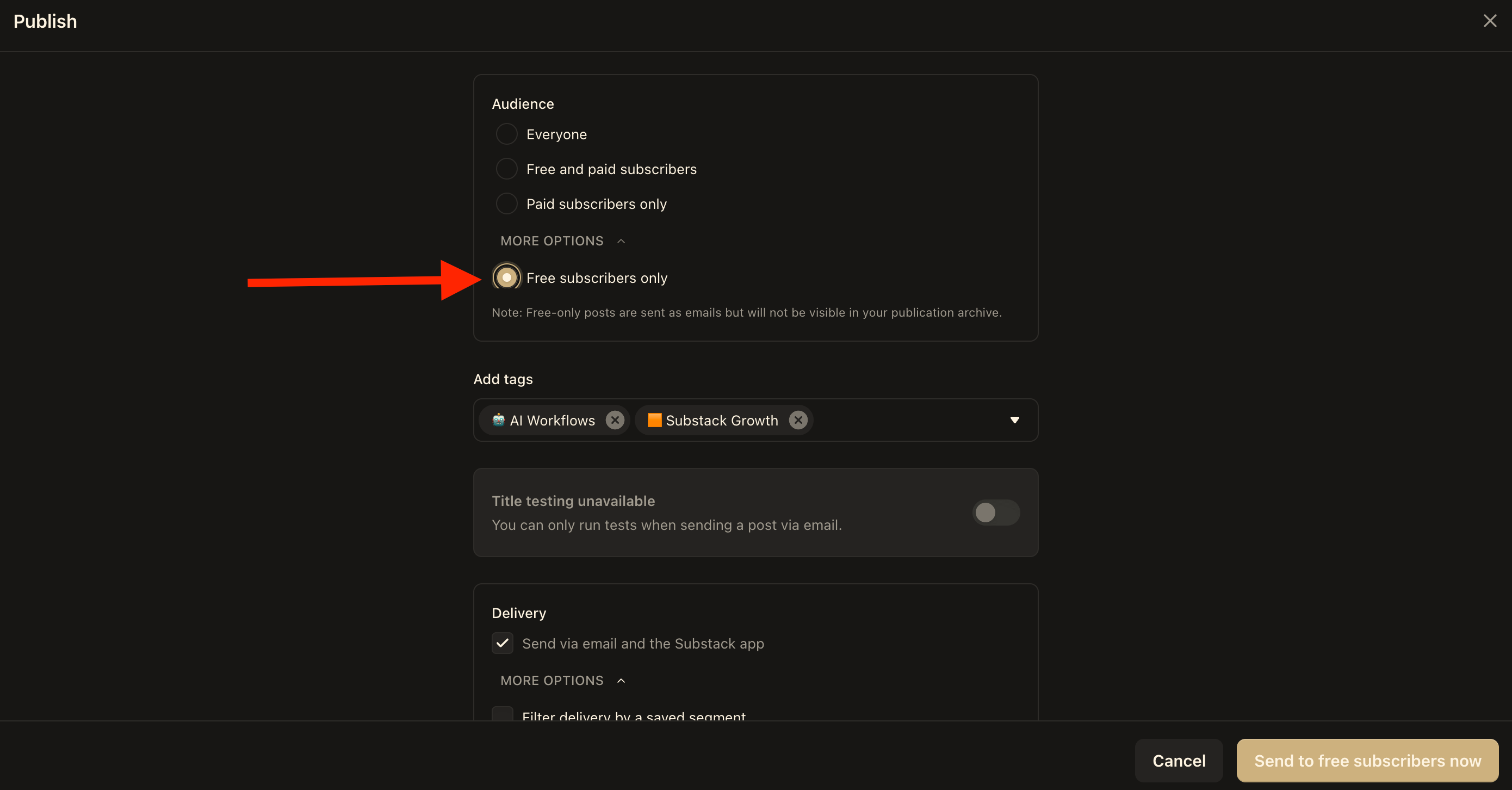
Make your launch evergreen
A launch sequence shouldn't only make money during launch week. Once it's written and tested, it becomes one of the most valuable assets in your Substack biz.
Every subscriber is new only once, so give each of them the same chance to discover and buy your product:
- Write your launch sequence.
- Send it live to your current audience.
- Move the same sequence into an automation.
- Every future subscriber now gets your launch automatically.
My Article Architect sequence runs in Kit, and over 1,000 subscribers have gone through it.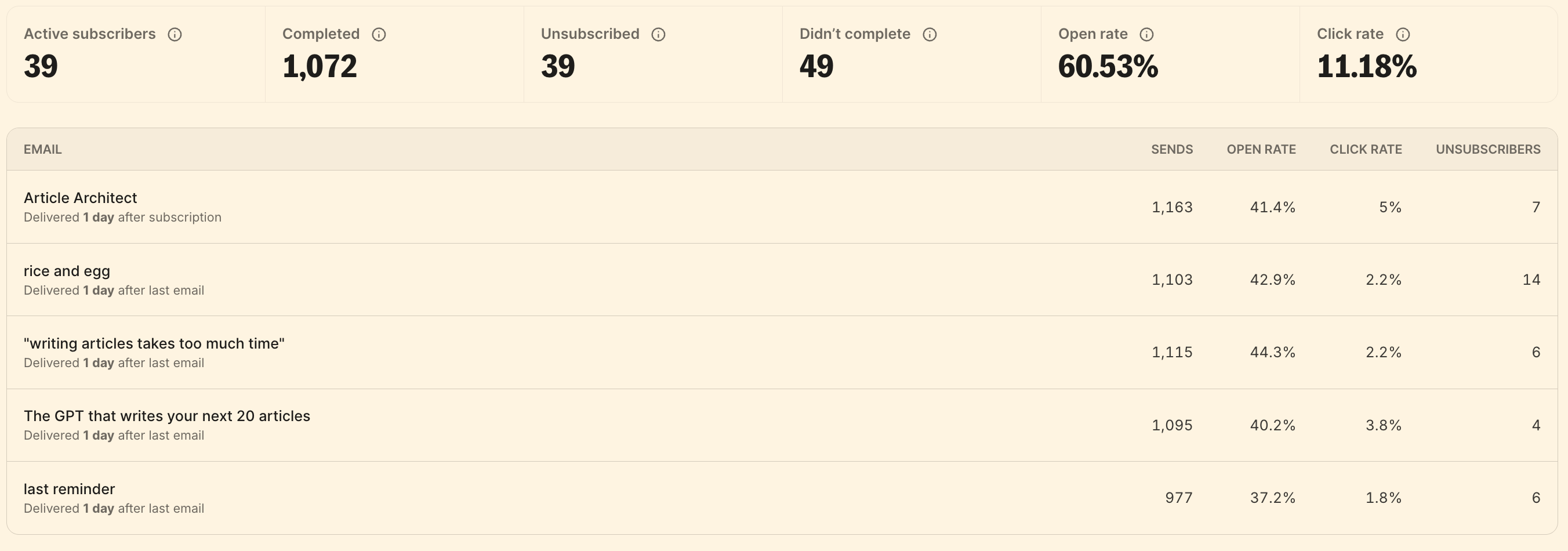
Launch once. Sell forever.
Write every mail before Day 1, send it as email-only posts each day, then move it into an automation so every new subscriber gets your best launch.
You now have every piece of your launch, and the free checklist below puts them all in the right order, so nothing gets forgotten before Mail 1 goes out.
Your First Digital Product Launch Sequence Checklist
This article packs a whole launch into one read, and it’s easy to lose it in your inbox before your product ever goes live, so I turned every step into Your First Digital Product Launch Sequence Checklist.
It’s the newest addition to the free-subscriber-exclusive Substack Side-Hustle Shelf.
Tick off one box at a time and launch your mail sequence! :D
The Launch Sequence I Wish I’d Had
Past Timo could have really used this article.
It would have shown him how to turn that one forgotten announcement into a killer launch sequence before he spent weeks on a product most of his readers heard about only once.
Now that you have it, skip the 🦗crickets🦗 phase entirely and launch your product with a sequence that brings in your first $100 earned online.
A paid product sells best through a multi-day launch sequence, so match your number of mails to the trust your price needs (3 mails for $7–$20 is a starting point, not a law).
Give every mail one job on the path from "interesting" to "maybe I need this" to "I should buy this today".
Add real urgency, practical like Gumroad flash-sale copy or psychological, like showing what waiting costs, and back it with proof from beta testers or your own results.
Write the outline and draft with AI, send it as email-only posts, then move it into an evergreen automation so every new subscriber gets the same chance to buy.
Upgrade now to access The Substack Biz Bootcamp, a 1-on-1 strategy call with me, The Classified Intelligence Vault, and many more paid sub benefits
See you next week Brian :)
Timo Mason🤠