The only article you need to reach your first 1K subs
By Timo Mason🤠
Published: 2026-10-14
URL: https://timomason.substack.com/p/how-to-win-substack-friends
Howdy, Wealth Writers🤠
🤡“Your network is your net worth”🤡
This basic-ass business phrase I heard 100 times couldn’t be further from the truth.
Before Substack, I was trading and doing network marketing, and in that industry this phrase is like the ‘amen’ in church, but it felt like people built a network cause they couldn’t handle being alone and procrastinated when it was time to make progress.
That may sound like I’m completely against networking, but it’s actually the opposite.
Your network is NOT your net worth, what matters is HOW you leverage it.
(Half of you just thought: “I don’t even have a network to leverage yet.”)
You do, even if it’s just 5 Substack friends you talk to regularly; if those relationships sit unused every week, you miss out on subs and sales.
I used my network to get 5,000 new readers from one guest post, 500+ subs through recommendations, and $693 from a single affiliate.
Today I share the full breakdown with you:
How to win Substack friends, leverage them so you both win, and influence the readers they bring you, so you can grow your first 1K subs and make your first $100 online.
Let’s goo! 🤠
Table of Contents
Book 1: How To Win Substack Friends
-
Chapter 1: Where To Find Your Future Substack Friends
-
Chapter 2: How To Make A Friend Without Making It Weird
-
Chapter 3: The 2 Ways To Lose Substack Friends Fast
-
Chapter 4: It’s All Just Pixels On A Screen
Book 2: How To Leverage Your Substack Friends (So You Both Win)
-
Chapter 5: Recommendation Swaps: Friends Who Send You Subs On Autopilot
-
Chapter 6: Guest Posts & Collabs: Borrow Your Friend’s Whole Audience
-
Chapter 7: Testimonials: Let Your Friends Vouch For You
-
Chapter 8: Beta Testers: Friends Who Make Your Product Better
-
Chapter 9: Affiliates: Friends Who Help You Sell
Book 3: How To Influence Readers
-
Chapter 10: Reply To Every Single Comment
-
Chapter 11: The 5-Message DM System That Turns Subscribers Into Superfans
-
Chapter 12: Use The Subscriber Chat
Bonus
-
The Substack Friends Checklist
-
The Network Net-Worth Audit Prompt
Book 1: How To Win Substack Friends
Before you can leverage a single Substack friend, you have to win them first, and that starts with knowing where to find them.
Chapter 1: Where To Find Your Future Substack Friends
When you first join Substack, finding creators to connect with feels easy.
You discover a few newsletters you like, follow some people, start engaging, but at some point (usually faster than you expect) you’re stuck in a bubble.
So here’s the system I use to consistently find new creators worth connecting with👇
Method 1: The Suggestions Tab
Substack has a built-in discovery feature that most creators scroll past without a second thought.
It’s Substack’s way of saying: “Based on what you read and who you follow, here are creators you might like”
You find it if you scroll down a little bit on your For You Page👇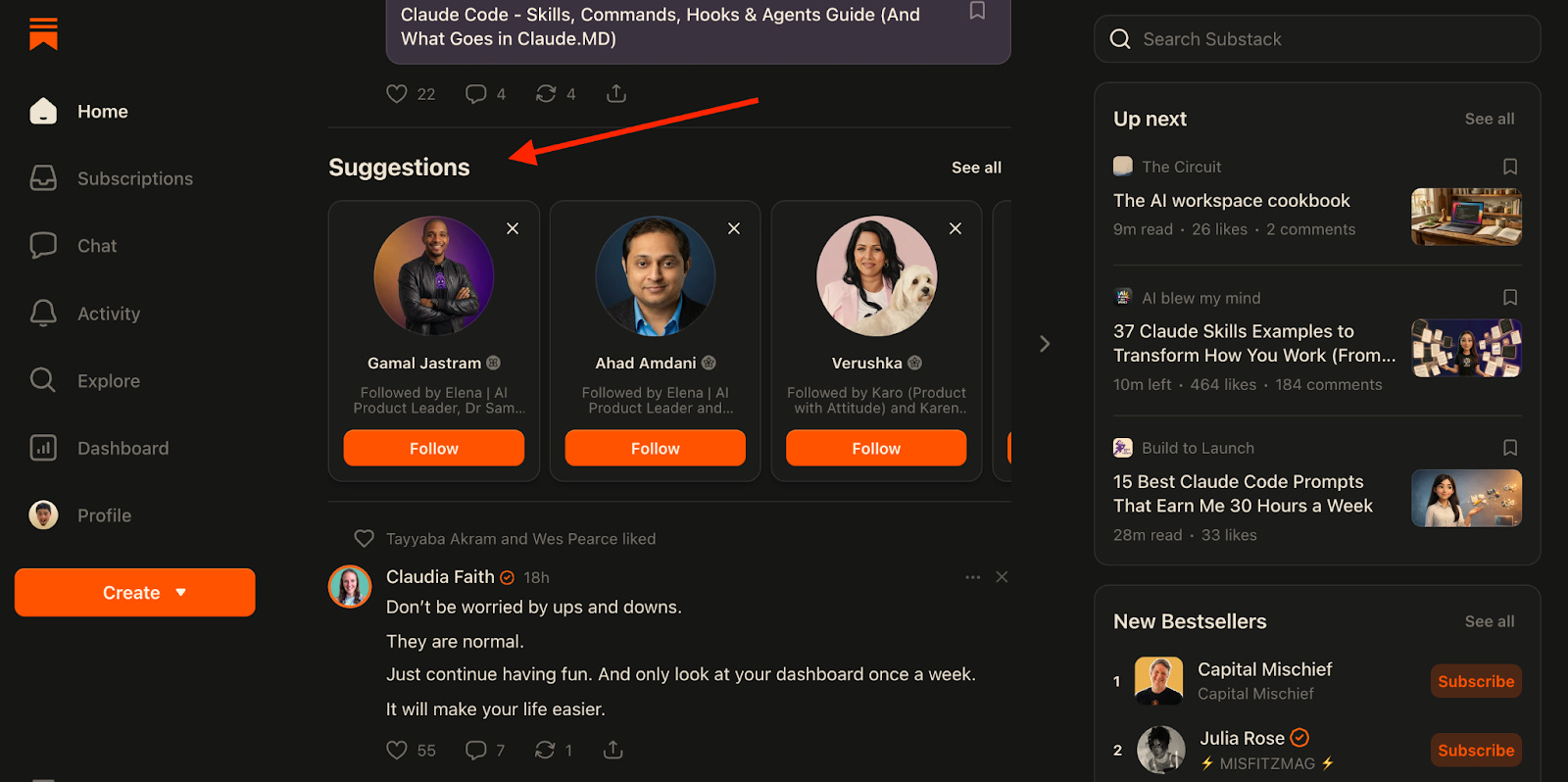
Method 2: The Network Of Your Network
Every creator you follow already has their own network.
Pay attention to who they collaborate with, who they mention, who they restack.
When a creator you respect does a collab post with someone new, that’s how you discover a creator you never would have found on your own.
This isn’t a method you actively sit down and do; it happens in the background as you consume content naturally.
Method 3: The Recommendations Trail
Once you’ve found a few aligned creators through Method 1 or Method 2, use this to multiply that list.
-
Pick a relevant publication in your niche you found through Method 1 or 2.
-
Add /recommendations to their Substack URL.
-
You now have the list of people that have an active Substack network, so the chance of turning them into a Substack friend is high
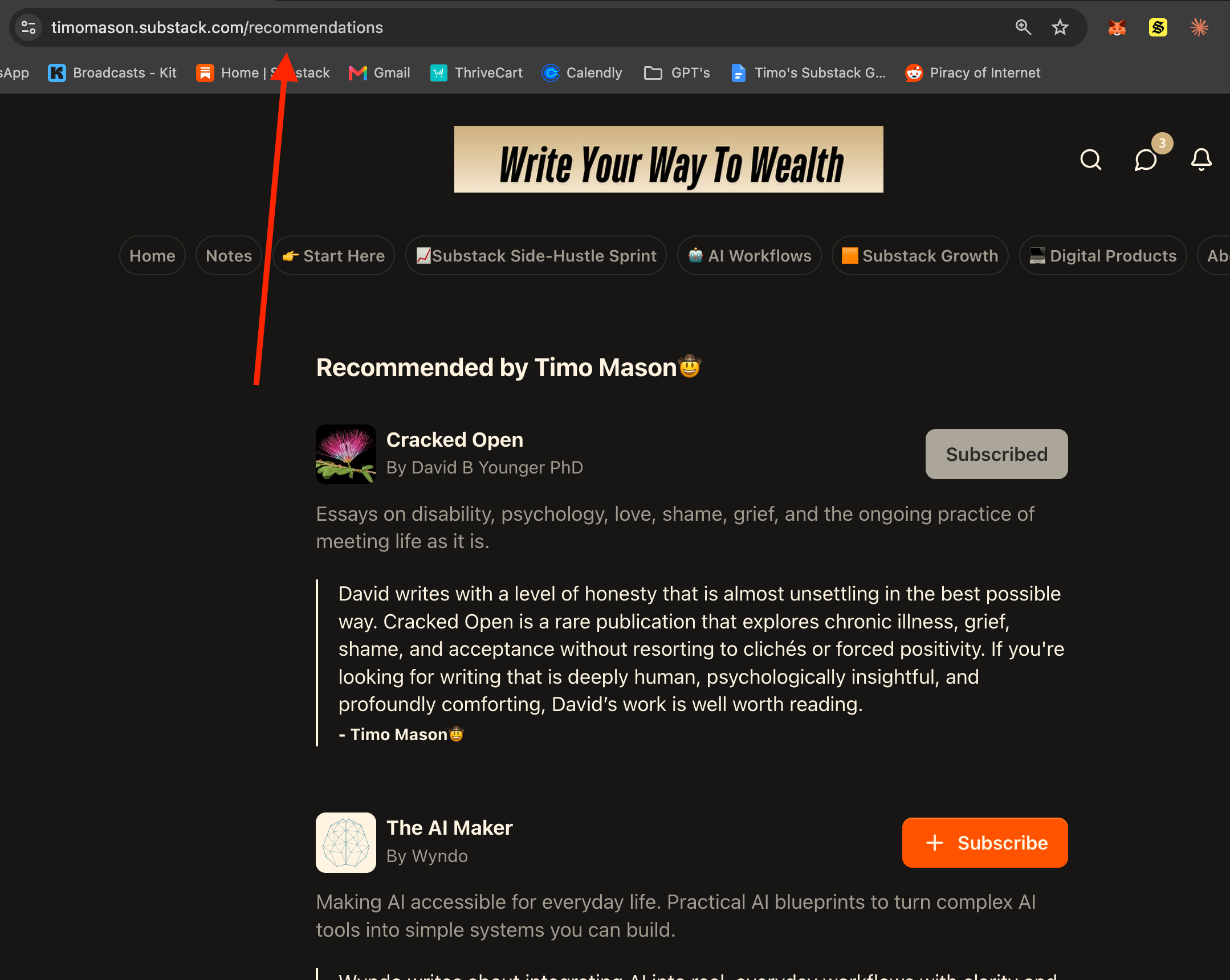 This is the URL you would use on my Substack to see all my recommendations in one list
Method 4: Curation Newsletters
Curation newsletters spotlight other creators worth reading, and they solve a problem creators struggle with.
put it perfectly in the comments of one of my own Curation posts:
“I’m having a very hard time finding new people to follow (Substack, hear me out... sort out your search algorithms haha) so these types of post help a lot!”
Substack’s search isn’t great, so curation newsletters are the workaround.
3 Curations I recommend:
-
Cozora by , &
-
The First Digital Dollar Project by
-
Method 5: Creator Match
You find this feature in your Creator Tools inside your dashboard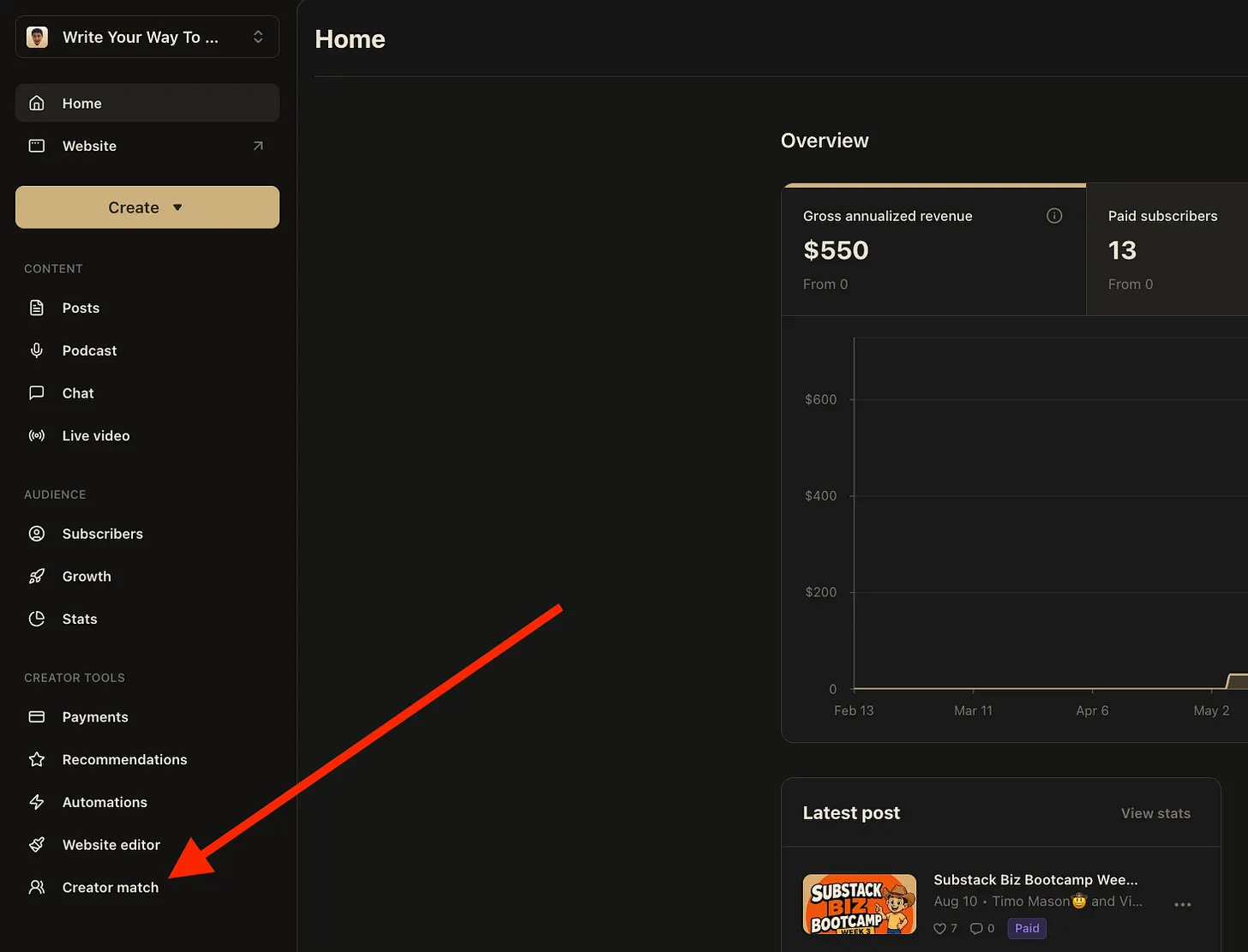
The interface looks like this: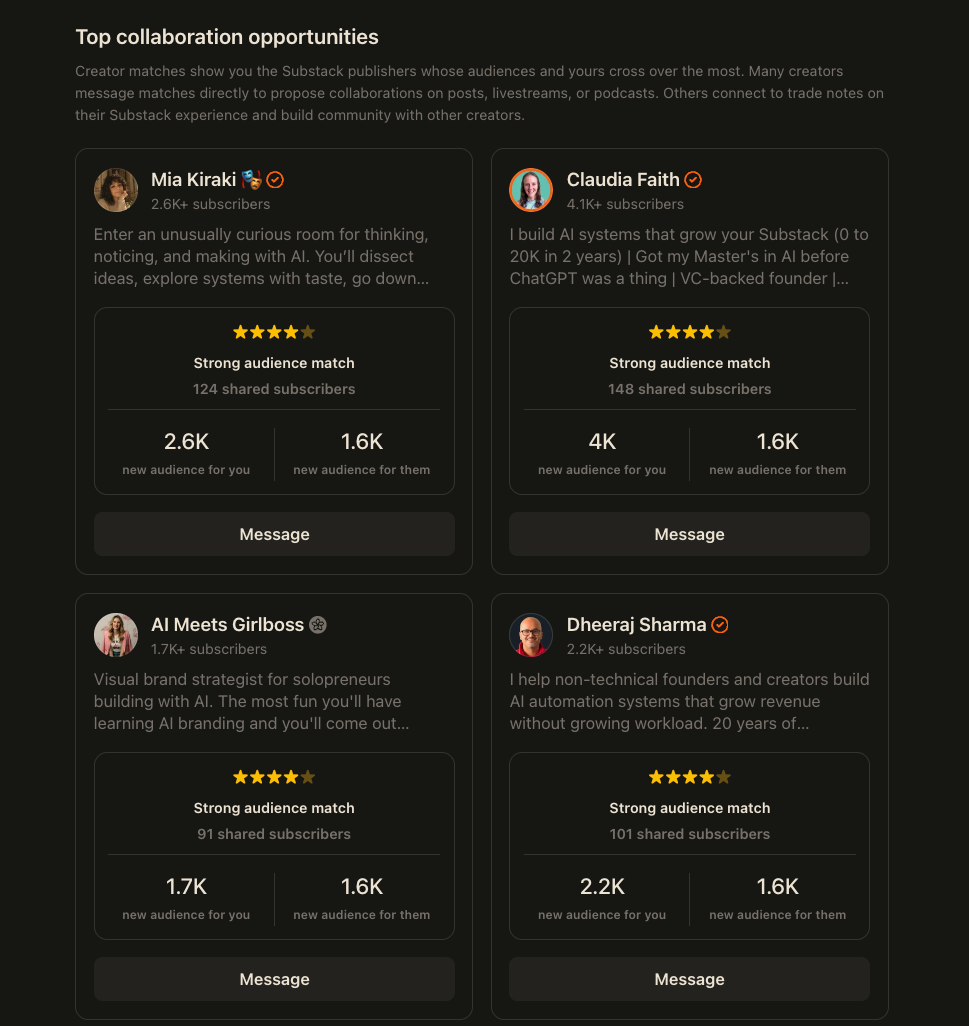
3 Reasons why this feature is goated
-
It only surfaces matches where there's mutual opportunity, meaning your audience overlaps with theirs and theirs overlaps with yours.
-
Matches get a star rating from three to five stars, Substack won't even surface anything below three.
-
Each match shows the estimated new subscribers you could gain and what the other creator could gain.
Why You Shouldn’t Trust The Feature 100%
The tool ranks matches by subscriber count and overlap, it doesn't tell you a thing about how engaged that person's list actually is.
A highly-rated match with a big but sleepy list is worth less to you than a lower-rated match whose readers actually comment and reply.
Before you message anyone, spend two minutes on their Substack and check whether their “big” audience is also engaged.
Find Substack friends where they already gather.
The Suggestions tab, the network of your network, the /recommendations trail, curation newsletters and Creator Match all hand you creators worth knowing, as long as you check that their audience is engaged, not just big.
Now you know how to find creators worth connecting with.
Here’s how to slide into their DM’s without making it weird…
Do you have a Substack friend that could benefit from this mini-book? :)
Sharing is caring and fully free of charge👇 :D
Chapter 2: How To Make A Friend Without Making It Weird
Most DMs fail before they're even read because the message makes it painfully obvious the sender didn’t do their homework.
“Hey, love your work! Would you be down to recommend each other?”
That message tells the other person you didn’t read a single word they wrote.
The fastest way to get ignored by a creator you admire is to treat them like a networking checkbox.
My Friendship Philosophy (Other Creators Will Hate Me For This)
I 100% disagree with the Substack advice out there.
Gurus teach the “build the relationship first, then ask for a recommendation” model.
I believe real creator friendships get built through working together and winning together, not weeks of talkie-talkie.
A recommendation swap (you recommend them and they recommend you) is one of the fastest ways to start winning together.
You both gain subscribers, and the relationship deepens cause you’ve already got a shared result.
So I optimize for creators who are direct, straight-up, and open to mutual support.
Step 1: Fix Your Profile First
BEFORE you send a single DM, make sure your profile looks clean and intentional.
The first thing any creator does after your message lands is to check out your profile, so if yours doesn’t look “recommendation-worthy” you get left in the dust.
A great profile will increase your outreach-to-recommendations conversion rate MASSIVELY, so go through The Perfect Substack Profile series.
Step 2: Read Their Work
Before you send a DM, go read their work.
Not a quick skim. Actually read it. This is what separates a message that gets a reply from one that gets ignored.
Step 3: Reach Out With Something Specific
Now you’re ready to DM.
And the keyword is specific.
A genuine question about something they wrote. A thought their article sparked. A compliment that couldn’t have been copied and pasted to anyone else.
Something like:
“Hey, I just read your piece on [specific topic] and the part about [specific point] completely changed how I think about [X]. Do you find that most of your audience struggles with this too?”
That message does 3 things at once.
-
It shows you’re thoughtful
-
It proves you actually read their work
-
It opens a real conversation instead of a transaction
Prove you read their work before you ask for anything.
Fix your profile, read their work and open with one specific point from it, cause that's what turns a cold DM into a real conversation with a creator who's ready to grow with you.
Now you know exactly how to find creators and how to reach out the right way.
You can do all of that perfectly and still blow it.
I see two specific mistakes creators make all the time on Substack, and either one is enough to kill your reputation.
Let’s make sure you’re not making them…
Chapter 3: The 2 Ways To Lose Substack Friends Fast
Don’t #1: Drop Links to Your Articles in Other People’s Comments
This one is more damaging than it seems.
You see a creator post a note that’s relevant to something you’ve written, so you jump in the comments and drop your article link. Feels natural, right?
Wrong.
To everyone reading that comment section (including the creator) it looks like you showed up purely to self-promote.
, put it perfectly:
“Don’t use other people’s notes as a billboard.”
Don’t #2: Use AI to Reply to Comments
It’s tempting to set up an engagement to slide into DMs and leave comments on notes & articles.
Save time, stay consistent, keep the algorithm happy, right?
BUT people can tell, the reply is too clean, too structured. It has none of the texture of a real human response.
The moment someone figures out they just “connected“ with a chatbot, trust is gone.
The whole point of networking on Substack is that it’s human.
The second you automate engagement, you’re not networking anymore, you’re just running a bot with your face on it.
Two simple rules.
Don’t drop links that feel like promotion. Don’t fake replies.
Never use other people's Notes as a billboard, and never fake a reply.
Dropping your links in their comments and letting AI reply for you are the 2 mistakes that leave a mark, and everything else is fixable.
You now know where to find Substack friends, how to reach out and what never to do, so the only thing left between you and your first Substack friend is the send button…
Chapter 4: It’s All Just Pixels On A Screen
You know what kills more collaborations than anything else?
Never reaching out at the end of the day.
Someone does all the research, finds 10 perfect creators, drafts the pitch in their head.
Then the self-doubt kicks in:
-
“I need a bigger audience first.”
-
“My content isn’t good enough yet.”
-
“What if they think I’m not qualified?”
So they wait, overthink, and never hit send.
It’s all just pixels on a screen.
That’s it.
You’re not walking up to someone at a conference and risking face-to-face rejection; you type a few sentences into a message box and click send.
You have nothing to lose.
Literally nothing.
If they say no, you're in the exact same position you were in before you asked, if they say yes, you just unlocked access to thousands of readers.
No downside exists. Only upside.
Worst case: you stay exactly where you are.
Best case: this changes your entire Substack journey.
So stop treating it like life or death, cause it’s not, you’ll be surprised how easy it feels once you realize it’s just pixels. :)
Hit send.
It's all just pixels on a screen, so the worst case is staying exactly where you are and the best case is access to thousands of new readers.
Once you hit send and a Substack friend says yes, the real fun starts, cause now you can leverage that friendship so you both win…
Liked this article so far?
Don’t gatekeep it from your Substack friends. ;)
Sharing is caring and fully free of charge👇 :D
Book 2: How To Leverage Your Substack Friends (So You Both Win)
A Substack friend you only chat with in the DMs is nice, a Substack friend you win together with is a growth asset.
Every creator in your network has their own audience, and part of those readers would subscribe to you if they just knew you existed.
Here are 5 ways I leverage my Substack friends, and every one is a win for both sides.
Chapter 5: Recommendation Swaps: Friends Who Send You Subs On Autopilot
Want to get subscribers on autopilot?
Well… who wouldn’t? :D
The closest thing we have is the Recommendations feature.
(Half of you just thought: I already have a recommendations section.)
Well… “having one” isn’t the same as one that actually brings you in subscribers week after week. ;)
For example I recommend and he recommends me back, so far he's brought me 5 subscribers and I've brought him 11.
Small numbers, but they keep coming in without either of us doing any extra work, and they count toward the 500+ total.
How Recommendations Work
When a visitor subscribes to any publication, Substack shows them that publication’s recommendations right after they hit subscribe.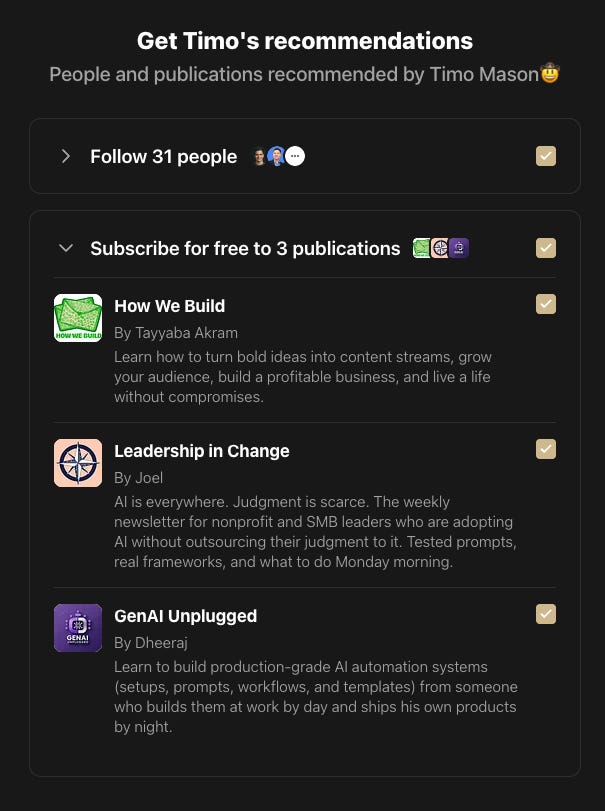 View of the recommendations from the visitor perspective
At this point, the visitor’s brain is in discovery mode, so if your publication is in the same interest field as the one they just subscribed to, hitting “subscribe” on your publication too feels like the natural next step.
You don’t even have to put in any work to get discovered.
The only work happens earlier, convincing the creator to recommend you in the first place, so now I will also show you how to make this process smooth as 🧈butter🧈. :D
How To Set Up / Manage Recommendations Correctly
Recommendations live inside your Substack dashboard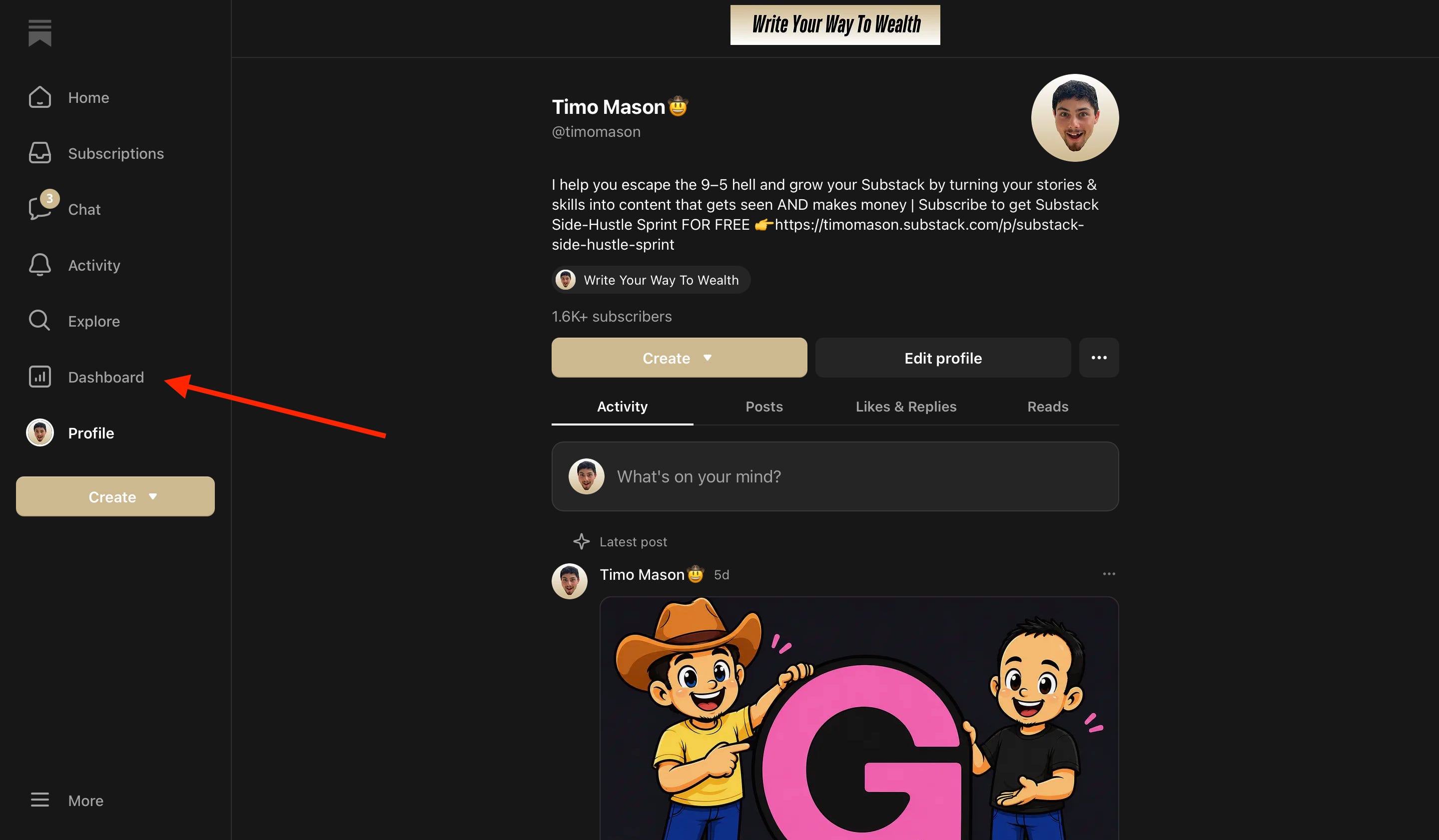
Under (who would have thought it) Recommendations.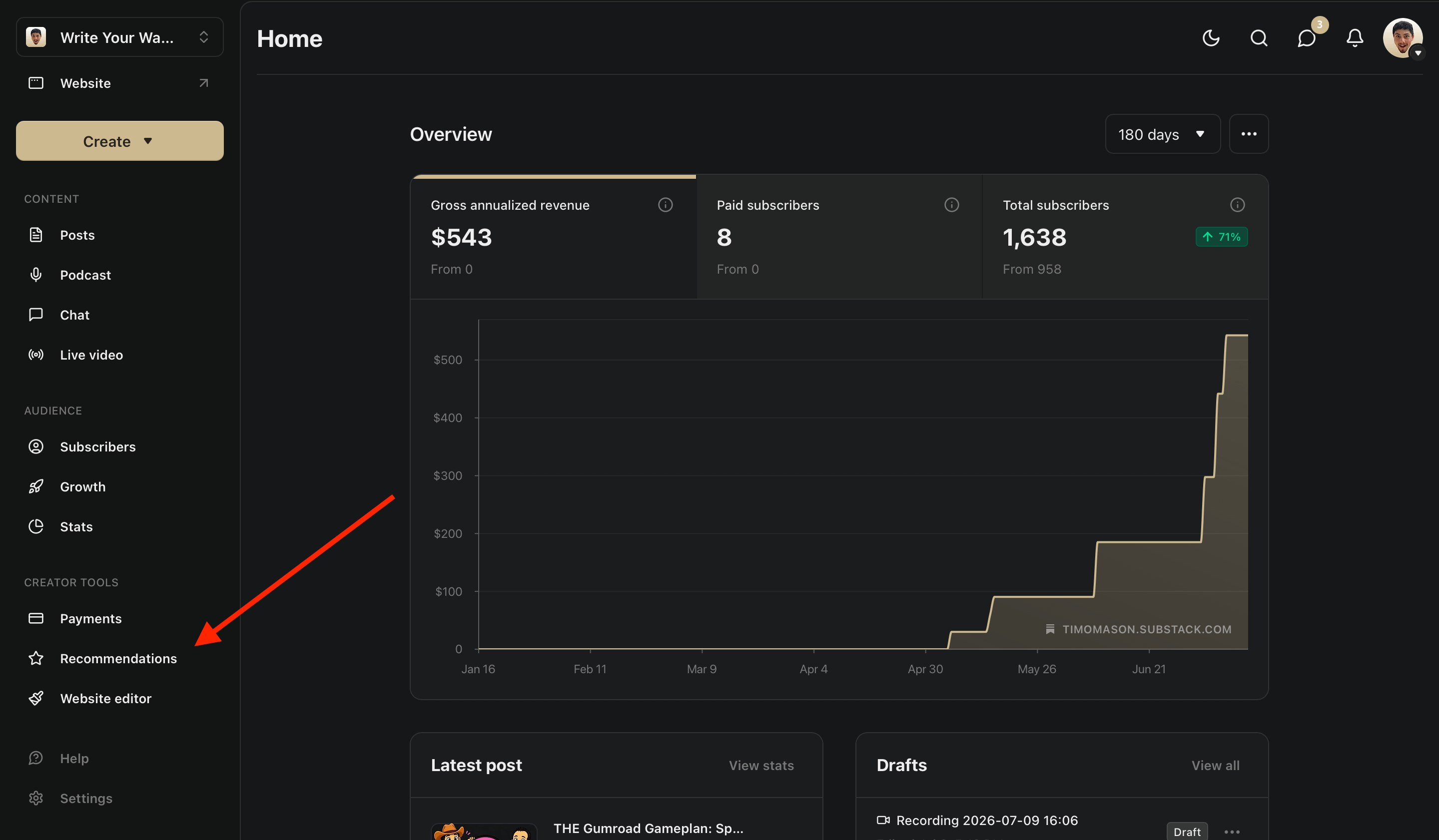
There, you'll find an overview of your incoming & outgoing recommendations, and you can add new ones as you wish.
My 3-Step Recommendation Workflow
Step 1: Clean Up Your Outgoing Recommendations
Before you add a single new recommendation, audit what you already have.
-
List every publication you currently recommend.
-
For each one, check: do they recommend you back?
-
If the answer’s no, ask directly for a swap using the DM framework below, then wait 3 days.
-
Still no reply? Remove them.
“But what if I don’t want to seem pushy by directly asking?”
You’re running a business, and a one-directional recommendation is a misdirection that could go to somebody who supports you too.
Step 2: Find Recommendation Partners
For this, we reach out to all your Substack friends you made from book 1 + the recommendation trail strategy, to discover more opportunities.
So you don’t have to scroll up again here’s the process again. :)
-
Pick one of your friends' publications
-
Add /recommendations to their Substack URL.
-
You now have the list of people they are recommending, so the chance is high that these people are open to a recommendation swap also
This is the URL you would use on my Substack to see all my recommendations in one list
Step 3: Ask Via DMs
Recommendations come from asking directly, not from liking, commenting, or just recommending them and hoping they return the favor.
Copy these scripts, rewrite them in your voice, fill in the blanks, and send them via DM.
Initial message:
“Hey [Name], I recently came across your work on [Publication Name] and really love what you’re doing, especially [specific thing you genuinely appreciated]. I run [Your Publication], which is for [audience] who want to [outcome]. I think there’s real audience overlap between our readers, and I wondered if you’d be open to a recommendation swap to start, and we could explore other ideas from there.
Follow-up after 3 days (if no reply):
“Hey [Name], just bumping this up in case it got buried. No pressure at all, if it’s not the right fit, I totally understand. Wanted to make sure you saw it.”
Weekly Execution Checklist
Run this every week, no exceptions:
✓ Identify 20 aligned creators
✓ Send 20 DMs using the framework
✓ Follow up with anyone at day 3
✓ Check your current list and remove anyone who stopped recommending you
Is this really worth all the work?😩
Yes! Just take another look at the results I got. ;)
Long-Term Notice
Recommendations are a slowly-but-surely thing that compounds the longer you stick with it.
20 DMs a week feels small in isolation, stack twelve weeks of it and you’ve contacted 240 creators and built a recommendation network that keeps feeding you subscribers long after you stop actively DMing.
Swap recommendations with every Substack friend who's ready to grow with you.
Clean up your one-way recommendations, send 20 swap DMs a week, and follow up on day 3, cause this slow-and-steady channel brought me 500+ subs without any extra work.
Recommendations are slow & steady while guest posts and collabs put you in front of someone else's whole audience at once, so let’s take advantage of them too. :)
Chapter 6: Guest Posts & Collabs: Borrow Your Friend’s Whole Audience
One post brought me 5,000 new readers in a day.
It wasn’t a viral lucky hit.
I didn’t pay for ads or buy my way onto someone’s feed.
It was a strategic collaboration and the person who brought in the 5K audience even thanked me for it. :D
Most Substack writers think growth means: write better headlines, post consistently, hope the algorithm notices you, wait 18 months to hit 1,000 subscribers.
That’s not a strategy, that’s a prayer in disguise.
Smart creators play a different game.
They collaborate their way into other people’s audiences with guest posts and co-authored articles.
When I wrote a guest post for ’s newsletter, The AI Maker, my subscriber count spiked harder than ever.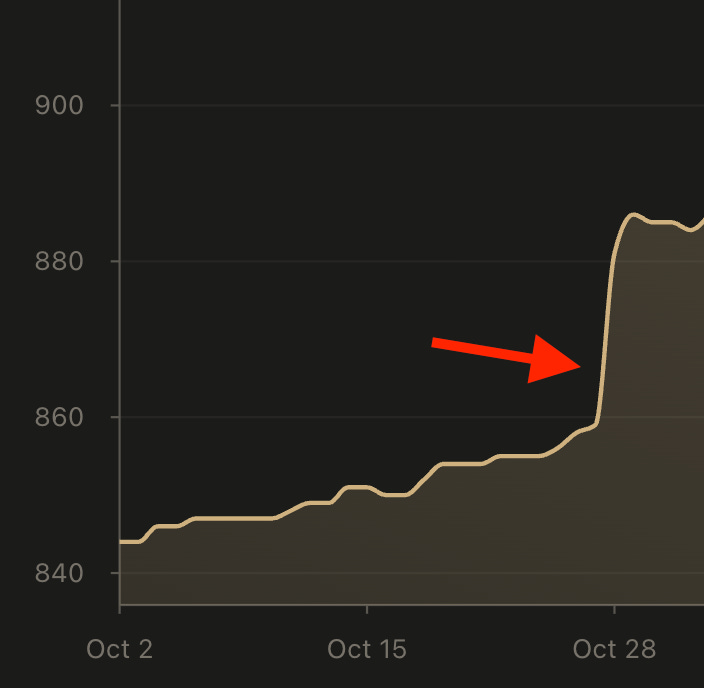
Wyndo got a killer article for his readers without lifting a finger, and I got instant access to his entire audience.
Both of us won.
What Audience Hacking Actually Is
It means strategic collaboration with other Substack writers to get your work in front of their readers.
You write something valuable for another creator’s newsletter. Their audience reads it. A percentage thinks, “Damn, this slaps. Who is this person?” They click your name, check out your newsletter, and subscribe.
3 Reasons why it works so well on Substack:
1. Email feels intimate.
Unlike social media, where people scroll past everything, email hits their inbox. If someone opens a newsletter, they’ve engaged. They trust the sender, and when that sender introduces you through a guest post, that trust transfers to you instantly.
2. Substack readers collect newsletters.
People on Substack don’t just read one newsletter. They subscribe to 10, 20, sometimes 50 different writers. They hunt for new voices and a good guest post acts like a curated recommendation: “If you like me, you’ll love this person.”
3. The math crushes.
Say you write a guest post for a newsletter with 5,000 readers. Even if only 2% of readers click through to your profile and subscribe, that’s 100 new subscribers from one article you didn’t even publish on your own Substack.
Most people screw up when choosing the right content format. This decision determines whether you get a “Yes, let’s do it!“ or radio silence.
So let’s break down the 3 collaboration formats that actually work, and when to use each one.
The 3 Converting Collab Formats
Format #1: The Guest Post
You reach out to another Substack creator and ask to write an article for their newsletter.
You write, they publish, their audience discovers you.
Why it works:
When you publish on someone else’s Substack, their readers assume you’ve been vetted. The host essentially says, “I trust this person enough to let them talk to you.” That implicit endorsement beats any ad you could buy.
Plus, the host gets a high-quality article without doing the work. You get access to their entire audience. Both of you win.
Best for:
Any creator willing to put in the work. This format pitches easiest because you offer pure value. They get free content, you get exposure.
Pro tip:
If the collaboration goes well and they loved your article, circle back later and ask if they’d want to write a guest post for your newsletter too.
Format #2: The Co-Authored Article
This format has you and another writer create one piece of content together, and you both publish it to your respective newsletters.
Why it works:
You pool expertise and split the workload. The article benefits from two perspectives, which makes it more valuable. And since you both invest in making it great, the quality usually improves.
Plus, you both promote it hard because you both have skin in the game.
For example, here’s a post I wrote together with about how to pimp up your Substack with Claude design
Best for:
Writers who complement each other’s expertise. For example, one person writes about AI tools, the other writes about content strategy. Together, you create “How to Use AI Tools for Content Strategy.“
Format #3: The Curation Collab
This format has you feature multiple creators in a single article.
You write an article mentioning other Substack creators and their newsletters. When they see they’ve been featured, many share it with their audience, which helps their readers discover you.
Why it works:
You leverage multiple audiences at once instead of just one. If you feature 10 creators and half share the article, you’ve tapped into 5 different audiences with a single post.
Best for:
Creators who want to maximize reach with one piece of content. The more people you feature, the more potential promotion you get. (But don’t overdo it)
How to Land Substack Collab Partners
Most creators spend weeks “researching” and never actually reach out, or they fire off generic DMs to 50 people and wonder why nobody responds.
Before you hunt for collab partners, understand what they want.
Subscriber count doesn’t tell the whole story.
Yes… numbers matter. A creator with 5,000 subscribers signals they’re doing something right, but when you pitch a guest post, the host doesn’t just glance at your subscriber count and decide.
They click through to your newsletter and read if your content is “guest-post worthy”
That determines if you get a yes or no.
If you have 200 subscribers but your posts cut sharp, deliver value, and read well, you’ll get more yeses than someone with 2,000 subscribers posting mid-content.
Subscriber count gets you noticed, but quality gets you approved.
So before you pitch anyone, make sure you have at least 3-5 solid articles published because that’s what they’ll judge you on.
Then you are ready to slide into their DMs.
Here’s the DM template that gets responses:
Hey [Name],
I’ve just checked out your newsletter and loved your recent post on [specific topic].
I write about [your niche] and thought your audience might find value in [specific article idea that fits their content].
Would you be open to me writing a guest post for [Newsletter Name]? Happy to tailor it to what resonates with your readers.
Either way, keep up the great work.
[Your Name]
Why this works:
✓ You reference something specific (shows you actually read their stuff)
✓ You lead with value (what’s in it for them)
✓ You make it easy to say yes (no big commitment)
✓ You’re not needy (the “either way” line shows you’re fine if they decline)
Most creators will either say yes immediately or ask for more details.
If they don’t respond within a week, follow up once. If they still don’t respond, move on.
The key to landing collabs is volume over perfection.
Pitch 10 people; 3-5 will respond, and 1-2 will say yes.
That’s the natural conversion rate. :)
Borrow your friend's audience with a guest post or collab.
Pick a format, get 3-5 solid articles live and pitch 10 creators, cause 1-2 yeses can bring you more readers than months of posting alone, like the 5,000 I got from one post on Wyndo's newsletter.
Guest posts and recommendations get you new subscribers, and the next 3 chapters show you how your Substack friends help you turn those subscribers into trust and money…
Do you have a Substack friend that could benefit from this mini-book? :)
Sharing is caring and fully free of charge👇 :D
Chapter 7: Testimonials: Let Your Friends Vouch For You
A stranger landing on your Substack doesn't know you yet, so they look for proof that someone else trusts you.
Nothing does that better than a testimonial block with real people saying you’re a cool and helpful dude.👇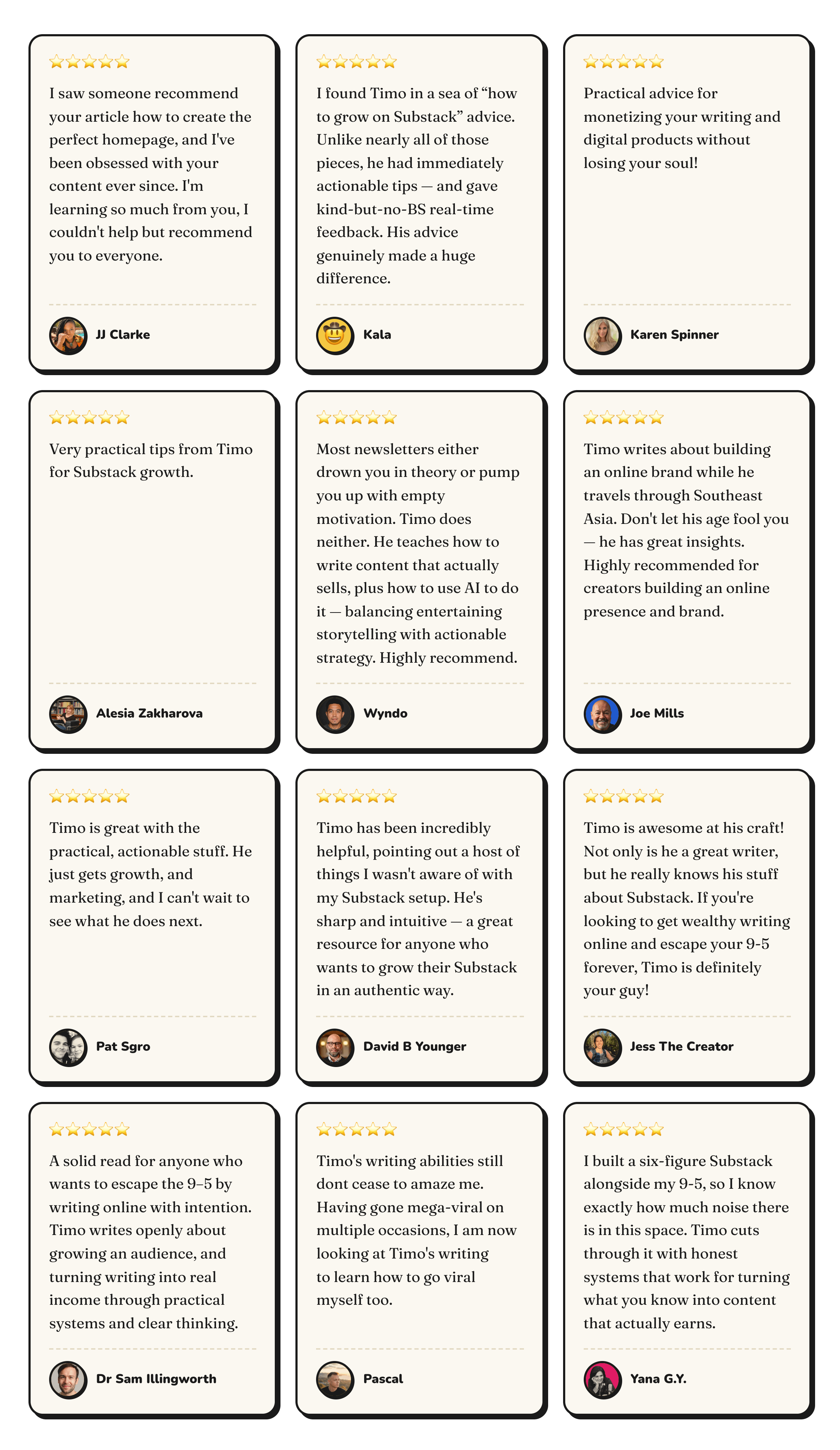
This is my testimonial row, and it exists thanks to , , , , , , , , , , and
It’s displayed on a bunch of places on my Substack, like my Start Here page and my welcome mail.
Almost every creator in that row is part of my network, and I got these testimonials cause we were already connected, and they genuinely like my content.
It also works both ways. Whenever they asked, I helped them out or wrote a testimonial for them, so they trust me just like I trust them. :)
Let your Substack friends vouch for you, and vouch for them back.
Testimonials from creators in your network show new readers that people they already trust vouch for you.
It works both ways: when you return testimonials, you build their trust, too.
Testimonials build trust, and your Substack friends can do even more for you before a product ever goes live…
Chapter 8: Beta Testers: Friends Who Make Your Product Better
When you're unsure about a content or product idea, ask your network.
They are happy to help and glad to have someone to reach out to when they are in a similar situation.
When I built Substack HQ (my Notion template to manage Substack content), I invited some fellow creators to beta-test it before launch.
(the king of Notion templates) agreed to test it, gave me valuable feedback to improve and position the product, and even provided a testimonial, which loops right back to Chapter 7 and now helps me sell Substack HQ.
, and also gave me valuable feedback to make Substack HQ better in ways I would not have thought of myself. :)
Let your friends test it before your readers see it.
Before you launch a product or big post, let a few creators from your network test it, cause they'll spot what you missed.
You get a better product, and often a testimonial that feeds right back into Chapter 7.
A better product is great, and once it launches, your Substack friends can help you sell it too…
Chapter 9: Affiliates: Friends Who Help You Sell
When you launch a product, give creators in your network an affiliate link so they earn a cut of every sale they bring in.
Once, in 2025, I launched a course on Gumroad, one big email marketing expert with a high-quality email list of 10K+ subs agreed to be an affiliate. He single-handedly turned the launch into a win by adding $693 to revenue.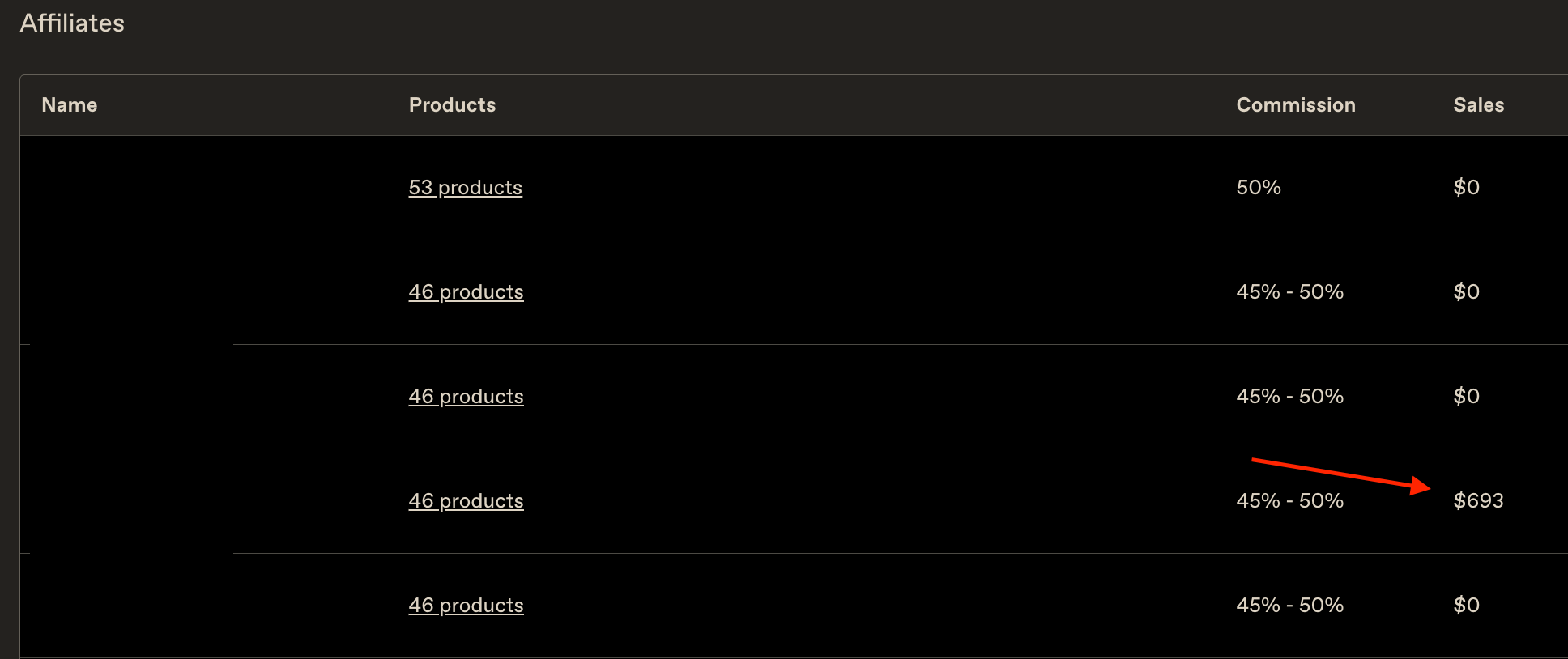
Give your friends a reason to sell for you.
Give creators in your network an affiliate link when you launch, so they earn from every sale they bring in.
One affiliate added $693 to my Gumroad launch and turned it into a win.
Your Substack friends bring you readers, subs and sales, and now it’s on you to make sure those new readers actually stick around…
Book 3: How To Influence Readers
You just got a new subscriber, and for about ten minutes, it feels amazing.
Then you go back to writing the next article, and that subscriber goes back to their Substack feed, and you both forget the other exists.
99% of Substack creators obsess about getting subscribers, but almost nobody builds a system to deepen that relationship and turn a mere “subscriber” into a superfan! :D
Book 3 fixes that, with 3 chapters that turn the readers your Substack friends bring you into committed fans.
Chapter 10: Reply To Every Single Comment
Think about who’s reading your Substack.
They are probably as busy as you.
-
9-5
-
Maybe kids
-
A to-do list that never gets shorter
Their free time is precious, and they’re already spending a piece of it reading your content.
Now imagine they don’t just read it, they stop, think, and type out a comment.
That person is busy, just like you, they could’ve scrolled past, liked it, and moved on, but they didn’t.
The least you can do is reply back.
Why Comments Are Gold
Replying to every comment is basic human respect, and it's also the highest-leverage habit for the Substack algorithm.
A like takes one second. A restack takes two. But a comment takes intention. It means someone read what you wrote, formed a thought, and cared enough to share it publicly.
The Substack algorithm reads that signal loudly.
More comments = Substack pushes out your content to more people.
- Every comment is a micro-relationship waiting to be built.
The person commenting is already warm. They already trust you enough to engage. All you have to do is show up for them, the same way they just showed up for you.
The Reply Framework
✓ Reply to every comment, every time (on your notes AND your articles. No exceptions.)
✓ Make it personal (reference something they actually said. Don’t copy-paste the same “Thanks for sharing!” back at everyone.)
✓ End your reply with a question (A question invites them to respond again. Now you have a real conversation happening inside your content.)
Something like:
“That’s exactly what happened to me in my first month, took me way too long to figure out. What’s been the hardest part for you so far?”
That one line can turn a single comment into a full-fledged conversation, and this convo is one of the best ways to boost your content AND build real relationships.
Reply to every comment, and end with a question.
A reply that references what they said and ends with a question turns a one-time comment into a real conversation, and the Substack algorithm pushes that conversation out to more people.
Now let’s talk about the people who just hit subscribe, and why the first week is your most important window…
Chapter 11: The 5-Message DM System That Turns Subscribers Into Superfans
Most creators celebrate a new subscriber for about three seconds.
They see the notification, feel a little dopamine hit, and move on.
And yes… I’m sure they get an amazing, personal welcome email from you. :)
BUT Substack gives us something even more direct, and almost nobody is using it.
The DM feature.
Every week, new subscribers are joining your world, and most creators let that moment pass with nothing but an automated email.
Why the First Week Matters Most
Think about it from their side.
They just found your Substack. They’re curious and actually want to hear from you; that’s literally why they subscribed.
That window doesn’t stay open forever.
Life gets busy. Inboxes fill up. The excitement fades.
The creators who reach out in that first week catch people at exactly the right moment, when the connection is fresh and the interest is real.
(Half of you just thought: “Well… I don’t have time to personally message every new subscriber.”)
That’s why I will show you a DM system that runs pretty much on autopilot. :D
3 Reasons Why Every Creator Should Leverage DMs
1. You get the truth
Majority of your article comments are positive and highlight the “good” parts of your writing, but to improve you need REAL feedback.
What’s confusing, unclear, missing, or poorly structured.
Ask your readers directly via DM, and they'll give you their real opinion, something that would never appear in any public comment section.
2. You build relationships
DMs are the most personal way to communicate with your readers.
Just the fact that you put in the effort to reach out is a major sympathy point for them.
This way you move in their mind from “some guy I read” to “the cool creator I personally chat with :D”
3. You filter for people that qualify for more help
I got all my coaching clients so far through DMs.
We just talked and saw that it was actually a good fit.
I could truthfully say, “I made $1000’s through Substack DMs.”
BUT…
DMs are primarily about building relationships, and ONLY about selling if that’s the next natural step to help them move forward.
The DM Tool That Does The Work For You
Sending 20-plus personal DMs a week by hand is a part-time job you didn’t sign up for.
StackContacts Connect* from , is the tool I use, to take the workload off my shoulders.
It automates DM sending and auto-inserts each subscriber’s display name, so “Howdy {{USER_NAME}}🤠” becomes “Howdy Sarah🤠” without you typing a single name.
My 5 Message DM Sequence To Turn Readers Into Superfans
DM 1: Turn followers into subscribers
Some people only follow and don’t subscribe; this DM helps them take the next step.
Howdy {{USER_NAME}} 🤠
Thanks for following! :D
I was wondering what stopped you from actually subscribing? (yeah that’s different than following)
Cause I have the free 5-day Substack Side-Hustle Sprint prepared for you to send out right after you hit “subscribe”. :)
Let me know whats stopping you, and if I already convinced you to become a subscriber and receive the free 5-day Substack Side-Hustle Sprint you can click here → http://timomason.substack.com/subscribe
DM 2: Welcome + Bucket Question
Say hi to every new subscriber and bring them deeper into your content ecosystem.
Howdy {{USER_NAME}} 🤠
I just saw you subscribed to Write Your Way To Wealth. :)
People usually subscribe for one of these:
- Getting started on Substack and setting it up perfectly
- Building a loyal audience
- Turning Subscribers into customers
Which (if any) sound relevant? I might have something that can help you. :)
DM 3: The Right Next Article
Send one high-fit piece of content per bucket, and ask a simple clarifying question to keep the convo going.
Nice, when you are just getting started, I can definitely recommend this article to you, which is a quick win to set up your Substack profile perfectly. :)
Why did you decide to start Substack / Whats your goal here?
Don’t rotate links for every person.
Pick one strong article per bucket and reuse it.
DM 4: One Clear Ask
Turn a nice chat into a concrete action:
Sharing the newsletter, giving you a testimonial or providing feedback.
Use whatever is your priority right now.
Sharing the newsletter to maximize growth:
If you enjoy the newsletter, do you know 1 person who’d like it too?
Feel free to share the publication with this link:
[PASTE YOUR PUBLICATION URL HERE]
Testimonials when you focus on building social proof:
If the newsletter has helped you in any way, would you be open to sending 1–2 sentences I could use as a testimonial?
Feedback when you want to improve the user experience:
Quick favor, I’m trying to improve my content.
If you have 60 seconds, what part of the newsletter has been most useful so far, and what do you wish I’d cover more?
DM 5: The 30-Day Check-In
Sending a DM 30 days after they subscribed shows you actually care.
Howdy {{USER_NAME}} 🤠
You subscribed to Write Your Way To Wealth about a month ago.
Time flies ;)
Just wanted to check in and see how you’re doing. What’s your biggest bottleneck right now?
Ask one open question, then use their reply to route them into help, content, or a deeper conversation.
This single check-in DM can resurrect subscribers who forgot they ever signed up.
Your 7-Step Implementation Checklist
-
Get the DM tool StackContacts Connect
-
Write DM 1 (follow-to-subscribe nudge)
-
Write DM 2 (welcome + buckets)
-
Pick 1 best link per bucket for DM 3
-
Write DM 4 (share ask, plus optional feedback ask)
-
Write DM 5 (30-day follow-up)
-
Activate the automation
Talk to every new subscriber in their first week.
The 5-message DM system turns subscribers into superfans on autopilot, and DMs are where every one of my coaching clients came from.
Now let’s talk about a feature most Substack creators ignore, and how the best ones use it to turn their newsletters into full-fledged communities…
Chapter 12: Use The Subscriber Chat
Substack has a built-in chat feature.
A direct, real-time line between you and every single subscriber.
No algorithm decides who sees it, and no inbox filters, just you talking directly to the people who care most about your work.
Most creators never touch it.
That’s like having a private room full of your most engaged readers and never walking in.
What the Subscriber Chat Is
Think of it as a group chat that lives inside your Substack.
Only your subscribers can access it, so everyone in there already knows who you are, reads your work, and wants to hear from you.
It’s basically a minimum viable community, where every subscriber can talk with you and each other.
How to Use The Subscriber Chat
There’s no single right way to run your chat.
Here are 2 approaches from creators who built a real sense of community in their subscriber chat.
The Template Approach by
Anfernee runs structured weekly prompts. Same format, every week, on repeat.
-
Finish Friday — “What did you ship this week?”
-
Mission Monday — “What’s one desired outcome you have for this week?”
-
Tweak Thursday — “Drop a link to your current project and I provide feedback.”
Same question. Every week, almost zero extra effort once you set it up.
It creates a community rhythm. Subscribers start showing up because they know what to expect. They answer, they read each other’s answers, they start talking. Anfernee just asked one question, and the community does the rest.
If you’re time-constrained and want to run a chat without it taking over your life, this is the model to copy.
The Intimate Approach by
Jenny’s approach is simple but powerful.
Every time she publishes a new article, she shares it in the chat, but not just as a link dump.
She adds a little background, the thought behind the piece, something personal that didn’t make it into the article itself.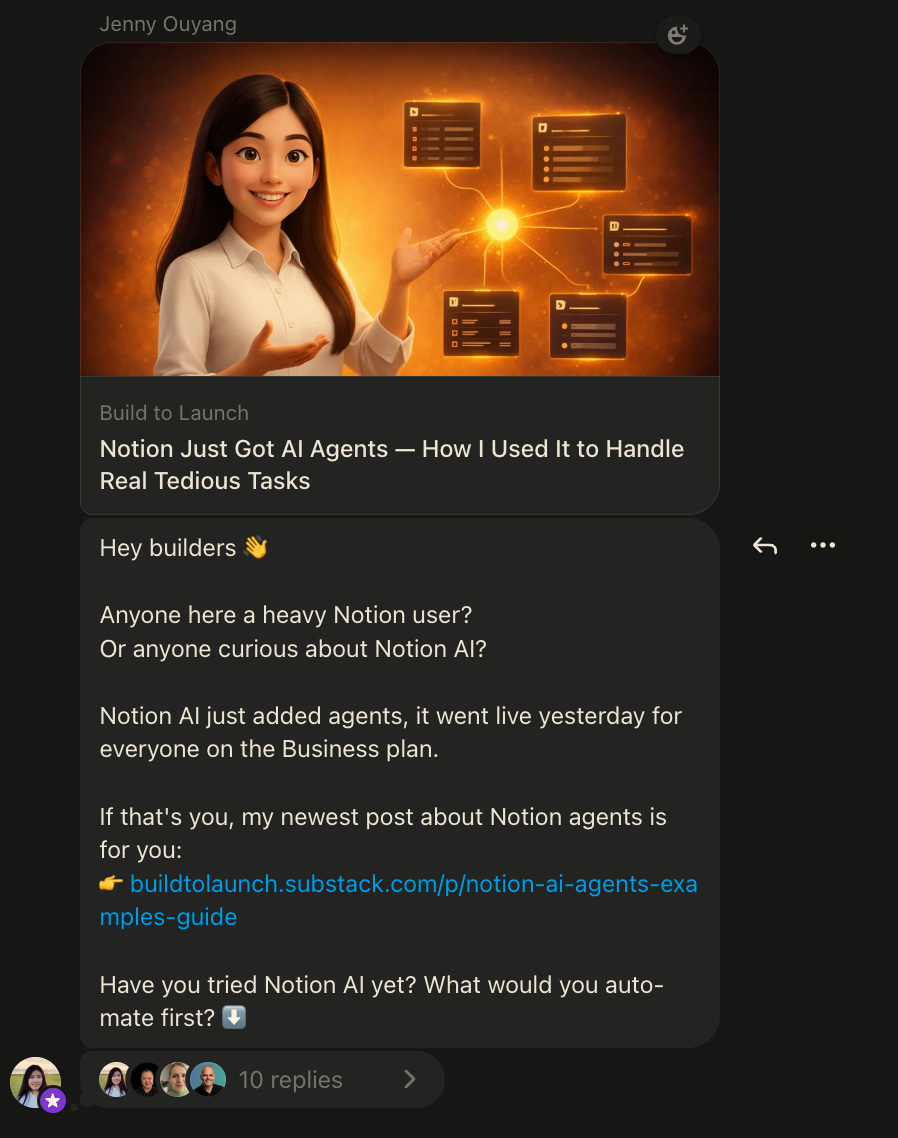
It creates an intimate feeling, like subscribers are getting a private behind-the-scenes look at the newsletter. Not just what she published, but why she wrote it and what she was actually thinking.
Then she ends with a question to spark a real conversation inside the community.
The article is public. The chat is personal, and that small difference makes subscribers feel like insiders.
The Simplest Way to Start
You don’t need a full system on day one.
Start with Jenny’s approach, it takes two minutes:
✓ Publish your next article
✓ Share it in your chat
✓ Add one genuine question or a private thought you didn’t include in the article
That’s your first chat post.
The Subscriber Chat won’t replace your newsletter, but it can create a real sense of community.
Give your readers a place to talk.
Share each new article in your Subscriber Chat with one private thought and one question, cause that 2-minute habit turns your newsletter into a community.
The Substack Friends Checklist
This mini-book packs 12 chapters into one article, and nobody puts all of that into action in one sitting, so I turned every step into a free checklist you can duplicate, keep forever and tick off one chapter at a time:
The Network Net-Worth Audit Prompt
This mini-book has 12 chapters, and trying to apply them all at once is the fastest way to apply none of them.
This paid-sub exclusive prompt checks your network across all 3 Books, shows you which one is holding your growth back the most, and gives you a 7-day plan to fix it. :)
Paid subs see the Network Net-Worth Audit Prompt here. Upgrade now to get full access.
Your Network Is NOT Your Net Worth
Let’s come back to that basic-ass phrase one last time:
“yOuR nEtWoRk iS yOuR nEt-WoRtH”
The network marketing crowd had huge networks, but they mostly used them to feel less alone and to put off actual progress.
Book 1 showed you how to win Substack friends who are ready to grow with you, without weeks of talkie-talkie.
From there, Book 2 turns those friendships into your path to your first 1K subs and your first $100 online: recommendation swaps that keep sending you new subs every week, guest posts that put you in front of a whole new audience at once, testimonials that make strangers trust you, beta testers who make your first product better, and affiliates who help you sell it.
Book 3 then makes sure the readers your Substack friends send you actually stick around, cause your first 1K subs only count if they stay, read and one day buy from you.
Win Substack friends by finding them through the Suggestions tab, the Recommendations Trail, curation newsletters and Creator Match, then reach out with something specific and optimize for creators who are ready to grow together.
Leverage them with recommendation swaps, guest posts, testimonials, beta feedback and affiliate links so you both win, and influence the readers they bring you by replying to every comment, running the 5-message DM system and using your Subscriber Chat.
Pick one lever and ask one creator friend this week, that’s all it takes to start.
Upgrade now to access The Substack Biz Bootcamp, my weekly AI Prompt Drop, The Classified Intelligence Vault and a 1-on-1 strategy call with me
See you next week, Brian :)
Timo Mason🤠