The uncomfortable truth about viral spikes that most Substack gurus won't say out loud
By Timo Mason🤠
Published: 2026-03-10
URL: https://timomason.substack.com/p/chasing-viral-notes-kills-your-newsletter

Howdy, Wealth Gang🤠
Every creator wants to go viral.
And I get why.
You’re up at 11 pm, kids are asleep, laptop open, writing your third draft of the week, and then some guy with 200 followers posts a random note and wakes up with 1,000 new subscribers.
It feels like the game is rigged, so naturally, you start studying the spike.
You chase the format that blew up last Tuesday.
You reverse-engineer the hook.
You post at the “right” time.
I know this game intimately, because I won it once, with a Twitter thread that hit 5 million views.
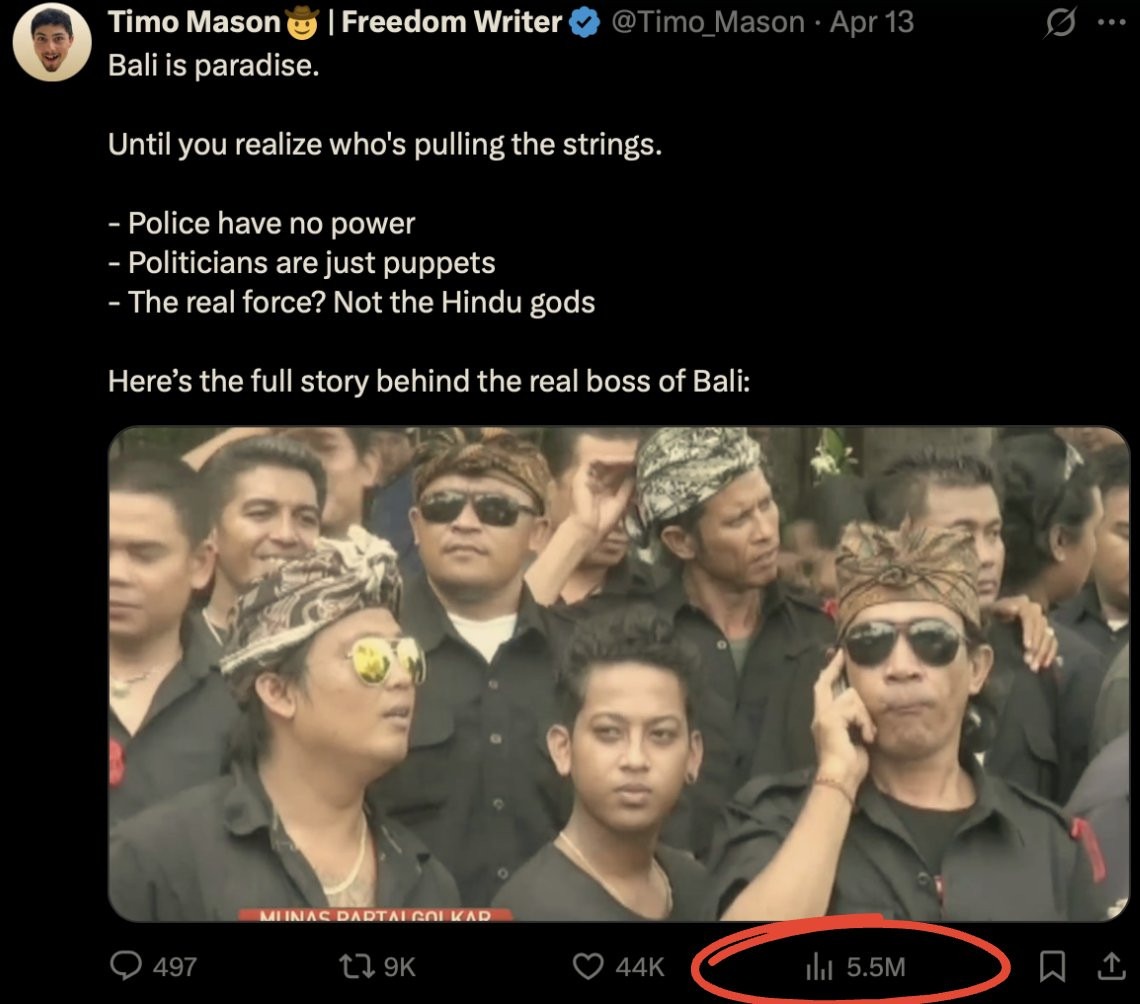
For about a week, I was untouchable.
Notifications going crazy, follower count climbing, strangers quoting my words back at me.
I genuinely thought, “Okay, I guess I’m a Twitter superstar now.”
Two weeks later, nobody cared.
Not a gradual fade, a cliff.
The algorithm had already moved on to the next shiny thing, and it took “my audience“ with it.
The followers stayed on paper, but the attention was gone.
No real subscribers, just a really impressive screenshot and a quiet timeline.
Going viral feels like momentum, but it’s just noise with good timing.
Here’s the truth, the Substack growth gurus praising “viral notes” won’t say out loud:
Going viral is not a strategy, it’s a weather event.
You can increase your chances of getting struck by lightning, sure. But you wouldn’t build your entire house out of lightning rods and call it architecture.
And yet that’s exactly what most side-hustlers do.
They spend their precious 5–10 weekly hours optimizing for the top of the pyramid — the part that’s the most unpredictable, the most algorithm-dependent, and the least durable.
The creators quietly compounding in the background do the exact opposite.
They build surfaces — discovery assets that work while they sleep, compound over months, and don’t disappear when the algorithm has a bad day.
So in today’s article you will learn:
✓ The Leverage Pyramid (3-layer framework that shows you exactly where to put your energy)
✓ How to build the base: clear positioning, evergreen articles, and real relationships
✓ Why recommendations and collabs start flowing naturally once the base is solid
The Substack Leverage Pyramid
Most growth advice is focused on one thing: getting attention right now.
It’s not wrong, but it’s only the top of the Substack Leverage pyramid, which isthe worst place to start.
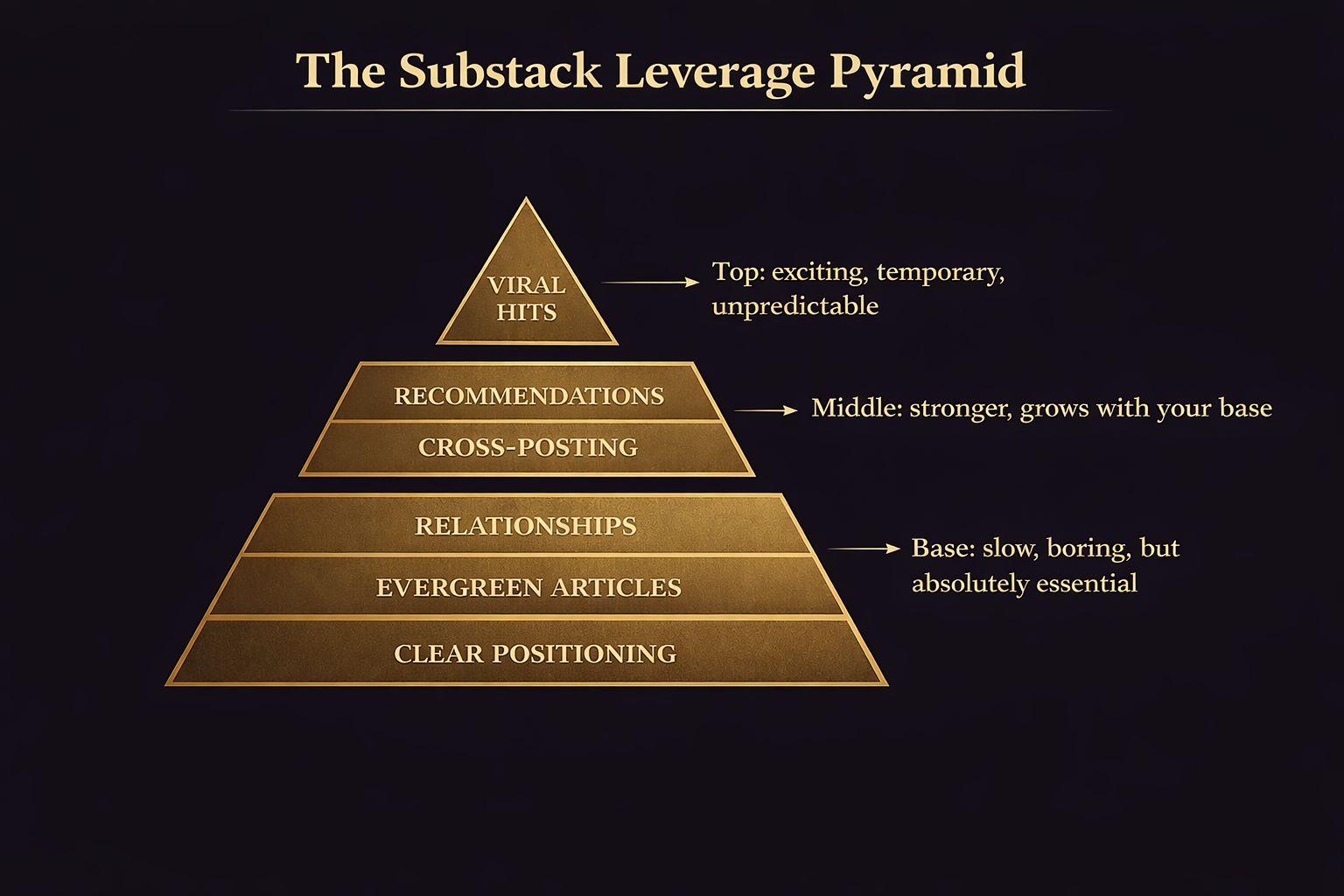
Three layers. Completely different energy levels.
The base is where serious builders spend most of their time. Nobody’s going viral from “I spent three months refining my niche positioning,” But this is the layer that makes everything above it work.
The middle is where things start to compound. Recommendations from other creators, cross-posting into new audiences, you can’t manufacture it but it happens naturally when your base is solid.
The top is where most beginners live. Viral Notes, algorithm games, trending hooks. High excitement, low durability. Viral moments are not bad, it’s just that they’re empty without the layers underneath them.
Most beginners build from the top down. Serious builders build from the bottom up.
In the next section, we’re going to go deep on the base, because that’s where your leverage actually lives.
Base Layer #1: Clear Positioning
Positioning isn’t a strategy document or a 3-hour branding exercise, it’s your Substack profile.
Someone discovers you, clicks your name, and lands on your profile. They spend about 4 seconds deciding if you’re worthsubscribing. In those 4 seconds, three things either work or they don’t:
- Profile picture — Does it look like a real person worth trusting?
- Bio — Does it tell me exactly who you help and with what?
- Banner — Does it visually reinforce the same message, or is it a random landscape photo you took in 2019?
These three elements are your first impression, and first impressions on Substack are often your only impression.
If someone can’t figure out what you’re about in 4 seconds, they’re gone, and they’re never coming back.
Here’s a prompt that’ll help you nail your bio in under 10 minutes:
“Help me write a one-line bio. I help [Insert Target Audience] achieve [Insert Result] with [Insert Skill or Method]. Give me 3 clear options under 120 characters. Make them sharp, confident, and authentic.”
Run that, pick the one that sounds most like you, and update your profile today.
That’s your positioning foundation. One profile, three elements, zero confusion.
Base Layer #2: Evergreen Articles
Timely content is a sugar rush.
It spikes, it trends, it gets shared for 48 hours, and then it dies. Nobody’s googling your hot take about a Twitter drama from three months ago.
Evergreen content is the opposite. It’s articles built around principles through stories, insights, guides, and opinions that are just as useful today as they will be two years from now.
Think: “How to write a Substack welcome email that converts” vs “My thoughts on the latest Substack update.”
One of those compounds, the other expires.
Why this matters for you specifically:
You have 5–10 hours a week, maybe less. Every article you write is an investment and you want that investment paying dividends for years, not days.
An evergreen article might not blow up when you hit publish, but it will quietly pull in new readers every single month and keep working long after you’ve moved on to your next piece.
And the compounding effect kicks in too…
Every evergreen article you publish expands your content ecosystem. When someone discovers you and loves what they read, they don’t just subscribe and leave, they binge. They click on another relevant piece, then another, then another.
That’s content architecture at play.
The more evergreen articles you have, the more you can interlink between them and guide readers deeper into your world.
You’re not just writing articles, you’re building a rabbit hole people actually want to fall into.
Base Layer #3: Relationships
Relationships are NOT about landing collabs or getting recommended by bigger creators.
Those things live in the middle of the pyramid for a reason, they’re not part of building relationships, they’re what follows naturally once the relationship is at the right level.
Real relationships in the Substack creator space are simple:
Talk to people. Help them. Expect nothing back.
In practice, this looks like two things:
- Reach out to fellow creators whose work you genuinely respect. Not a copy-paste DM asking for a collab. Just a real message saying what resonated and why. Start a conversation like a human being.
- Engage with people who comment on your content. Someone left a thoughtful reply on your Note or article? Don’t just heart it. Reply. Ask them a question. See how you can help them move forward.
Most creators skip this completely because it doesn’t feel like “growth work.” There’s no metric for it. It doesn’t show up in your subscriber count tomorrow.
But that’s actually a good thing.
This isn’t part of the numbers game of growing on Substack. Instead of seeing it as hustle, see it as a natural extension of being a social human that connects with other friendly humans. :)
When The Base Is Right, Everything Else Follows
You don’t do the middle layer, it happens to you.
When your positioning is clear, your evergreen articles build trust, and you build relationships, the middle layer builds itself.
As your relationships deepen naturally, the conversation starts shifting on its own. Ideas for recommending each other come up organically. A collab article gets mentioned in passing. A cross-recommendation just makes sense. Nobody had to pitch anything, it just came up, the way it does when two people genuinely respect each other’s work.
And then something interesting happens at the top.
When your middle layer is flowing — when recommendations are sending you a steady stream of the right readers, and cross-posting is putting your content in front of aligned audiences — the algorithm starts working for you too.
Your content hits enough engaging readers, so occasionally, one of those pieces blows up.
That’s the viral moment you have been looking for, and this time it actually means something, because underneath the spike is a pyramid strong enough to convert that attention into real, lasting growth.
The top of the pyramid was always meant to be a bonus, not a starting point.
Build the base. Trust the order.
Start At The Bottom
Most creators are playing the wrong game.
They’re optimizing for the layer that matters least, spending their limited hours chasing something unpredictable while the real leverage sits untouched at the bottom of the pyramid.
You now know better.
Clear positioning. Evergreen articles. Genuine relationships.
These aren’t sexy, but six months from now, when recommendations start flowing, collabs come up naturally and a content piece finally blows up, you’ll know exactly why.
The builders who win were patient enough to build the bottom first.
So here’s your next step. Pick one base layer and do something about it today:
✓ Positioning — Run the bio prompt and update your Substack profile.
✓ Evergreen content — Write one article you’d still be proud of two years from now.
✓ Relationships — Reach out to one creator today. No agenda. Just a real message.
If you’re building a Substack newsletter alongside a full-time job and want more practical, no-fluff strategies to grow and monetize it,subscribe to Write Your Way To Wealth.
See ya soon
Timo Mason🤠
Liked this post? 2 ways you can support me
- Share it with a creator friend who will benefit.
- Ask a question or share your thoughts in the comments.
Thanks for reading Write Your Way To Wealth! Subscribe for free to receive new posts and support my work.