You don’t need a big list to make your first sale. You need the right setup before launch day.
By Carrie Loranger
Published: 2026-11-10
URL: https://thrivewithcarrie.substack.com/p/first-digital-product-small-newsletter
If I had a dollar for every time I hear writers say they'll make a product "once their list is bigger," I’d have enough for a really nice vacation by now.
At 300 subscribers it's 1,000. At 1,000 it's 5,000. The number keeps moving like a goalpost on wheels, because it was never the real reason they didn’t build their offer.
A small list can buy a small product. They just won't buy a big, vague one. And they definitely won’t buy no offer at all.
Can you sell a digital product with a small newsletter?
Yes. A product sells when it solves one specific problem your readers already have, at a price that doesn't need a committee meeting. List size changes how many you sell. It doesn't decide whether you can sell.
Your first product is also the fastest way to learn what your readers will pay for. Every sale and every "not for me" reply teaches you something.
Why your first product idea is too big
In my coaching business, I frequently see people who want to build a course as their first offer. Eight modules, a workbook for each one, a community, maybe coaching calls. This is not the way to go for your first product. It would take months to build, and you don't know yet if anyone wants it.
Bad first product: "The Complete System for Building Your Freelance Business."
Good first product: "The Rate Calculator: know what to charge your next client in 10 minutes."
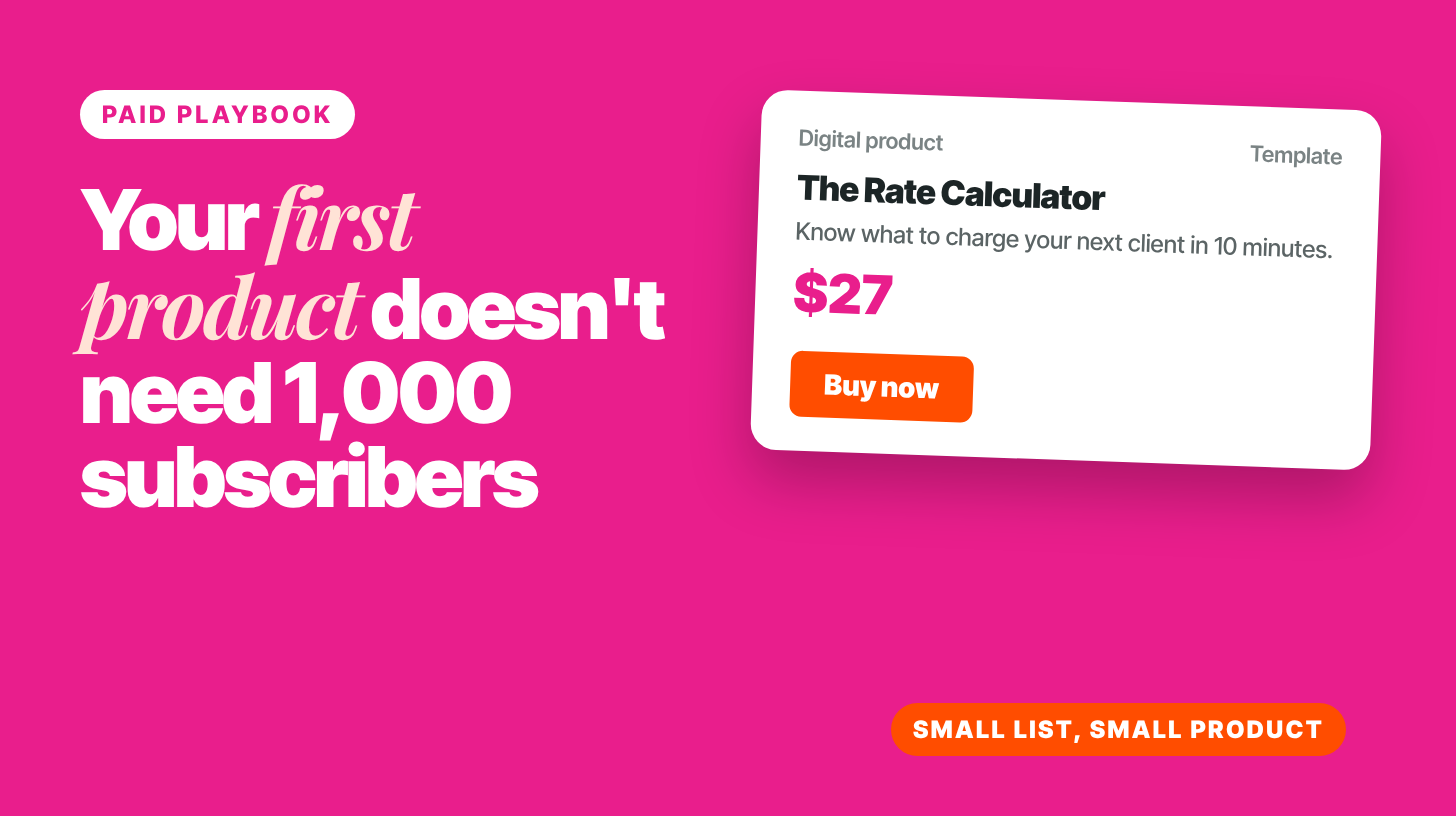
\Heads up: this is a sample, not a real product. Use it as a model for yours.\
The second one answers a question your readers are asking, and you can build and launch it in a weekend.
What should your first digital product be?
Look at the question you answer most. Check your replies, comments, DMs and the Chat. The question that shows up again and again is your first product, in the smallest format that answers it.
One of my bestselling digital products is a pricing calculator. It answers a single question writers ask me constantly: what should I charge for my newsletter? That's the size to aim for.
If you haven’t picked your first offer yet, the Offer Stack Builder asks eight questions and tells you which offer model fits where you are now.
Are you ready for a digital product?
If readers ask you the same question more than once a month, yes. That question is your product.
If nobody replies to your posts yet, start there. Ask one specific question at the end of your next three posts and see what comes back. You’ll have your product idea within a few weeks.
FAQ
How many subscribers do I need to sell a digital product?
There's no minimum. A small, engaged list buying a small product it needs will sell more than a big list being offered something vague.
What price should my first digital product be?
Under $50. Low enough to buy on the spot, high enough that buyers take it seriously and use it.
Should I sell my product on Substack or somewhere else?
Write the sales post on Substack, where your readers are, and use a checkout tool like Gumroad, Stan or Payhip for the payment and delivery. I sell mine on Gumroad. Here’s my shop if you want to see how the product pages are set up.
What if nobody buys?
Then you learned the promise didn't land, and you learned it in a weekend. Change the promise or the problem, and try again.
What paid subscribers get in this issue
- The Small Product Test: five checks to run before you build anything, including how to price it.
- The income-streams ladder: where your first product fits and what to sell next.
- An AI prompt that turns your readers’ own questions into three product ideas you can build this weekend.
Want the full build, step by step?
Everything in this issue is taught step-by-step inside The Academy. It's every course I've ever published, all in one place, with new courses added every month, and you'll learn to build with AI so the repetitive work runs without you. Paid members get all of it, plus my bestselling digital products and every monthly challenge.
VIP members also get the AI, Agents & Vibe Coding Accelerator, a 60-minute 1:1 call with me and Academy LIVE group coaching.
The Small Product Test
Run your idea through these five checks before you build anything. If it fails one, shrink it until it passes.
1. One problem
In one sentence, can you name the specific, narrow problem as your reader would say it out loud? "I don't know what to charge" passes. "I want to grow my business" fails.
2. One promise
Can you finish this line: "After using this, you'll be able to \\\ in \\\"? A specific outcome in a short time is what makes a small product easy to buy.
3. The smallest format
Pick the format that delivers the promise with the least build time: a template, a checklist, a calculator, a swipe file, a short video walkthrough. If a one-page template does the job, a course is the wrong format. My One-Hour Newsletter System is one system that does one job, and that’s the size to aim for.
4. A starter price
Keep your first product under $50. At that price, it’s an easy yes. In the early growth phase you’re establishing your value and building trust. A low-risk digital product is a no-brainer for someone who has been seeing you in their feed for a while and wants to take the next step.
5. Proof before you build
Sell it before it's finished. Use your chat, Notes and posts to ask people if they would buy your product. If five people are willing to pay for the promise, you know it's worth making. If nobody raises their hand, you saved yourself time.
When your first buyers get a result, ask them for a testimonial right away. I collect mine with a simple form and share them on my Wall of Love, and those reviews sell the next round for you.
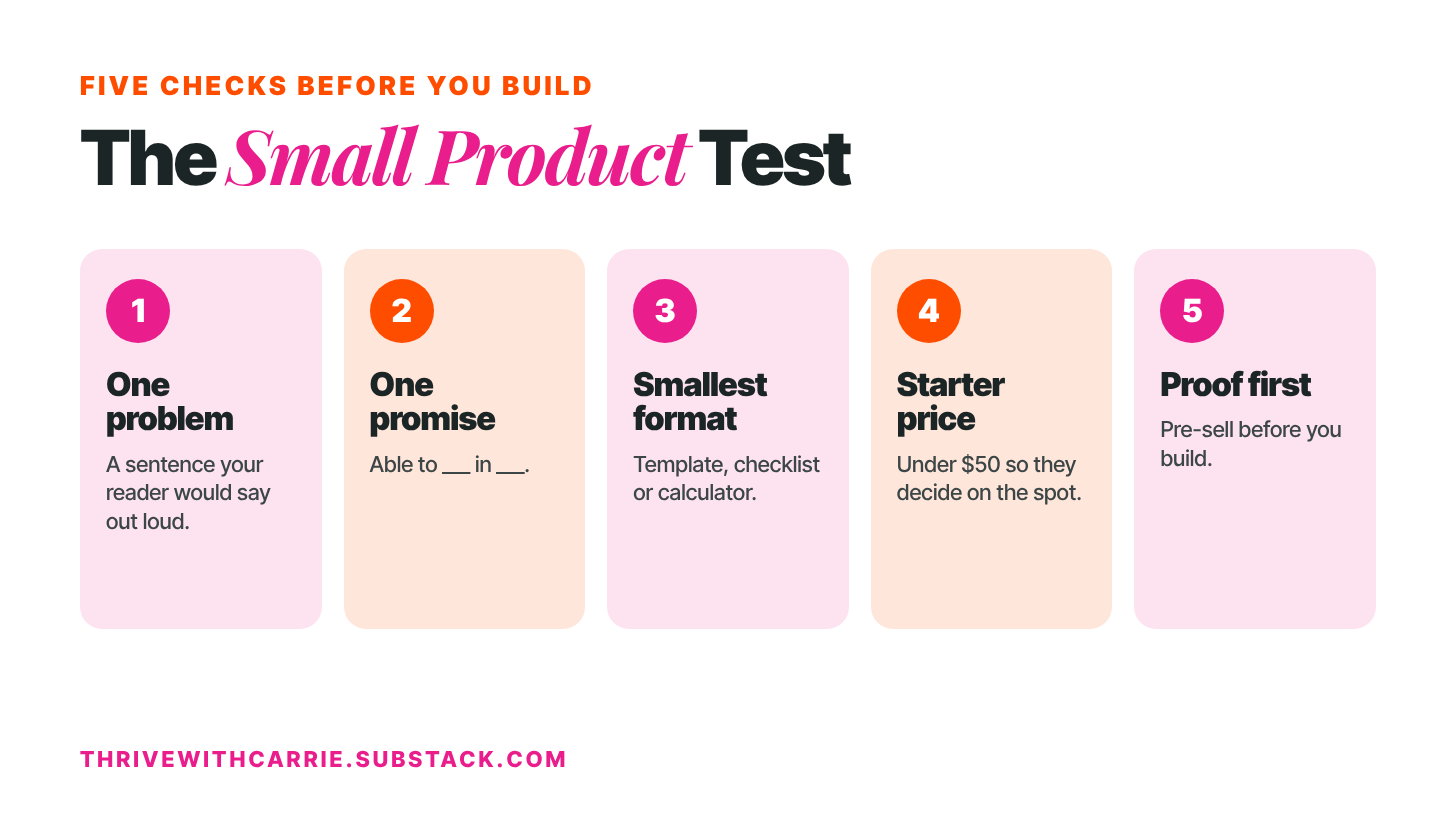
\The Small Product Test: five checks before you build anything.\
Where your first product fits in your income streams
A small product is often the first step on a ladder: a free newsletter, then a low-priced product, then your paid tier, then something bigger like 1:1 coaching. Each step is easier to sell to someone who bought the one before it. If you want your first product chosen, priced and launched with me beside you, that is what my eight weeks of coaching are built for.
You can also fold your product into your paid tier later as a member perk or use it as a bonus for other offers. That's what I did with mine.
Your AI prompt: find your first product
Copy this into ChatGPT, Claude or any AI writing tool. Fill in the brackets first.
Here are questions my readers have asked me in replies, comments and DMs: [paste 10 to 20].
My readers are [who they are]. Group these by the problem behind them and tell me which problem shows up most.
For that problem, suggest three small digital products I could make in a weekend, such as a template, checklist, calculator or short guide. Give each one a one-sentence promise in this format: "After using this, you'll be able to \\\ in \\\." Recommend a starter price under $50 for each and tell me why.
Pick the one you'd be proud to sell.
For the launch itself, how to launch your first digital product this week walks you through the pre-sale, and my Digital Product in a Day Guide gives you the five steps from idea to first sale.
The full build is in The Academy
The prompt gets you the idea. Build Your Offer in The Academy walks you through social proof, your paywall model and pricing on video, with a worksheet, and Add Income Streams, coming soon, covers sponsorships, affiliates and your first digital product step-by-step.
Your Action Steps
- Run the AI prompt above on your last 20 reader questions.
- Run your top idea through the Small Product Test and shrink it until it passes all five checks.
- Write your one-sentence promise today.
- Block out this weekend for the build.
- Send your pre-sale post next Monday with a launch price and a deadline.
Your list is big enough for a small product. Build the small one first.
The product you’re avoiding because it feels too simple is usually the one your readers will buy first. Simple sells because it’s easy to understand.
Carrie
Carrie Loranger is a Substack coach and bestseller, and the founder of 9-To-Thrive. She grew it from zero to 12,600+ subscribers and a six-figure business, and she shows writers how to build Substacks that bring in income every month.
Published weekly for paid subscribers of 9-To-Thrive. Not a subscriber yet? Get the next one →
Disclaimer. My results aren't typical. Yours may vary depending on many factors, including the effort you put in, your niche, your experience, the time you have, your market, your audience and many other variables. This newsletter teaches strategies and systems; it does not guarantee subscribers, income or any specific result. Some links in this post are affiliate links, and I may earn a small commission at no extra cost to you.