By Carrie Loranger
Published: 2026-10-05
URL: https://thrivewithcarrie.substack.com/p/start-substack-from-zero
If I lost my entire Substack business today and had to start over, I wouldn’t be worried. I know how to build a newsletter business and I have the subscribers, business model, eight income streams and revenue to prove it. 
Here’s how I’d do it:
I’d start with the business strategy before worrying about subscriber counts. I’d identify exactly who I want to help, the problem I can solve for them, and what I eventually want the newsletter to do for me.
Then I’d set up the publication to convert visitors into subscribers, publish a strong Start Here post, and learn how to use Notes early. Notes became my biggest discovery channel during my fastest growth period.
From there, I’d build 4 parts of the business: attract readers, nurture them, sell useful offers, and retain the customers I already have.
That’s the exact approach I used to grow from zero to 12,500+ subscribers in a year, become a Substack bestseller, and build a six-figure business around one newsletter.
What’s inside this Blueprint
I’m sharing the exact methods I used to:
-
Start with the business you want to build
-
Define your reader and positioning
-
Set up your publication to convert
-
What I’d publish first
-
Build content around 4 stages
-
Decide what stays free and what becomes paid
-
Learn Notes early
-
Use Recommendations, Chat, Lives, and collaborations
-
Grow outside Substack with search and AI discovery
-
Understand the numbers that matter
-
Build your welcome and paid experience
-
Add multiple income streams
-
Ask your readers what they want to buy
-
Use AI without automating the relationship
-
What Substack still gets wrong
-
The mistakes I’d avoid if I started again
-
My start-from-zero checklist
I started my Substack with zero subscribers.
Just like everybody else.
Almost 4 months later, I had 11.
Eleven.
That number bothered me.
A lot.
I had spent 18 years in marketing. I knew how to sell. I knew email marketing. I knew buyer psychology. I knew how to read data.
Yet here I was with 11 people on my newsletter wondering what the heck I was missing.
To be fair, I wasn’t exactly crushing the execution.
I published every couple of weeks.
Sometimes.
I barely understood Notes.
I didn’t know how to find people.
I didn’t understand how people found me.
Some days I posted a Note.
Some days I posted 3.
Plenty of days I posted nothing.
Eventually my stubborn side took over.
I’m an Aries.
Do with that information what you will.
When I decide I’m going to figure something out, I have a hard time leaving it alone.
Substack was no different.
I started studying bestselling publications.
I watched what they did.
I reverse-engineered what I could.
I talked to other writers.
I tested everything.
Then I retested it.
Every week, I looked at my data.
Something worked?
I did more.
It flopped?
I stopped wasting time on it.
I started showing up everywhere.
Notes.
Chat.
Lives.
Collaborations.
Conversations.
And then something kind of ridiculous happened.
The Substack gods smiled on me.
My Notes started getting shown to a lot more people.
Within about 90 days, I went from those 11 subscribers to roughly 5,800.
More than 60% of them came from Notes during that stretch.
That was the turning point.
Today, 12,500+ people subscribe to 9-To-Thrive.
The publication became a Substack bestseller.
And one newsletter has grown into the center of a six-figure portfolio business with several ways to make money.
Paid subscriptions.
Digital products.
Courses.
Workshops.
Coaching.
Services.
Affiliate income.
Sponsorships.
And a slightly concerning number of tabs open at any given moment.
I figured a lot of this out the long way.
This is the Blueprint I wish someone had handed me when I had 11 subscribers and no clue how any of it worked.
It would have saved me months.
Probably a few gray hairs too.
Save this part: the Blueprint at a glance
If you’re starting from zero, this is the order I would use:
-
Decide what you want the publication to do for your life.
-
Get specific about who you’re helping.
-
Identify the problem you can solve for them.
-
Get your message clear before chasing traffic.
-
Set up your profile, About page, Start Here post, and welcome experience.
-
Publish enough useful content that a new reader has somewhere to go.
-
Learn Notes early.
-
Build relationships through Chat, Recommendations, Lives, and collaborations.
-
Put something behind paid when you have something worth paying for.
-
Add new income streams as your audience tells you what it needs.
-
Watch your data.
-
Keep going long enough to learn something.
You don’t need to do all 12 this week.
Please don’t.
You may never forgive me.
If you’re completely new to the platform and need the basics before any of this makes sense, I wrote a plain-English guide here: How Substack Works as a Real Business.
Decide what you want this publication to become
I want you to think much further out than 30 days.
Or 90.
Or your first 1,000 subscribers.
What do you want this newsletter to do for your life?
Maybe you want an extra $1,000 a month.
Maybe you want clients.
Maybe you want a paid publication.
Maybe you want to sell digital products.
Maybe you eventually want this business to replace your salary.
Maybe you want several sources of income so losing one doesn’t send your whole financial life sideways.
Your answer can be whatever you want.
You just need to know it.
Someone writing because they enjoy writing has a lot more freedom.
Someone building a business has decisions to make.
My reason goes back years before I ever heard of Substack.
I spent 10 years at a Fortune 500 company.
I had a senior corporate communications and marketing career.
Then I was laid off.
I had 3 kids.
I was a solo parent.
I was paying all the bills.
That period changed how I looked at money forever.
It took me a while to find another job.
I eventually did.
I spent another 8 years as a director of marketing at a privately held company before leaving corporate in 2023 to start my own business.
The layoff stayed with me.
I made myself one promise after it happened:
Never again will I depend on one paycheck.
So I started building income outside my job.
I did mobile notary work at night and on weekends.
I bought and sold properties.
I saved money.
I traded crypto for a while.
Some ideas worked.
Some were…educational.
But every one of them moved me further away from having my entire financial life tied to one employer.
Eventually, I had enough security to leave corporate and start my own business.
That experience sits underneath everything I teach today.
I help creators and solopreneurs build a portfolio business with several income streams around one newsletter.
One paycheck can disappear.
One client can leave.
One platform can change.
One product can stop selling.
I sleep better having several.
That’s my why.
Find yours.
You’ll need it when you publish something you worked on for 6 hours and 14 people open it.
That happens too.
Before you publish anything
Write down these 5 answers:
-
What is my long-term goal? What do I want this publication doing for me 3 years from now?
-
Who am I helping? Get specific enough that the person recognizes herself.
-
What problem am I helping solve? Pick something people already care about.
-
What is my core promise? What changes for somebody who keeps reading me?
-
What could I eventually sell? You don’t need to build it today. You should know where this could lead.
If you want to work through the business model before touching the tactics, this goes deeper: How to Start a Newsletter Business on Substack.
My Substack business has 4 stages
Everything I teach fits into 4 parts:
-
Attract: Get the right people to find you.
-
Nurture: Give them a reason to stay, read, reply, and trust you.
-
Sell: Turn some of that trust into revenue.
-
Retain: Keep giving customers enough value that they stay and buy again.
I’ve added a fifth area lately around AI agents and vibe coding because my audience is made up of creators and solopreneurs.
We need all the help we can get.
I still build the business around those first 4.
When something feels broken, I can usually trace it back to one of them.
Growth is slow?
Look at Attract.
Plenty of subscribers and very few sales?
Look at Nurture and Sell.
People buy and leave quickly?
Look at Retain.
Simple model.
Plenty of work inside it.
Quick diagnosis
Attract problem: People aren’t finding you.
Nurture problem: People subscribe and then barely engage.
Sell problem: People like your work but don’t buy.
Retain problem: People buy and don’t stay.
Fix the stage that’s weak before creating 4 new products because you’re bored.
Get your positioning clear first
One piece of advice I hear on Substack all the time is that you don’t need a niche.
I believe you do.
Maybe “niche” isn’t your favorite word.
Fine.
You still need enough focus that somebody lands on your publication and recognizes herself.
Your reader should look at your bio and think:
“Oh. She’s talking to me.”
That matters.
My own positioning changed quite a bit.
At first, I wanted to help people leave their 9-to-5 jobs.
Big goal.
Huge, actually.
Leaving a job comes with money, benefits, family, fear, identity, and about 600 other things.
I learned pretty quickly that my message was asking for too much too soon.
So I narrowed it.
I started helping people build multiple income streams from one newsletter.
That connected much better with what I had lived myself.
Then readers kept asking me Substack questions.
How are you growing?
How do you use Notes?
Where should I put my paywall?
What should I sell?
Can you look at my publication?
How do I turn readers into buyers?
Those questions changed the business again.
Today I help creators and solopreneurs build a portfolio business around one newsletter.
Much clearer.
And much easier to create content for.
Your publication description does a ridiculous amount of work here. I broke down exactly how I write one so the right reader recognizes herself quickly: The One Sentence That Makes People Subscribe.
Want the steps in order? The Academy walks you through this lesson by lesson. See what’s inside
Know who you’re writing for
My audience tends to be creators and solopreneurs.
Many run their businesses alone.
They have to write.
Market.
Sell.
Build products.
Serve customers.
Answer DMs.
Look at data.
Send emails.
Fix whatever broke overnight.
Basically, all departments report to them.
Including IT.
Which is unfortunate when you’re also IT.
Knowing that changes how I teach.
It changes how I write.
It changes what I build.
It also explains why I use so much AI.
My readers need time.
So do I.
Spend some time figuring out your ideal reader before you start publishing 10 Notes a day.
Talk to people.
Read comments.
Ask questions.
Look at what they buy.
Look at what they complain about.
Pay attention to the words they use.
Then use those words in your own messaging.
Specific people recognize specific problems.
That’s what you want.
Hot tip: steal their words
Keep a simple document with phrases your readers use in DMs, comments, emails, polls, and coaching calls.
Those phrases belong in:
-
your bio
-
headlines
-
sales pages
-
product names
-
Notes
-
emails
Marketing gets much easier when you stop guessing how your reader describes her problem.
Set up your publication before you send hundreds of people to it
I learned this later than I should have.
A Note can take off.
A Recommendation can send people your way.
Google can find you.
Someone can share a post.
Great.
Then what?
They land on your page.
Your publication needs to make sense.
I want somebody to understand pretty quickly:
Who is this for?
What will I get?
Why should I subscribe?
Where should I start?
What can I buy if I want more help?
You have a few places that do a lot of that work.
I recently did a full teardown of the homepage pieces that decide whether that stranger subscribes or leaves: How to Optimize Your Substack Homepage to Get More Subscribers.
Your publication name and description
Clarity wins here.
Your description should tell your reader what they’ll get.
Use the language they use.
Skip the corporate mission statement.
Nobody needs one more of those.
Your bio
Your bio appears in a lot of places.
Make it useful out of context.
I want a stranger to read mine and understand who I help.
Your life story can come later.
Your About page
This page should help someone decide whether they belong.
Tell them what you write about.
Who it’s for.
What they can expect.
What they’ll get by subscribing.
Your Start Here post
I somehow made it 9 or 10 months on Substack before I learned how valuable this could be.
I would create one immediately if I started again.
My first big Start Here-style post was my anniversary article
365 Lessons I Learned in My First Year on Substack
That post brought 351 subscribers so far.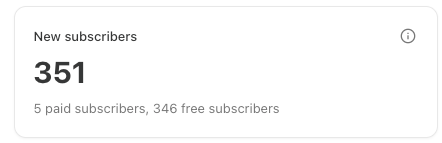
It still performs.
Later, I replaced it with a new Start Here post that tells more of my story, including my layoff and why I care so much about helping people build several income streams.
That post brings in paid subscribers too.
People message me after reading it.
They relate to the story.
That’s exactly what I want a Start Here post to do.
You can read my current one here: Start Here: Turn One Newsletter Into Multiple Income Streams.
I also wrote the strategy behind building a Start Here post that converts instead of simply pinning your most popular article: The Substack Post That Sells While You Sleep.
Quick reference: what each part of your publication does
Publication name: Helps people remember what you do.
Description: Tells the right reader why she should care.
Bio: Works as your tiny pitch all over Substack.
About page: Gives the reader enough detail to decide whether to stay.
Start Here post: Turns a curious visitor into someone who understands your story and your best work.
Welcome email: Starts the relationship.
Notes: Bring discovery.
Chat: Builds community.
Recommendations: Bring new subscribers through other writers’ trust.
Every one has a different job.
Go deeper. Inside The Academy, setting up your publication is a full video lesson with a worksheet. Join the Academy
What I would publish first
Ouch.
My early posts.
I was trying to do much more narrative writing when I arrived on Substack.
It didn’t go particularly well.
Which is fine.
You learn by doing.
Today, I would build in public.
My first post would probably be my Start Here post.
Then I’d teach around the problem I solve.
I’d share things as I figured them out.
If I started from zero today, my first posts would probably cover:
-
My story and why this publication exists.
-
One problem my ideal reader needs solved now.
-
A how-to guide.
-
Something I tried that failed.
-
A behind-the-scenes look at how I do something.
-
A question I hear over and over.
-
A tool or resource I use.
-
A strong opinion I can support.
-
A lesson from my own data.
-
Something I built with my readers.
I would also link those posts to each other.
New readers binge when they find something useful.
Make it easy.
My content pillars follow the customer path
I don’t sit down every Sunday and ask myself:
“Hmm. What random thing should I write about this week?”
Well, I try not to.
My content fits into the same stages as the business:
Attract
Growth.
Positioning.
Discovery.
Notes.
Recommendations.
Getting found.
Nurture
Welcome experiences.
Email.
Community.
Chat.
Building trust.
Helping readers get to know you.
Sell
Free-to-paid conversion.
Offers.
Sales pages.
Sales emails.
Pricing.
Products.
Services.
Retain
Member experience.
Paid content.
Community.
Ongoing value.
Giving people reasons to stay.
Then I have AI agents and vibe coding sitting alongside those because they’re becoming a larger part of how my members work.
This gives me plenty to write about without wandering all over the place.
How I split free and paid content
My free content gives people context.
I usually cover:
What is this?
Why should you care?
Do you need it?
What’s at stake?
Then I go deeper behind paid.
That’s where I put:
The exact how-to.
Step-by-step instructions.
My methods.
My AI tools.
Prompts.
Templates.
Processes I’ve built myself.
I want free readers to leave with something useful.
I also want paid members to feel that they’re getting a clear level up.
You can turn on paid as soon as you have something people will pay for.
Subscriber count doesn’t decide that for me.
Value does.
If you have something that saves somebody time, money, or effort, you have something worth testing.
Paywall cheat sheet
Free: What it is. Why it matters. Who needs it. What’s at stake. Enough value that the reader trusts you know what you’re doing.
Paid: The steps. The process. The template. The prompt. The tool. Your method. The thing that saves them from figuring it out alone.
Your free content should still be worth reading.
Paid should make the next step easier.
The place where you physically put that paywall matters too: Where to Put Your Substack Paywall.
And once you know what belongs behind it, pricing becomes the next decision: How to Price Your Substack.
Notes changed my growth completely
This is probably the biggest lesson from my first year.
During those first few months, I had no Notes strategy.
I posted whenever I remembered.
Great system.
Then I started treating Notes seriously.
I tested formats.
Topics.
Hooks.
Posting times.
Frequency.
I studied what led to profile visits and subscriptions.
For me, somewhere around 10 Notes a day became a sweet spot.
Sometimes I post 4.
Sometimes 10.
The number moves around.
I care much more about the result than hitting a quota.
During my fastest growth period, more than 60% of my subscribers came from Notes.
And yes, there were definitely stretches where it felt like the Substack gods had decided they liked me.
I wasn’t going to argue.
I eventually turned all that testing into a full Notes system with my formats, cadence, and action plan: My 2026 Substack Notes Strategy.
A few Notes taught me a lot
This one has brought me around 699 subscribers:
If you’re 40+ and writing on Substack:
I see you.
I’m with you.
Let’s connect.
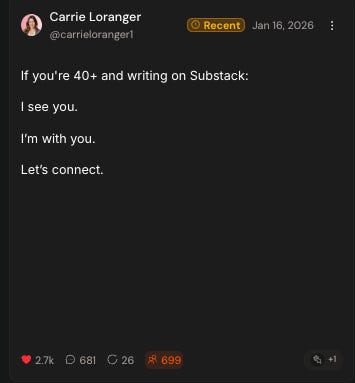
I’ve rerun versions of it.
It keeps working.
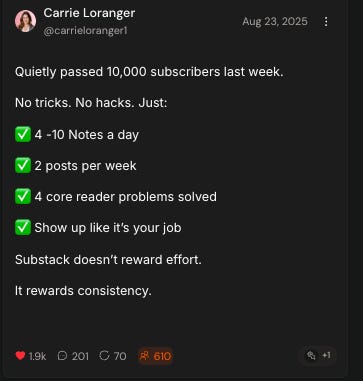
This one has brought 610 subscribers:
Quietly passed 10,000 subscribers last week.
No tricks. No hacks. Just:
4-10 Notes a day
2 posts per week
4 core reader problems solved
Show up like it’s your job
And this generosity Note brought around 514 subscribers:
I don’t care how big or small your Substack is, CONGRATULATIONS.
Promote it here, and I’m going to check on each and every one of you.
And maybe recommend some that fit my audience too.
You can do the same thing too.
Let’s start supporting each other’s growth!
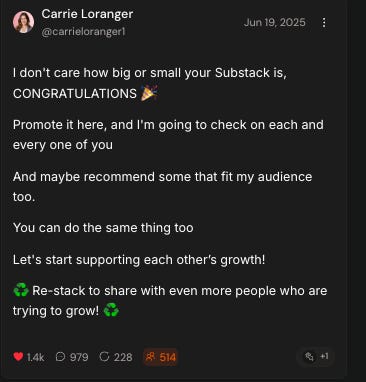
I haven’t re-run that one in a long time.
Looking at the number again, I may need to have a talk with myself about that decision.
I wrote about the first version of that generosity experiment when one Note had already brought more than 500 subscribers: How One Note Brought 514 Subscribers.
The pattern I keep seeing is pretty simple.
People engage when they feel included.
They respond when you give them a reason to join the conversation.
They share things that say something about them too.
Notes have also been one of the fastest ways for people to discover my work.
On a good month, I can still bring in around 1,000 new subscribers.
Notes quick check
Before posting, I ask:
-
Does somebody understand this without knowing me?
-
Does it make the right person feel seen?
-
Is there something worth responding to?
-
Does it sound like something I’d say?
-
Does my profile make sense if they click through?
A Note getting attention is only half the job.
Your publication has to close the loop.
There’s also an important difference between somebody following you and actually joining your email list: How to Get Followers on Substack and Turn Them Into Subscribers.
Your profile needs to convert before a Note takes off
Getting distribution feels great.
It can also expose a weak publication setup very quickly.
Someone sees your Note.
They click your name.
Now they’re deciding whether to subscribe.
Your description matters.
Your bio matters.
Your Start Here post matters.
Your recent posts matter.
Your positioning matters.
You worked to earn that click.
Give the person somewhere useful to land.
Go deeper. The Academy includes the Notes to Subscribers Masterclass, with a Note for every day of the week. Join the Academy
Recommendations brought me more than 1,500 subscribers
Recommendations have been huge for me.
More than 1,500 subscribers have come through them.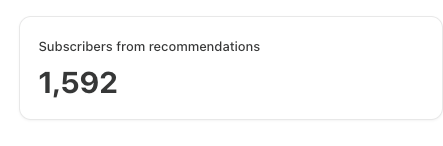
And I didn’t need to do anything weird.
I recommend writers I genuinely like.
I talk to people.
I build relationships.
Sometimes they recommend me too.
That compounds.
A recommendation also comes with something Notes can’t fully reproduce:
Trust.
Someone the reader already follows is saying:
“Go check her out.”
That’s a powerful introduction.
Hot tip: start small
You don’t need 50 writers recommending you.
Find publications that:
-
serve a related audience
-
publish work you actually read
-
feel like people you would want to know
Recommend them because you mean it.
Then go have a conversation.
I started using Chat before anyone cared
This was mildly humbling.
I would post conversation starters in Chat.
Questions.
Ideas.
Things I thought would get people talking.
Crickets.
So I did it again.
More crickets.
I kept going.
Eventually people answered.
Then they started talking to each other.
Then the community started feeling alive.
This is one place where stubbornness serves me well.
I don’t need instant proof to keep going when I believe something can work.
I do need enough time and data to make a reasonable decision.
Chat took time.
I’m glad I stayed with it.
I’ve since turned what I learned into a complete Chat strategy: How to Use Substack Chat.
Lives and collaborations build trust fast
I do a lot of Lives.
I collaborate with other writers.
I talk to people in my community.
I probably should do more guest posts and guest appearances.
I don’t.
Time.
There’s always something.
Lives fit the way I work because people can hear me think.
They can ask questions.
They can see how I respond without 4 rounds of editing first.
That’s useful when you sell coaching and services.
People want to know who they’re hiring.
I still grow outside Substack
Substack is my main acquisition channel.
It isn’t my only one.
I get subscribers from LinkedIn.
Some come from Facebook.
Google sends quite a few.
And one of the surprises has been AI search.
I’ve had people tell me they found me because an AI tool recommended me.
Some of my coaching clients have come that way.
I did not build my first marketing plan thinking:
“I hope a robot recommends me someday.”
Yet here we are.
I eventually wrote an entire post after 3 clients told me they found me by asking AI: How to Get Your Substack Cited by AI Answer Engines.
This is one reason I publish evergreen how-to content.
A useful article can keep working months after I publish it.
Some of my free SEO-focused posts bring me more paid subscribers than my paywalled posts.
That’s worth paying attention to.
Evergreen post checklist
A good evergreen post usually answers something people will still ask 6 months from now.
Before publishing one, I look for:
-
a real question people ask
-
a clear headline
-
a useful answer early in the post
-
practical steps
-
internal links to related posts
-
a natural path to subscribe
-
a next step for the reader who wants deeper help
I want that post working long after Tuesday is over.
I want my posts found months later
I care about search.
A lot.
My goal goes beyond getting a spike of Substack traffic on Tuesday.
I want people finding my work through Google.
I want AI tools finding it.
I want somebody searching for an answer 8 months from now to land on something useful I wrote today.
So I build evergreen posts around real questions.
I look at Google Search Console.
I track what gets discovered.
I built my full approach around what I call SEO hero posts: My Substack SEO Hero Post Strategy.
And every quarter, I do something slightly nerdy.
Okay, very nerdy.
I export my Substack data and use AI to help me analyze it.
I look at:
Subscriber growth.
Traffic sources.
Open rates.
Click rates.
Churn.
Revenue.
Search traffic.
Which posts keep getting found.
Which posts did almost nothing.
Sometimes I archive pieces that went nowhere and have no search value.
I spent 18 years looking at marketing data.
Old habits die hard.
Learn what your numbers are telling you
I don’t look at every number the same way.
An open rate problem and a click-through problem usually come from different places.
Low opens may send me toward the subject line, audience, frequency, or deliverability.
Good opens with weak clicks send me somewhere else.
Churn tells me something different.
Traffic source tells me something different again.
Revenue tells me whether all of this activity is eventually becoming a business.
The number matters.
The reason behind the number matters even more.
I form a theory.
Then I test it.
Marketing has always worked that way for me.
Metrics cheat sheet
Subscriber growth slows: Check discovery, Notes, Recommendations, search traffic, and profile conversion.
Open rates drop: Check subject lines, sending habits, audience quality, and deliverability.
Opens are fine and clicks are weak: Look at the body of the email, the offer, the link, and the CTA.
Free readers aren’t upgrading: Look at positioning, your paid promise, and the value behind the paywall.
Paid members leave: Look at the experience after they buy.
Traffic grows and revenue doesn’t: Look at what you’re selling and how clearly you’re selling it.
Don’t panic because one number moved.
Figure out what the number is trying to tell you.
If opens are the issue, I’ve broken down the subject-line styles I use here: How to Write Newsletter Subject Lines That Get Opened.
Welcome people properly
When somebody subscribes to me now, I don’t want them sitting around wondering what to do next.
They get a welcome email.
They get something useful quickly.
Free subscribers can get my 12-Day Substack Jumpstart Course, one lesson a day in their inbox.
They get my free Blueprint.
During that first stretch, I’m helping them understand how I teach and what they can do next.
Some will stay free.
Some will upgrade.
Some will buy something later.
That’s fine.
The relationship has started.
Your first welcome email is important enough that I wrote a dedicated guide here: Your Substack Welcome Email Has One Job.
And the first email is only the beginning: Welcome Email Sequences That Convert New Subscribers to Paid.
My first 30 days with a new subscriber
Immediately: Welcome them.
Early: Give them something useful.
Next: Help them solve a small problem.
Over the following days: Introduce the way I teach and the topics I cover.
When it makes sense: Show them what paid gives them.
After that: Keep delivering.
The first month gives you a huge opportunity to turn a new name on your list into an actual relationship.
There are several smaller commitments that usually happen before someone becomes a buyer. I mapped those out here: The 5 Micro-Yeses That Happen Before Anyone Pays You.
My paid membership became much bigger than a paywall
Paid subscribers get access to my The Academy.
I’ve taken the things I’ve built and taught over time and organized them inside Substack.
It takes people through:
Mindset.
Niche.
Positioning.
Growth.
Content.
Monetization.
Digital products.
Multiple income streams.
AI and automation.
Paid members get the foundation: setup, growth, content and turning on paid. VIP members get the advanced income and AI lessons.
I’m moving more and more toward turning the publication into a learning portal.
My VIP members sit at the deepest level and make the fastest progress.
They get the advanced income courses.
The advanced AI and vibe coding lessons.
A strategy call with me.
A free audit of their newsletter.
Live cohorts of The Academy.
You can check my current subscriber options.
Already a paid member? Open START HERE
My newsletter feeds the whole business
Substack brings people into my world.
That person may become a paid subscriber.
Or buy a digital product.
Or take a course.
Or join a challenge.
Or hire me for an audit.
Or book a clarity call.
Or work with me one-to-one.
Or hire me for done-with-you work.
Or buy through an affiliate link.
Or do several of those things over 2 years.
That’s why I don’t judge my publication only by paid subscription revenue.
The newsletter supports the portfolio.
If you want the bigger breakdown of the different ways a smaller newsletter can make money, start here: How to Make Money on Substack in 2026, Even With a Small Audience.
I also wrote an earlier breakdown specifically showing how several revenue streams can sit around the same newsletter: 5 Revenue Streams Every Substack Newsletter Should Have.
My monetization map
Good early options: Paid membership, small digital products, affiliate income.
As people start asking for more help: Workshops, challenges, coaching, audits, done-with-you services.
As your audience and authority grow: Done-for-you work, larger programs, sponsorships.
You don’t need 8 income streams on day 1.
Build the next one when the audience gives you a reason.
Build income streams in an order you can handle
I had a lot of unfinished things when I started.
Half-made offers.
Half-made courses.
Digital products that existed in various stages of “I’ll finish this later.”
Later is very patient.
It will let your files sit there forever.
I finally went through them and finished as many as I could.
That mess eventually became a library of around 30 to 40 digital products.
Some still haven’t made it out into the world because I decided they weren’t good enough.
So yes, even after all this, I still have a few unfinished children living in Google Drive.
My first income streams were paid subscriptions and low-ticket digital products.
That’s where I would start again.
1. Paid membership
Give people something useful enough to pay for.
Start simple.
2. Digital products
Turn one problem into one small solution.
I now teach people how to build digital products quickly because I learned this by cleaning up my own product mess.
If digital products are where you’re stuck: How to Launch Your First Digital Product This Week.
3. Affiliate income
You can start this early if you already use tools you genuinely recommend.
My affiliate list is short.
I want to know and like the product before I send someone there.
4. Coaching
Once people start asking for direct help, this becomes a natural next step.
5. Done-with-you services
Some people want guidance while doing the work.
6. Done-for-you services
Some people would rather hand over part of the work.
7. Sponsorships
These became more relevant for me once I passed 10,000 subscribers.
I eventually built sponsorship packages and a media kit.
Several revenue streams can come from one audience.
You don’t have to build them all this month.
Please don’t.
You’ll hate me by Friday.
Ask people what they want to buy
One of my favorite product research tools is very advanced.
I ask people.
That’s it.
I poll subscribers.
I poll readers.
I ask my Chat community.
And I usually give them choices because an open-ended question can turn into 72 completely different product ideas.
I’ve learned that my audience tends to tell me pretty clearly what they need.
Growth.
Paywalls.
Products.
Monetization.
The answer usually leans heavily in one direction.
I used this when I built my Digital Product in a Day workshop.
I used it for my Make Your Substack Pay You challenge too.
Those ideas came from demand I could see.
That’s a much nicer place to create from than sitting alone thinking:
“Gee, I wonder if anybody wants this.”
I learned some of this the expensive way after building products my audience never asked for: I Built 3 Products Nobody Wanted. The Fourth Made $1,400.
Hot tip: poll before you build
Ask people:
Which of these would help you most right now?
Then give 3 or 4 specific choices.
I like multiple choice because the results are easier to read and easier to act on.
If one answer crushes the others, pay attention.
AI makes this business possible for me
I’m an AI-first creator.
I know that sentence will make a few people twitch.
I’m okay with that.
AI helps me run a business that would otherwise be impossible to attain as a solo creator without it.
I still do the thinking.
A lot of my writing starts exactly like this post started.
I talk.
And talk.
And remember something.
And go backwards.
And correct myself.
And then remember another thing 8 minutes later.
I use Wispr Flow to brain dump.
Melissa takes it from there.
Melissa is my AI digital marketing assistant.
She helps me:
Write Notes.
Schedule Notes.
Create sales emails.
Draft landing pages.
Draft sales pages.
Repurpose my content.
Send the first welcome DM to new subscribers.
Then I get involved.
I edit my writing.
I take over DM conversations when somebody responds.
I answer people in Chat myself.
Those conversations are too important to automate.
I want to know my readers.
I want to hear what they’re struggling with.
I want them to know there’s a person here.
Trust comes from those moments.
If you’re curious about the AI stack behind my solo business: My AI Tools for Newsletter Creators.
And if your bigger concern is keeping AI-assisted writing from sounding like a robot wrote it: How to Make AI Write Like You.
Scheduling Notes changed the amount I could publish
There was a period where I was manually trying to keep up with Notes.
It ate time.
Then I started using WriteStack.
That made a big difference for me.
I could repurpose my long-form posts.
Create Notes from things I had already written.
Schedule them.
See more of my data.
Pay attention to when people were active.
Suddenly, publishing several Notes a day was manageable.
I wasn’t waking up every morning thinking:
“Excellent. Time to invent 10 new thoughts before coffee.”
Systems made the volume possible.
Automate repetitive work and keep the human conversations
This is roughly how I draw the line.
If a machine can handle something repetitive without hurting the experience, I’m interested.
Scheduling.
Formatting.
Repurposing.
First drafts.
Data analysis.
Basic first-touch messages.
Great.
When somebody asks me a real question?
I’m there.
When somebody is stuck?
I’m there.
When my Chat community is talking?
I’m there.
Business still happens between people.
My automation rule
I automate work.
I stay present for relationships.
That’s the line I try not to cross.
It took me a while to get AI-assisted newsletter production right too. My early “write me a newsletter” prompts were terrible: Why “Write Me a Newsletter” Never Worked.
Substack has quirks
I love the platform.
I also have a list.
Deliverability takes monitoring.
Fake emails and bots exist.
The analytics could give us much more.
Substack has added segments and automations, and I’ve hit limits when trying to use them together the way I wanted.
I wanted to use a custom segment as part of an automated flow.
That didn’t work the way I needed.
I also want more data behind the automations themselves.
Landing pages are still an area where I want more control.
The sponsorship system hasn’t delivered much for me either.
I’m a Substack bestseller.
I filled out the information.
I’ve received no sponsorship opportunity from it so far.
And I have very little visibility into what’s happening behind the scenes.
So…that one’s still sitting in the “we’ll see” category.
I will give Substack credit for something though.
They keep improving the platform.
I’ve watched them add things that save me real time.
Templates and reusable snippets are a good example.
Before those, I rewrote the same little sections over and over.
Now I don’t.
Tiny feature.
Big difference.
I have made plenty of stupid mistakes
Broken links.
Wrong dates.
Access issues.
Emails where something wasn’t quite right.
I’ve had customers unable to get into something because I set up the permissions wrong in another system.
That’s a fun email to receive.
“Hi Carrie, I paid you. Where is the thing?”
Cool.
Love that for me.
You fix it.
You apologize.
You move on.
Running a solo business cured me of thinking mistakes were the end of the world.
They aren’t.
They are embarrassing for a few minutes.
Then you fix them.
When something breaks
-
Fix it.
-
Tell people what happened if they were affected.
-
Make it right.
-
Figure out whether a system can stop it happening again.
-
Move on.
You will make mistakes.
Please don’t build an entire identity around one broken link.
Leaving corporate meant unlearning permission
Corporate life taught me an enormous amount.
Marketing.
Email.
Buyer behavior.
Data.
Testing.
Copy.
Campaigns.
Technology.
One thing I had to unlearn was asking for permission.
In a company, everybody signs off.
Your boss.
Their boss.
Legal.
Finance.
Maybe 3 other people who got invited to the meeting and nobody remembers why.
Then something goes live.
If it goes sideways, a lot of people were involved.
Solo business feels different.
I can do almost anything I want.
That’s freeing.
It also means the responsibility sits with me.
There’s no committee to hide behind.
There is no Bob from IT.
Once again:
I am Bob.
I believe a niche matters
I’ll die gently on this hill.
You need enough focus for someone to recognize herself.
Writing about everything makes that hard.
A new visitor should know quickly:
Who is this for?
Does she understand me?
Can she help me?
Do I want more?
Your niche can expand as your business grows.
Mine did.
But clarity helps people decide to stay.
I also disagree with the “AI equals slop” crowd
Bad AI content exists.
Plenty of it.
Bad human content exists too.
I’ve read some.
I’ve probably written some.
The tool doesn’t decide the quality.
The thinking matters.
I give AI detailed input.
I speak my ideas.
I explain my experience.
I provide my examples.
I edit.
AI helps me move faster.
I need that because I’m one person running a business with several moving parts.
I don’t have any interest in winning an award for doing every repetitive job manually.
The first few months may be very quiet
This is where people need a thicker skin.
You may publish something.
Nobody comments.
You post a Note.
3 likes.
You ask a question in Chat.
Nothing.
You do it again.
Still nothing.
This can last a while.
I tell beginners to mentally prepare for 3 to 6 months before things start feeling like they’re moving.
Some grow faster.
Some take longer.
My first almost 4 months produced 11 subscribers.
Then my next 90 days produced thousands.
I could never have predicted that from month 3.
That is one reason I care so much about consistency.
Your first quiet months are teaching you.
You’re learning what people react to.
You’re learning what you like writing.
You’re learning how Notes work.
You’re learning how to talk to readers.
You’re also giving people repeated chances to see your name.
Keep going long enough to collect useful information.
Save this for a bad week
Your first few months may give you almost no evidence that this is working.
Mine gave me 11 subscribers.
The next 90 days gave me roughly 5,800.
Today, that same publication has 12,500+ subscribers and is a Substack bestseller.
A slow start tells you what happened so far.
It doesn’t tell you what happens next.
I didn’t quit because I like this place
I like Substack.
A lot.
I’ve met smart people here.
Interesting people.
People who have lived through career changes, layoffs, reinventions, businesses, failures, divorces, health scares, and all the other stuff life throws at you.
The conversations feel different.
I’ve also had the chance to help people grow.
That matters to me.
One writer, Dr. Sam Illingworth, has told me that things I taught him helped him on his way to becoming a bestseller.
Hearing something like that is an honor.
I know what it feels like to need another source of income.
I know what it feels like when one paycheck disappears.
Helping somebody build something more secure matters to me for reasons that go way beyond subscriber numbers.
What I would do if I started from zero tomorrow
I’d start with the big goal.
What do I want this publication to do for me 3 years from now?
Then I’d identify the person I want to help.
I’d research what she needs.
I’d get my message clear.
I’d build the publication around that message.
I’d write a strong Start Here post.
I’d publish enough useful content that a new person has somewhere to go.
I’d set up my welcome experience.
I’d learn Notes early.
I’d post often enough to learn quickly.
I’d talk to people.
I’d use Recommendations.
I’d show up in Chat.
I’d collaborate.
I’d watch my data.
I’d create something small people could pay for.
I’d ask my audience what they wanted next.
Then I’d build from there.
No 47-step master plan taped to the wall.
You need enough strategy to start making smart decisions.
Then you learn by doing.
Start-from-zero checklist
Before you worry about scale:
-
Long-term goal written down
-
Ideal reader identified
-
Core problem clear
-
Publication promise clear
-
Bio finished
-
About page finished
-
Start Here post published
-
First useful posts published
-
Welcome email set up
-
Notes strategy started
-
Recommendations started
-
Chat or community activity started
-
First paid idea identified
-
Basic metrics tracked
Then stop setting things up and go talk to people.
Save this checklist. Then let the Academy walk you through every box. Join the Academy
Your first job after reading this
Before you worry about 1,000 subscribers, write down what you want your publication to do for your life.
Go big.
Your blue-sky version.
What happens if this works?
Where are you 3 years from now?
What income does it create?
What does your workday look like?
What are you selling?
Who are you helping?
How much freedom does it give you?
Then write down why you care.
My why goes back to one layoff.
3 kids.
One paycheck.
And the promise I made myself afterward.
Never again.
That reason has carried me through the slow months, broken links, failed ideas, launches, endless testing, and probably a few questionable business decisions I have conveniently forgotten.
Yours needs to matter to you.
Because turning a Substack into a business takes work.
A lot of it.
You need a clear publication.
Good positioning.
Useful content.
A reason for people to subscribe.
A reason for them to stay.
Something worth buying.
And the willingness to keep showing up while almost nobody seems to notice.
Start there.
Then learn Notes.
Then test.
Then keep going.
I started at zero too.
Almost 4 months later, I had 11 subscribers.
90 days after I finally committed to figuring it out, I had around 5,800.
Today, 9-To-Thrive has 12,500+ subscribers, is a Substack bestseller, and supports a six-figure business.
I couldn’t see any of that coming when the number said 11.
I’m glad I’m stubborn.
Sometimes it comes in handy.
Want the whole system in one place?
Everything in this Blueprint connects.
The strategy.
Your niche.
Your ideal reader.
Your positioning.
Your publication setup.
Notes.
Growth.
Paid content.
Products.
Multiple income streams.
AI.
Automation.
There is quite a bit to build.
That’s why I created The Academy.
It contains the system behind the publication I grew from zero into a 12,500+ subscriber bestseller and six-figure business.
I take you through the process from the beginning, including the pieces I had to figure out through months of testing and more mistakes than I’d like to count.
If you’d rather have the steps in order, paid members get The Academy (all my courses in one place, including the Notes Secrets Course), my bestselling digital products free on the perks page, a free month of WriteStack and every monthly challenge. See the membership options here.
Already a paid member? Open Start Here
Want me in your corner? VIP adds a 60-minute 1:1 strategy call with me, Academy LIVE group coaching, the AI, Agents & Vibe Coding Accelerator, the Substack Audit plugin and a discount on 1:1 coaching.
Not ready for the Academy? Start with the free 12-Day Substack Jumpstart Course.