The problem is not the AI robot. It's the blank slate you handed it.
By Carrie Loranger
Published: 2026-06-02
URL: https://thrivewithcarrie.substack.com/p/make-ai-write-like-you
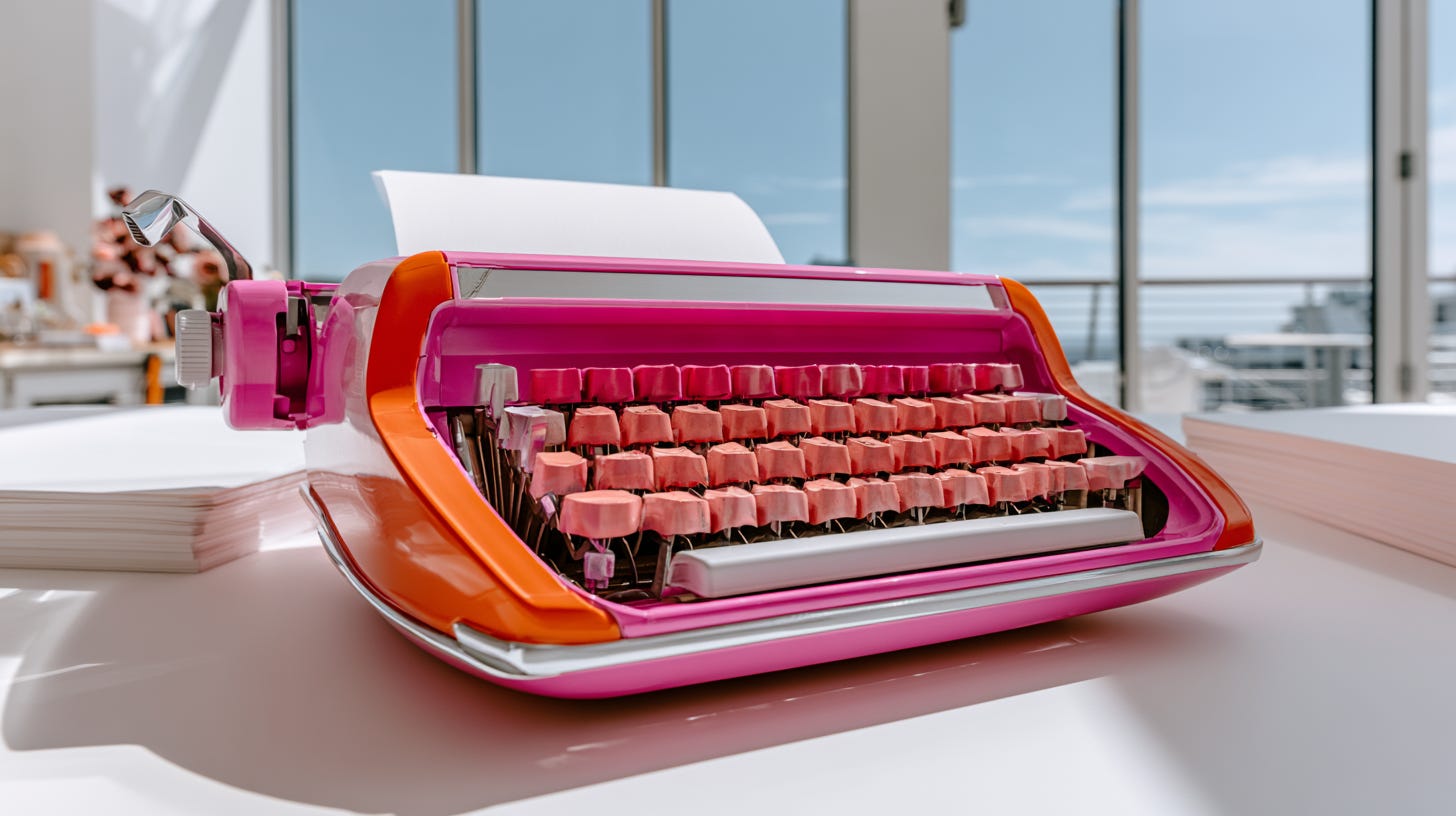 Nobody ever accused a typewriter of sounding like everyone else.
This post is part of my guide to content that sells. If you’re new here, start with Content Pillars That End in a Sale.
This post is part of my guide to AI tools for newsletter creators.
You can tell when something came straight out of a blank AI chat window. It has a smell.
It starts with the em dashes. One sentence uses three of them, every one doing a job a comma could have handled.
Then the vocabulary. Everything is “without the overwhelm” now. Every lesson is a “game changer”. Every point is a “hard truth”, and at least once we are all going to delve. Nobody has delved out loud since 1840, but the robot delves with its whole heart.
Then the quirky sentence structures. “It’s not a newsletter, it’s a movement.” A generic opener like “Most creators” or “In today’s fast-paced digital world,” which is a sentence no living person has ever said to another living person. And the headers, each one wearing a tiny rocket ship (why?) 🚀
You probably scrolled past multiple posts like this today and chances are, you don’t remember one of them.
You retained none of it because the writing came from nobody.
Here’s what happens when you hand a machine a blank slate and ask it to fill the space: it grabs the most average version of every word. It produces the most likely sentence based on a mathematical formula, then the next most likely one, all the way down the page. It reads fine and mean nothing at the same time.
The first mistake is relying on AI for your ideas. AI isn’t where your ideas come from. It’s where they get bigger. You bring the opinion, the stories only you have, the stance that you believe in, the expertise and origin story that is uniquely yours and it helps you shape that into content that is unmistakably written by you.
Give it your real material and what comes out could only have come from you. Give it nothing and it gives you the generic nobody.
And Yes, I use AI to produce my content because it saves time, but I don’t let AI run the show - I’m the producer, director and the actor reading the script I wrote.
Today I’m sharing my process that anybody can use to create better, more specific, relatable content that is authentically YOU.
Here’s my process: Before I enlist AI’s help with a social post, newsletter, video script, or any other content I’m teaching, I open Wispr Flow and I talk.
Why out loud: talking tends to surface speech patterns that typed responses hide. Your go-to phrases, words you use in unique ways, your sentence rhythm, and the way you explain things. That's the raw material your Voiceprint uses, and you produce it naturally when you speak.
This isn’t tidy talking. I pace around my office and ramble at the screen for ten minutes, full of ums, half-finished sentences, a couple of tangents, and the occasional “no wait, back up.”
Wispr Flow catches all of it in the AI chat window. What lands on the screen is an ugly wall of text nobody but me could decode, and that in that mess is the gold. It’s a download of my thoughts before I’ve cleaned them up for company. Only then do I let AI put the pile in order.
The brain dump handles the raw material and I could stop there. But there is a second piece to this that will result in an even better, more YOU final product and I see people miss this one often.
You have to train your AI properly.
Your AI has to know your style, your preferences, beliefs, anlgles and everything about you and your creator life so it can write like you.
It’s important that it know the words you prefer and the words you would never be caught using (I keep a list, and “delve” sits at the top), as well as the takes you’ll defend and the trends you skipped. Give it none of that and you’re back to the average of everyone. Give it a real picture of how you think, speak, and process information and it stops guessing.
People skip this because it sounds like work, and because nobody handed them a simple way to start.
So I built one especially for creators, by a creator who writes for a living and got tired of sounding like a generic press release.
It’s called Your AI Voiceprint. A free prompt (well 2 actually) that turns any AI into a relentless interviewer. It asks how you write, what you stand for, and what you’d never touch, then compiles your answers into one file. The file is your voiceprint and you can feed that file to Claude, ChatGPT, or whatever AI tool you use.
You will spend about 30 minutes answering the question, preferably with Wispr Flow or any other Voice-to-text tool, answering out loud, and the file is yours to sharpen and update as circumstances change.
It won’t write your work for you and that’s the point. It makes sure that when AI helps, the words still sound like a unique individual - a.k.a. You.
Grab it here:
There’s a faster way to do this
Everything in this post is one piece of a bigger system. Inside The Academy, I walk you through all of it in order, from your homepage to your first paid subscriber. Paid members also get my bestselling digital products free, a free month of WriteStack and every monthly challenge.
Want me in your corner? VIP adds a 60-minute 1:1 strategy call with me, Academy LIVE group coaching and the AI, Agents & Vibe Coding Accelerator.
Other ways I can help you:
→ The Academy: all my courses in one place, with my bestselling digital products and every monthly challenge included.
→ The Substack Setup Sprint: four 1:1 sessions to set up your Substack the right way, with support between sessions.
→ The 9-To-Thrive Accelerator: eight weeks of private 1:1 coaching to build your newsletter business.
→ Substack Newsletter Audit: a recorded video review of your Substack with specific fixes you can make right away.
→ Clarity Call: one 60-minute call to untangle your strategy and leave with a clear direction.
Love 9‑To‑Thrive? Go paid for all of my playbooks, AI skill packs and tools, my private member perks page, and behind‑the‑scenes moves I don’t share publicly, so you can implement faster with less guesswork.