The loneliness epidemic, hustle culture backlash, and the village we lost
By Maryam Mehrtash
Published: 2026-04-28
URL: https://thisisnotamemo.substack.com/p/we-were-never-meant-to-do-this-alone
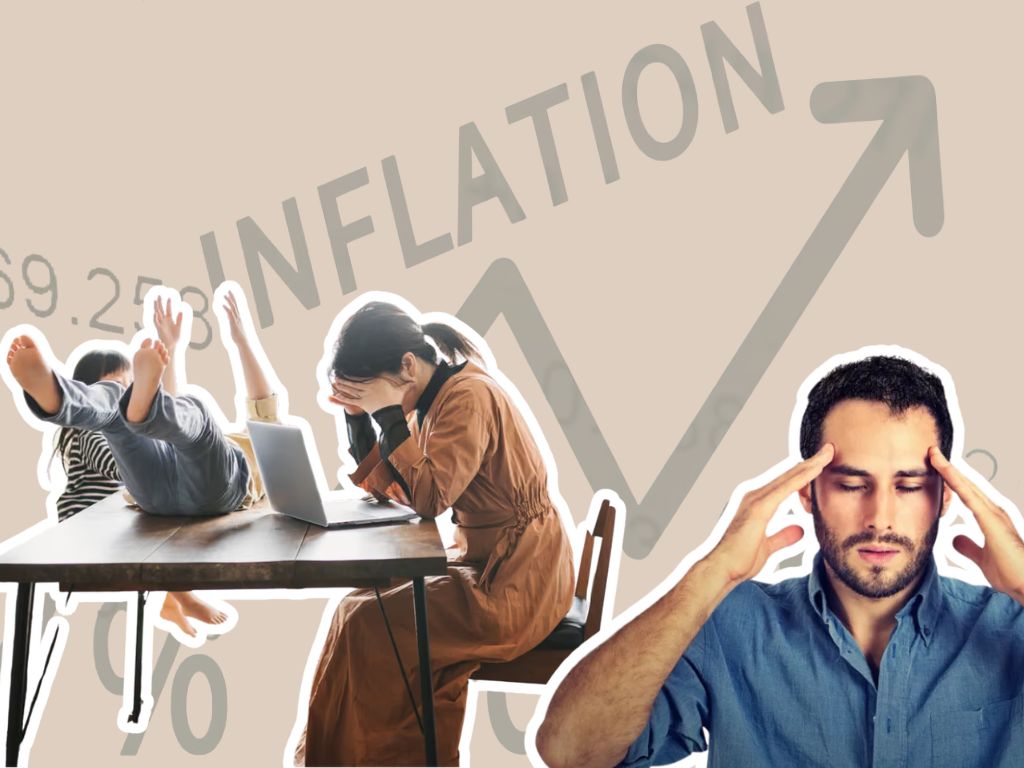
A lot of my friends are struggling right now. And I don’t mean a little stressed. I mean barely holding it together.
In just the past few weeks, four different friends had their fathers hospitalized. Two were diagnosed with cancer. One is fighting pneumonia. And one of them just lost her dad. They are all millennial women. They all have young children at home. They are all trying to maintain full-time careers, hold their marriages and households together, and carry the noise of the entire world on their shoulders.
And it’s not just the personal.
People are losing their jobs. In 2025 alone, 1.2 million Americans were laid off, the highest number since the pandemic. The unemployment rate is 4.3%, and economists will tell you the labor market is healthy.
But that number masks a darker reality. The people who lost their jobs aren’t simply finding new ones at the same level. Many feel like they may never earn what they once did. They are being told to reskill, learn AI, pivot, reinvent, while already running on empty.
Meanwhile, prices have risen roughly 25% since 2020. Groceries alone are up nearly 30%.
The annual inflation rate may have cooled, but it is compounding on top of years of already elevated costs. People are not imagining it. The cost of everything keeps going up, and nearly half of Americans said they ended 2025 worse off than they started it.
The economy looks fine on paper. It does not feel fine for the average person.
This Is Not A Memo is a reader-supported publication. To receive new posts and support my work, consider becoming a paid subscriber. Currently offering 25% off.
The Weight
On top of all of that, the world feels like it’s on fire. The news cycle is relentless. The uncertainty is constant. There is no off switch.
The data confirms what we are all feeling. A staggering 84% of parents report burnout at work due to care struggles. One in four adults are part of the sandwich generation, raising small children while caring for aging parents at the same time. Depression rates among adults under 30 have doubled.
And the US Surgeon General declared loneliness a public health epidemic, warning that the health impact of isolation is equivalent to smoking 15 cigarettes a day.
We are the most connected generation in human history, and we have never been more alone.
I just want to take a moment and acknowledge the weight. I am not going to tell you to meditate. I am not going to tell you to journal. I am not going to tell you that everything happens for a reason.
It’s heavy. And I think we need to stop pretending that it’s not.
The Invisible Aftershock
We often talk about the economy in terms of hard data: unemployment rates, GDP, inflation. But there is a massive gap between the economic statistics and the lived reality of the average person.
In a recent essay titled “If America’s So Rich, How’d It Get So Sad?”, explored this exact disconnect. He pointed to a 2026 paper by University of Chicago economist Sam Peltzman, showing a sharp, unprecedented decline in happiness in the US after COVID, what he calls a “regime change” in national sentiment.
This decline isn’t isolated. It spans across nearly every demographic. Thompson argues that the simplest explanation is that the 2020 pandemic never truly ended as a cultural and political force. The biological crisis gave way to an economic and social aftershock. He calls it a “permademic.” We spent an abnormal amount of time inside our homes, isolated from our communities, and we never fully rebuilt the connections we lost.
We are trying to survive a collective trauma using individualistic solutions. We are told to optimize our morning routines, set better boundaries, and practice self-care. But you cannot meditate your way out of a structural problem.
The Ambition Trap
This tension showed up clearly in the recent cultural moment surrounding Emma Grede. When she launched her new book, Start With Yourself, she proudly claimed the title of a “three-hour mom” and argued strongly against the work-from-home movement, stating that you simply cannot gain the same knowledge and mentorship outside the office.
The internet exploded. The backlash was swift and loud, with many accusing her of reigniting toxic hustle culture and being completely out of touch with the reality of modern working parents.
Here is the thing: I am a fan of Emma Grede. I am not upset by her saying she is a three-hour mom. That’s her choice, and we are all built differently. In fact, studies consistently show that a child's development is deeply linked to a mother's psychological well-being and fulfillment. If building an empire makes her a happier, more present mother for those three hours, then she is doing exactly what works for her.
I also think she is telling the truth about remote work. The core of what she is saying is that you get ahead in your career through proximity to power. I agree with this. I saw it firsthand when I was at a major media company: the people who were in the office on the East Coast got promoted faster than the people working on the West Coast in LA, simply because they were closer to the decision-makers in NYC. Proximity matters. Mentorship happens in the margins.
But here is where the tension lies: being in the office doesn't work for everyone if they cannot afford the extra childcare, or if they don't have a village to help them manage the logistics of a commute and a rigid schedule.
Why did her comments strike such a raw nerve? It wasn't because she was wrong. It was because she is advocating for a level of ambition that is fundamentally unsustainable for the average person without a village.
Emma Grede has a village. It is likely a highly paid one, consisting of nannies, assistants, and support staff, but it is a village nonetheless. Most people do not have that luxury. The anger directed at her isn’t really about her personal choices; it is about the grief of trying to do it all alone. When we hear someone championing the relentless grind, it feels like a slap in the face to those who are already drowning under the weight of their responsibilities without any structural support.
The real question isn’t how hard we should work. It’s who is holding the weight while we do it.
The Myth of the Solitary Hero
I saw an Instagram post this week that said, “We were never meant to raise families alone. Modern isolation isn’t progress.” It had over 38,000 likes. The top comment read, “This wasn’t a dream. This was normal human life before the Industrial Revolution.”
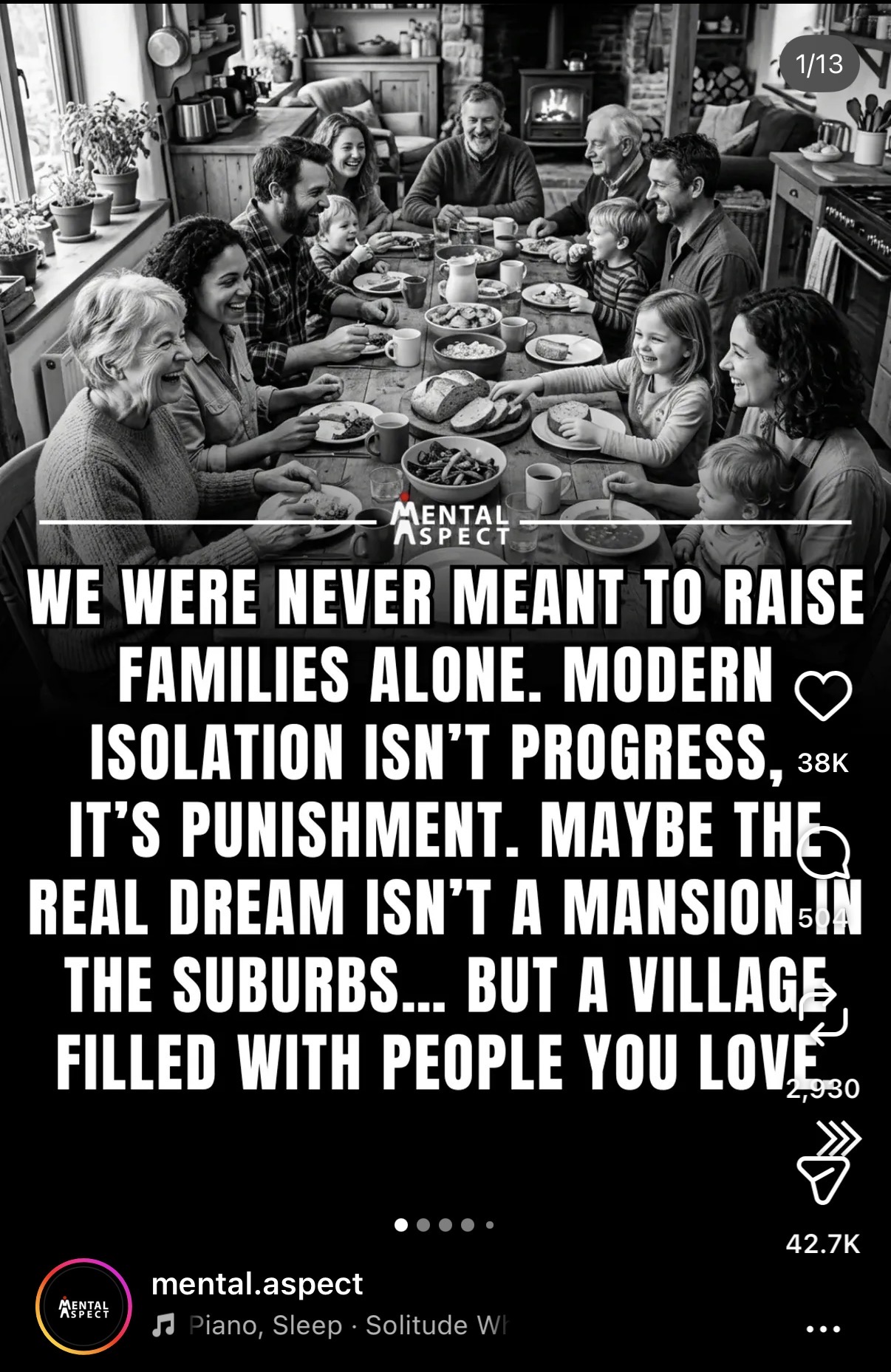 \Image Source: Instagram [email protected]\
For most of human history, we raised children together. We shared the weight of survival. We lived in communities where someone could hold your baby while you fell apart for five minutes. We were never meant to do this alone.
The modern world sold us a different story: That success is individual.
That if you hustle hard enough, you can have the career, the family, and the life, all by yourself. That story has broken us. The loneliness epidemic is not accidental. It is the outcome of a system that prioritizes individual achievement over communal support.
Rebuilding the Infrastructure of Care
This is a call to action. To the leaders, the founders, the policymakers, the investors, and the builders: We need to do better. We need to build better.
We need to stop building technology that isolates us and start building systems that actually support us. We need workplaces that recognize we are human beings with sick parents and toddlers and bills and grief, not just productivity metrics to be optimized. We need a culture that invests in the village, because the village isn’t a luxury. It is how we were designed to survive. There has to be a better way. We just have to start making better decisions, at every level of society.
To every woman reading this who feels like she is drowning right now: You are not failing. The system is failing you.
To every man carrying more than he let’s on: You are not alone.
And I want you to know something else. What you are doing right now, holding it all together, or trying to, takes an extraordinary amount of courage. The kind no one gives you credit for. The kind that doesn’t come with applause or a promotion. The quiet courage of showing up every single day for the people who depend on you, even when no one is showing up for you.
Please, check on your friends today. Because I promise you, even the ones who look like they are holding it all together are carrying more than you know. We cannot fix the broken systems overnight, but we can start by being the village for each other right now.
With Courage,
Maryam
Thank you to those of you who filled out the survey I sent out on Friday! If you haven't yet, the link is here. Your feedback is so important in shaping the future of This Is Not A Memo!
Also, a quick reminder: the 25% off annual subscription offer expires this Friday. If you’re a Free Subscriber, and want to support the work I do at a discounted price, and get access to the Paid Tier, this is the time.