How creators, studios, brands, and tech are collapsing into one ecosystem
By Maryam Mehrtash
Published: 2026-04-07
URL: https://thisisnotamemo.substack.com/p/the-hollywood-files-the-great-convergence
Welcome back to The Hollywood Files, where we peel back the curtain on the business of storytelling, the grit, the ego, and the quiet moments of courage it takes to build a career in entertainment.
A few months ago, I wrote that every brand is a studio now. I also wrote that the chaos in Hollywood isn’t a collapse, it’s a correction.
But it’s worth pausing to acknowledge the human cost of that correction. If you work in entertainment, the last few years have been brutal.
The most recent headlines aren’t showing any remorse, with layoffs in Q1 2026 hitting Epic Games, Spotify Studios, Starz, CBS News Radio, WME, Axios, Lionsgate, Universal Music Group, CNBC, KTLA/Nextstar Media, Netflix, The Washington Post, Amazon, and several others.
Paramount Global laid off 1,000 employees in October 2025, with whispers of thousands more job cuts looming if the Warner Bros. Discovery acquisition goes through. Employment is down roughly 30% across the industry, from the late-2022 peak for actors, carpenters, costumers, and the hundreds of other professions that make movies and TV shows.
Even with the Writers Guild reaching a surprise, swift tentative agreement with the studios this week to avert another strike, the anxiety remains. A century-old entertainment economy is evaporating in Los Angeles. If you are out of work right now, if you are staring at a resume and wondering how to pivot, I see you. The fear is real.
But there is also hope.
The models are shifting, but the fundamental truth remains: community and connection are the most defensible currencies in culture. The skills you built in traditional Hollywood, storytelling, production management, audience psychology, creative problem-solving, are exactly the skills the new economy is desperate for. You don’t need to abandon your expertise; you need to transfer it.
If you needed proof that the old models are dying and the new ones are taking over, consider this: in 2025, for the first time in history, YouTube generated more revenue ($62 billion) than the Walt Disney Company ($60.9 billion).
We are no longer waiting for the creator economy and traditional media to collide. They have fully converged.
If you are trying to build a career, a brand, or a business in entertainment today, you cannot afford to think in silos. The walls themselves have been torn down.
Here is a roundup of the most important deals that just reshaped the industry, and what they mean for the future of storytelling.
This Is Not A Memo is a reader-supported publication. To receive new posts and support my work, consider becoming a free or paid subscriber.
1. Tubi x TikTok: The Creator-to-Premium Pipeline
The News: Last month, Tubi (the Fox-owned free ad-supported streamer) and TikTok announced the “Creatorverse Incubator.” The partnership will identify top TikTok creators and give them a direct pathway to develop exclusive, long-form original shows, both scripted and unscripted, for Tubi.
The Insight: This is the formal bridge from the phone screen to the living room screen. For years, traditional studios looked down on digital creators. Now, they are actively recruiting them to save their streaming platforms.
Why?Distribution is now a commodity. Community is the moat. Tubi isn’t just buying shows; they are buying pre-built, highly engaged audiences. As Dawn Yang, TikTok’s global head of entertainment partnerships, noted, this gives creators the chance to “turn their creativity into lasting impact.”
If you are a creator, your short-form content is no longer just a marketing tool. It is your pilot presentation. If you are a traditional producer looking for your next gig, this is where the budgets are moving.
2. Disney+ “Verts”: The UI is the Message
The News: Last month, Disney+ rolled out “Verts” to its mobile app, a TikTok-like, swipeable vertical video feed featuring scenes and moments from its massive catalog. While it currently serves as a discovery tool for existing Disney content, the company explicitly stated that Verts will eventually feature “content from creators that reflects our fandoms.”
The Insight: The medium is the message, and the UI is the strategy. When the most legacy entertainment brand on the planet, hires YouTube veteran Adam Smith, as Chief of Product and Technology, and redesigns its flagship streaming app to mimic a social media feed, the debate is over. Vertical video has won.
But the real story is what comes next. By opening the door to creator content within the Disney+ ecosystem, Disney is acknowledging that the future of fandom isn’t just top-down broadcasting; it’s bottom-up participation. Studios are realizing they can’t just license the creator economy, they have to integrate it into their core product.
3. Mazda’s “5 Sides of the CX-5”: The Brand-as-Studio Reality
The News: When Mazda launched its new CX-5 SUV, they didn’t buy a standard commercial. Instead, they debuted five short films during the Oscars commercial breaks. Directed by Paul Hunter, the “5 Sides of the CX-5” campaign spans five classic Hollywood genres: Romance, Action, Sci-Fi, Musical, and Horror. Mazda is now planning to distribute these films across YouTube, TikTok, Hulu, and potentially even in movie theaters before summer blockbusters.
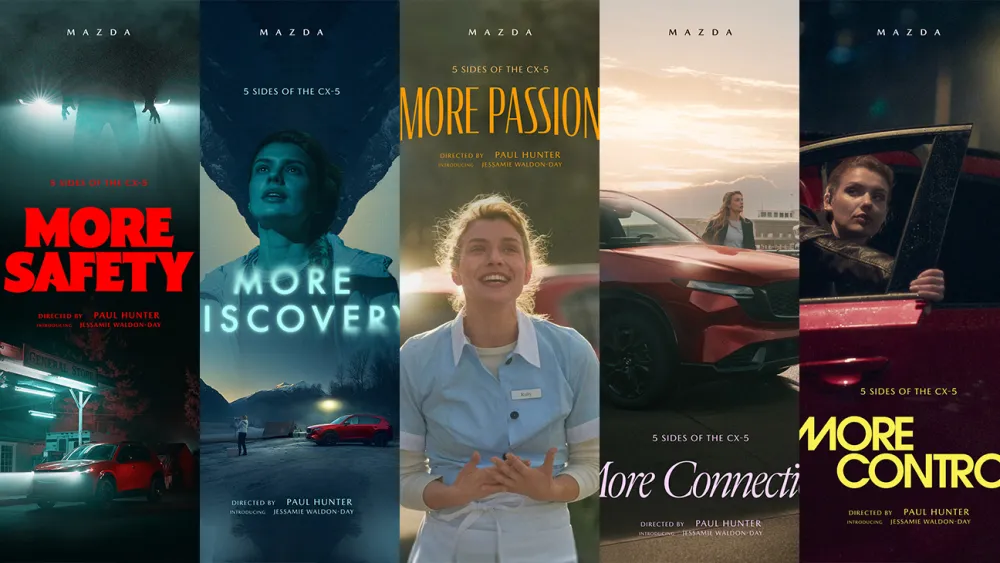 \Image: Mazda created movie posters for fake titles in its new ad campaign. Courtesy of Mazda via Hollywood Reporter\
The Insight: As Fast Company recently declared, “Branded entertainment will just be entertainment in 2026.”
Mazda’s CMO, Brad Audet, realized that in a hyper-competitive market, interruptive advertising is dead. “We couldn’t just come out with another standard automotive spot,” he said. “We really needed to do something that broke through.”
Brands are realizing that if they want attention, they have to earn it with actual storytelling. They are hiring real directors, utilizing real Hollywood talent (including members of the Academy Gold mentorship program), and treating their products as characters within a narrative, rather than items to be sold. Every brand is a studio now. And for out-of-work Hollywood professionals, every brand is a potential employer.
4. OpenAI Buys TBPN: The Tech-Media Takeover
The News: OpenAI recently announced its acquisition of TBPN, a highly influential, tech-focused streaming talk show and podcast. The show, which launched in 2025, has been described as a merger between SportsCenter and LinkedIn.
The Insight: OpenAI is officially a media company. Following a massive $122 billion funding round, the AI giant isn’t just building the tools that will reshape content creation; they are buying the platforms that control the narrative.
When the company building the artificial intelligence also owns the media company discussing its impact, the game changes entirely. It signals that tech companies understand the power of owned media and direct audience connection. They aren’t just disrupting Hollywood; they are becoming the broadcasters.
5. The Democratization of Production
The News: At SXSW last month, Blumhouse CMO, Karen Barragan revealed that the legendary horror studio is now finding feature film directors on YouTube.
In fact, they have two major studio movies coming out in May directed by YouTubers. As Adobe VP Hannah Elsakr noted on the same panel, “People are greenlighting themselves, which is an incredible thing” .
The Insight: The tools of production have been completely democratized. AI tools are reducing post-production costs by 50-70% . One person with a laptop can now do what used to take a team of ten.
But here is the crucial takeaway: if AI can handle the technical work, the scarcity is no longer production value. The scarcity is trust, community, narrative building and taste.
This is why your traditional Hollywood skills are so valuable. Anyone can generate a video now, but very few people know how to craft a compelling narrative, build tension, or understand audience psychology. Your human skills are your ultimate leverage.
The Convergence Era
The global creator economy reached $205 billion in 2024 and is projected to hit an astonishing $1.35 trillion by 2033.
We are in the Convergence Era.
If you are a creator, you are a studio.
If you are a brand, you are a network.
If you are an executive, you need to understand how to navigate all three.
The chaos you see in the headlines, the layoffs, the mergers, the shifting strategies, is simply the old system correcting under the weight of its own assumptions. What looks like destruction to the incumbent looks like pure opportunity to the insurgent.
The models are shifting, but the fundamental truth remains: community and connection are the most defensible currencies in culture.
The tools are here. The audience is waiting.
What are you going to build?
With Courage,
Maryam
Thanks for reading This Is Not A Memo! This post is public so feel free to share it.