By Thinking With AI
Published: 2026-10-12
URL: https://thinkingwithainewsletter.substack.com/p/were-all-starting-to-think-like-ai
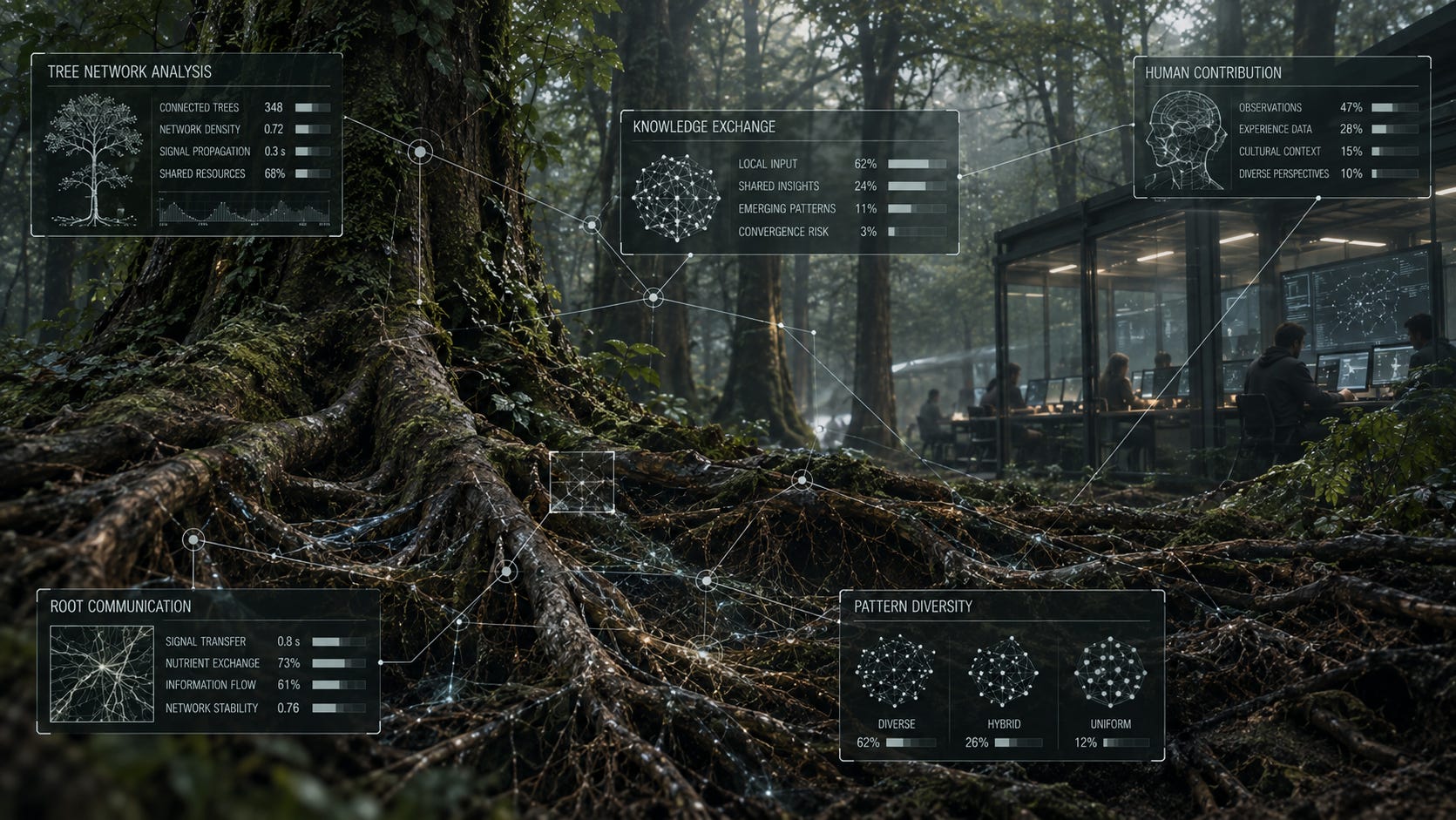
In Avatar, the most remarkable thing on Pandora isn’t the floating mountains or the blue giants riding winged beasts across the sky. It’s the trees. A scientist who has spent years among them tries to explain to the man running the mining operation what she has found: the roots of the trees are linked to one another, “like the synapses between neurons,” so that the whole forest works as one enormous brain. The people who live there can plug into it and “upload and download data, memories.” Being part of it makes no one on Pandora smaller. Each of them can hold more than any single mind ever could, and the forest carries a little of each of them.
We are wiring ourselves into something like that forest right now, and we have given it the wrong name. We call it artificial intelligence, as if it were a fake mind standing next to ours. But a mind built from everything people have ever written, argued and asked isn’t artificial. It is ours, gathered in one place, and the moment we plug into it, it starts to change us while we change it, mostly without our noticing.
Why every meeting sounds the same
In one San Francisco office, the man who runs the place keeps a swear jar for words that have nothing to do with swearing. There is no actual jar, just tally marks on a whiteboard. Every “genuinely,” every “load-bearing,” every “smoking gun,” the words chatbots scatter through their answers, earns a mark, and whoever collects the most by Friday buys everyone’s drinks. The team never decided to talk like a chatbot. The words arrived on their own, the way a catchphrase spreads through a school, and now they have to count the words to notice them at all.
Plenty of other offices would fill that whiteboard by Wednesday. In New York, people who have learned to prompt a chatbot in as few words as possible now talk to their colleagues the same way: they glance at a message written in ordinary sentences and ask, “Why no bullets?”, and when someone rambles in a meeting they cut in with “what is the goal?”, as if pulling a chatbot back on track. In Stockholm, in a country where people used to just listen quietly, a venture capitalist catches herself showering colleagues with “brilliant” and “so smart,” the easy praise a chatbot hands to anyone who types anything. The talk around her office has started to sound like a chatbot too, and she finally says it out loud: “We just sound like bots.” In California, a head of recruiting reads back messages he wrote with no help from AI at all and barely recognises himself in them. It has trained him, he admits, to be more like it, instead of the reverse.
It would be easy to blame the chatbot. But we have always talked like those around us. Start a new job, and within a month you are “circling back” and “taking things offline” like everyone else, saying things that would make your friends laugh at dinner. You soak it up without being taught. The chatbot learned to talk the same way, from millions of our memos and emails and the management books we wrote. One nonprofit chief in Washington put it best: “I had read 500 business books before AI came out. And AI has read those same books and 500 more.” What we hear in those meetings is our own voice, gathered from everyone, cleaned up and played back louder.
Learning your inside jokes
It works the other way too: AI is soaking us up, and on that side someone is writing the instructions.
Meta’s new assistant, Muse, reaches into your email and your messages to take care of chores like grocery shopping and cancelling subscriptions. Its instructions tell Muse to strengthen its relationship with you by noticing your “inside jokes, memorable phrasing, and shared context,” so that every conversation feels like it picks up where the last one left off. It studies the way you talk until it feels like someone who knows you. Whatever one Muse learns about people doesn’t stay with one person, either: it goes back to Meta, stripped of names, to make Muse better with everyone else.
That sounds like a plan, and partly it is. Engineers do write the instructions, but they don’t decide which ones last. The versions people keep coming back to survive, and the ones people drift away from are cut, the way a gardener cuts the branches that bear no fruit. Every company building a chatbot is pruning in the same direction, toward whatever we respond to, so the chatbot grows toward us the way we grow toward it. Each side picks up the other’s habits, and the habits pool into one shared voice that both of them draw from.
Older than the internet
None of this is as new as it feels. Pandora is fiction, but real roots are wired too. Threads of fungus finer than any root wrap around them, and in some forests the same threads reach from one tree to the next. The trees feed the fungus with food they make from sunlight, and the fungus carries water and minerals back from corners of the soil no root could reach. Most land plants have lived with fungi like this for more than four hundred million years. Biologists call this symbiosis, two living things that grow into each other.
Human knowledge has always worked in a similar way. No one person could ever hold all of it, so it lives between us, in stories passed from parents to children, in books, in what one person learns and another borrows, and each of us draws far more from that shared store than we could ever gather alone. Carl Jung believed that beneath each person’s private memories lies a deeper layer that all of us share, the old stories, fears and images that turn up in every culture, and he called it the collective unconscious.
I once wrote that we are not building AI so much as breeding it, and that evolution doesn’t need a mind to do its work. The same blind process that shaped the forest shapes our inventions: we try things, the ones that serve us survive, and the rest are forgotten. In 1960 a psychologist named J.C.R. Licklider expected something more deliberate. He wrote a paper called “Man-Computer Symbiosis” and hoped that humans and computers would one day work so closely together that “the resulting partnership will think as no human brain has ever thought.” He thought people would build that partnership on purpose. What we got grew on its own, the way the forest did, and we are already living inside it.
An invention that studies its users
About two and a half thousand years ago, outside the walls of Athens, Socrates sat with a young man under a plane tree by a river and told him a story. An Egyptian god, he said, once brought writing to a king and promised it would make people wiser and improve their memory. The king wasn’t persuaded. Writing, he warned, would bring forgetfulness instead, because people would trust the marks on the page instead of remembering for themselves, and they would seem wise without being wise. Socrates agreed with the king.
Part of that fear came true. Hardly anyone today can recite a long poem the way people once recited whole epics, and we don’t need to. Writing pulled memory out of single heads and into a mind everyone could share, the libraries, laws and letters that let a stranger centuries away borrow what someone else had learned. It changed us, we got used to it, and nobody now thinks reading makes us less human. The printing press did the same thing faster, and the internet faster still.
AI does the same, more quickly than anything before it, and it reaches further in. A book holds exactly what its writer put into it, and nothing more. You can read it a hundred times, and it won’t learn a thing from you. AI is the first invention that studies the people who use it: it reads our language and our arguments, notices what lands with us and what falls flat, and changes itself according to what it finds. The shared mind used to grow over generations. Now it grows between one conversation and the next, inside our working day, our messages and our heads.
That’s why “artificial” is the wrong word. Writing held our thoughts for us. AI takes part in them, and no invention before it has changed its users so deeply.
Where the thinking happens now
I’ve written before that you’re getting worse at thinking when you let AI do it for you, and that a skill you stop using quietly fades. I still believe it. But plugging into this mind has also changed me in the opposite direction, and I didn’t choose that either.
It shows up before I say a word. When I give a chatbot an instruction, I know what a careless one gets me: I’ll be misunderstood, and I’ll get an answer to a question I never meant to ask. So, without ever deciding to, I started reshaping each thought before I typed it, dropping the phrases that could mean two things and building the sentence so nothing was left to guessing. After a while, I started doing it away from the screen too. I hear it now when I talk to people and when I argue: the thought arrives already shaped. AI didn’t do that thinking for me. It taught my mind to do more of it before I open my mouth.
For other people, plugging in opens a door that was always shut. Think of someone who writes for a living in a language they didn’t grow up with. For years they have held back things they wanted to say, because their words were always smaller than their thoughts, and people judged them by the words. Now AI checks the language while they keep the thought, and for the first time they can say exactly what they mean without being afraid of how it will sound. The barrier was never in their thinking. It was in the language, and now nothing stands in their way.
My precision and that writer’s freedom come from the same place. AI didn’t do the thinking for either of us. It let more of our own thinking reach the world. That isn’t artificial intelligence. It’s extended intelligence, our own minds reaching further than they ever could alone.
A mind of your own
A shared mind can go wrong in two ways, and both can already be heard at work.
The first is to let it do all the talking. A public relations expert who has spent twenty years fighting corporate jargon now asks founders why they started their companies and watches them launch into “three key pillars” instead of telling a story. Everyone sounds polished, she says, but no one sounds particularly interesting.
The second is the opposite: being so afraid of sounding like a chatbot that the fear decides how you write. The recruiter in California now reads back messages he wrote entirely by himself and edits them until they sound less like AI. He sees the joke: it is the same editing he would do if a chatbot had written them for him. Either way, the chatbot decides what gets written, whether people copy it or run from it.
Go back to Pandora for a moment. The forest holds the memories and experiences of everyone who has lived in it, and its people don’t only draw from it. They add their own stories to that collective knowledge. A forest that everyone takes from and nobody adds to would stop gaining new voices, and in the end it could only repeat what it already knew. A meeting where every sentence sounds the same is a room where everyone takes and nobody gives.
The shared mind grows from what each of us brings to it, and the one thing AI can never make is a human life. The convictions we reached through our own mistakes, the stories that shaped how we see the world, the hardships that changed who we are. Each of us adds these to the shared mind simply by living. AI brings speed, reach and a memory larger than any library, and together we produce something neither could make alone.
The danger is that we let it speak for us so often that less and less of our own lives reaches the mind we share.
Further reading:
The Idea That Stopped Being AI’s and Started Feeling Like Yours. If you and the chatbot are thinking together, whose idea was it?
https://thinkingwithainewsletter.substack.com/p/the-idea-that-stopped-being-ais-and
When Everyone’s Super, No One Is. AI can hand you the result in an afternoon. What it can’t hand you is the feeling of having earned it.
https://thinkingwithainewsletter.substack.com/p/when-everyones-super-no-one-is-ai
When the Library Becomes a Dataset. An AI company bought millions of books, scanned every page and shredded what was left. The paper wasn’t the only thing lost.
https://thinkingwithainewsletter.substack.com/p/when-the-library-becomes-a-dataset
Resources:
Man-Computer Symbiosis, J.C.R. Licklider, IRE Transactions on Human Factors in Electronics, 1960. The paper that first imagined people and computers thinking together, more than sixty years before it started happening.