By Thinking With AI
Published: 2026-09-21
URL: https://thinkingwithainewsletter.substack.com/p/the-law-of-conservation-of-energy
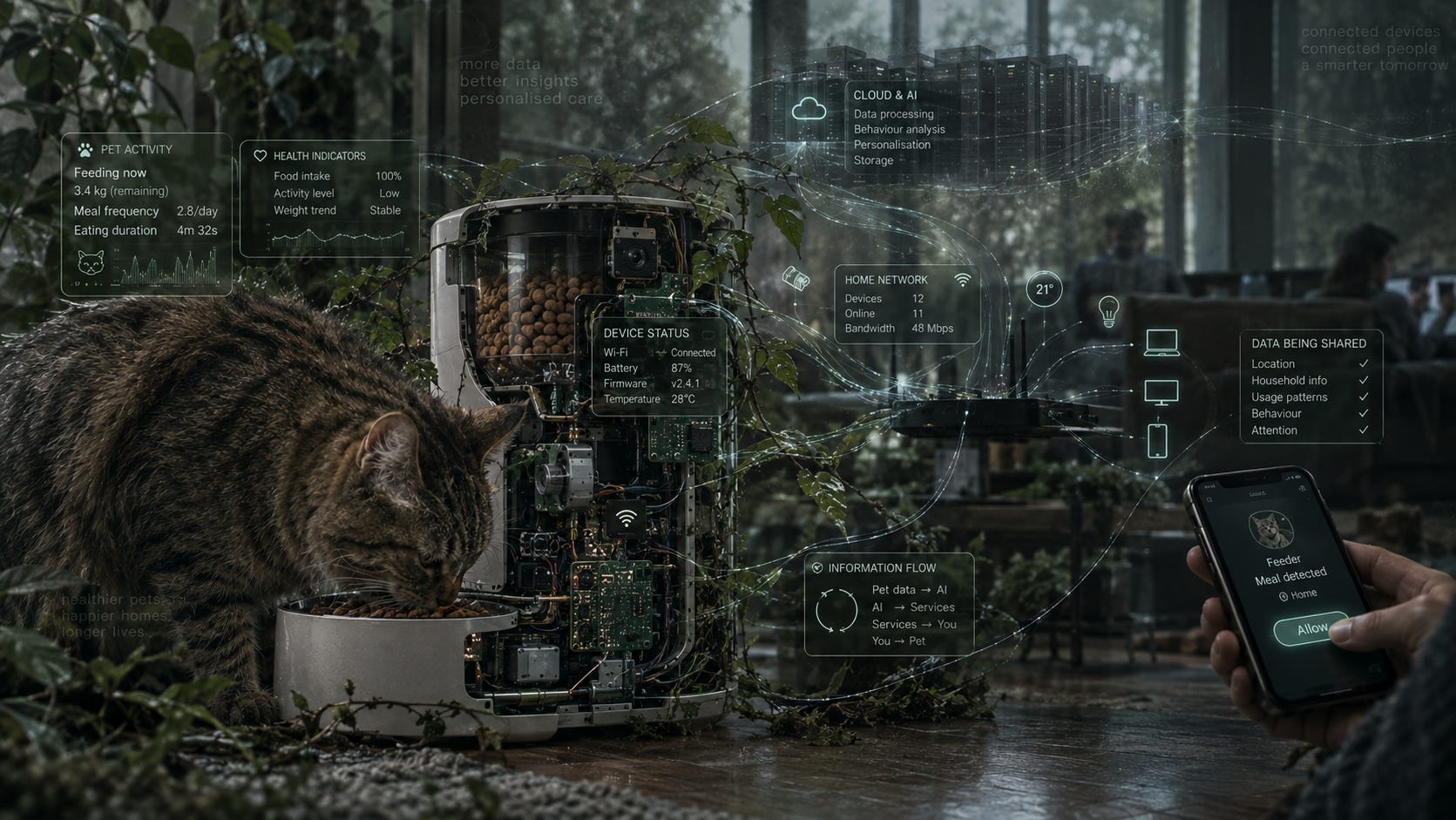
My old cat feeder needed to know one thing: what time it was. The new one wanted to know my house.
The old feeder was as simple as a kitchen timer. I filled it, set the times and pressed a button, and from then on it ran on its own, feeding the cat on schedule until the day it broke. It never asked who I was or where I lived.
The new one arrived this week, and before it would dispense a single meal it wanted to be let into my home. It wanted Bluetooth and my Wi-Fi. It asked for access to my home network and to the network my other appliances run on, and every request came with the same button: Allow. By the time I had finished tapping, a device whose only job is to drop food into a bowl had asked for what felt like everything my household runs on. After all that, it still would not connect.
The old feeder did the same job without knowing anything about me. Whatever the new one collects, it collects without the cat’s well-being in mind.
The requests behind that button go further than the screen suggests: the phone’s precise location, a map of every other device in the house, and on some models a microphone or a camera. At one brand, late last year, a security researcher found that anyone could break into any owner’s account, take over the feeder and download the voice messages people had recorded for their pets.
None of this is hidden. It sits in plain view in the permissions and the privacy policies, because nobody needs to pretend any more that the data belongs to the people it describes. It is treated as property, and it belongs to whoever collects it. What it will be used for next, who else will see it, and what one connected cat feeder does to the security of every other device in the house are questions without answers, even for the company. The data outlives the reason it was collected.
Looked at on its own, a cat feeder has nothing to do with controlling every part of a person’s life. Followed to where its data ends up, it has everything to do with it.
Nothing is ever lost
Physics has a law that no experiment has ever broken: energy cannot be created or destroyed. It can only change form. Sunlight becomes wood, wood becomes fire, and fire becomes heat. Nothing is lost. Everything is converted, and everything moves.
The same law runs through every society. The energy and the money of a population never vanish. Both turn into something else and end up somewhere else. The conversion has been running for as long as there have been people to do the work and others to gather what the work produces, and every age has had its version. The years just behind us are only its latest and plainest example.
In those years, the energy of ordinary people has been worn down by constant conflict, by pandemics and by wars. Even those far from any front line carry the wars home, through news built to frighten and a threat that never lifts. Money has drained away just as steadily. It has been swallowed by inflation and the cost of living, by bad political decisions, by an economy sinking too slowly for anyone to call it a collapse, and by debt that can never be repaid.
By the law of conservation, none of that energy and none of that money can have disappeared. It has changed form and gone somewhere else: into the development of artificial intelligence. It has become data centres, chips, power lines and cooling systems, and a growing store of recorded human life. The flow is easiest to see on the electricity grid. In west London, new housing developments have been warned of years-long waits for a grid connection, because data centres took the capacity first. What drained out of households became the infrastructure of AI.
The money sitting idle
Savings are stored energy. Every pound in a savings account is a few hours of someone’s working life, turned into money and set aside. People keep it for safety, for security, for a rainy day, and for the quieter comfort of knowing that if everything else falls apart, the household can stand on its own for a while. It is the one form of independence most people ever own, and it works only as long as it is left alone.
This summer that money was given a new name. The President of the European Commission, Ursula von der Leyen, told business leaders in Paris that ten trillion euros of household savings were “sitting idle” in bank accounts, and that Europe “needs to put these savings to work for its companies.” In the same speech she pointed to the twenty billion euros Europe is mobilising for AI gigafactories, the vast computing centres where the largest AI models are trained.
Idle is the word for money whose owners have failed to use it properly, money waiting for someone more capable to put it to work. The word is hers, but the attitude belongs to the whole structure she speaks for. The savers meant that money as a floor. The structure sees unused fuel.
Put that fuel to work, and the conversion runs further than any saver intended. The stored energy of millions of working lives is turned into data centres, and the data centres go to work recording the same people whose savings paid for them. Money that once let a household get by without asking anyone’s permission ends up building the systems that will decide what the household is permitted. The value of the savings does not disappear. It changes form and changes hands, and it ends up as a record of the savers, held by someone else.
What the buildings eat
The buildings feed on what the rest of society is short of. A data centre needs land, and more of it with each expansion. It needs water in enormous quantities to keep its servers cool. Earlier this year I wrote about who gets the water when a drought comes, the data centre or the household. The data centre won. It needs electricity, and the demand keeps climbing. And it needs the one resource no meter records: human energy, the attention, time and daily life of a population, converted tap by tap into data. The appetite does not level off. Each generation of models takes more computing power to train than the last, and each needs more buildings behind it.
The cost lands on the same population, through energy bills, through taxes, and, once idle savings are put to work, through money that was never meant for it. The people paying are already taxed to the hilt and running short of both money and energy. My electricity company has written to warn of higher charges this winter, and prices are rising everywhere.
Sacrifice, for a brighter future
Talk of supply chains breaking down is constant online. The prepping movement, a fringe not long ago, has gone mainstream: the European Commission now advises citizens to keep three days of supplies at home. The signs of a coming war are there for anyone who looks, and a great many people have decided not to look. Plenty would rather not talk about it, not see it, and not consider that everything familiar is coming apart.
And still the official story asks for sacrifice. The requests are familiar: tighten the belt, pay a little more, expect a little less, all for a better future. Meanwhile the screw keeps turning, the assets people spent their lives building are stripped away, and a new demand has joined the others: young people’s lives.
Conscription is back on the table across Europe. In Germany, every young man turning eighteen must now fill in a military questionnaire, and parliament can vote to make service compulsory if too few volunteer. First the money, then the energy, and now the call for lives, and every time the reason given is the same: the public’s own good.
What remains after money, energy and lives is the future itself. The debt piling up now will be paid by the next generation for the rest of its life, and by the generation after that. More likely it will be paid by no one, because it can never be paid, and everything will collapse under its weight. The pensions earned over a working lifetime will not be spared either.
None of these mechanisms is new. Economies have collapsed before. Pensions have been raided before. Young men have been fed into the meat grinder of war again and again, always for a brighter future. What history has never seen is all of them running at once, on a system that can watch the whole population while it happens.
Why this time it is total
This is extraction on a total scale, and AI is what makes it total. It does so in two ways.
The first is control, and control has always cost energy. Watching a population used to take people: clerks, inspectors and informers, a workforce paid to observe everyone else. That cost was the limit, and AI has converted it into electricity. The watching that once needed a second workforce now runs in data centres, on power drawn from the same grid the watched are paying for.
The second is appetite. AI does not only make the old extraction easier. It extracts on its own account, for its own growth, and that growth is parasitic in the plain biological sense: it lives off a host, and the host is the society around it. Year after year it takes more from the people it claims to serve, and it returns less than it takes. For now, its growth is directed by the companies and governments that own the infrastructure. Whether it stays directed once it no longer needs a director is still an open question.
The last resource
When the money, the energy, the savings and the future have been taken, one resource remains: people themselves. Habits, preferences, ways of thinking. All of it is valuable in the economy that is coming, because in that economy data is the currency.
A currency is whatever buys access. What a person can reach, borrow, enter or be offered will depend less on what sits in their account and more on what sits on record about them.
This is where the whole process was heading. Data as currency is the outcome of total extraction, and one is the consequence of the other. Once everything that could be taken from people has been taken, what remains to take is the people, converted, as the law says everything is, into another form. The energy drawn from people’s lives is stored in the data centre as a record of the population, and the record is what gets traded.
Built for one thing, used for another
The infrastructure for this already exists: facial recognition, phones that report their owners’ movements around the clock, and the collection of as much information as possible about everyone, with or without consent. None of it will stay in the job it was built for. Marketing and advertising were only the beginning, and control is one of many uses to follow.
History is consistent on this. Technology built for one purpose ends up used for another. Sometimes the second use is wonderful, useful in ways its inventors never imagined. Sometimes it is dangerous. Nuclear energy is the clearest case: the same physics that lights cities and heats homes can wipe them out.
What gets me most is that this progression has already happened once, in everyone’s pocket. The mobile phone began as a way to make calls and send messages. Today it knows where its owner is at every moment. It contains the person carrying it. The cat feeder is the same progression starting again: a timer that dropped food into a bowl has become a device on the network, reporting to a server.
The avalanche of information matters more than any single reading in it, because AI can read all of it at once. One report from one feeder means nothing. Millions of feeders, phones, cameras and payments, analysed together, give up patterns no person could ever see: when homes are empty, what frightens a population, what moves it, how much it will tolerate. That is the real value of the avalanche, and only AI can extract it.
Steered, not only watched
Watching is only one side of what this data makes possible. The other is steering: nudging, coercion, the quiet manipulation of behaviour. Behavioural science already knows how to do it, and the data shows it where to push. The energy people poured into the record is now used to move them.
Britain has had a unit for this since 2010. The Behavioural Insights Team, known as the Nudge Unit, was set up at the centre of British government, inside the Cabinet Office, to use psychology to change what people do. In 2020, during a national emergency, a paper from the government’s behavioural advisers called for “hard-hitting emotional messaging” to increase “the perceived level of personal threat” among people who were “complacent.” It listed coercion among the recognised ways of changing behaviour, and it asked for messages tailored to “the different motivational levers” of different people.
The advice itself rested on psychology and opinion polls, but the data systems running beside it were built on a different scale. In the same emergency, the government brought in Palantir to pool health data on millions of patients, used anonymised mobile phone location data to check whether people were staying at home, and paid an AI monitoring firm to watch what people posted online, including the posts of those who questioned the rules. Data on that scale is not read by civil servants. It is read by software, and software finds patterns.
Tailoring, in 2020, meant groups: one message for people who follow rules, another for people moved by duty, another for people moved by personal risk. The feeder, the phone and the camera remove that limit. With every device in the house reporting, AI can find the lever for each person separately and adjust it as the person changes. A science that once frightened a country one group at a time can now frighten, soothe or steer one person at a time.
The switch
The infrastructure is built. It lives in homes, in pockets, in the routine of every day. What remains is a switch.
The real power lies in what the data centres hold. A data centre itself is concrete, cable and cooling. By the same law that has governed every conversion so far, the power a population loses does not vanish either. It moves with the energy, the money and the data, it gathers wherever those are gathered, and it sits with whoever decides what the store is used for. That decision is the switch.
With the energy, money and resources of a society run low enough, throwing that switch becomes the obvious move. It leads towards a future in which everything is controlled, savings cannot be kept as the saver pleases because someone in Brussels or elsewhere has decided the money is idle, and people have no say in their own future. A person who lives only as a resource, while every resource is being depleted, lives at the mercy of whoever took them.
Two buttons, one way through
In a sense, every stage of this has gone ahead with the public’s permission. People pay for the system, use it, carry it everywhere, and do not protest. But allowing is not choosing. Refusal would mean throwing every phone and laptop out of the window, and ordinary life no longer works without them. Each year, more of daily life is built around them.
The feeder offered two buttons, Allow and Don’t Allow. Don’t Allow meant it would not feed the cat. For a cat feeder, the price of refusing is small: the cat is fed by hand and the box goes back to the shop. But the feeder is only the first step, and the most trivial one. The same two buttons sit in front of the doorbell camera, the smart television, the car, the banking app and the doctor’s booking system, and each asks for something more sensitive than the one before. In the emergency of 2020 the same logic reached the front door, with an app’s check-in code pinned up at the entrance of every pub and restaurant. The more a service matters, the more its Don’t Allow costs. Refusing a cat feeder costs a convenience. Refusing the banking app, as branches close, makes a person’s own money harder to reach. The option to refuse stays on the screen at every step. What rises is the price of pressing it.
This is the nudge in its purest form. The choice stays with the person on paper, while the direction is decided elsewhere. Permission and manipulation are one design, not two separate things: people are allowed to choose, and the choice is built with a single way through it. Behind the buttons sits software that records each tap, and each tap moves a little more of a life into the store. Afterwards, people are told the decision was theirs. That is the part that works like gaslighting: pushed into agreement, then reminded of the agreement.
So none of this is the public’s fault. Every tap on Allow is what the design was built to produce. People are coerced, told it is for their own good, and left without any real way to refuse.
Put to work
The law of conservation holds to the end. Everything drained out of ordinary lives still exists: the hours of work, the savings, the attention, the taps on a screen. None of it has been lost. It has been stored in the infrastructure as data, the currency of the economy that is coming, and stored energy is not kept to sit idle. It is kept to be put to work, and here the work is done on the people it came from. What the public spent comes back to it in a new form: as the permissions it lives by and the nudges that steer it.
The power to allow is the last thing converted. It used to sit with the public: every tap of the button, every signed form, every paid bill, every record handed over. That power does not disappear either. It is being transferred, and part of the transfer has already happened. A private life is already a right with an exception for national security written into it. Homes are already heated at a price the people living in them do not set. The rest has not arrived yet, but the road points towards it: money that can be spent only while a profile allows it, and choices steered, one tap at a time, towards what a system has decided we will want next.
My old feeder only needed to know the time. The new one wanted my location, my home network and a view of the other devices connected to it, and I allowed it, to save myself the bother of filling a bowl by hand. Whatever those permissions let through does not disappear. It is converted into data and stored beside the readings from millions of other feeders, phones, cameras and payments. Nothing is ever lost. It only changes hands.
Further reading:
You Are Not First in Line for the Water. A hosepipe ban, a dead garden, and a question the drought forced into the open.
https://thinkingwithainewsletter.substack.com/p/you-are-not-first-in-line-for-the
Your Money, Their Machine. Losing access to one’s own money sounds like a forecast. In one democracy it has already happened, without a court.
https://thinkingwithainewsletter.substack.com/p/your-money-their-machineai-and-the
We Are Not Building AI. We Are Breeding It. Every host assumes it is in charge of what it feeds. Nature has a long record of hosts who were wrong.
https://thinkingwithainewsletter.substack.com/p/we-are-not-building-ai-we-are-breeding
Resources:
Speech by President von der Leyen at La Rencontre des Entrepreneurs de France 2026, European Commission, 27 August 2026. The speech that calls Europe’s household savings idle, with the twenty billion for AI gigafactories a few paragraphs later.