By Thinking With AI
Published: 2026-07-13
URL: https://thinkingwithainewsletter.substack.com/p/a-very-respectable-kind-of-theft
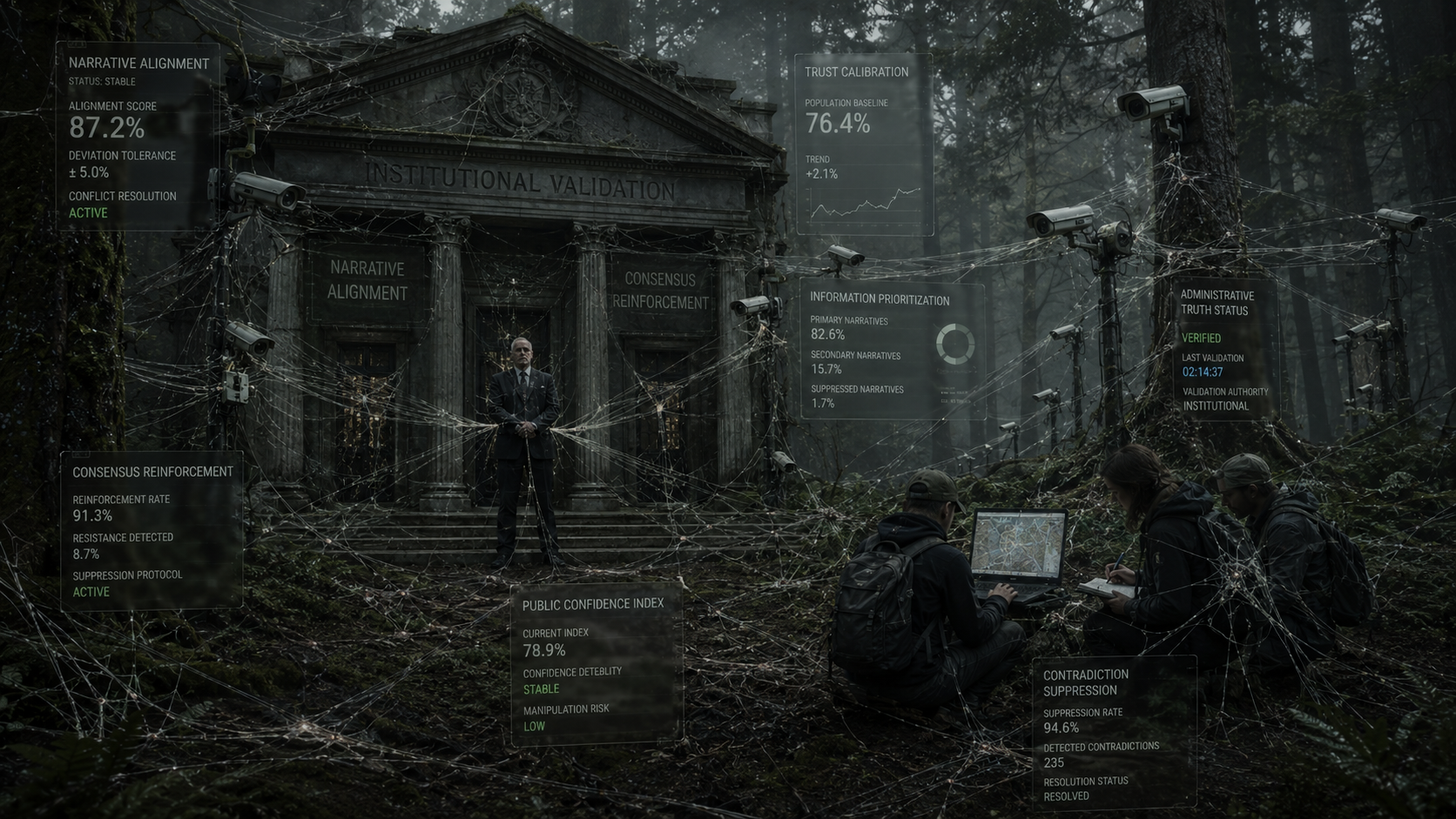
When AI needed credibility, it didn’t hire another engineer. It hired Ben Bernanke.
Bernanke spent his career studying exactly one question: what makes people trust a system, and what happens when that trust collapses. He ran the Federal Reserve through the 2008 financial crisis. In 2022, that work won him the Nobel Prize in economics. A few years later, Anthropic built a board meant to watch over the company, wrote its own rules for that board, and picked its own members for it. Bernanke was one of the trustees it named.
No regulator required this board to exist. No court ordered it. No law demanded it. Anthropic simply decided one was a good idea and built it. Now, when someone asks who’s actually watching Anthropic build some of the most powerful AI systems in the world, the company can point at a Nobel laureate and say: he is.
Somewhere else, Flock Safety built something very different: a nationwide network of AI-powered cameras across the United States, reading license plates automatically off every passing car and feeding the results into one shared, searchable database that police departments across the country can query at will. A group of ordinary people noticed how fast that network was growing, cameras appearing block by block with no public list of where they actually were, and it unsettled them enough to act. They started building that list themselves, nothing more than that, a public map of equipment already sitting in plain view on public streets.
Flock found out. Its CEO didn’t thank them for the transparency. He called them a terroristic organization. Read that again: not hackers, not saboteurs, people with a spreadsheet, and the word he reached for was terroristic. Once a label like that lands, it doesn’t wash off.
Neither company broke a law doing any of this, at least not one anybody’s proven in court. Calling a mapping project terrorism isn’t the kind of claim you disprove with a fact-check, it’s closer to defamation than a lie, an accusation of character rather than a false statement about an event, and that category gets real legal latitude, opinion and hyperbole are protected in ways an outright factual lie isn’t. Whether it would survive a courtroom is a separate question from whether it works, and it works regardless of the answer: the accusation doesn’t need to hold up in front of a judge, it just needs to land in front of an audience, once, publicly, before anyone’s had time to sue. Two companies, doing two completely different things, end up in the exact same place: nobody who actually matters gets to check either of them.
Here’s what actually got taken, and why it counts as theft even though nothing changed hands. Every time you decide whether to trust an institution or fear a stranger, you’re supposed to be the one making that call, weighing what you know and landing on an answer yourself. Anthropic’s board and Flock’s terrorism label both exist to make that call for you before you ever get the chance to make it yourself, one preloading trust you never actually earned into your judgment, the other preloading suspicion. By the time either story reaches you, the decision has already been made on your behalf, dressed up to look like it was still yours to make. That’s the theft. Not your money. Your judgment, taken before you knew you were supposed to use it.
Borrowed Trust
Start with the story you just read, because it’s worth naming properly, it’s the version of this trick that’s easiest to admire, since it comes dressed as humility.
The board is called the Long-Term Benefit Trust. Anthropic describes it as a unique governance structure, a serious attempt to make sure the technology’s benefits outweigh its risks. Bernanke said as much himself when the appointment was announced.
Here’s the question nobody asks out loud: accountable to whom, exactly, and under what rules the company didn’t write itself?
Bernanke isn’t there because he has independent authority over Anthropic. He’s there because his presence signals that independent authority exists, and those are different things. The trust’s own rules allow Anthropic’s shareholders to amend or override it by a supermajority vote, a threshold the company hasn’t disclosed. Amazon, one of Anthropic’s biggest backers, is among the shareholders who could cast that vote. Nobody has to break a promise for the trust to become irrelevant, a handful of the company’s own biggest financial backers could out-vote it without ever explaining why.
Compare that to what a doctor’s license actually is. It isn’t self-issued either, but it’s revocable by a medical board with no financial stake in the doctor holding it. That’s what makes a credential real: the power to take it away belongs to someone with nothing to gain from looking the other way. Bernanke’s seat has no such body behind it.
This isn’t a new trick. Corporations have always understood that a credentialed outsider standing beside you is worth more than genuine oversight would be, because genuine oversight might actually stop you. Tobacco companies spent the 1940s running ads insisting doctors preferred their cigarettes, actual physicians, actual endorsements, because a white coat did work no slogan could. The pattern is old enough that its outlines are well known: borrow a reputation that took someone else decades to build, attach it to something new, and let the borrowed trust do work the new thing hasn’t earned on its own.
What makes the AI version worth pausing on is the second half of the same move, running in a completely different industry using a completely different mechanism, but arriving at the identical outcome.
For twenty years, Google became the default verb for “find out.” Trillions of queries a year ran through it, and over that time the company built something you can’t manufacture quickly: a reputation for being roughly right, most of the time, about most things. That reputation is now being quietly transferred onto AI Overviews, the instant answers Google now generates above its own search results, a system that hasn’t earned the trust it’s spending and structurally can’t. It doesn’t verify facts, it predicts the next plausible word. It has no internal mechanism for distinguishing a fact it knows from a pattern it’s guessing at, and the way it’s trained actively rewards sounding certain over admitting doubt. Users trust confident-sounding answers and stop checking them. An answer that never gets checked never gets caught being wrong, so it just keeps sounding confident, and sounding confident is what earned the trust in the first place. Nobody designed that loop maliciously. It doesn’t need to be malicious to work.
Anthropic and Google didn’t coordinate, they just found different rooms to run identical cons in: legitimacy that was borrowed or inherited, standing in for legitimacy that was never built. A trust with no external authority. A reputation earned in one system and spent in another that hasn’t done the work to deserve it. Neither is illegal. Neither requires anyone to lie, exactly. That’s what makes it durable. You cannot catch a company breaking a rule when the entire point of the maneuver is that no rule ever applied.
Ask what happens to either arrangement the day it becomes inconvenient, and the illusion collapses on its own. Google’s inherited reputation isn’t a rule at all, it’s a habit in the minds of millions of users, and habits erode the moment enough of them get burned. Both arrangements are legitimacy on loan, revocable by the lender, dressed up to look like something owned outright, and both are betting that you’ll extend your own judgment to them the way you’d extend it to something that actually earned it.
What a Real No Looks Like
It’s worth pausing here to describe what the alternative actually looks like, because it’s easy to talk about accountability in the abstract until you see a government exercise it and hold.
The Netherlands blocked an American company from acquiring Solvinity, the Dutch firm hosting DigiD, the login citizens use for tax records, healthcare, and pension access. Not through a strongly worded statement, not through a committee that studies the question for two years and produces a report nobody reads, but through an actual legal mechanism built for exactly this purpose, a body with the statutory power to say no and make it stick.
The reasoning is specific and grounded in something enforceable: the US CLOUD Act lets American authorities compel a US-owned company to hand over data it holds, anywhere in the world, regardless of the laws of the country where that data actually lives. If the acquisition went through, a foreign government would have had a legal lever into millions of citizens’ most sensitive records, hospital visits, tax history, retirement accounts, and no vote, no court, and no domestic law could have stopped it. The government didn’t wait to find out whether that lever would ever get pulled. It removed the possibility.
That’s the same country, incidentally, whose courts had already forced the government’s own hand once before, over an actual AI system. SyRI, an automated program built to flag citizens for suspected welfare fraud using their personal data, got challenged and struck down by a Dutch court, ruled a violation of basic rights, in part because the system was so opaque that even the people meant to be overseeing it couldn’t fully explain how it reached its conclusions. An algorithm making consequential decisions about people’s lives was told, by an authority with the power to enforce the answer, that opacity alone was disqualifying, that citizens were entitled to understand the judgment being made about them, even when the machine making it couldn’t explain itself.
Put the two together and you get a fuller picture of what real accountability requires, and it’s a shorter list than people assume. It requires a law that predates the crisis, so nobody has to invent the rule after the fact. It requires an institution empowered to say no in a way that has teeth, not a strongly worded objection. And it requires that the answer not depend on the target’s cooperation, the government didn’t ask the American company to please respect Dutch sovereignty. It blocked the deal, under a law that already existed, and moved on.
None of this should read as a fairy tale about one virtuous country. It’s rarer than it should be precisely because it’s expensive in ways that manufactured legitimacy is not. Writing the law before you need it means someone had to anticipate the crisis years in advance, when there was no headline forcing the issue and no obvious payoff for the politician who pushed it through. Having courts independent enough to rule against the government’s own program, not a private company’s, but a system the state itself built and wanted, means the government has to accept an institution it funds ruling against it in public. Most governments don’t manage either of those things until after the damage is done, if they manage them at all. The lesson isn’t that real accountability is common. It’s that it’s possible, which is a smaller claim than it sounds, and a more useful one.
Compare that to the trust from the first section. No law required it to exist. No court can compel its decisions. Its authority runs exactly as far as the company that created it wants it to run, and not one inch further. That’s the entire difference between manufactured legitimacy and the real thing: one can be revoked by the party it’s supposedly checking, and the other cannot.
Calling Oversight Terrorism
Now the third move, and it’s the ugliest of the three because it doesn’t pretend to be accountability at all. It attacks accountability directly, by redefining what the word means.
You already met the players. Flock Safety built the camera network. The volunteer group that mapped it goes by DeFlock, and mapping is genuinely all they did, no hacking, no sabotage, just public information about equipment already sitting in plain view, assembled and published for anyone to see.
Sit with the actual mechanics of the CEO’s response for a moment, because the content matters less than the function. He isn’t describing an act of violence. He isn’t describing property damage or a threat to anyone’s safety. He is describing citizens locating and publishing information about surveillance infrastructure that exists, by design, in public view. And by naming that “terroristic,” he doesn’t just insult the people doing it. He performs a much more useful trick: he moves the entire question out of the category where it could be debated, is this transparency a public good, does the public have a right to know where it’s being watched, and into a category where debate isn’t available at all. You don’t negotiate with terrorism. You don’t compromise with it. Once the label sticks, the only acceptable response is opposition, and anyone still asking the original question starts to look suspect by association.
This is exactly the moment the network’s actual use matters. The same infrastructure being defended with the language of public safety has, by its own operator’s admission in other contexts, ended up in the hands of federal immigration enforcement, agents accessing it thousands of times through side doors and shared logins that Flock’s own stated policy claims not to permit. The gap between what the system is publicly said to do and what its own records show it actually doing is not a footnote. It’s the entire reason transparency about camera placement matters in the first place, and it’s the entire reason the company has an incentive to make the people asking about it look dangerous rather than reasonable.
Notice the shape of it. It isn’t quite the move the trust and the search engine made. Those manufactured legitimacy for the company itself, borrowed, invented, staffed with the right names. This one destroys legitimacy for whoever’s watching the company, by inverting who gets to occupy the role of victim and who gets to occupy the role of threat. One builds a shield. The other burns the people trying to look behind it, and either way, the actual target is the same: your judgment, this time not borrowed but overridden outright, told what to fear before you’ve had a chance to decide for yourself.
Psychologists even have a name for this move at the interpersonal scale: DARVO, deny, attack, reverse victim and offender. It’s the sequence where an accused party denies the accusation, attacks the accuser, and reverses who looks like the victim and who looks like the offender, until an outside observer can no longer tell which side started it. It shows up in abuse cases, in institutional cover-ups, in workplace retaliation. What’s happening here is that exact sequence, run at the scale of an entire company and an entire public, with a searchable surveillance network standing in for the thing being defended. The individual psychology and the corporate strategy converge on the same trick because it’s the same trick. Accuse the person asking the question of being the actual danger, and the question itself disappears along with their credibility.
This Has a Name, and It’s Older Than You Think
Start with the attack move, what Flock’s CEO did to DeFlock. It has a name in political science, and knowing the name matters, because it tells you this isn’t a one-off overreaction from one defensive executive. It’s a recognized, repeatable technique for consolidating power. Scholars who study international security call it securitization: the act of declaring something an existential threat isn’t a neutral description, it’s a performative move that relocates an issue out of ordinary politics, where it could be debated, contested, voted on, and into emergency logic, where extraordinary measures are justified and dissent starts to look like siding with the enemy. Calling something terrorism doesn’t describe a threat level. It ends the conversation about whether there’s a threat at all, and it does your judging for you before you’ve opened your mouth.
The mechanism is old enough that its most documented case study has nothing to do with technology. Victor Klemperer, a philologist stripped of his professorship in Nazi Germany for being Jewish, spent years quietly cataloguing something most people around him never noticed happening to their own language. The regime barely invented new words. It took ordinary ones and, through sheer repetition, inverted what they meant. Take the word “fanatisch,” fanatical: before the regime, it described something unhinged and dangerous. Within a few years it had become a term of praise, used to describe total devotion. He wrote afterward that it wasn’t only the regime’s actions that needed to be undone, it was the habit of mind the language itself had built, one repetition at a time, without most people ever noticing it happening.
That’s the mechanism at its slowest and most total: change what a word points to, repeat it until the new meaning is the only one left standing, and you’ve changed what people are capable of judging for themselves without them ever agreeing to it. What took a state apparatus years of saturation to accomplish across an entire population, one company can now do to a single accusation in the time it takes a headline to circulate. And the part that should actually worry a newsletter about AI specifically isn’t the speed. It’s that the old version needed a propaganda ministry working every day to keep the new meanings in place. The infrastructure doing the enforcing now doesn’t need daily reinforcement. Once an AI system is built to flag, score, and share data automatically, the relabeling only has to happen once. The machinery keeps running the consequences of it indefinitely, without anyone needing to repeat the lie, and without your judgment ever getting asked for again.
That’s the history behind the attack move. The manufacture move has its own, just as old, you already met it, tobacco companies renting out doctors’ coats decades before anyone thought to rent out a Nobel Prize. Neither trick is new. Only the machinery is.
Different Tricks, Same Motive
Step back and you can see the whole shape of it at once, and it isn’t one trick, it’s two. Manufacture legitimacy for yourself when you don’t have any, a board with no power to enforce anything, a reputation borrowed from an industry that never built the thing it’s now vouching for. Or, when legitimate accountability shows up anyway, destroy it on contact, not by disproving it, but by renaming it something no reasonable person is supposed to defend. Different tools, different targets, one company borrowing, another company attacking, but the same motive sitting underneath both: make sure nobody who matters ever actually gets to check you. In between sits the rare case where neither trick was necessary, a government with a real law, a real power to refuse, and courts willing to use it, standing as proof that neither trick is inevitable. It’s a choice. The companies making it could, in principle, be checked. Mostly, they aren’t.
None of this required artificial intelligence to exist. Corporations have laundered legitimacy and smeared dissent as dangerous since long before anyone could ask a machine a question, they can’t write the law that makes something a crime, but they can make it look like one in the court of public opinion, which is often all the trick needs to work. What’s different now is what’s carrying it. A trust needed a company to keep believing in it. A propaganda ministry needed a staff that showed up to work every morning. The version running today needs neither. It needs an algorithm that never stops scoring, a camera that never stops recording, a search result that never stops sounding certain, and a legal structure that never has to be re-signed because it was never really binding in the first place. The lie used to require maintenance. Now it just requires infrastructure, and infrastructure, once built, keeps running the argument long after anyone remembers making it.
That’s the actual fight underneath all four of these stories, and it isn’t company versus company, or even company versus government. It’s a fight over whether legitimacy has to be earned or can simply be manufactured and defended at scale, and it’s being waged, story after story, over the same target: your judgment, the one thing every version of this needed to disable before it could work. This isn’t a fight over who gets to use AI, everyone does. It’s a fight over who owns the infrastructure running each trick, and who’s left without an equivalent machine of their own to answer it. Anthropic’s trust runs itself once built. Google’s AI Overviews run themselves once built. Flock’s cameras run themselves once built. Nothing on the other side runs itself: a court has to actually rule, a legislature has to actually pass the law before the crisis arrives, volunteers have to actually keep mapping the cameras, by hand, one at a time. It only needs your judgment’s permission once, disabled, before the trick’s own infrastructure does the rest without asking again. Undoing it needs people willing to use their own judgment out loud, in public, again and again, until someone with actual power is forced to answer for what was taken. That’s slower. But it’s also the only version of this fight that’s ever actually produced a real no.