By Thinking With AI
Published: 2026-06-29
URL: https://thinkingwithainewsletter.substack.com/p/the-ai-doesnt-just-watch-you-it-changes
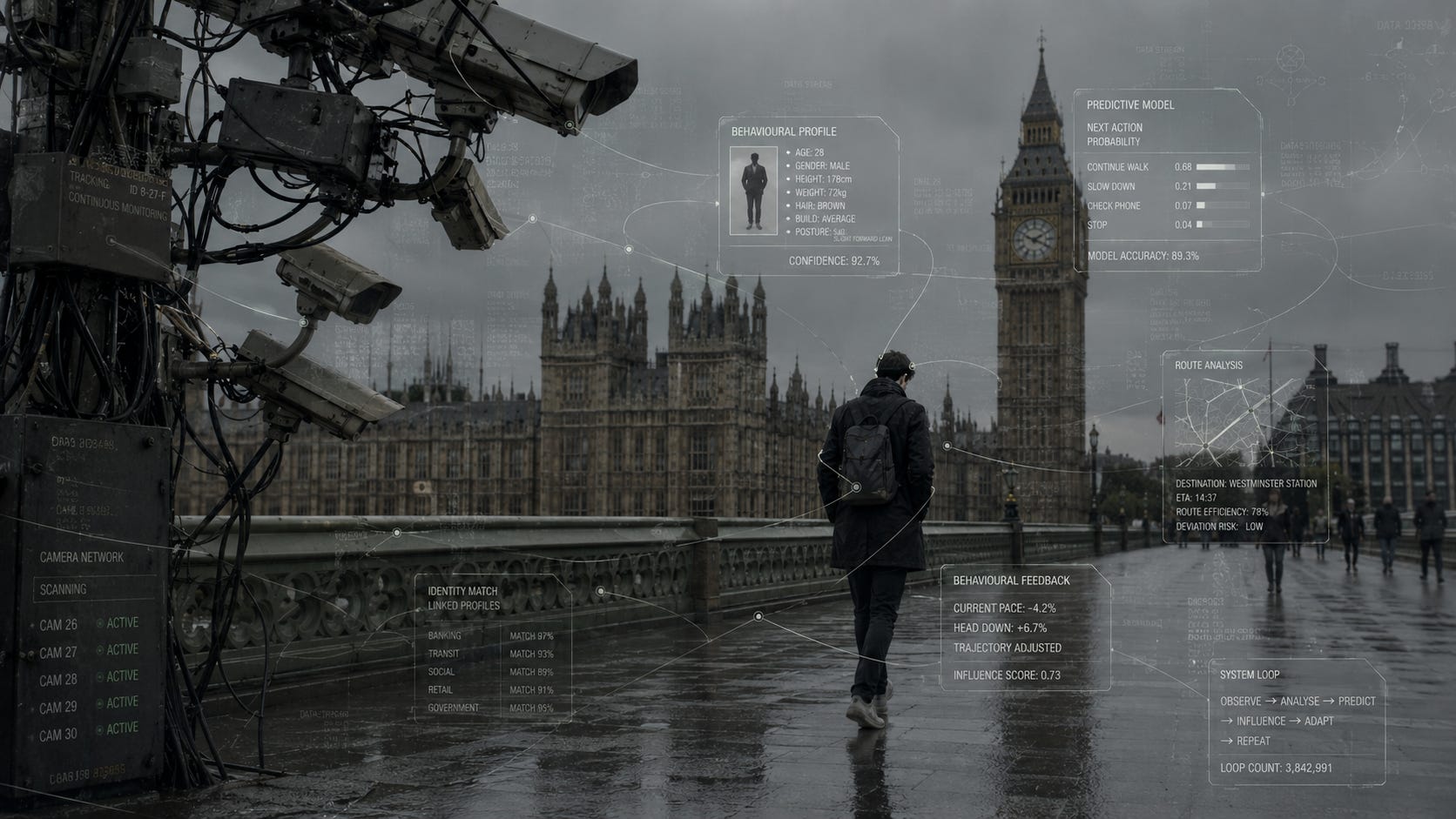
My favourite walk in London runs from Westminster Bridge down to the Tower, and a few hundred cameras watch me as I go. I have never counted them, and I do not need to, because I am aware of them the whole way, the way you stay aware of a stranger standing a little too close behind you in a queue. They sit on the lampposts and the corners of buildings and the bridges, patient and unblinking, and for most of my life I let them fade into the scenery.
I could afford to. They recorded, the recordings sat untouched on a drive somewhere, and unless a crime needed solving nobody ever looked. That changed this year. Only this month the head of the Metropolitan Police said the force would turn artificial intelligence loose on the footage from the million or so cameras watching the city. The cameras did not multiply. They woke up. What used to be a dull glass eye is now an eye joined to a mind that never sleeps and never forgets a face. And an eye that can think does something to the person it watches that a blind lens never could.
A particle changes when it is watched
I keep going back to an old experiment from physics, and I should say plainly, before anything else, that I am using it as a metaphor and not as proof. In that experiment a particle behaves one way when it is left alone and another way the moment someone measures it. No one pushes it. No one touches it. The simple fact of being observed is enough to change how it moves.
I am not saying we are particles. We are not. But the parallel is uncomfortably close, and the one real difference does not work in our favour. A particle only changes when an actual instrument reaches out and measures it. A person changes at the mere suggestion of being watched, with no instrument involved and, very often, no one watching at all. That is the strange part, and it is worth looking at directly.
There is a small study I think about more often than it deserves. In a university tearoom, people left coins in an honesty box for their coffee, and every week the researchers changed the picture on the wall above the box. In the weeks the image showed a pair of eyes instead of flowers, people paid almost three times as much. No one was watching. No one was even in the room. A photograph of eyes was enough to prick the whole tearoom’s conscience. We do not even wait for a guard to climb the tower and look down. We carry one inside us, and we keep his watch for him every hour we are awake, and no one has to pay us a penny to do it.
This time the watcher is real
If that was the whole story, there would be some comfort in it, because a belief can be changed. But the eyes watching you now are not a picture on a wall. They are real, and they learn.
Old cameras simply recorded, and almost no one ever watched the footage. An AI does not just keep the footage, it reads it. It learns how you move through a station, how long you pause at a window, who walks beside you, the look on your face when you think nobody is watching. In time it knows you well enough to pick you out and follow you from one camera to the next. And the cameras are only part of it. The same kind of intelligence reaches everything else that gets logged about you: what you search for, what you buy, the things you stop to look at without meaning to. Out of all of it, the machine builds a model of you. It keeps what it gathers and uses it to work out what you will do next. Then the prediction is put to work. Online, it shapes what you are shown and what you are charged. On the street, it can lift your face out of a crowd and hand it to someone who has been waiting for it. The old surveillance system was there to make you behave. The new one wants to know you well enough to influence you, and to do it so gently you never feel the hand at your back.
This is the part I find hard to shake. It works on you from two sides at once. If you know you are watched, you do the work yourself, smoothing your face as you pass the cameras. If you do not know, the machine does it to you anyway, working from the record it has built, whether you are aware of it or not. Knowing changes you. Not knowing does not save you. Watched or analysed, you end up a little changed either way.
A different kind of watching
You might say none of this is new, and you would be half right. People have always watched each other. The village watched. God watched, or we believed he did, which came to the same thing. What has changed is not how much we are watched, but the way we are watched.
The village watched in glances, with long gaps in between, and through a human memory that blurs and softens and in the end dies. It remembered too, and in my experience a village neither forgets nor forgives you in a hurry. But its memory lived in human heads, and it died when they did. The new watching is not built that way. It does not blur and it does not soften, and what it keeps, it keeps in perfect detail. Some of what it gathers is wiped within weeks, but that wiping is a setting, not a mercy, and a setting can be changed. The rest it holds for years: your face on a database, your record online, kept ready to be searched and passed on. Ten times as many cameras would only have given us ten times the same thin watching. A machine that forgets nothing it chooses to keep, and understands what it sees, is a different animal, not a larger number. The camera used to be just an eye. Now it has a mind.
Sold as a kindness
None of this was forced on us at gunpoint. It was offered to us, nicely wrapped, which works far better, because a thing you take gladly is a thing you will go on to defend. Two writers saw a road like this one and pictured where it led, and they pictured it from opposite ends. Orwell feared control through pain, the boot and the telescreen. Huxley feared control through pleasure, a happy people taught to love the thing that ran their lives. What we got came the way Huxley said it would, as a present. It came as convenience and safety, as a feed that seems to read your mind, as a payment that goes through in a second, and most of all as a promise to keep your children safe.
That last promise is worth stopping on, because it is happening in Britain right now and it shows the whole trick in miniature. To keep children safe online, the law now makes grown adults prove their age before they can reach more and more of the internet, and you prove it by letting an AI scan your face or by handing over your ID. This month the government moved to put the same checks on opening a social media account at all, which quietly ends the ordinary freedom of being a stranger online. It is sold as looking after the young. What it builds is a system that always knows which real person is sitting behind the screen. The safety and the control are not two separate things, one arriving after the other. They are two sides of the same offer. You are shown the kind side. The cruel side is already here.
Money is where the cruel side shows most clearly. The politician Nigel Farage had his bank accounts closed, and the bank’s own papers showed his opinions were part of the reason. In Canada, during the protests of 2022, the government used emergency powers to freeze the accounts of people tied to the protests, with no court order, and judges later ruled the whole thing unlawful. And cash, the last money that cannot be switched off from a distance, is quietly being retired, sold to us as a grubby little nuisance no one will miss. When everything you own sits inside a system that can be told to refuse you, your freedom lasts exactly as long as your good behaviour and not a day longer.
The unwatched room we all once had
What is being taken is harder to name than privacy. Privacy sounds like a curtain, something you hang at a window and pull when you want to. What I mean goes deeper, and it belonged to all of us once: an unwatched room inside, where you were no one in particular and could stay that way as long as you liked.
Watch a small child playing on their own, before the world has handed them a self to defend. They are nobody at all. They are a pirate, then a dog, then a cloud, then a thing with no name, performing for no one and guarding nothing. That is what the unwatched room is for, and it was never just the child’s. The grown adult had one too, in the hours nobody saw, in the thoughts never said out loud, in the person they were behind a shut door. It is where a self puts itself together before it has to go out and be an appearance. Take that room away, raise someone watched from the first day, and they learn to ask how they look before they have finished asking who they are. The big question we are built to live inside, who am I, gets quietly traded for a smaller, more nervous one, how do I come across. Most people never feel the trade being made. The AI does not need them to. It only ever wanted the appearance, because the appearance is the part it can read.
What gets handed down
What I discuss next is a thought experiment, not a fact, and I want to be honest about that before I start. So far this has all been about one person, watched and slowly changed. I keep wondering whether that change stops with them, or passes down to their children. Some things that happen to a body sink in so deep they last beyond a single life. One experiment, by Brian Dias and Kerry Ressler at Emory University, comes to mind. Mice that were taught to fear a certain smell passed that fear on to pups who had never smelled it, not through anything they did but through a chemical mark left on a gene. In people, the children of Holocaust survivors have been found to carry changes in the genes that handle stress, as if something of the horror was passed down to them. None of this is settled science, and I am not resting my argument on it. I just keep noticing the same thing: what is done to a body can outlive the body it was done to.
There is a surer road than biology, in any case, and it needs nothing from our genes. We hand our children the world as we found it, and they take it for just the way things are. A parent who grew up watched, and is always aware of how they come across, raises a child who learns to do the same, like the weather, never questioned because never once seen from outside. Carry that down three or four generations and the learned thing stops feeling learned. It starts to feel like human nature. What unsettles me most is that this behaviour would outlast the thing that caused it. Switch off every camera tomorrow and the habit would stay, settled into people the first machines never watched, the way a fear can go on living long after the thing that taught it has gone.
The ones who do not flinch
I do not want to leave you there, because that is not the whole story. There are people who know full well they are watched and will not perform anyway. They do not lower their voices. They do not fix their faces. They go on being themselves in plain sight of the lens, not because they are unaware of the cameras but because they refuse to let it change them, and I find myself wondering how many of them are out there.
This matters more than it looks, because of the way a shared habit actually shifts. People who study these things have found that a committed minority does not have to become a majority to turn a whole society around. Past a certain point, everyone else swings over surprisingly fast, and the best study we have puts that share at about a quarter. I would not pretend a tidy experiment settles what a country of millions will do. But it means the way out is not a fight in the usual, exhausting sense. The system changes us by coaxing us to bend towards it, to make ourselves smaller and to be always on guard. The answer is to bend the other way, out in the open, where other people can see you do it and follow suit. A refusal done in plain sight and passed on is its own kind of inheritance, and it runs down the same line the fear does.
So the cameras on my walk are not waiting for some far-off day we still have time to argue about. The change has already begun. The unsettling part was never the watching itself, which we have lived with forever. It is that the machine now reworks us instead of just recording us, quietly, while we go about our lives. The one thing still entirely ours is whether we keep being ourselves while it watches, and how many of us find the nerve to do it.
There is a second question sitting under that one, and I have been circling it the whole way without saying it out loud. None of this happened by accident. The system was built to do a job, and it is doing it: it has made us a species that watches itself for nothing, and does the work an army of informers once did without ever being told to. The next essay is about what this system is really for, and what it costs the rest of us. I will see you there.