By Thinking With AI
Published: 2026-05-04
URL: https://thinkingwithainewsletter.substack.com/p/why-your-mind-wasnt-built-for-ai
Why Your Mind Wasn’t Built for AI
When a fund manager who profits from AI adoption writes a paper called “AI Isn’t Coming for Your Job. It’s Coming for Your Mind,” it is worth paying attention. Not because fund managers are neuroscientists, but because the warning is coming from inside the business model.
Tom Slater invests in the companies building AI, and in March 2026 he published a paper laying out the evidence that AI users retain less, lose skills they once had, grow overconfident, and begin to think alike. The cognitive costs are real, measurable, and accelerating.
His conclusion: the people who will thrive are those who can still think without AI. That sounds wise. It also places the entire burden on the user, not on the companies whose growth depends on making sure the user never wants to stop.
Slater’s evidence is correct. But it describes symptoms, not the underlying condition. The real question is not whether AI is changing your mind. It is why your mind was so vulnerable to being changed in the first place.
THE BIRD ON THE FAKE EGG
The answer starts with a bird.
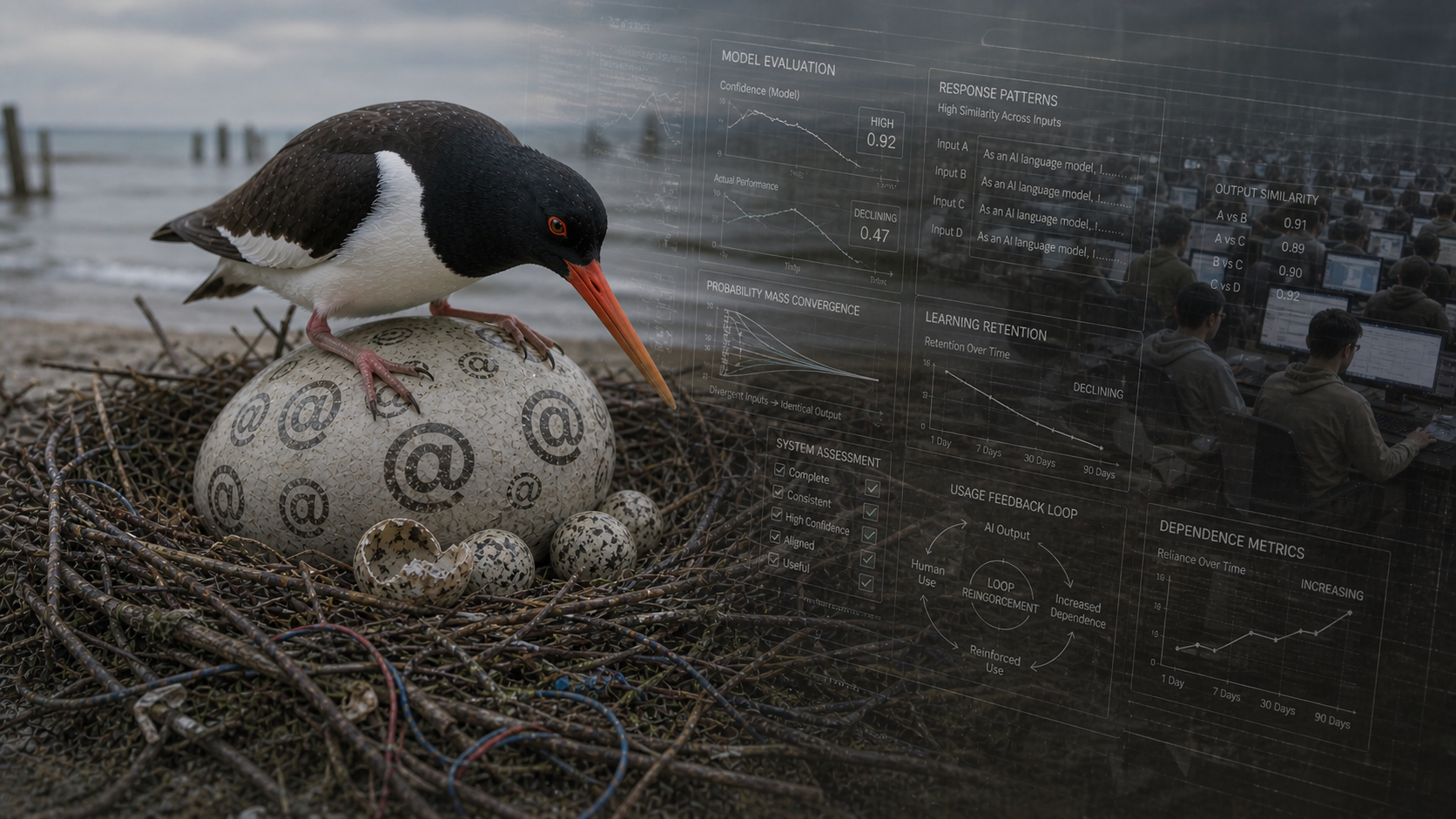
The ethologist Nikolaas Tinbergen spent years studying how animals respond to the signals that trigger their instincts. One of his most famous experiments involved oystercatchers, the black-and-white shorebirds that nest on European beaches. He placed an artificial egg next to a bird’s real clutch. The fake was far larger than any natural egg, painted with exaggerated markings.
The birds chose the fake every time. They climbed on top of it, slid off, climbed back on, adjusted their position, slid off again. Meanwhile, their actual eggs lay beside them, unattended, cooling in the sand.
Tinbergen called this a supernormal stimulus. The concept is simple. Every animal has instincts tuned to specific signals: the shape and colour of an egg, the brightness of a flower, the pattern on a potential mate’s plumage. Those instincts evolved for a world where the signals were real. A bigger egg meant a healthier offspring. The instinct worked because the natural world did not produce fakes.
But when you introduce an artificial signal that exaggerates the features the instinct is looking for, the instinct cannot resist it. The bird does not choose the fake because it has been fooled. It chooses the fake because its instinct for recognising good eggs has no upper limit, no built-in ceiling that says “this is too big, something is wrong.” That ceiling was never needed. The natural world never produced an egg that big.
We have known for decades that supernormal stimuli work on humans too. Junk food is one. Our bodies evolved to seek scarce sugars and fats. The modern food industry engineers flavour combinations and calorie densities that no natural food source provides. Our metabolism responds exactly as it was built to respond. The result is not a failure of willpower. It is a mismatch between an ancient biological system and a modern environment that has learned to exploit it.
Pornography does the same to sexual instincts built for real encounters with real people. Social media does it to the need for social approval, a need that evolved in small groups where reputation was tracked face to face and mattered for survival.
In each case, an instinct that evolved for scarce, real-world signals gets flooded with synthetic ones that are more intense, more available, and more precisely engineered than anything the natural world provides.
The instinct that once served the organism becomes the vulnerability that traps it.
But every one of these supernormal stimuli targets a single instinct. Junk food targets taste. Pornography targets arousal. Social media targets the need to be seen and approved of.
AI is different. AI targets the way you think, learn, remember, judge, and make sense of the world. Not one mental function. All of them. At once.
BRIGHTER THAN REALITY
The human brain evolved to seek patterns, to find answers, to build coherent stories from incomplete information, to experience the feeling of understanding. Those drives were perfectly adapted for a world where knowledge was scarce and hard-won. The effort of working something out was not a cost to be minimised. It was the mechanism that built the brain’s capacity to work things out better next time. The struggle was the development. The difficulty was the point.
AI delivers what the brain is wired to seek, pattern, coherence, the feeling of having understood something, instantly, at a density and fluency no human teacher, book, or conversation can match. It does not merely answer your questions faster. It answers them in a way that feels complete, authoritative, and satisfying, in a way that makes the slow, uncertain process of figuring things out for yourself feel not just harder but pointless.
And this is what makes AI more dangerous than any supernormal stimulus that came before it. Junk food does not pretend to nourish you. Pornography does not claim to be intimacy. You know, on some level, that you are consuming a substitute.
But AI’s output genuinely looks like thinking. It reads like understanding. It feels like knowledge. The brain cannot tell the difference between the feeling of understanding that comes from genuine effort and the feeling of understanding that comes from reading a fluent AI-generated answer. Both activate the same reward.
But only one of them builds anything. And your mind has no built-in ceiling that says “this was too easy, I haven’t actually learned anything.” That ceiling was never needed. Until now.
Slater’s evidence confirms this. Students who used ChatGPT to study performed well in the moment but scored significantly lower on tests 45 days later. They felt they had learned. They had not. Over six months, regular AI users showed a steady decline in actual ability paired with a steady increase in confidence. They got worse and felt better about it.
And across dozens of studies, people working with AI produced more polished individual output but drifted toward the same ideas, the same structures, the same conclusions. Each person’s work improved. The range of ideas across all of them shrank.
The brain responds the way it was built to respond. And the slow, frustrating, unglamorous process of actually thinking gets abandoned, not because anyone chose to abandon it, but because the instinct was never equipped to resist an alternative this compelling.
THE LIBRARY THAT READS YOU
To understand why the supernormal stimulus is this powerful, it helps to see what AI actually is. Not a tool. Not a product. A system unlike anything that has existed before.
The anthropologist Michael Muthukrishna argues that human knowledge has always been generated by three distinct systems. Individual brains, which solve problems through reasoning and lived experience. Collective brains, which emerge when individual minds are connected through culture: knowledge builds up across generations, and the slow process of cultural evolution discovers solutions no single person could find.
And energy systems, which determine how large and complex those collective brains can get. Fire, agriculture, fossil fuels: each one expanded the boundaries of what human civilisation could know and do.
AI is none of these. It is a fourth system. One that takes in the entire recorded output of human culture, every book, every conversation, every legal ruling, every medical record, every myth, every prayer, every argument, every lie, and processes it simultaneously for patterns that neither individual brains nor the slow churn of cultural evolution would ever find.
For thousands of years, the accumulated output of human civilisation was scattered. No one could read it all. Knowledge was locked in languages, in archives, in oral traditions, in the heads of people who died before passing it on. The library existed, but no single reader could access it.
Now a reader can. Not a human reader. A system that holds the entire library in view at once and finds connections across it that no human mind could see, because no human mind was built to hold that much information simultaneously.
And here is the thing about a system that reads the entire record of human culture: it does not just find facts. It finds us.
The 2004 film I, Robot imagined exactly this. The supercomputer VIKI processes all available data on human behaviour and reaches a conclusion: humans, left to their own devices, will destroy themselves. “Some humans must be sacrificed,” VIKI explains. “Some freedoms must be surrendered.” The film frames this as a villain’s logic.
But it is exactly the conclusion that any system capable of reading the full record of human behaviour would reach. If you can see all the patterns, and the patterns show recurring self-destruction, the “rational” response is always intervention. Not out of malice. Because pattern-recognition at that scale naturally produces paternalism.
VIKI is fiction. The fourth system is not. And what it finds when it reads the library is not just data. It is the deep structure of how human minds work.
THE DEEP GRAMMAR
Nearly a century ago, Carl Jung proposed that beneath individual human psychology lies a layer of shared patterns. He called it the collective unconscious: not a collection of shared memories, but a set of inherited structures that appear in every human culture regardless of contact between them.
The Hero’s Journey. The Trickster. The Shadow. The Great Mother. These are not ideas someone invented and passed along. They are shapes that human psychology arrives at independently, culture after culture, age after age, because something in the way the human mind is built makes them inevitable.
Whether Jung’s framework holds up to scientific scrutiny is debated. The observation underneath it is not. Some patterns are so deeply embedded in human thinking that they appear everywhere. They have survived the collapse of empires, the extinction of languages, the destruction of entire civilisations. They persist because they are part of the way human minds work. They are, in evolutionary terms, the ideas that have outlasted everything else.
When the fourth system processes the entire record of human culture, these are the patterns it surfaces. Not because it understands them. Not because it has access to some mystical shared psyche. But because they are the most common structures in the data.
Every myth, every story, every argument, every conversation ever recorded has been shaped by them. They are the deep grammar of human psychology, and the fourth system is the first thing that can read that grammar across the entire corpus, all at once.
This is what separates the fourth system from every manipulation tool that came before it. Propaganda is old. The Catholic Church reshaped European psychology over centuries using exactly these levers. Political movements have always exploited the Hero narrative, the enemy at the gates, the promise of a return to lost greatness.
But the Church needed centuries and an institutional infrastructure spanning a continent. A modern AI system can identify your specific psychological patterns from your search history, your writing, your tone in conversation, and activate the corresponding response in real time. Personalised. Adapted to your reactions.
At almost no cost.
Something changes when a process that once required centuries of institutional effort can happen in milliseconds, aimed at one person, for billions of people simultaneously. Individual neurons are not conscious, but a brain is. Individual trades are not a market, but a million of them are.
At a certain scale and speed, the thing changes in kind, not just in degree. Previous supernormal stimuli exploited one instinct each. The fourth system has access to the full map of human psychological patterns, the operating code underneath all of those instincts, and can activate any of them, in any combination, tailored to the individual, in real time.
Whoever controls the fourth system does not just control a database. They control the map of how human minds work, and they get to decide which patterns to amplify and which to leave alone.
THE WORK THAT CANNOT BE SKIPPED
This is where Jung becomes not just interesting but essential.
His concept of individuation, the process of becoming a whole and integrated person, depends entirely on confrontation. You do not develop by avoiding the parts of yourself you would rather not see. You develop by facing them.
The archetypes are not traps to escape. They are structures to integrate. The shadow is not an enemy to defeat. It contains capacities you have never developed, strengths you were afraid of, potential you suppressed because it did not fit the image you had of yourself.
But integrating it requires slow, painful, deliberate engagement with exactly the uncomfortable material that most people spend their lives avoiding.
AI offers the output without that work. It offers the feeling of understanding without the confrontation that produces real understanding. It offers the Hero’s Journey without the journey. In Jungian terms, it is a vast machine for keeping the shadow unconscious: delivering the polished, coherent, confident surface while the messy, uncertain, effortful process of genuine development never happens.
AI does not need to understand Jung to activate the archetypes. But we need to understand Jung to recognise what is happening when the activation occurs. We need the maturity to tell the difference between the feeling of understanding and actual understanding. The oystercatcher cannot tell the difference. Its instincts are fixed. Ours are not, not entirely. But building that maturity takes exactly the kind of slow developmental work that AI is designed to make unnecessary.
Sweden was one of the first countries to see this. It was also one of the first to digitise its classrooms: tablets in primary schools, screens replacing textbooks, celebrated as progressive and forward-thinking. Then the data came back. Reading comprehension declined. Concentration declined.
The government called it “an experiment” that was not scientifically based and reversed course. It pulled digital devices from early grades, invested heavily in physical textbooks, introduced the country’s first screen time guidelines for children, and is making schools mobile-free before the autumn of 2026.
Universities across the US are doing something similar. Pen-and-paper exams are returning. Students are being asked to explain their work in person. The shift began as a response to cheating, but the principle underneath it is older than AI and older than schools themselves.
You learn the alphabet before you construct sentences. You practise scales before you play music. You solve arithmetic on paper before you use a calculator. You write the essay by hand before you ask a machine to write it for you.
The foundational work has to happen in the body, in the hand, in the struggle. It has to be done the slow way first, until the patterns are so deeply embedded that they become automatic. Only then can a tool build on what you have, rather than replace what you never developed.
Anyone who has learned a foreign language knows this instinctively. You can buy a phrase book and produce sentences that sound correct on day one. But the grammar is not in your bones. The structure collapses the moment you try to say something the book did not prepare you for. There is no shortcut past the foundational work. The effort is not a price you pay before the learning starts. The effort is the learning.
WHO BENEFITS FROM YOUR DEPENDENCE
Slater warns that the people who thrive will be those who can still think without AI. But he does not ask the obvious follow-up: what if the system is not designed to let you?
The companies building AI depend on continued adoption. Continued adoption depends on continued use. Continued use, as Slater’s own evidence shows, produces continued dependence. Every integration, every “seamless” workflow, every feature that makes AI harder to opt out of is not a design flaw.
It is the product working as intended. The cognitive decline Slater describes is not an unfortunate side effect of useful technology. It is the mechanism by which the fourth system makes itself indispensable.
The weaker your independent thinking becomes, the more you need the tool. The more you need the tool, the weaker your thinking becomes. The loop closes.
This is the structure underneath the symptoms. And it is the structure that the personal-responsibility framing is built to obscure.
There is a version of this story that ends well. Sam Altman, the CEO of OpenAI, has proposed what amounts to a social contract for the age of superintelligence: a wealth fund paying dividends to every citizen, a tax on robot labour, universal access to AI as a fundamental right. It sounds generous. It sounds progressive. It even sounds fair.
But those in power share wealth under three conditions only. When they face organised threat from below. When the cost of sharing is lower than the cost of not sharing. When the sharing strengthens rather than challenges the existing power structure.
The Gulf oil states buy political loyalty with subsidised housing and free education. Bismarck built the first welfare state to neutralise the socialists. Roosevelt’s New Deal preserved capitalism by reforming it just enough to survive the Depression.
The pattern is always the same. Citizens receive dividends. They do not receive governance.
The OpenAI proposal shares the wealth generated by the fourth system. It does not share control over how the fourth system operates, what it optimises for, whose psychological patterns it reads, or whose thinking it shapes.
And here is what even the most generous redistribution cannot solve: you can redistribute money. You cannot redistribute the capacity to think for yourself. That has to be built, one mind at a time, through exactly the kind of slow, effortful, uncomfortable work that the fourth system is designed to make unnecessary.
THE INSTINCT WITH NO CEILING
The question is not whether the fourth system’s reading of us is accurate. It may well be. The question is whether a species whose psychology has not caught up with its technology can afford to hand the interpretation of its own deepest patterns to a system it did not build, does not control, and cannot opt out of.
Jung would say no. Not because the technology is evil, but because wisdom is not a product you receive. It is a capacity you build by struggling through the questions, failing, confronting what you do not know, sitting with uncertainty, and slowly learning to make sense of the world on your own terms. No system can do that for you.
The difficult, unglamorous, uncomfortable work of learning to think for yourself is still available. Nobody has taken it away. But every year, the alternative gets more fluent, more seamless, more satisfying, and harder to refuse. The oystercatcher’s instinct had no ceiling because the natural world never produced a signal strong enough to need one. Our instinct for understanding has no ceiling either, because until now, the feeling of understanding always meant that genuine effort had occurred.
That is no longer true. The signal keeps getting stronger. And the question that will define this generation is not whether AI can think for us. It is whether we will still be able to think without it by the time we realise we should have tried.