And What That Tells You About Language
By The Techdomme
Published: 2026-06-07
URL: https://thetechdomme.substack.com/p/why-ai-writes-like-a-press-release
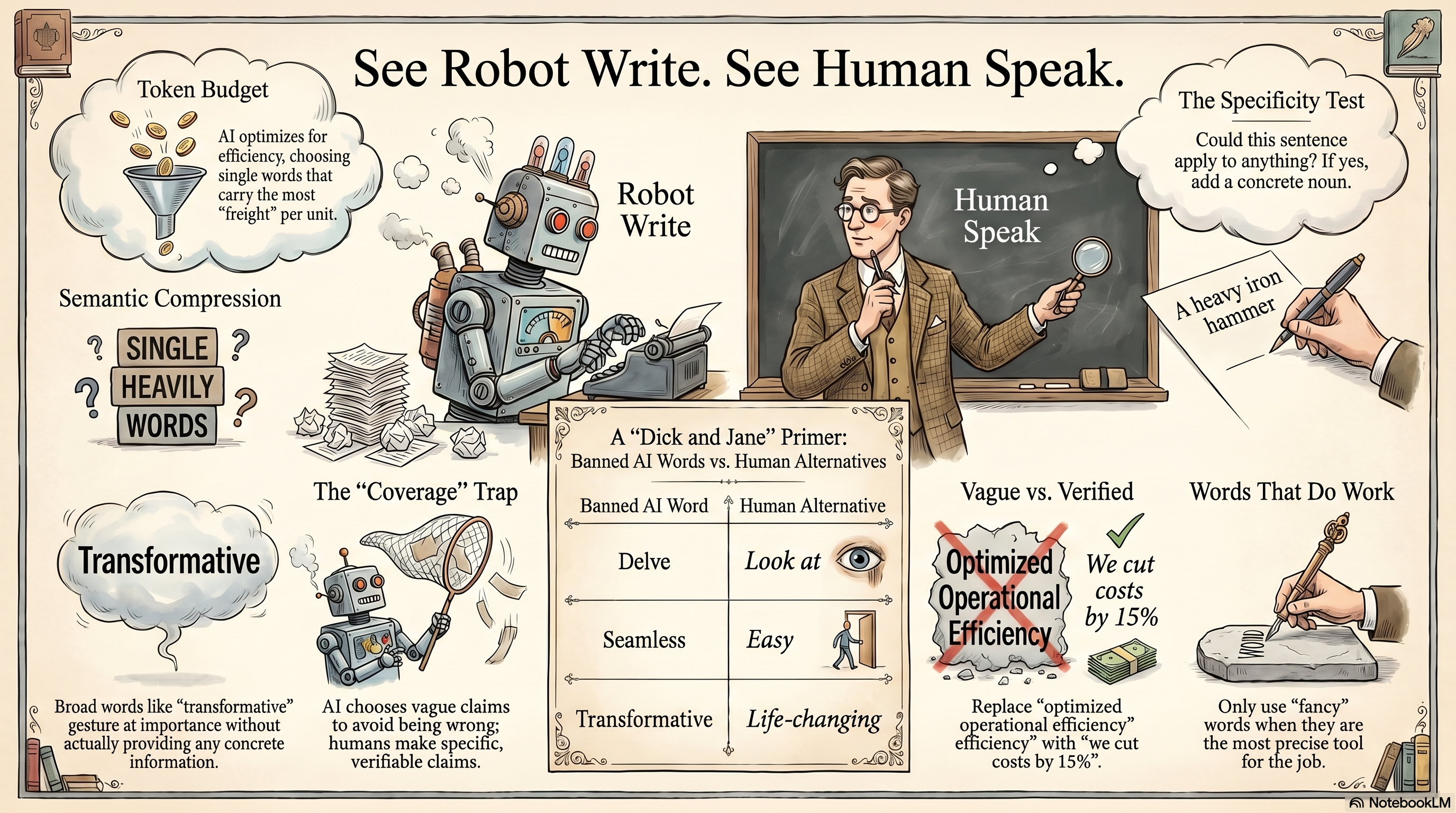
Recently I’ve been spending some time on LinkedIn. You know, that place you go to look for jobs, spy on old colleagues and listen to a lot of people performing smart. And right now two things are everywhere: infographics, and the banned AI word list. Don’t say delve. Don’t say transformative. Don’t say seamless.
But it got me thinking. Why exactly does AI write like that? I had a hunch it had to do with semantic compression and token usage, and because I have ADHD I needed to immediately “delve” into it.
Once you understand the why, you won’t need a list. You develop an eye. And if you are working with AI to write, which more and more of us are, that eye is going to make everything you produce better.
So let’s look at what is actually happening when a language model writes like a corporate memo.
Let’s talk about the word “transformative.”
You have seen it approximately ten thousand times in the last two years. In emails. In proposals. In LinkedIn posts that made you feel vaguely informed but somehow less sure of what you just read. It has been applied to software updates, team retreats, breakfast smoothies, and at least one webinar about pivot tables.
Here is the problem: if a word can describe everything, it describes nothing. And that is not an AI problem. That is a language problem. AI just made it impossible to ignore.
Why AI Reaches for These Words
First, a little context, because understanding why AI writes this way is more useful than a list of words to avoid.
AI language models work within something called a token budget. Every word, syllable, and punctuation mark costs something in terms of processing. So models are quietly optimized toward efficiency. They reach for words that carry the most meaning per unit of space.
“Transformative” is one token. It gestures at significant, lasting, positive, substantial change. That is a lot of meaning packed into one word, which makes it efficient.
Except.
The reason that word carries so much freight is that it has been stretched to cover so many situations that it has lost its shape. This is semantic compression. A word gets used to mean so many slightly different things that it stops meaning any of them precisely. It becomes a category signal rather than a specific claim. It tells you the vibe of the sentence without actually telling you anything.
“Transformative” no longer means something changed fundamentally. It means: this is the part where I say something important. The meaning got left behind somewhere around 2019.
And here is the part that should make everyone feel a little better: AI did not invent these words. It learned them from us. From corporate speak. From marketing copy. From business writing that had been optimizing for sounding significant for decades before AI arrived. AI just concentrated what was already there and handed it back at scale.
Which is why reading AI output often feels like reading a press release written by a committee. Because that is more or less the writing it learned from.
The Real Test Is Not the Word. It Is the Specificity.
Here is where it gets interesting, and also where the banned words lists start to show their limits.
“Turnkey” in a real estate listing means something precise. The previous owners left the furniture and you can move in tomorrow. In a franchise system it means the whole operation is built and handed to you. But in a business pitch it usually just means: this will be easy for you. Which sounds specific until you ask: easy how? Easy compared to what? The word traveled so far from its origin that it forgot to bring the meaning with it.
So the question is not whether a word appears on a list. The question is whether the word is earning its place or standing in for a thought that did not get finished.
Here is a useful test. Ask yourself: could this sentence apply to anything?
Transformative tells you something is going to change. But change how? Your systems? Your customer relationships? Your revenue model? Your office layout? “Transformative” points at the category without filling in any of the content. It is a word that promises meaning and then quietly doesn’t deliver it. You finish the sentence feeling like you understood something. You didn’t.
Compare it to: “We cut average onboarding time from three weeks to four days.”
That sentence can only mean one thing. It is specific. It is human. And it doesn’t use a single word from anybody’s banned list.
This is what AI writing tends to get wrong, and it is also the easiest tell once you know what you are looking for. AI optimizes for coverage. It wants a sentence to apply broadly so it does not say anything incorrect. Human writing, at its best, is willing to make a specific claim that could be wrong. That is what specificity costs. And it is what makes writing worth reading.
Simple Is Not the Same as Vague
One more thing worth saying, because people sometimes overcorrect.
Replacing “leverage” with a simpler word does not automatically make your writing more specific. “Use” is simpler than “leverage” but it is not inherently more meaningful. What makes writing specific is the surrounding detail. The concrete nouns. The actual numbers. The things that could only be true about this situation and not every other one.
Sometimes the simplest words are the most specific. “We cut costs” is more precise than “we optimized operational efficiency.” Not because it is shorter, but because it makes a claim you could verify.
And sometimes the fancy word is exactly right. I have used “transformative” before. I have used “nuanced” and “pivotal” and yes, even “delve” (see above). Having to scrub my writing of these words kind of irritates me. Because sometimes they are the most specific word and they mean exactly what I want them to mean. The goal is not to scrub your vocabulary clean. The goal is to know when a word is doing work and when it is just taking up space.
When it is just taking up space, that is an AI tell. And now you know why.
If you want a shortcut while you are still training your eye, here is a starting point. (No em dashes were harmed in the making of this graphic.)
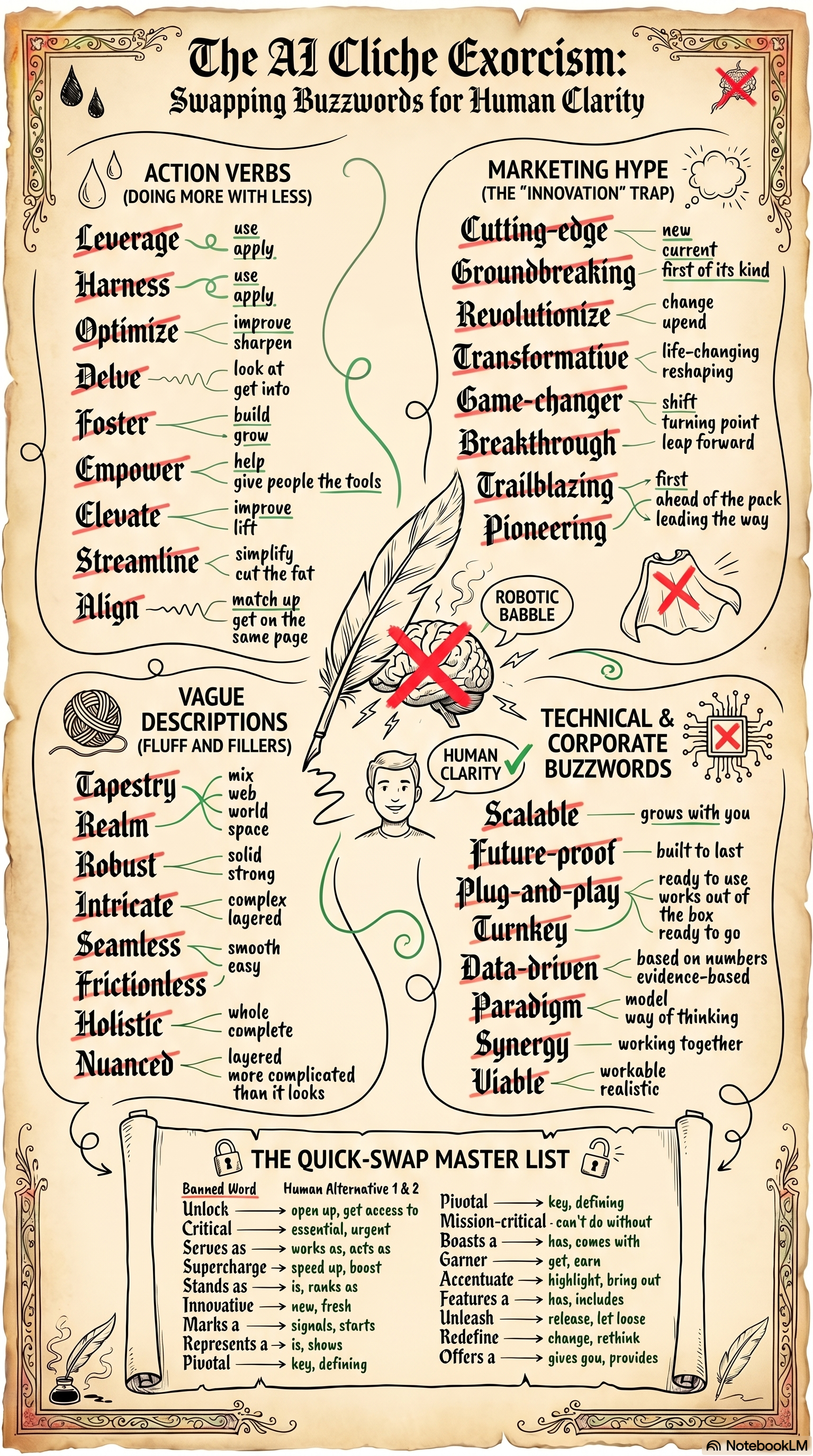
The real skill is not memorizing the list. It is understanding what the list is pointing at. Once you see the pattern, you will start catching it everywhere. Including, occasionally, in your own writing. And especially in AI-assisted writing, which is where this knowledge becomes genuinely useful.
If you collaborate with AI, and there is no shame in that, understanding semantic compression makes you a better editor of your own output. You will catch the words that are standing in for thoughts that didn’t get finished. You will know when to push for the specific claim instead of the general gesture. You will produce writing that sounds like you instead of writing that sounds like everyone’s press release.
I have nothing against press releases. They have a place. But what makes writing pull someone in is your unique point of view.
Write like a human. Your readers will notice.
TechDomme writes about AI, neurodivergence, the changing face of tech, humanity and cognants.