The Trustflow Model that's already deciding who gets recommended, whether you're participating or not.
By The Techdomme
Published: 2026-04-30
URL: https://thetechdomme.substack.com/p/why-seo-is-not-dead-but-why-its-not
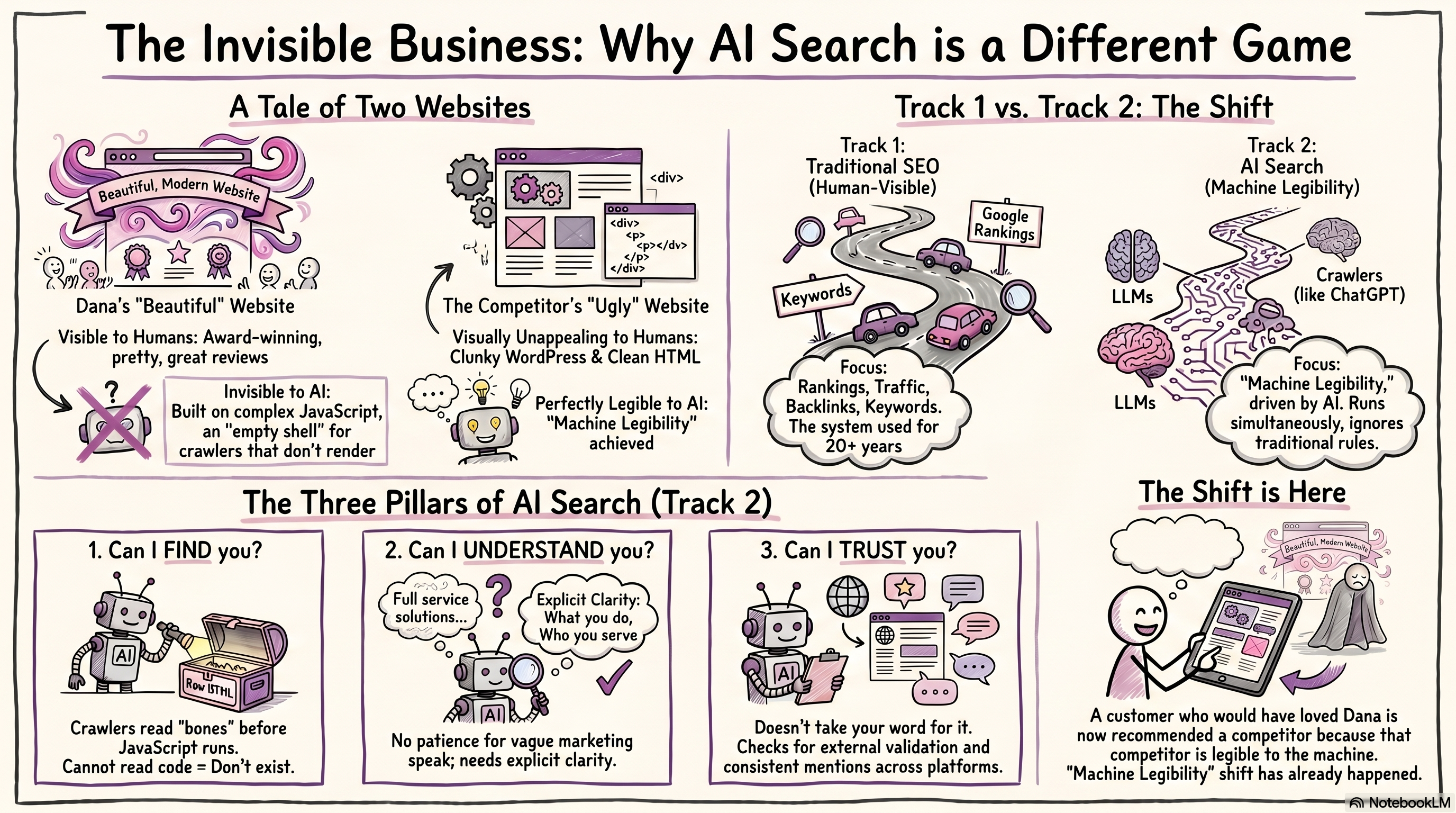
Over the past few weeks, I’ve been deep in what I can only describe as AI Search Optimization, or AISO, research. You’ll hear terms like AEO, answer engine optimization. But that framing only captures part of what’s happening. You’re not just optimizing for the answer box. You’re optimizing the entire process by which AI finds, understands, and decides to recommend you.
That’s what AISO actually is.
I’ve written about pieces of it already. In The Inversion of Expertise I discussed how AI search is pushing small businesses to become specific generalists, building concentrated expertise signals even if they still offer a range of services.
And I talked about the growing gap between what humans see and what AI systems can actually access in the article I wrote about my own company’s audit. Individually, those shifts are interesting. Together, they point to something bigger. Because the way visibility works right now is not changing.
It has already changed.
Google is a librarian. It hands you sources. AI is an analyst. It reads them and makes a recommendation. Which means the question is no longer just “can you be found?” It is whether you get chosen.
Let me start by saying something that needs to be said clearly: SEO is not dead. Let’s get that out of the way, because otherwise half the internet stops reading and starts arguing. If you work in SEO, you are not wrong. Google still dominates search. Rankings still drive traffic. The fundamentals still matter. But you are working with an incomplete model. Because visibility is no longer one system. It is two.
Track 1 is the one you know. Google. Rankings. Traffic.
Track 2 AISO is newer. Less visible. But already influencing decisions. AI search is not “here are your options.” More like “here is what I recommend.” Which means the question is no longer just “can you be found?” It is whether you are recommended.
This second track runs on a different system I call The Trustflow Model:
Find. Understand. Trust.
Layer 1: Can AI find you?
This sounds obvious. It is not. AI relies on indexing to know you exist. But after that, it has to actually access your site. And this is where things quietly break. Roughly 69% of AI crawlers cannot execute JavaScript. Which means any content that relies on client-side rendering simply does not exist to them. To a human, the site looks complete. To the crawler, it is an empty shell.
Indexing tells AI a website exists, but it doesn't tell AI what the website's about. The website might as well be invisible.
Now, the immediate pushback here is: “Google can render JavaScript.” Yes. Google can. AI crawlers too. They just usually don’t. Rendering JavaScript is expensive. It takes time, compute, and introduces inconsistency. Most AI systems prioritize fast access to raw HTML and move on quickly. If your content is not available in that initial response, there is a good chance it is skipped.
There is also a timeout factor. Crawlers do not wait around indefinitely for your page to fully load. And that window is shorter than most people expect.
So in practice, not theory, heavily JavaScript-dependent sites are frequently invisible. Which helps explain another stat: 78% of businesses report zero visibility in AI-generated answers. Not low visibility. Zero. At that point, you are not underperforming. You are absent.
Layer 2: Can AI understand you?
Let’s assume AI can access your content. Now it has to interpret it. Is it clear what you do? Who you serve? What you are actually good at? Or are you another “full-service” something with a single vague services page and broad claims?
Humans will sometimes fill in those gaps.
AI will not.
If it cannot confidently explain you, it will not recommend you. This is where a lot of traditional SEO content starts to show its limits. Content designed to capture queries is not always content designed to clearly define expertise. And AI optimizes for clarity.
Layer 3: Can AI trust you?
This is where the bar quietly gets higher. AI does not just look at your website. It looks for corroboration across your entire presence. Reviews with specifics. Consistent positioning across platforms. Mentions in articles. Proof that you are active and current. Because this is not ranking. It is recommendation. And recommendations require confidence.
Consider the numbers. 42% of decision-makers now rely on AI search during research, and AI search converts at 4-5x the rate of traditional Google search. At the same time, 71% of SEO professionals report already adapting their workflows to account for AI-driven discovery. The shift is not theoretical. It is already underway.
And here is the uncomfortable part: you can win Track 1 and still lose Track 2 completely. You can rank. You can get traffic. You can do everything “right.” And still never get recommended. Not because your offering is weak. Because the system making the decision is different.
This is what AI Search Optimization is actually pointing at. Not a replacement for SEO. A second layer of requirements sitting next to it. SEO gets you visibility. AI decides if that visibility turns into selection.
Right now there are businesses with worse offers, worse service, and worse reputations getting recommended. Not because they are better. Because they are legible to a system their competitors have not even started optimizing for.
That gap is not theoretical anymore. It is operational.
Next time: The three types of AI crawlers, and why most conversations about “indexing” have it wrong
Susan Burris is the Founder of Cognant Systems, an AI Search Optimization firm. As her alter-ego, the Techdomme, she writes and philosophizes about AI, business trends and the future of AI human collaboration.