An essential reading guide to feedback loops, complexity, organizational design, system dynamics, and the hidden mechanisms that shape organizational performance.
By Alex Pawlowski
Published: 2026-11-26
URL: https://thestrategystack.substack.com/p/best-systems-thinking-books-organizations

THE STRATEGY STACK · FIELD GUIDE · NOVEMBER 2026
Organizations are full of problems that appear straightforward when examined individually but become far more difficult when considered together. A department improves its efficiency while overall delivery deteriorates. An organization introduces more performance indicators and unintentionally encourages behavior that undermines its strategy. A new technology accelerates individual tasks while increasing the coordination burden across teams.
These outcomes become easier to understand through systems thinking.
Systems thinking examines how relationships, feedback loops, incentives, delays, and structures produce patterns of behavior over time. It encourages us to look beyond isolated events and immediate causes to understand the underlying conditions that generate recurring results.
At a Glance: Where to Start
For leaders, strategists, consultants, and operators, this perspective is particularly valuable. Organizations are interconnected social systems in which changing one component can influence many others, often in unexpected ways.
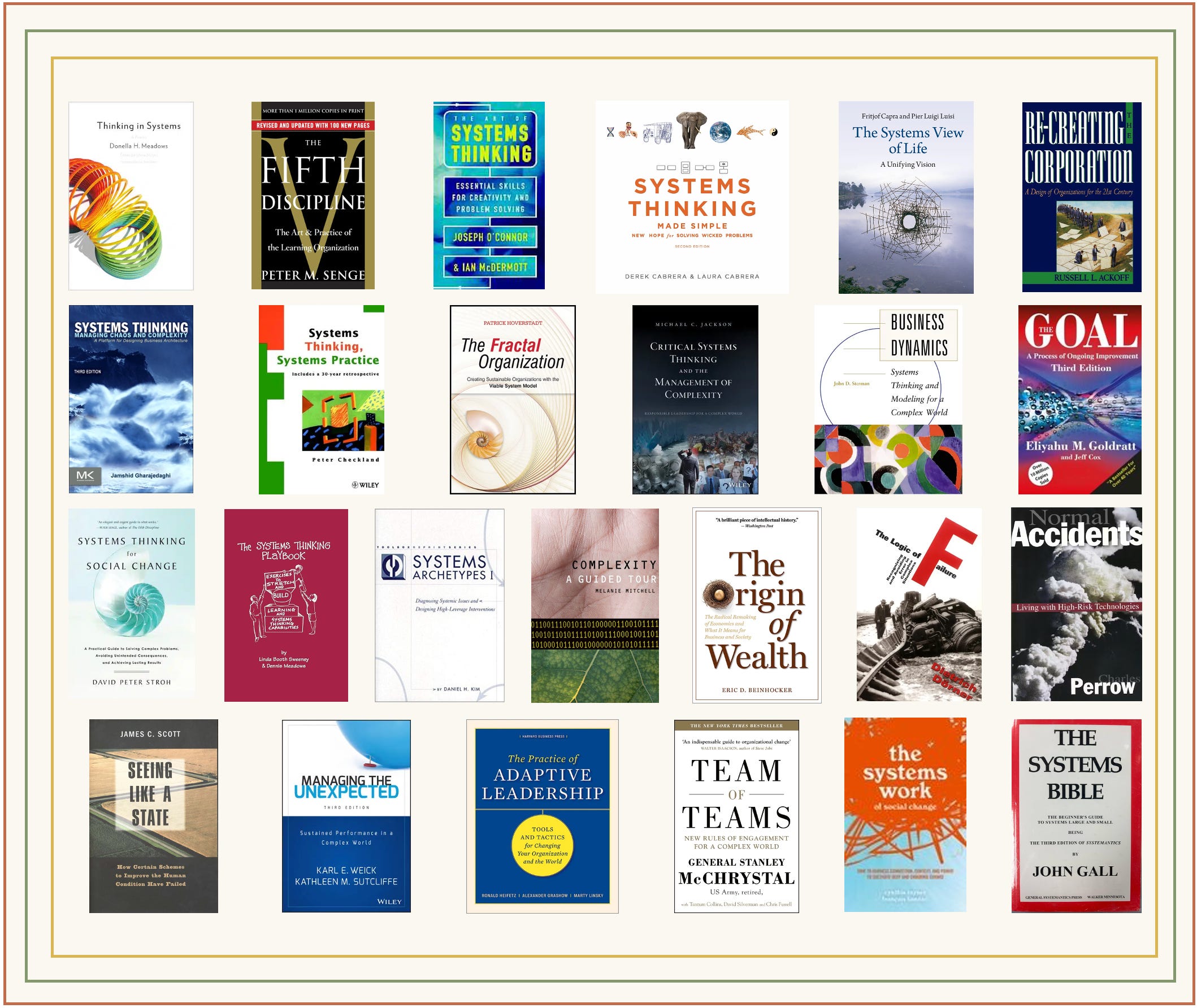
This collection brings together 25 books that develop different dimensions of systems thinking, from foundational concepts and system dynamics to organizational design, complexity science, decision-making, and adaptive leadership.
The selection includes accessible introductions, established academic works, practical management guides, and books that apply systemic reasoning to wider economic and social problems. Not every title is a conventional systems-thinking textbook. Some are included because they reveal important mechanisms through which complex organizations behave.
Explore The Strategy Stack
Practical frameworks for navigating AI, technology, and strategic change.
-
Start Here — Discover the publication and our most useful resources.
-
Watch on YouTube — Conversations and insights on strategy, innovation, and AI.
-
Follow on Instagram — Visual cheat sheets, frameworks, and practical ideas worth saving.
I. Foundations of Systems Thinking
These five books introduce the principles that distinguish systems thinking from conventional linear problem-solving. They explain how patterns emerge from relationships between components, why interventions generate unintended effects, and how to identify underlying structures.
1. Thinking in Systems: A Primer — Donella H. Meadows
Best for: Anyone beginning to study systems thinking.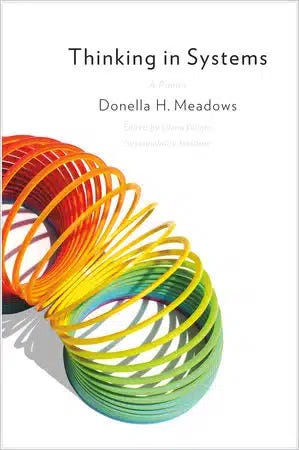
Donella Meadows provides one of the most accessible introductions to systems thinking, explaining how stocks, flows, feedback loops, delays, and system structures influence behavior. Her examples show why complex problems frequently resist apparently sensible solutions and why intervening in the wrong part of a system can reinforce the very problem we intended to solve.
The book is especially valuable for its treatment of leverage points: places within a system where changes can produce significant effects. Meadows encourages readers to examine the rules, information flows, goals, and underlying assumptions that shape system behavior.
Practical application: Examine a recurring organizational problem by identifying its feedback loops and structural causes before introducing another intervention.
2. The Fifth Discipline: The Art & Practice of the Learning Organization — Peter M. Senge
Best for: Leaders building organizations capable of sustained learning and adaptation.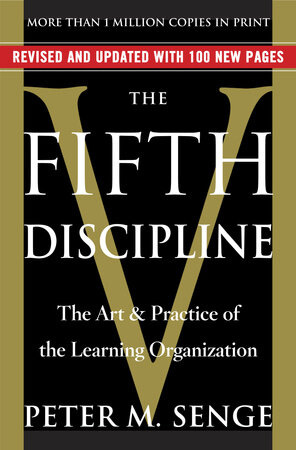
Peter Senge connects systems thinking directly to organizational performance. His framework combines five disciplines: systems thinking, personal mastery, mental models, shared vision, and team learning.
A central contribution is the examination of organizational learning disabilities and recurring patterns that prevent companies from understanding the consequences of their own decisions. Senge explains how local optimization, delayed feedback, and deeply embedded assumptions can undermine collective performance even when individuals act rationally.
Practical application: Analyze situations in which departmental decisions produce unintended consequences elsewhere in the organization.
3. The Art of Systems Thinking: Essential Skills for Creativity and Problem Solving — Joseph O’Connor and Ian McDermott
Best for: Readers seeking practical methods for understanding everyday complexity.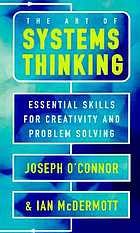
This book introduces systems thinking through recognizable situations involving relationships, communication, decision-making, and problem-solving. It explains reinforcing and balancing feedback loops, system boundaries, and the effects of delayed consequences.
Its accessibility makes it particularly useful for readers who want to move from conceptual understanding to observing system behavior in their professional environments.
Practical application: Map how decisions, responses, and unintended consequences interact within a recurring business problem.
4. Systems Thinking Made Simple: New Hope for Solving Wicked Problems — Derek Cabrera and Laura Cabrera
Best for: Developing a repeatable approach to structuring complex problems.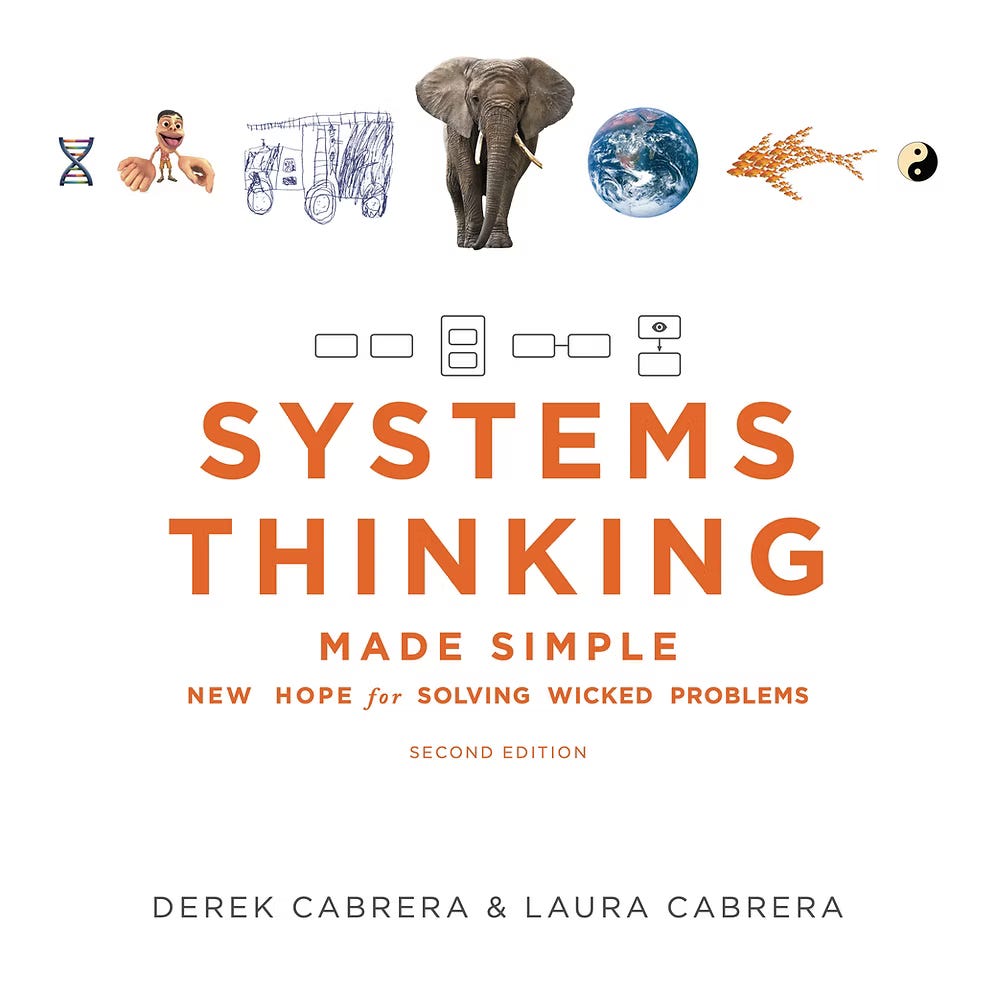
Derek and Laura Cabrera introduce systems thinking through the DSRP framework: distinctions, systems, relationships, and perspectives. These four elements provide a practical method for organizing knowledge and examining situations that resist simple explanations.
The framework is useful because it makes systems thinking applicable to everyday reasoning, rather than requiring readers to begin with elaborate models or specialized terminology.
Practical application: Reframe an organizational challenge by identifying its components, boundaries, relationships, and competing stakeholder perspectives.
5. The Systems View of Life: A Unifying Vision — Fritjof Capra and Pier Luigi Luisi
Best for: Understanding the broader scientific foundations of systems thinking.
Capra and Luisi examine the development of systemic perspectives across biology, ecology, cognitive science, and other disciplines. Their central contribution is a comprehensive account of how interconnected relationships, networks, and self-organizing processes influence the behavior of living systems.
Although broader and more academic than a typical management book, it provides an important conceptual foundation for understanding organizations as interconnected, adaptive systems rather than static collections of independent functions.
Practical application: Develop a more holistic understanding of organizational ecosystems, interdependencies, and adaptation.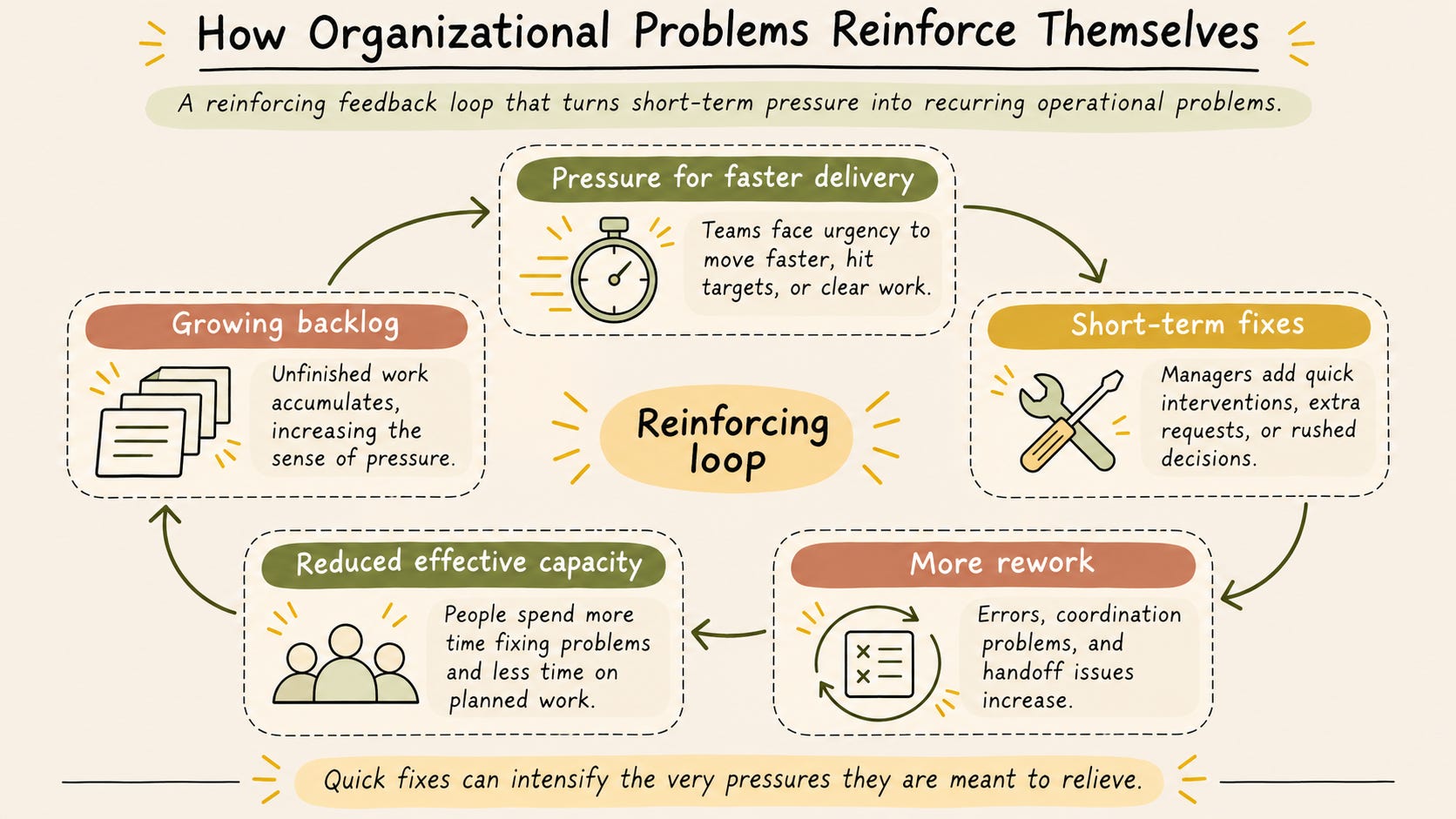 Short-term interventions can create additional rework, reduce effective capacity, and increase delivery pressure. The resulting reinforcing feedback loop helps explain why recurring organizational problems often persist despite repeated attempts to resolve them.
Read next
Understanding systems thinking begins with recognizing how relationships, feedback loops, delays, and underlying structures influence outcomes. Yet applying these principles to organizations requires a broader understanding of how incentives, decision-making processes, operational constraints, and organizational structures interact over time.
The five books above establish the foundations for examining interconnected systems, identifying recurring patterns, and questioning the assumptions behind seemingly straightforward problems. The remaining books extend these ideas into organizational design, system dynamics, complexity, risk, and adaptive leadership, offering different perspectives on how complex organizations function and change.
These TSS resources are free to explore:
-
Thinking Like a Strategist — Our ongoing editorial series examining the underlying mechanisms of strategic decisions, organizational behavior, competitive advantage, and the relationships that shape business outcomes.
-
The Business Model Series — A structured examination of how organizations create, deliver, and capture value, including the interdependencies between capabilities, activities, incentives, and economic outcomes.
-
Strategy Teardowns — Applied analyses of real companies, exploring how organizational structures, strategic choices, competitive mechanisms, and external forces interact to shape performance.
-
The Strategy Stack Knowledge Hub — Explore the concepts and frameworks underlying systems thinking, feedback loops, organizational design, complexity, strategic management, and business transformation.
Put systems thinking into practice
-
Operator Vault — Practical frameworks, diagnostic tools, decision templates, and reusable materials for identifying organizational constraints, mapping interdependencies, and translating systemic insights into strategic action.
-
Stack Atlas — Explore how systems thinking, organizational capabilities, competitive advantage, strategic decisions, business models, and complex adaptive systems connect.
Curated resource collections and editorial essays remain free. Paid membership provides access to deeper practical materials for diagnosing organizational challenges, evaluating interventions, and improving the execution of complex strategic decisions.
The complete Systems Thinking Books Library contains 25 titles organized into five essential areas, from foundational systems concepts and organizational architecture to feedback loops, complexity, and adaptive leadership.
Subscribe free to The Strategy Stack to unlock the remaining 20 books, along with curated reading recommendations for different organizational challenges and a practical guide to choosing the right systems-thinking approach.
You’ll also discover five questions for applying systems thinking in your organization, helping you identify recurring patterns, uncover structural causes, recognize unintended consequences, and develop more effective interventions.
II. Organizational Systems and Business Architecture
Understanding systems is only the beginning. The next challenge is designing organizations whose structures, decision rights, information flows, and incentives support their intended outcomes.
These books address organizational architecture from different systems perspectives.
6. Re-Creating the Corporation: A Design of Organizations for the 21st Century — Russell L. Ackoff
Best for: Executives and organizational designers.
Russell Ackoff examines how organizations can be redesigned as purposeful systems rather than managed as collections of independent departments. He connects interactive planning, learning, organizational democracy, and structural flexibility to long-term performance.
His approach challenges the tendency to optimize individual components without considering their contribution to the larger organization.
Practical application: Evaluate whether organizational structures and decision rights reinforce the company’s overall objectives or merely improve isolated functions.
7. Systems Thinking: Managing Chaos and Complexity — Jamshid Gharajedaghi
Best for: Advanced practitioners developing business architectures.
Gharajedaghi provides a comprehensive approach to systems thinking that combines organizational philosophy, interdependencies, iterative inquiry, and interactive design.
The book is particularly relevant to complex business environments because it treats organizations as sociocultural systems characterized by multiple purposes, interdependent activities, and continuous change.
Practical application: Analyze organizational architecture by examining how structure, function, and processes interact to produce business outcomes.
8. Systems Thinking, Systems Practice — Peter Checkland
Best for: Consultants and managers working with ambiguous organizational problems.
Peter Checkland’s work provides the foundations for Soft Systems Methodology, an approach developed for situations in which problems are difficult to define and stakeholders hold different interpretations of reality.
The method is especially valuable when organizational challenges cannot be reduced to a single measurable objective or a purely technical solution.
Practical application: Structure stakeholder discussions where participants disagree about the nature of a problem, its boundaries, or the meaning of a successful outcome.
9. The Fractal Organization: Creating Sustainable Organizations with the Viable System Model — Patrick Hoverstadt
Best for: Organizational design, governance, and management architecture.
Patrick Hoverstadt applies the Viable System Model to organizational design, showing how autonomy, coordination, control, intelligence, and policy interact in viable organizations.
The book provides a structured perspective on how organizations can manage complexity while retaining sufficient adaptability to respond to changing environments.
Practical application: Examine whether an organization has appropriate mechanisms for coordination, operational autonomy, strategic learning, and governance.
10. Critical Systems Thinking and the Management of Complexity — Michael C. Jackson
Best for: Advanced organizational analysis and selecting appropriate systems methodologies.
Michael Jackson examines a range of systems approaches and their suitability for different types of organizational complexity. The book emphasizes that no single methodology is appropriate for every situation.
Its contribution is particularly important for consultants and transformation leaders who need to select between analytical, participatory, organizational, and critical approaches to complex problems.
Practical application: Choose a systems methodology based on the problem’s technical characteristics, stakeholder relationships, and organizational context.
III. Feedback Loops, System Dynamics, and Intervention
Organizations often repeat undesirable behavior because the underlying system continues to reward or reproduce it.
These books help readers understand how decisions create dynamic consequences and how better interventions can change persistent patterns.
11. Business Dynamics: Systems Thinking and Modeling for a Complex World — John D. Sterman
Best for: Analysts, strategists, and leaders seeking rigorous modeling capabilities.
John Sterman’s textbook provides a comprehensive introduction to system dynamics, including causal feedback, accumulation, delays, simulation, and model validation.
Its applications extend across business strategy, operations, public policy, and organizational decision-making. The book is particularly useful when decision-makers need to understand how apparently small changes accumulate and produce significant long-term effects.
Practical application: Model the consequences of changes in pricing, capacity, demand, inventory, or organizational resources before implementing them.
12. The Goal: A Process of Ongoing Improvement — Eliyahu M. Goldratt and Jeff Cox
Best for: Operational leaders seeking to improve system-wide performance.
Through a fictional manufacturing business, Goldratt and Cox introduce the Theory of Constraints and demonstrate why optimizing individual processes can fail to improve overall throughput.
The central lesson is that organizational performance depends on the relationships between activities and the constraints that limit the performance of the entire system.
Practical application: Identify the constraint limiting an organization’s output and focus improvement efforts on that constraint before optimizing surrounding processes.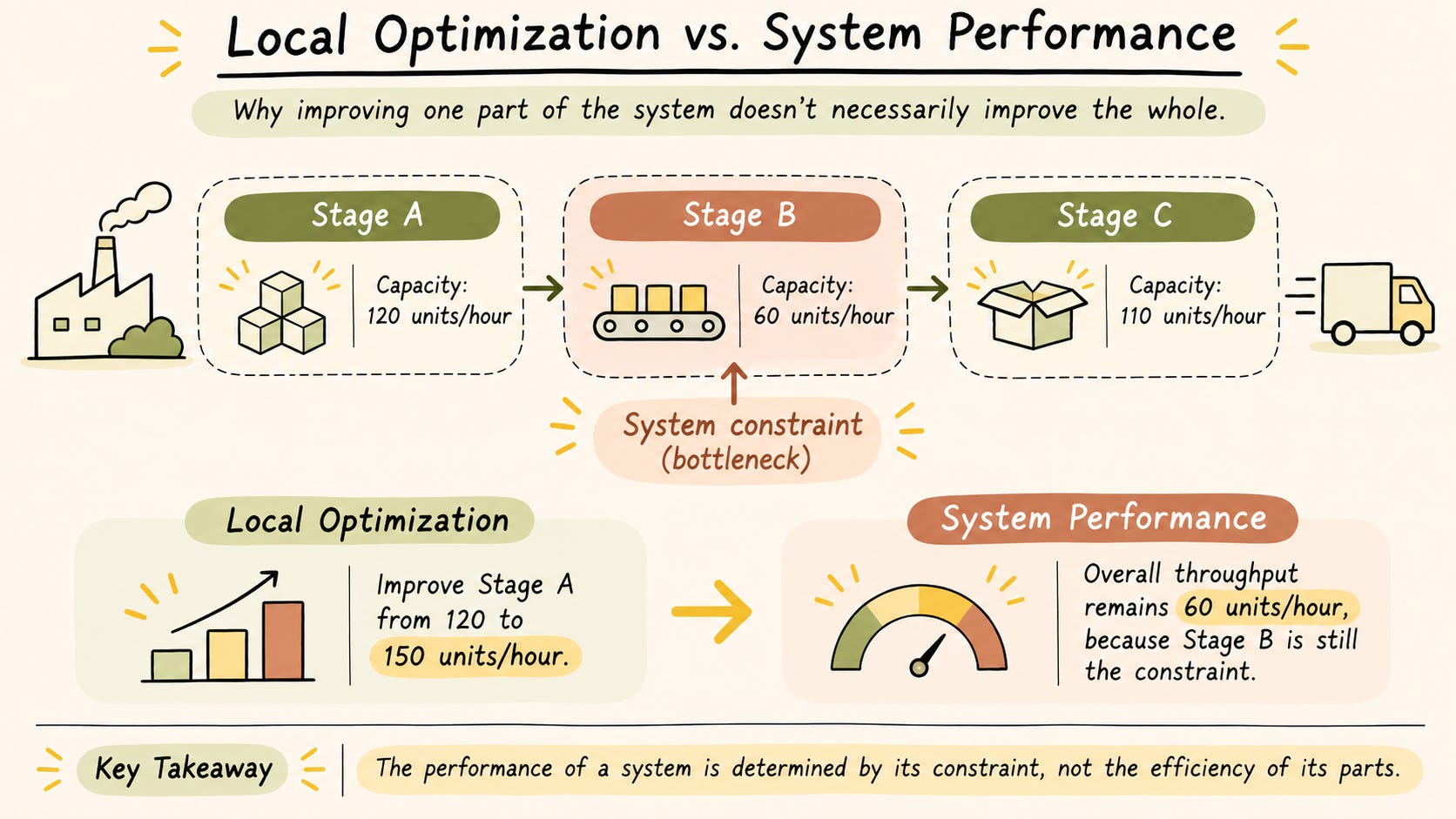 In this illustrative three-stage process, increasing Stage A’s capacity from 120 to 150 units per hour does not improve overall throughput because Stage B remains the bottleneck at 60 units per hour. Improving individual activities only increases system-wide performance when it addresses the constraints limiting the entire process.
From Systems Thinking to AI Monetization
Systems thinking helps explain why improving individual components of a business does not always improve its overall performance. Revenue growth, pricing decisions, customer behavior, operating costs, and organizational capabilities are interconnected. Changes in one area can create consequences elsewhere, sometimes undermining the intended outcome.
These relationships become particularly important in AI businesses, where customer usage, model inference costs, pricing structures, and service delivery economics continuously influence one another. A pricing model that encourages adoption may also increase infrastructure costs, while an operational improvement may have limited commercial value unless it translates into outcomes customers are willing to pay for.
The AI Monetization Playbook applies this systemic perspective to the commercial design of AI products and services. This practical 95-page guide covers AI pricing models, customer value validation, delivery economics, worked financial scenarios, and a structured 90-day roadmap for building commercially viable AI business models.
Included with The Strategy Stack paid membership.
13. Systems Thinking for Social Change — David Peter Stroh
Best for: Leaders addressing persistent, multi-stakeholder problems.
David Peter Stroh explains how systems thinking can improve collective problem-solving, especially when well-intended interventions repeatedly fail to produce lasting change.
Although written primarily for social challenges, its methods translate into organizational transformation, stakeholder alignment, strategic planning, and complex change initiatives.
Practical application: Identify the structures and assumptions that sustain a persistent problem before designing a coordinated intervention.
14. The Systems Thinking Playbook — Linda Booth Sweeney and Dennis Meadows
Best for: Facilitators, teams, educators, and workshop leaders.
This exercise-based resource provides experiential activities designed to help participants understand interdependence, feedback, delays, and system behavior.
Its practical contribution is to make abstract systems concepts observable through structured activities rather than relying exclusively on explanation or conceptual models.
Practical application: Use experiential exercises to help teams recognize the consequences of local decisions and develop shared systems-thinking capabilities.
15. Systems Archetypes I: Diagnosing Systemic Issues and Designing Interventions — Daniel H. Kim
Best for: Recognizing recurring organizational behavior patterns.
Daniel Kim’s concise treatment of systems archetypes introduces recurring patterns that can emerge across different organizational contexts.
Archetypes provide a diagnostic language for identifying situations in which well-intended actions create reinforcing problems, delayed consequences, or persistent limitations.
Practical application: Use system archetypes to diagnose recurring issues such as temporary fixes that create long-term dependencies or growth initiatives that encounter structural limits.
IV. Complexity, Emergence, and System Failure
Some organizational outcomes cannot be adequately explained through isolated decisions or individual errors. They emerge from interactions among technologies, institutions, processes, and people.
These books examine the mechanisms through which complex systems generate unexpected outcomes.
16. Complexity: A Guided Tour — Melanie Mitchell
Best for: Understanding complexity science and emergent behavior.
Melanie Mitchell introduces central ideas from complexity science, including emergence, adaptation, networks, computation, and self-organization.
The book helps explain how large-scale patterns can arise from local interactions without centralized coordination. Although its applications extend well beyond business, it provides an intellectual foundation for understanding complex organizational and economic systems.
Practical application: Examine how decentralized interactions and local incentives may generate organizational outcomes that no individual intended.
17. The Origin of Wealth: Evolution, Complexity, and the Radical Remaking of Economics — Eric D. Beinhocker
Best for: Strategists examining markets, competition, and economic evolution.
Eric Beinhocker explores how complexity science challenges conventional economic models and offers an evolutionary perspective on wealth creation.
His analysis connects economic adaptation, technological development, institutional change, and business innovation. The book is especially relevant for understanding why competitive environments evolve through interacting decisions rather than following predetermined paths.
Practical application: Analyze markets and business models as evolving systems shaped by variation, selection, adaptation, and interconnected participants.
18. The Logic of Failure: Recognizing and Avoiding Error in Complex Situations — Dietrich Dörner
Best for: Leaders making decisions under uncertainty.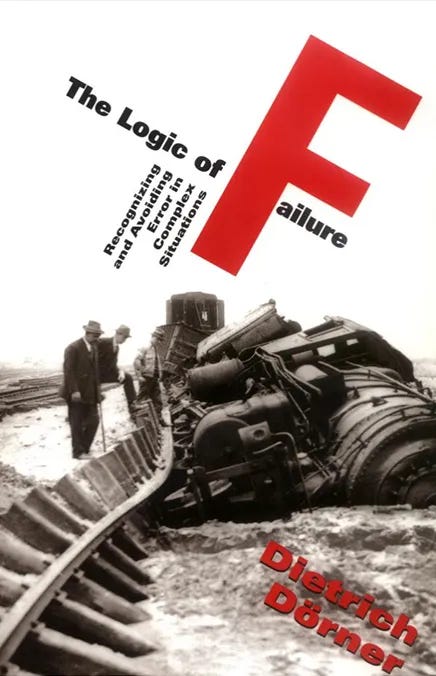
Dietrich Dörner examines why intelligent and capable decision-makers repeatedly produce poor outcomes when confronted with complex, dynamic environments.
Through research involving simulated environments and decision-making behavior, he explores how narrow attention, inadequate mental models, insufficient consideration of delayed consequences, and poorly coordinated interventions contribute to failure.
Practical application: Improve strategic decision-making by examining interactions, delays, secondary effects, and the limitations of immediate feedback.
19. Normal Accidents: Living with High-Risk Technologies — Charles Perrow
Best for: Understanding systemic risk and organizational vulnerabilities.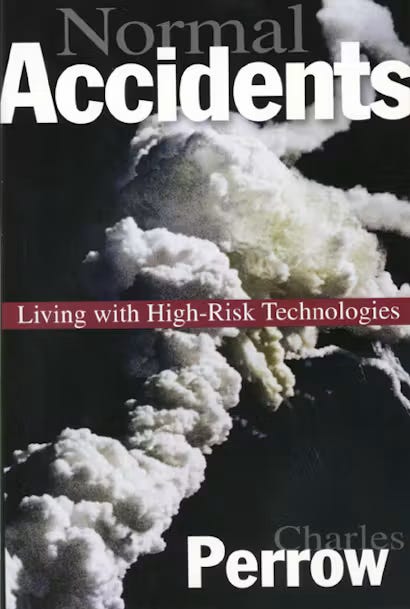
Charles Perrow examines how accidents can emerge within complex, tightly coupled technological systems even when individuals follow established procedures.
His work challenges the assumption that better rules, more supervision, or improved individual performance can eliminate every organizational failure.
Practical application: Evaluate whether critical organizational processes are so tightly coupled that small failures can rapidly propagate across the wider system.
20. Seeing Like a State: How Certain Schemes to Improve the Human Condition Have Failed — James C. Scott
Best for: Understanding the dangers of excessive simplification and centralized planning.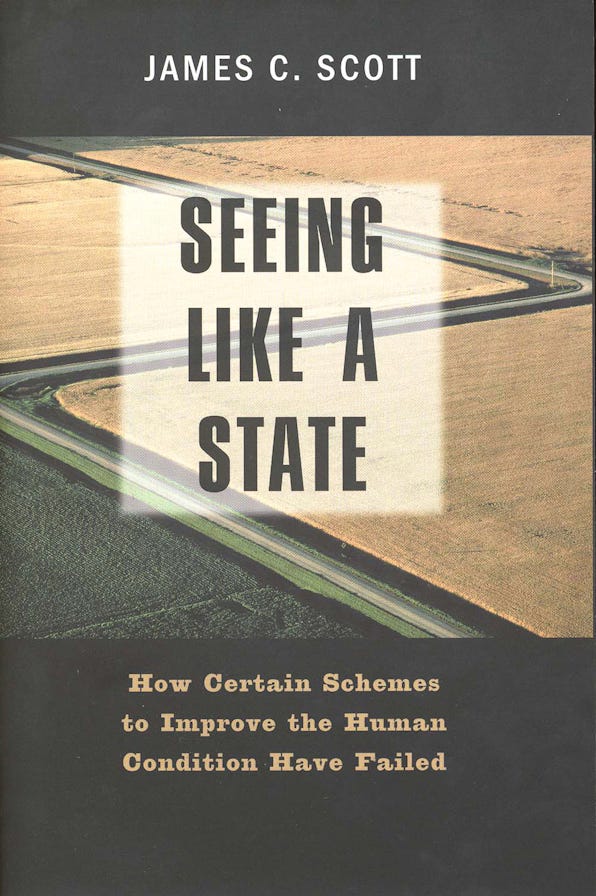
James Scott examines large-scale planning initiatives and the institutional assumptions that contributed to their failure.
For organizational leaders, the book offers a broader lesson about the consequences of reducing complex realities to simplified categories, standardized measurements, and centrally designed interventions that overlook local knowledge.
Practical application: Assess whether organizational transformation initiatives ignore operational knowledge, local variation, or important relationships that cannot be captured by centralized performance indicators.
V. Leadership, Adaptation, and Organizational Resilience
Systems thinking becomes particularly valuable when leaders must act within environments that cannot be fully predicted or centrally controlled.
The final five books explore how organizations can develop resilience, coordinate distributed capabilities, and adapt to changing conditions.
21. Managing the Unexpected: Sustained Performance in a Complex World — Karl E. Weick and Kathleen M. Sutcliffe
Best for: Leaders responsible for reliability, risk, and organizational resilience.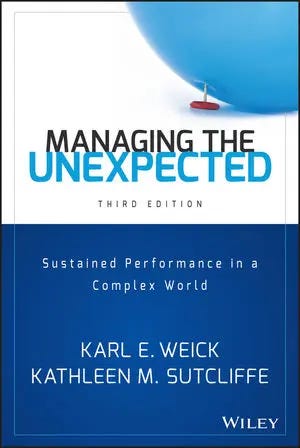
Weick and Sutcliffe examine how organizations operating in demanding environments can sustain reliable performance despite uncertainty and the possibility of failure.
Their work emphasizes organizational attention, sensitivity to operations, learning from anomalies, and the importance of maintaining the capacity to respond to unexpected situations.
Practical application: Design management routines that detect weak signals, encourage operational awareness, and enable organizations to respond before emerging problems escalate.
22. The Practice of Adaptive Leadership — Ronald Heifetz, Alexander Grashow, and Marty Linsky
Best for: Leaders navigating complex organizational change.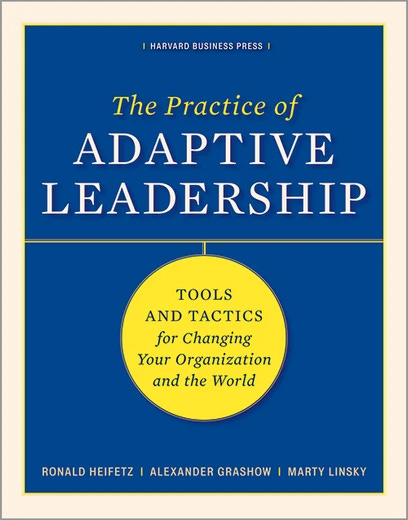
The authors provide practical methods for diagnosing adaptive challenges, understanding stakeholder interests, and leading change when established solutions are insufficient.
Their distinction between technical problems and adaptive challenges is particularly valuable for transformation initiatives. Some situations can be addressed through existing expertise, while others require changes in behavior, values, and organizational relationships.
Practical application: Distinguish between transformation problems that can be solved through technical improvements and those that require collective learning and adaptation.
23. Team of Teams: New Rules of Engagement for a Complex World — Stanley McChrystal, Tantum Collins, David Silverman, and Chris Fussell
Best for: Leaders designing coordination mechanisms across large organizations.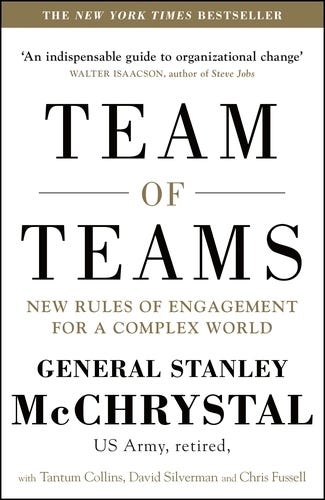
Drawing on military and organizational experience, the authors explore how traditional hierarchical structures can struggle in fast-changing environments characterized by uncertainty and interconnected challenges.
The book examines the importance of shared information, distributed decision-making, trust, and coordination across organizational boundaries.
Practical application: Evaluate whether teams possess sufficient information, decision autonomy, and cross-functional relationships to respond effectively to rapidly changing conditions.
24. The Systems Work of Social Change — Cynthia Rayner and François Bonnici
Best for: Leaders addressing problems that extend beyond individual organizational boundaries.
Rayner and Bonnici explore how change emerges through relationships, collective action, institutional context, and the distribution of power.
Their work offers a useful perspective for organizations operating within larger ecosystems where no single participant has sufficient authority or resources to determine outcomes independently.
Practical application: Examine how stakeholder relationships, institutional structures, and power dynamics influence the effectiveness of ecosystem-wide initiatives.
25. The Systems Bible: The Beginner’s Guide to Systems Large and Small — John Gall
Best for: Readers seeking a provocative perspective on why complex systems behave unexpectedly.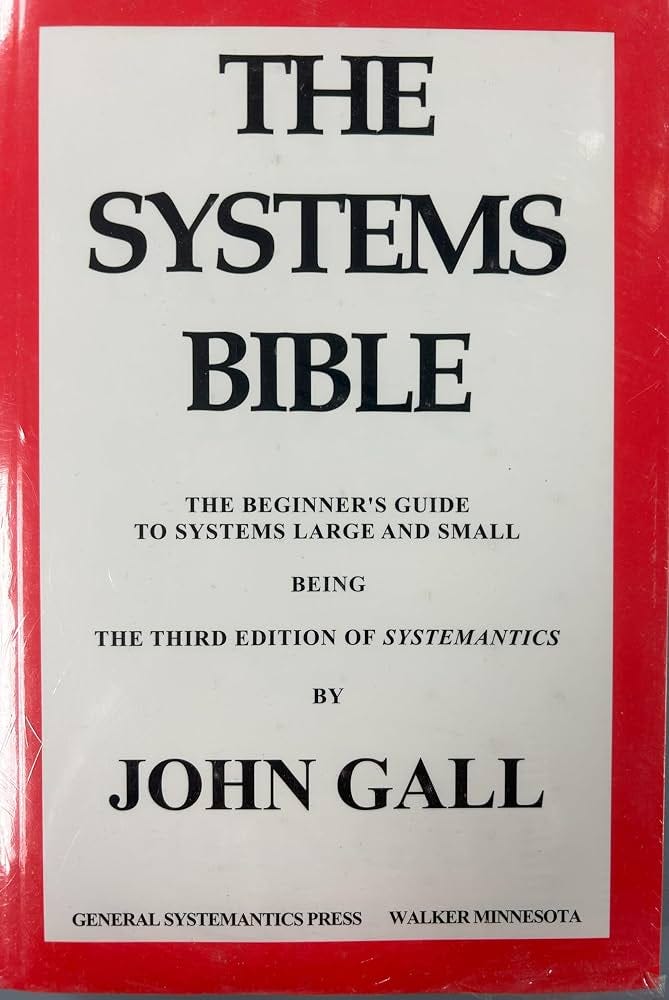
John Gall’s work approaches systems through observation, satire, and a collection of memorable principles about organizational behavior and system failure.
Although deliberately humorous and less methodologically rigorous than academic systems-thinking texts, it offers useful provocations about complexity, bureaucracy, unintended consequences, and the tendency of systems to behave differently from their designers’ intentions.
Practical application: Challenge organizational assumptions and encourage skepticism toward elaborate solutions whose real-world behavior has not been adequately tested.
How to Choose the Right Systems Thinking Book
The most useful book depends on the kind of problem you are trying to understand.
If you are new to systems thinking, begin with Donella Meadows and Peter Senge. Together, they provide the conceptual foundations and an organizational perspective.
If you are responsible for organizational transformation, explore Russell Ackoff, Peter Checkland, Patrick Hoverstadt, and Michael Jackson. These works provide different approaches to organizational structure, problem definition, and systemic design.
If you want to understand why business interventions fail, focus on John Sterman, Dietrich Dörner, Charles Perrow, and James Scott. Their perspectives help explain feedback delays, cognitive limitations, structural vulnerabilities, and unintended consequences.
If you need to improve operational performance, begin with The Goal and then explore Business Dynamics for a more rigorous approach to understanding dynamic behavior.
If you are leading in uncertain environments, read Managing the Unexpected, The Practice of Adaptive Leadership, and Team of Teams.
Systems thinking is a broad discipline, and no single framework captures every dimension of complexity. Combining conceptual, methodological, organizational, and behavioral perspectives provides a stronger foundation than relying on one approach alone.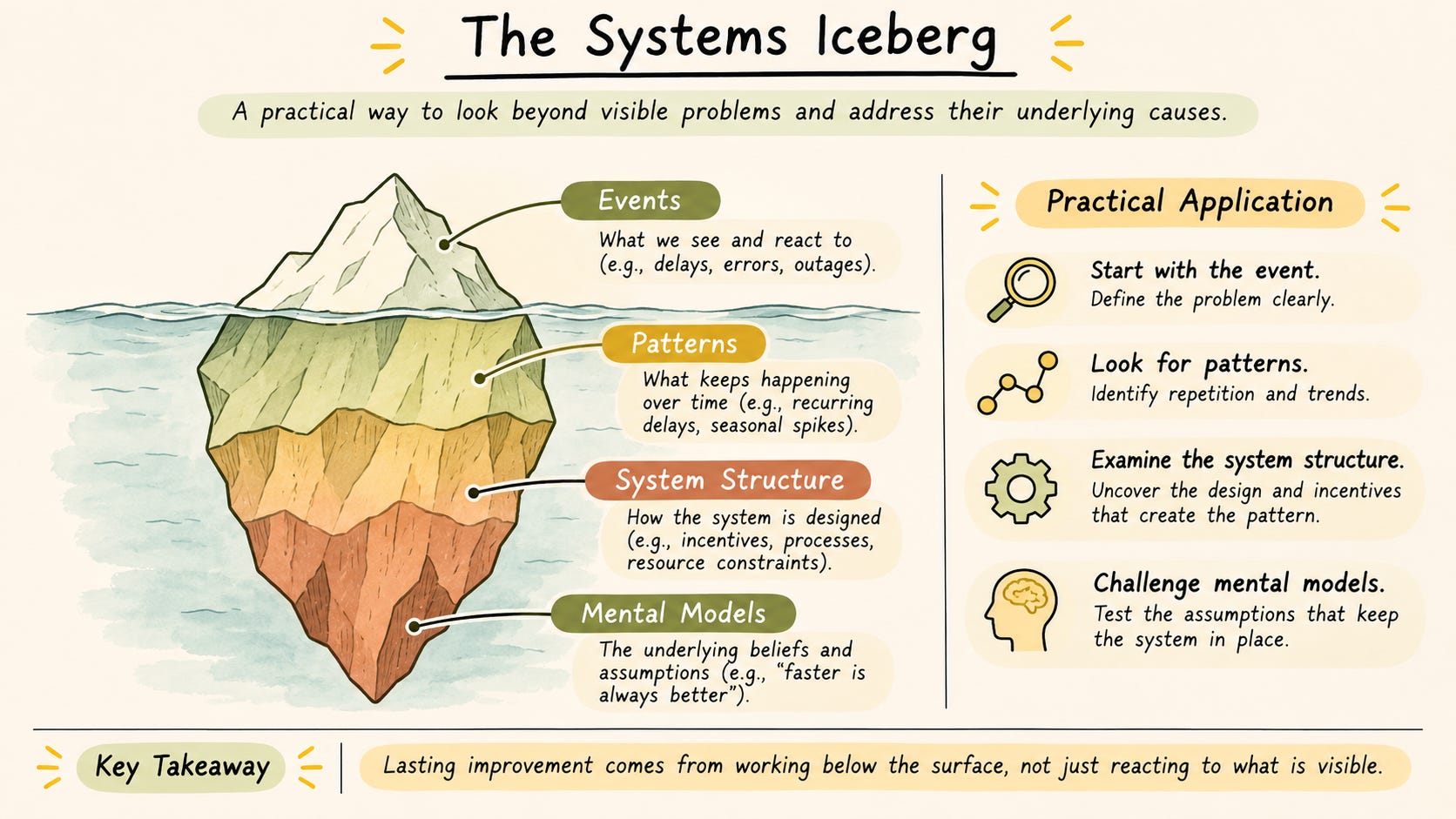 Visible organizational problems often emerge from recurring patterns, underlying system structures, and deeply embedded assumptions. Examining these deeper layers helps leaders move beyond reacting to individual events and identify opportunities for more effective interventions.
Five Questions to Apply Systems Thinking in Your Organization
Reading about systems becomes more valuable when the concepts are used to examine real decisions. The following questions provide a starting point:
-
What patterns keep repeating? Look beyond individual incidents and identify recurring outcomes that suggest an underlying structural cause.
-
Which incentives and feedback loops maintain those patterns? Examine how decisions, measurements, rewards, and responses influence one another.
-
Where do delays obscure cause and effect? Consider whether the consequences of current decisions emerge only after weeks, months, or longer.
-
What happens elsewhere when one part of the organization improves? Evaluate whether local efficiency creates new coordination costs, dependencies, or constraints.
-
Which assumptions define the problem we are trying to solve? Reconsider system boundaries, goals, stakeholder perspectives, and the underlying purpose of the intervention.
These questions can help teams move from reacting to visible symptoms toward examining the structures that produce them.
The Strategic Value of Systems Thinking
Business strategy frequently operates through simplification. Leaders establish objectives, define initiatives, allocate resources, and select metrics to guide execution. These activities are necessary, but they can become counterproductive when they obscure the relationships through which organizational performance actually emerges.
A strategy may be coherent at the corporate level while creating contradictory incentives within operating units. A productivity initiative may reduce effort in one process while increasing coordination costs elsewhere. An organizational redesign may improve accountability while weakening the informal relationships through which important information travels.
Systems thinking helps make these interactions visible.
For strategists and operators, its value lies in developing a more accurate understanding of how organizational decisions produce consequences over time. This supports better diagnosis, more informed interventions, and a greater awareness of the limitations of centralized control.
The books in this collection approach that challenge from different perspectives, but they share an important intellectual commitment: understanding complex systems requires attention to the relationships, structures, and dynamics that connect their individual components.
The objective is to become better at recognizing how the whole system behaves before deciding what to change.