A curated reading library for developing better judgment, challenging assumptions, understanding complex systems, and making stronger strategic decisions under uncertainty.
By Alex Pawlowski
Published: 2026-11-23
URL: https://thestrategystack.substack.com/p/best-strategic-thinking-decision-making-books

THE STRATEGY STACK · FIELD GUIDE · NOVEMBER 2026
Most strategic mistakes do not begin with an obviously bad decision. They begin earlier, when a problem is framed too narrowly, an assumption becomes accepted as fact, or a familiar explanation prevents someone from considering a better alternative.
A leadership team may spend weeks comparing investment opportunities without examining whether it is solving the right problem. An executive may mistake a favorable outcome for evidence of a good decision. A founder may optimize a promising business model without recognizing the dependencies that make it fragile. An organization may introduce an improvement that works locally while creating more serious problems elsewhere.
These are failures of thinking before they become failures of strategy.
Developing better strategic judgment requires several complementary capabilities. We need to recognize problems worth solving, examine situations through more than one conceptual lens, distinguish evidence from interpretation, reason about uncertainty, make explicit trade-offs, and understand how decisions interact with larger systems.
Those capabilities do not come from memorizing a collection of frameworks.
They develop through deliberate practice, exposure to different disciplines, and the willingness to examine how our own reasoning can go wrong.

That is the purpose of this reading library.
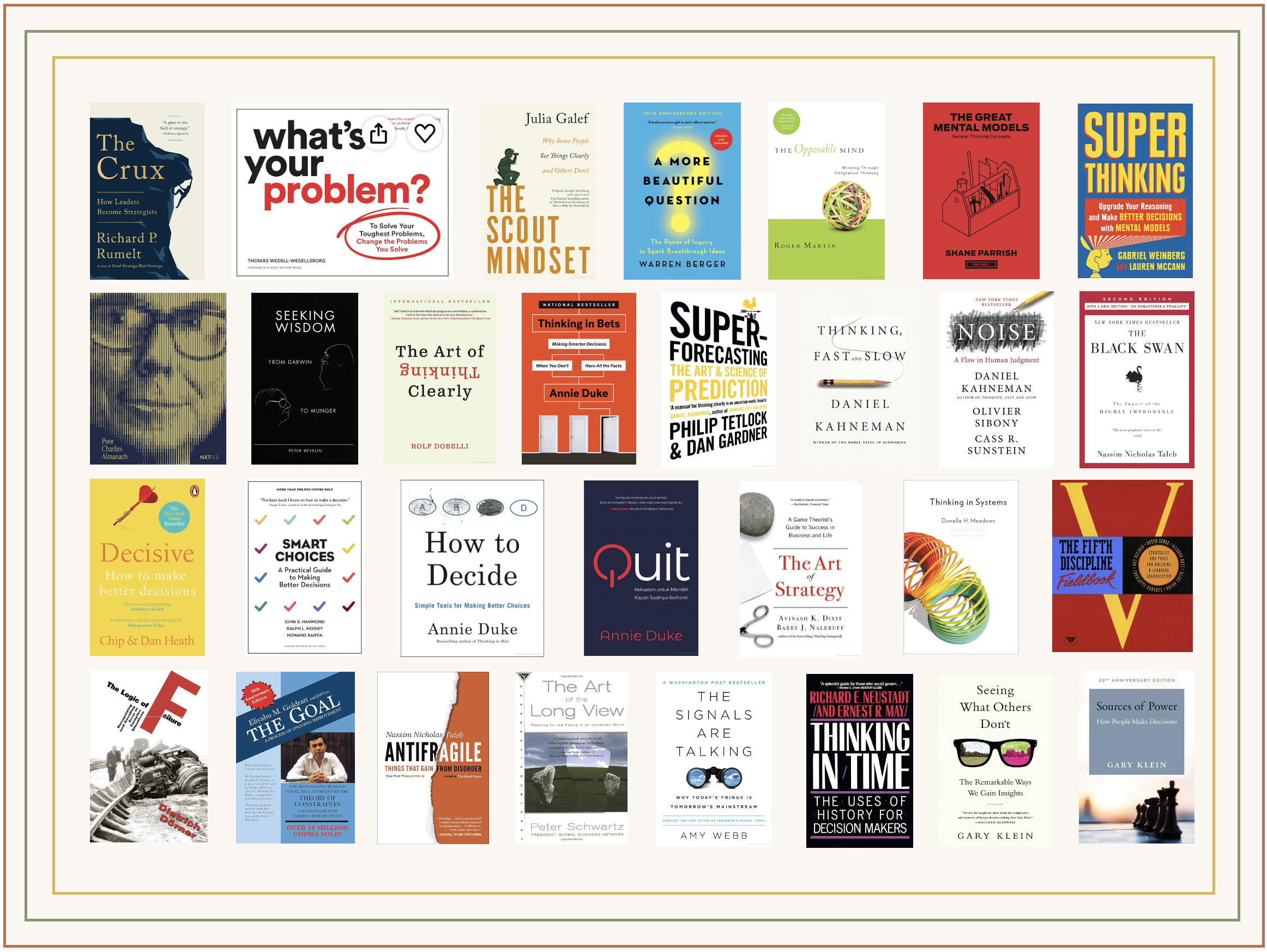
I have assembled 30 books covering strategic thinking, decision science, mental models, behavioral economics, systems thinking, and foresight. Some are foundational works that have shaped management and decision-making for decades. Others provide practical methods for the decisions professionals face today.
The selection is intentionally broader than conventional business strategy literature. Useful strategic thinking draws from psychology, economics, cognitive science, history, organizational learning, and the study of complex systems.
A strategist who understands competitive positioning but cannot distinguish a good decision from a lucky outcome has an incomplete toolkit. So does a leader who understands cognitive biases but overlooks incentives, dependencies, and second-order consequences.
The objective is to develop a more complete approach to judgment.
Explore The Strategy Stack
Practical frameworks for navigating AI, technology, and strategic change.
- Start Here — Discover the publication and our most useful resources.
- Watch on YouTube — Conversations and insights on strategy, innovation, and AI.
- Follow on Instagram — Visual cheat sheets, frameworks, and practical ideas worth saving.
How to Use This Reading Library
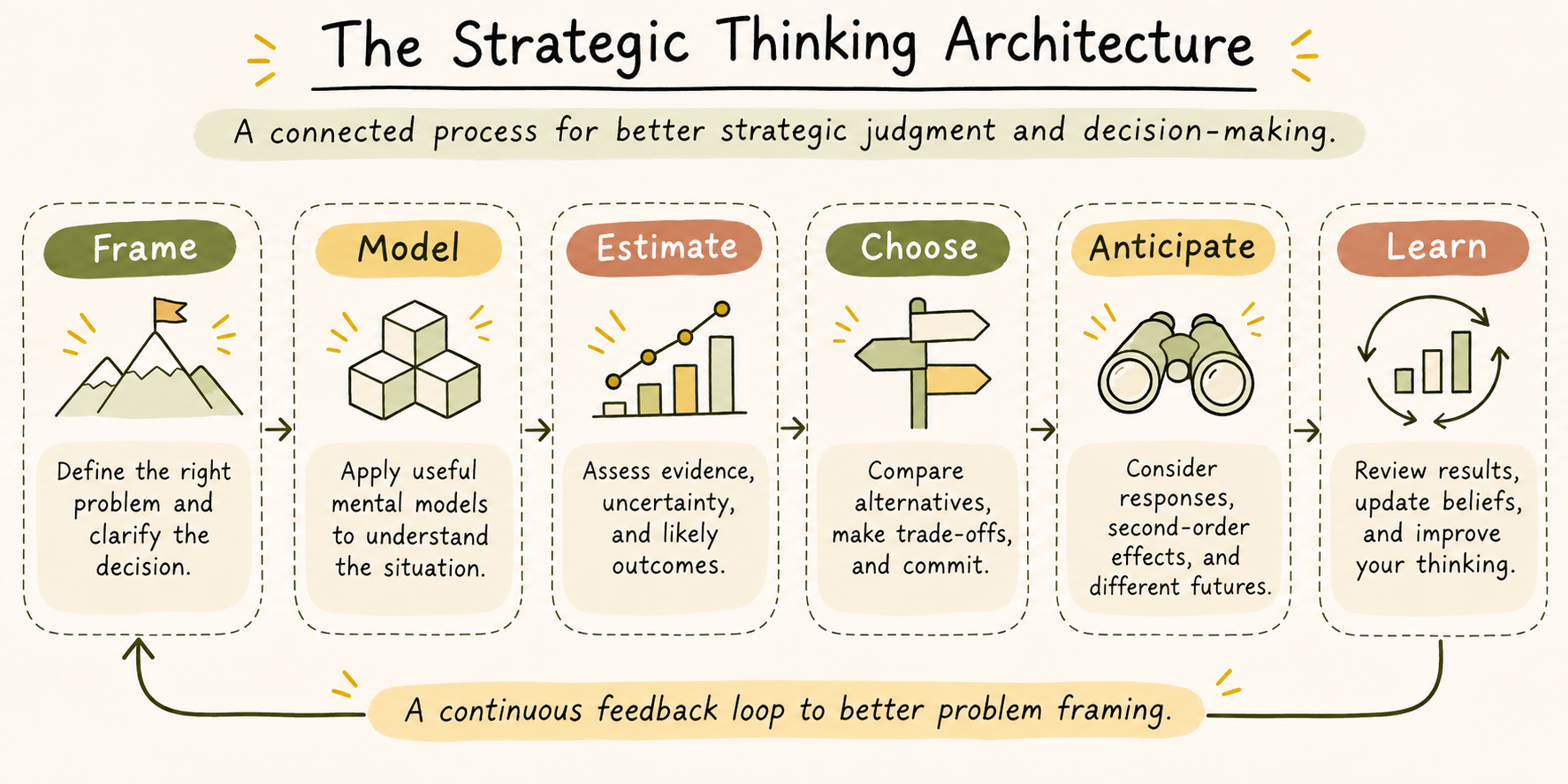
The 30 books are organized into six capabilities:
- Frame the right problem — Recognize what actually requires attention before committing to a solution.
- Build better mental models — Use complementary concepts to interpret unfamiliar situations.
- Think under uncertainty — Assess probabilities, evidence, bias, and the limits of prediction.
- Make difficult choices — Compare alternatives, evaluate trade-offs, and decide when to commit or stop.
- Understand complex systems — Recognize feedback loops, delays, dependencies, and unintended consequences.
- Develop strategic foresight — Interpret emerging changes, recognize meaningful patterns, and learn from experience.
Each book includes an explanation of its contribution, its most relevant audience, and a practical strategic takeaway.
You do not need to read all 30. A good starting point is to identify the kind of decision you currently struggle with and select a book that helps examine that difficulty.
The reading paths and exercises later in this collection provide a more structured way to do that.
01: Frame the Right Problem
Five books for developing clearer strategic questions, challenging assumptions, and avoiding premature solutions.
Organizations often dedicate considerable effort to solving problems that were never adequately defined.
The original question may have been shaped by organizational politics, an attractive technology, an urgent performance indicator, or the first explanation offered during a meeting. Once a problem acquires a label, subsequent analysis often concentrates on finding a solution within that frame.
Strategic thinking begins by examining the frame itself.
The following books help develop the ability to distinguish symptoms from underlying challenges, consider alternative interpretations, and resist committing too early to an apparently obvious answer.
01. The Crux: How Leaders Become Strategists — Richard P. Rumelt
Best for: Executives, strategy leaders, founders, and professionals responsible for navigating difficult organizational challenges.
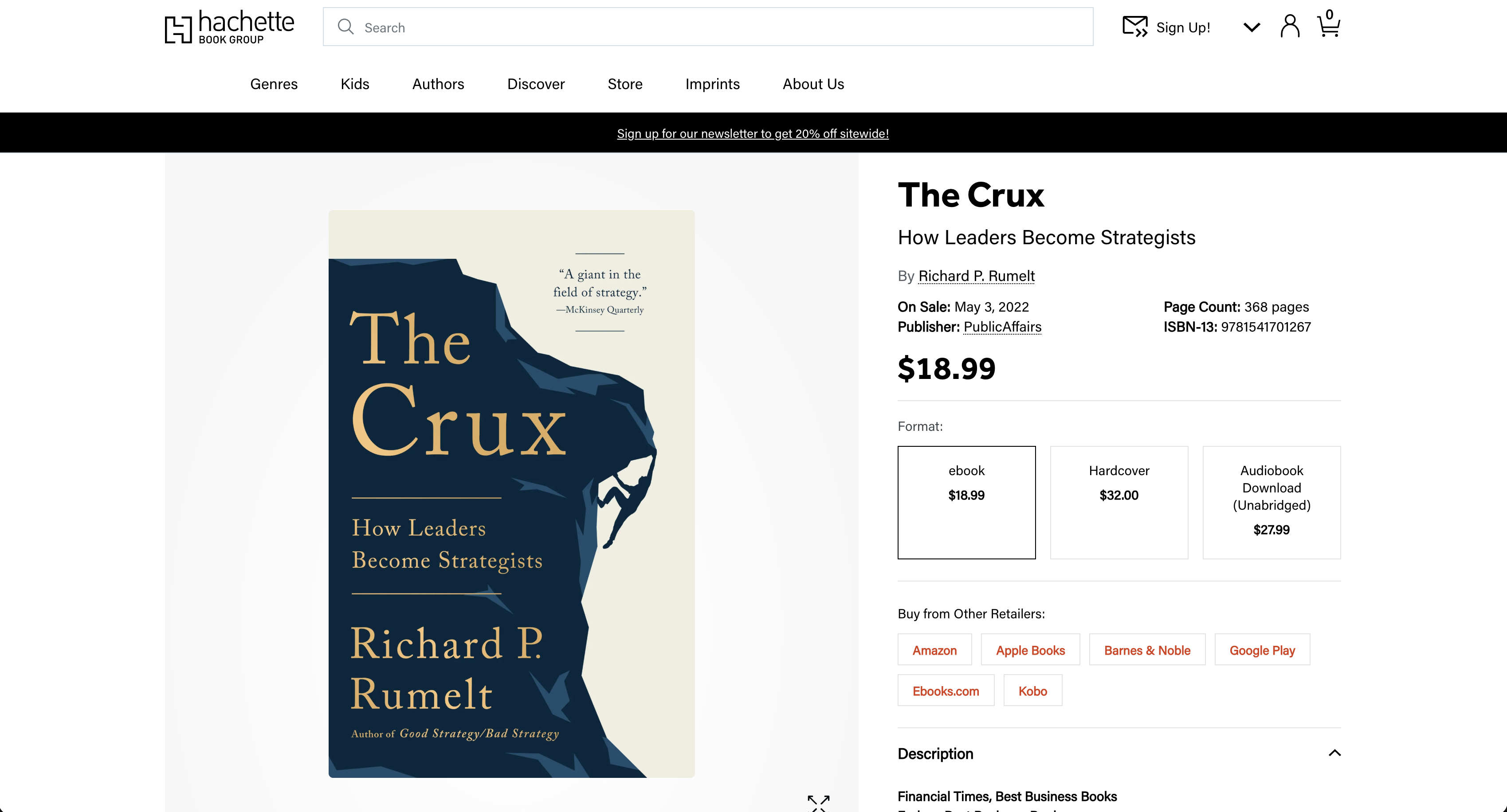
Richard Rumelt approaches strategy through the identification of consequential, addressable challenges. Organizations frequently face several problems simultaneously, but treating them as an undifferentiated agenda makes it difficult to concentrate resources or develop a coherent response.
The book encourages leaders to search for the crux: a central challenge whose resolution could produce substantial progress and that the organization has a realistic possibility of overcoming.
Its value lies in the discipline of diagnosis. Before discussing initiatives, leaders need to establish what is actually preventing progress and whether addressing that obstacle would meaningfully change the situation.
Strategic takeaway: Better strategy begins by identifying the challenge that matters most and can actually be addressed.
Apply it: List five obstacles affecting an important objective. Determine which one, if resolved, would have the greatest effect on the others.
02. What’s Your Problem? To Solve Your Toughest Problems, Change the Problems You Solve — Thomas Wedell-Wedellsborg
Best for: Managers, consultants, product leaders, and teams addressing persistent or poorly defined problems.
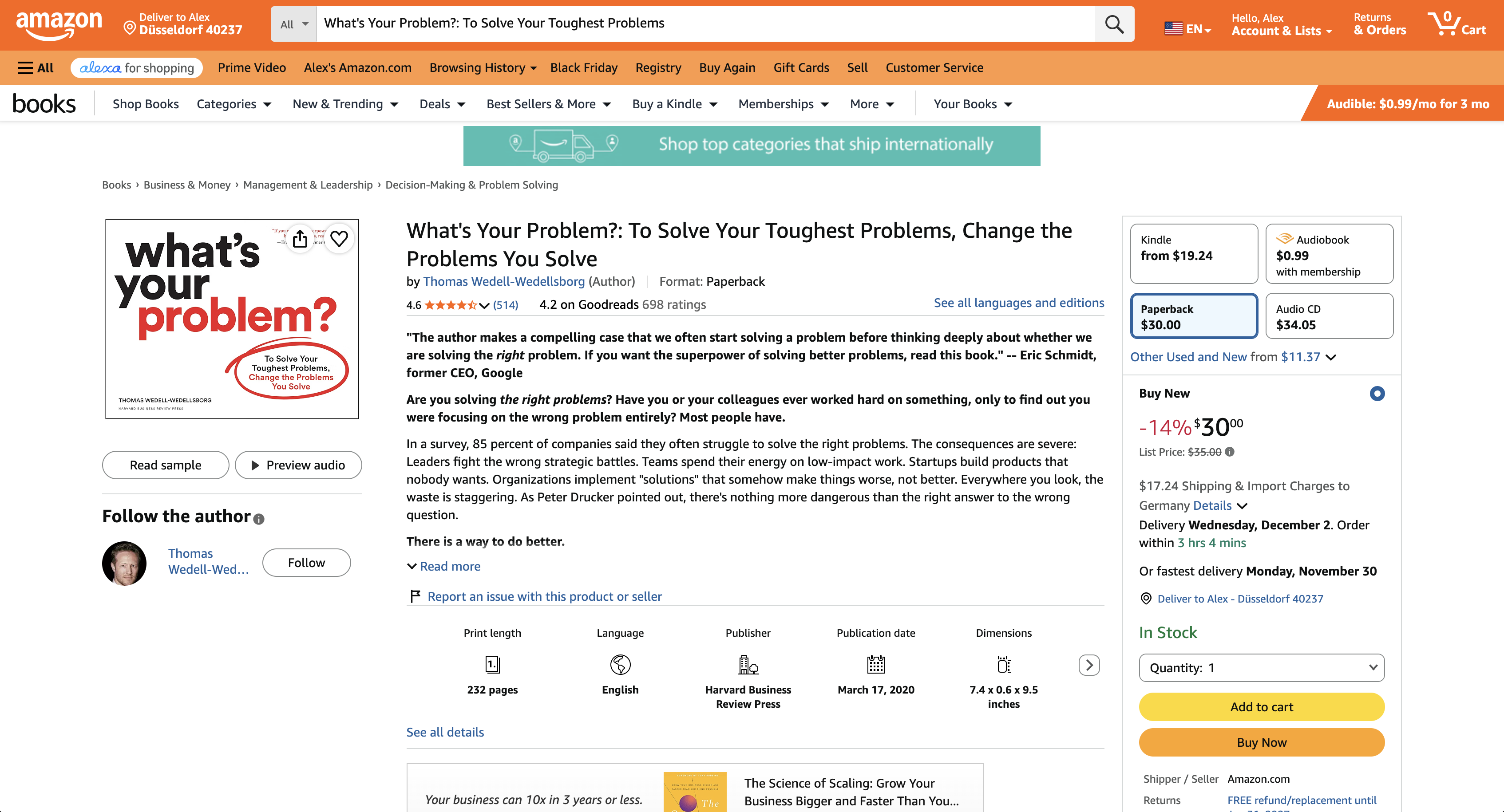
Thomas Wedell-Wedellsborg examines the practice of reframing: exploring whether a problem might be more effectively understood through a different question.
Organizations often move directly from recognizing an undesirable outcome to proposing solutions. The difficulty is that the initial explanation may reflect a narrow interpretation of what has happened.
Reframing encourages alternative perspectives, attention to overlooked stakeholders, and consideration of problems that conventional discussions leave outside their boundaries.
This is especially useful when teams repeatedly propose improvements without changing the underlying outcome.
Strategic takeaway: The quality of a solution is constrained by the quality of the problem it attempts to solve.
Apply it: Rewrite one persistent business problem from the perspectives of a customer, an employee, a competitor, and an external observer.
03. The Scout Mindset: Why Some People See Things Clearly and Others Don’t — Julia Galef
Best for: Strategists, analysts, decision-makers, and anyone responsible for evaluating competing explanations.
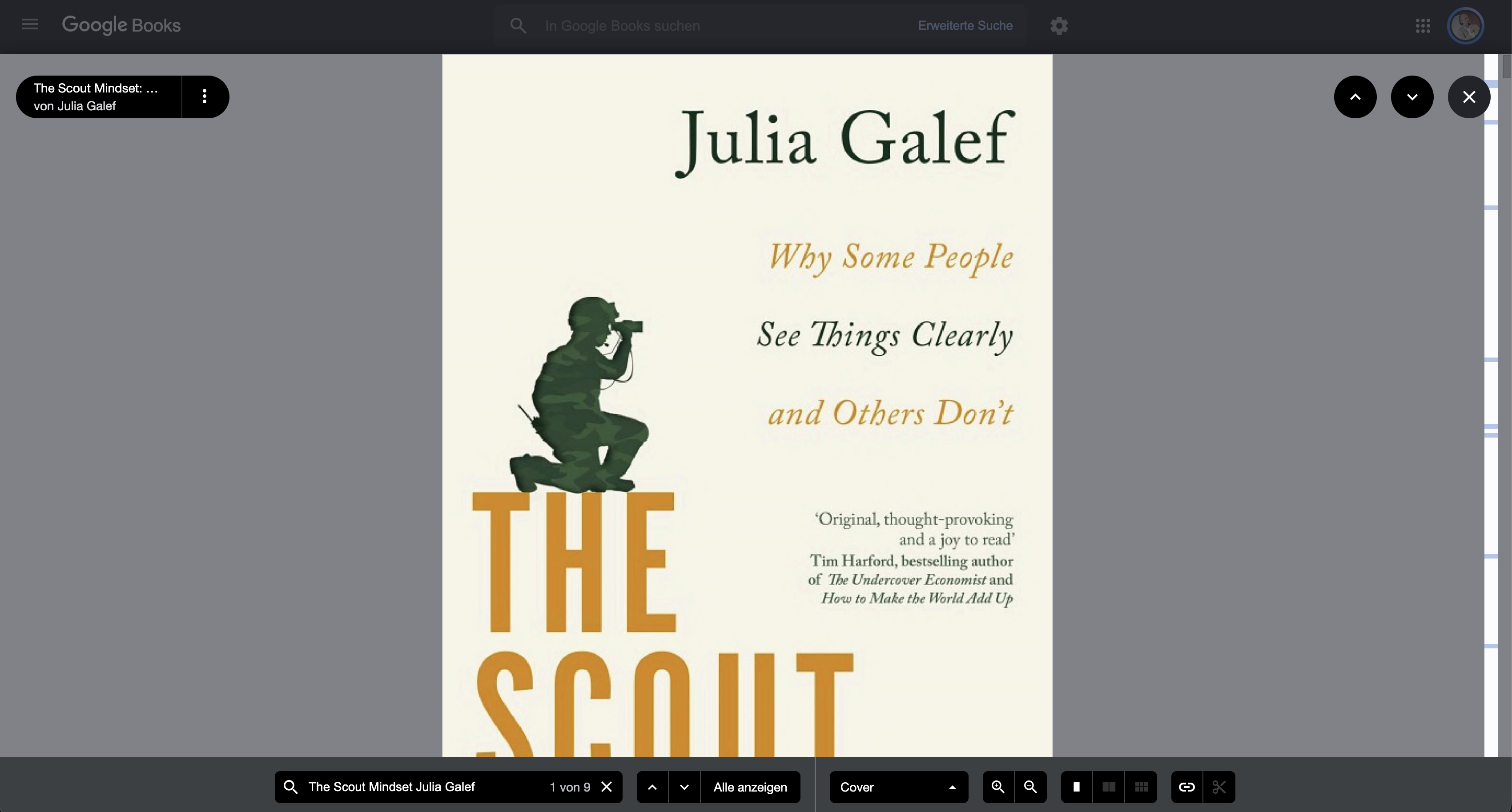
Julia Galef explores the difference between reasoning that protects an existing belief and reasoning that seeks a more accurate understanding of reality.
People are rarely neutral observers of information. Professional identities, incentives, reputations, and previous commitments can influence which evidence receives attention and how contradictory information is interpreted.
The scout mindset offers a practical orientation toward examining beliefs, revising conclusions, and treating uncertainty as information rather than weakness.
For strategists, this is especially relevant when assessing cherished assumptions about customers, competitors, market opportunities, or internal capabilities.
Strategic takeaway: The ability to revise a strategic belief is often more valuable than the ability to defend it convincingly.
Apply it: Identify one important strategic assumption and write down what evidence would genuinely change your mind.
04. A More Beautiful Question: The Power of Inquiry to Spark Breakthrough Ideas — Warren Berger
Best for: Innovation leaders, founders, educators, consultants, and teams seeking new approaches to familiar challenges.
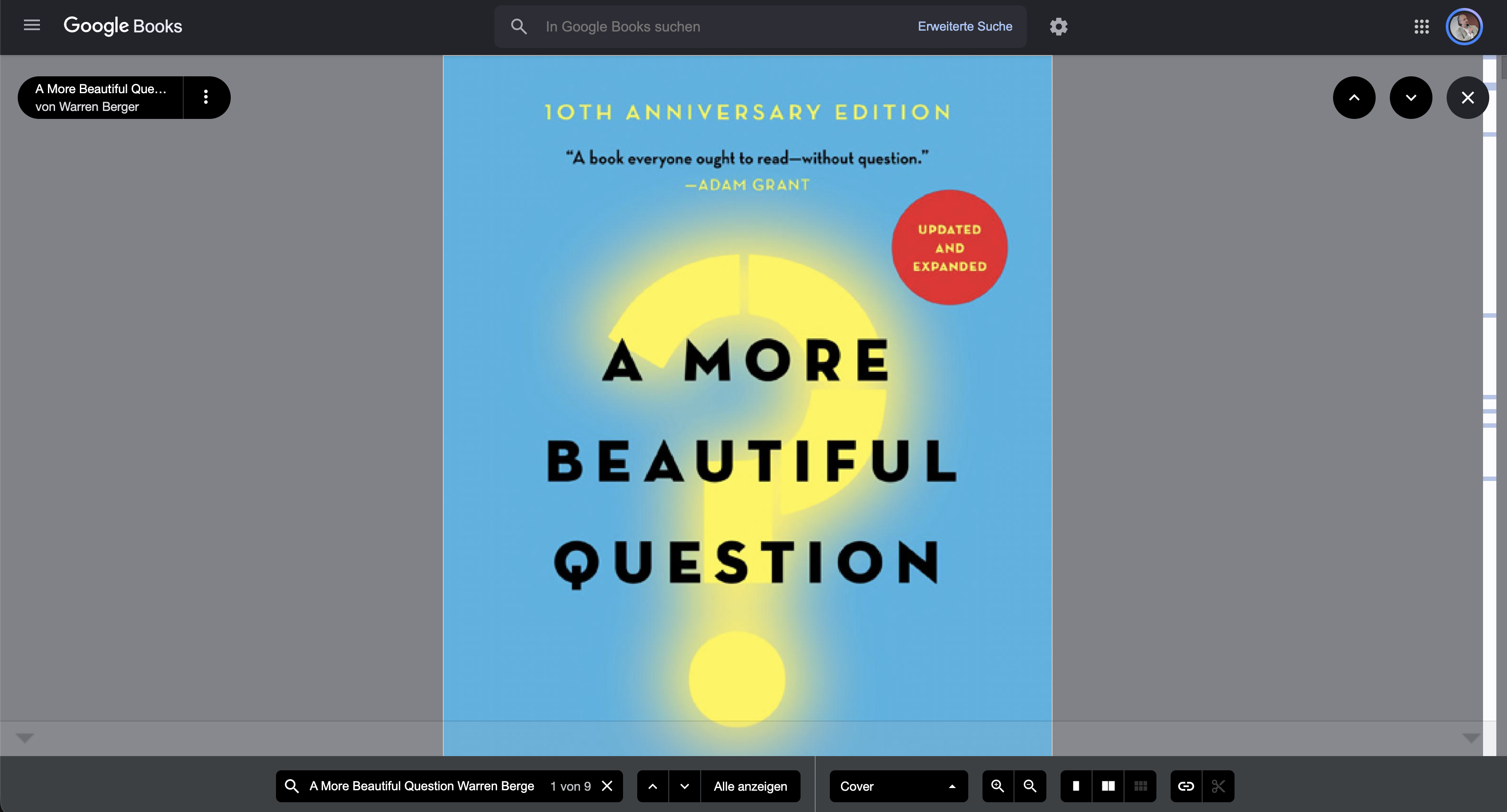
Warren Berger examines how questioning contributes to discovery, creativity, and innovation.
Organizations frequently reward the appearance of certainty. Leaders are expected to have answers, meetings concentrate on resolutions, and performance systems encourage rapid progress.
However, important opportunities often emerge when someone challenges a question that has become routine.
Berger explores the role of inquiry in changing perspectives and opening new directions for investigation. The practical implication is that questions should be treated as working tools rather than preliminary steps to be completed as quickly as possible.
Strategic takeaway: Better questions expand the range of strategic possibilities before the organization narrows its choices.
Apply it: Take an established initiative and develop three questions that challenge its purpose, assumptions, and proposed method.
05. The Opposable Mind: How Successful Leaders Win Through Integrative Thinking — Roger L. Martin
Best for: Senior executives, strategists, product leaders, and people facing difficult choices between competing priorities.
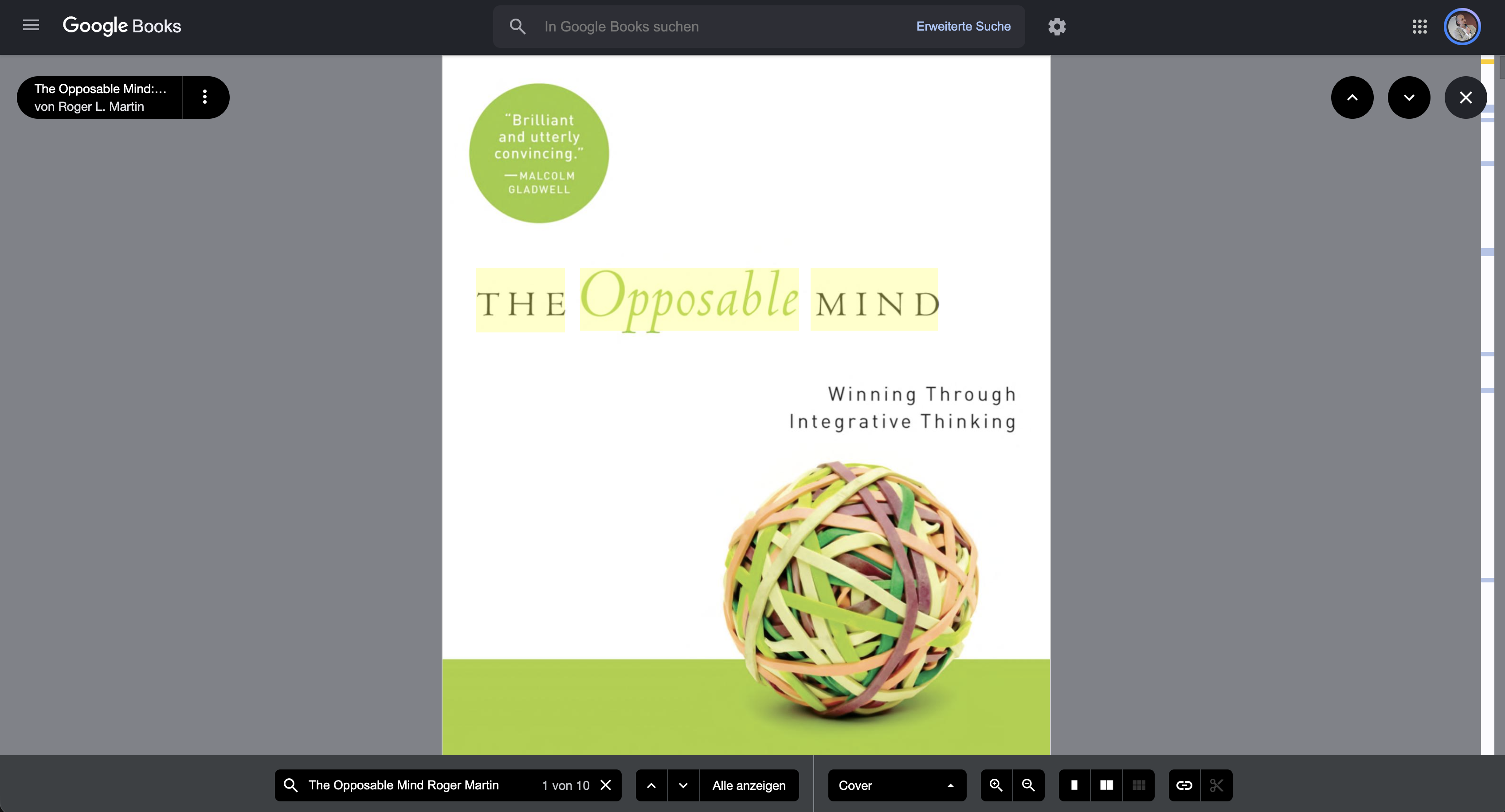
Roger Martin investigates integrative thinking: the ability to consider opposing ideas without immediately reducing the situation to a conventional compromise.
Many difficult business decisions are presented as fixed alternatives. Organizations must supposedly choose between efficiency and flexibility, growth and profitability, centralization and autonomy, or short-term results and long-term investment.
Integrative thinking encourages leaders to examine the assumptions that make these tensions appear unavoidable.
The objective is to search for a different configuration of the problem that may produce a more effective solution than either original alternative.
Strategic takeaway: Strategic alternatives are not always fixed. Better thinking can change the structure of the choice itself.
Apply it: Identify a recurring either-or decision and examine which assumptions make the alternatives seem mutually exclusive.
Read next
Developing strategic judgment requires more than understanding individual mental models or recognizing common cognitive biases. Better decisions depend on how we frame problems, evaluate evidence, reason under uncertainty, compare alternatives, and anticipate the consequences of our choices.
The five books above establish a foundation for questioning assumptions and approaching strategic problems with greater clarity. Their ideas become more valuable when combined with practical decision-making methods, systems thinking, and opportunities to apply those concepts to real organizational challenges.
These TSS resources are free to explore:
- Thinking Like a Strategist — Our ongoing editorial series examining how strategic judgment develops through better problem framing, mental models, competitive reasoning, and an understanding of organizational behavior.
- The Business Model Series — A structured examination of how organizations create, deliver, and capture value, helping readers apply strategic reasoning to the economic logic of businesses.
- Strategy Teardowns — Applied analyses of real companies, exploring the choices, trade-offs, competitive mechanisms, and underlying assumptions behind their strategies.
- The Strategy Stack Knowledge Hub — Explore the concepts and terminology underlying strategic thinking, decision-making, competitive advantage, systems thinking, and organizational design.
Put better thinking into practice
- Operator Vault — Practical frameworks, decision templates, strategic analysis tools, and reusable materials for evaluating alternatives, challenging assumptions, and translating strategic judgment into action.
- Stack Atlas — Explore how mental models, strategic decisions, competitive advantage, organizational capabilities, business models, and complex systems connect.
Curated resource collections and editorial essays remain free. Paid membership provides access to deeper practical materials for applying strategic concepts, structuring consequential decisions, and improving organizational execution.
The complete Strategic Thinking Books Library contains 30 titles organized around six essential capabilities, from problem framing and mental models to probabilistic reasoning, decision-making, systems thinking, and strategic foresight.
Subscribe free to The Strategy Stack to unlock the remaining 25 books, five curated reading pathways, and the original Strategic Thinking Decision Map, which connects common business challenges with the thinking methods best suited to addressing them.
You’ll also discover five questions for evaluating the quality of strategic reasoning, practical exercises for applying different mental models, and a Seven-Day Strategic Thinking Sprint designed to turn one consequential business decision into a structured process of investigation, evaluation, and learning.
02: Build Better Mental Models
Five books for interpreting situations through multiple disciplines and understanding how different mechanisms shape outcomes.
A mental model is a simplified representation of how something works.
Models help us make sense of complexity by focusing attention on particular relationships, constraints, or causal mechanisms. Economic models highlight incentives and trade-offs. Systems models reveal feedback and dependencies. Psychological models help explain how perception and behavior influence decisions.
No single model captures everything important.
Problems arise when a familiar conceptual tool becomes the only way we interpret a situation. A company may examine every strategic opportunity through financial returns while overlooking the distribution constraints that determine whether customers can be reached. Another may focus on innovation without understanding the incentives preventing adoption.
The following books help build a broader and more adaptable conceptual toolkit.
06. The Great Mental Models, Volume 1: General Thinking Concepts — Shane Parrish & Rhiannon Beaubien
Best for: Strategists, founders, managers, and professionals seeking a structured introduction to multidisciplinary thinking.
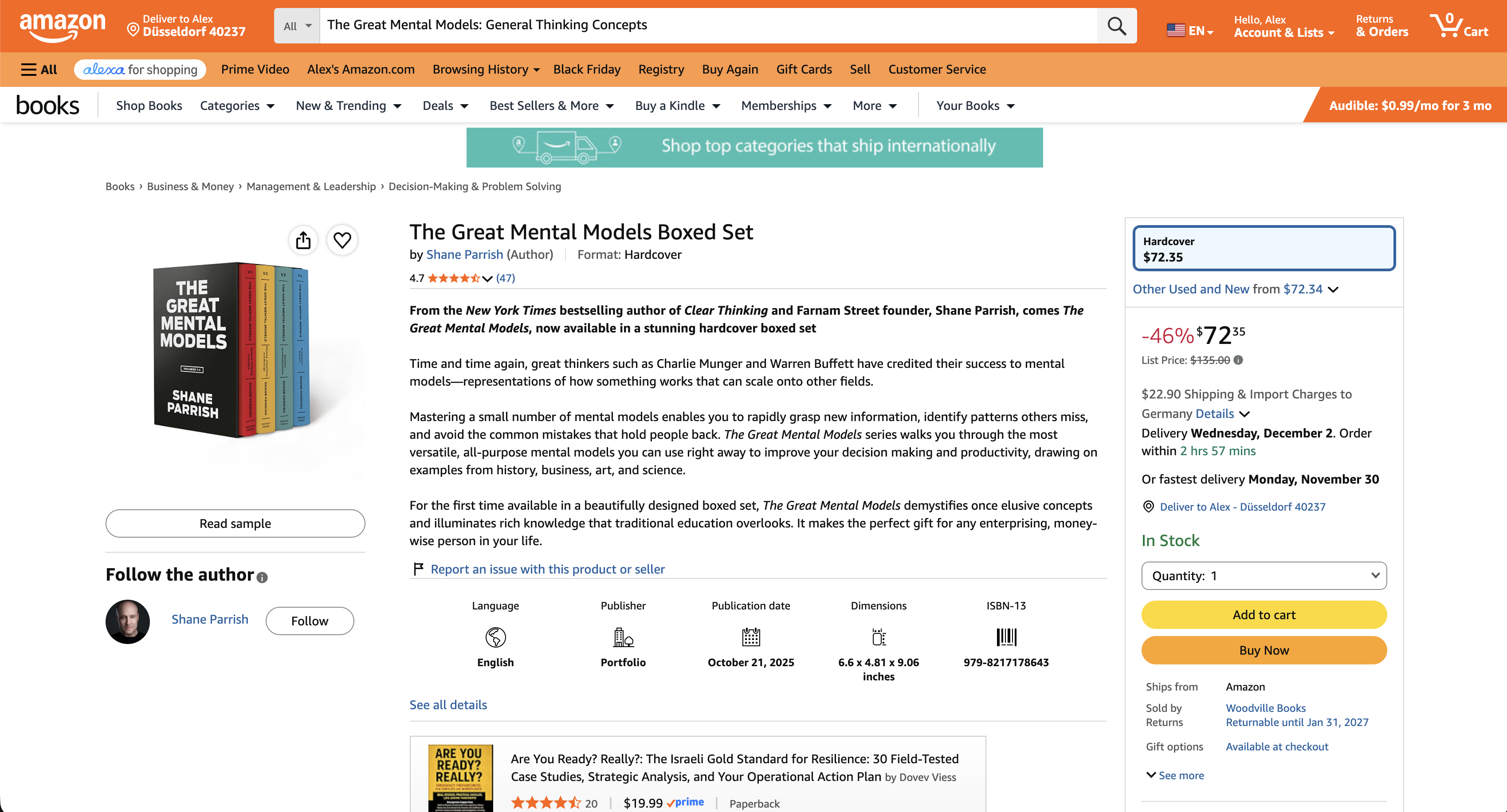
This first volume introduces foundational concepts that can improve reasoning across different situations.
Its central value is the idea that complex problems become easier to examine when we deliberately use more than one conceptual perspective.
Principles such as first-principles thinking, inversion, and probabilistic reasoning help reveal assumptions that ordinary discussion may overlook.
The practical challenge is not collecting models for their own sake. It is recognizing when a particular model is useful, what it explains, and where its limitations begin.
Strategic takeaway: A broader repertoire of mental models improves the ability to recognize different mechanisms within the same strategic problem.
Apply it: Reconsider an important decision using first principles, inversion, and second-order consequences. Record what each perspective changes.
07. Super Thinking: The Big Book of Mental Models — Gabriel Weinberg & Lauren McCann
Best for: General managers, analysts, entrepreneurs, and professionals seeking practical reasoning tools.
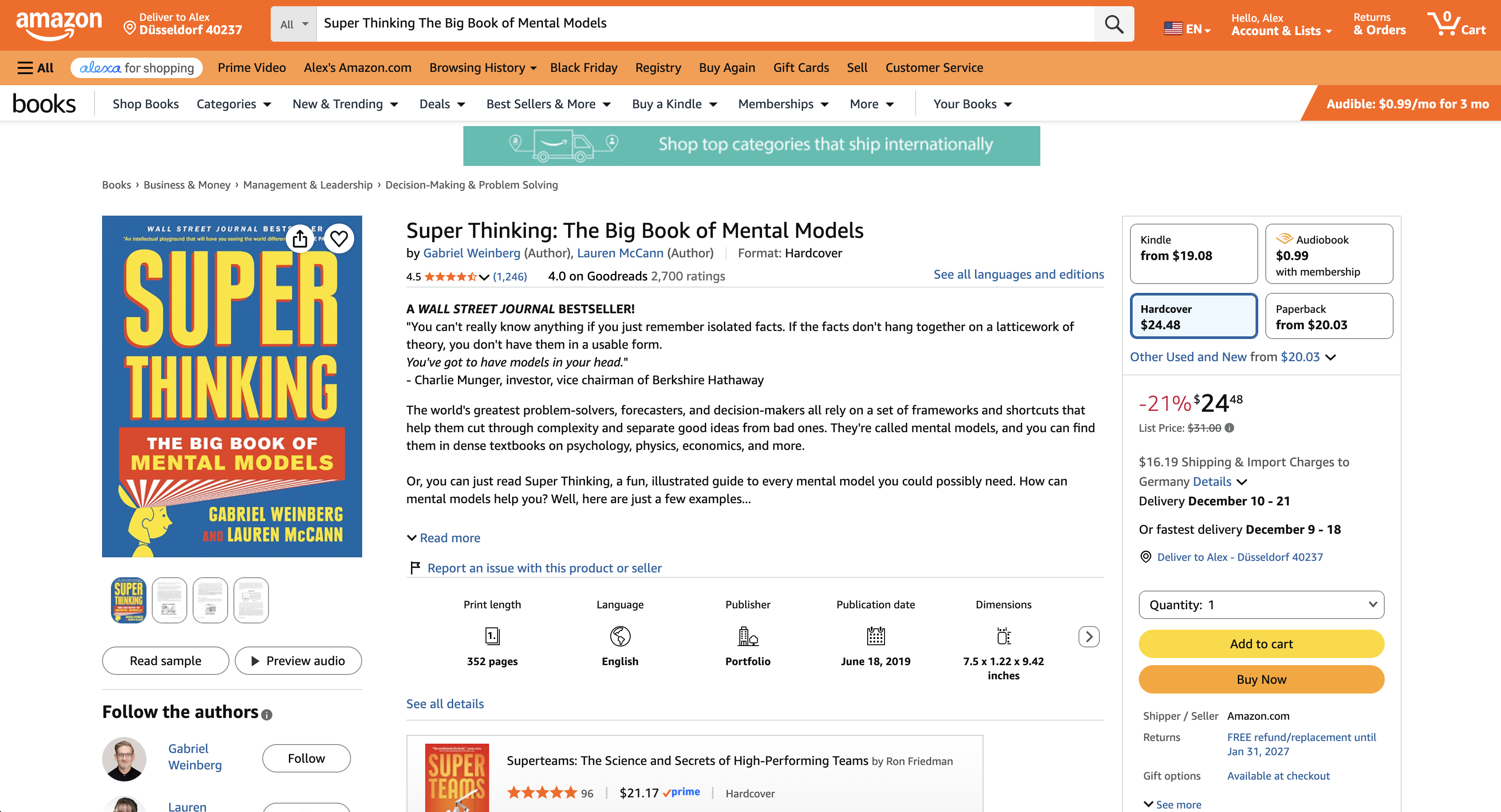
Super Thinking presents mental models drawn from economics, psychology, business, mathematics, and other disciplines.
The book is especially useful as a reference for recurring reasoning problems: identifying incentives, avoiding unintended consequences, understanding trade-offs, and recognizing patterns that appear in different contexts.
Its breadth makes it suitable for professionals who want to strengthen everyday judgment without committing immediately to an extensive academic treatment of each field.
The important discipline is to avoid treating model names as substitutes for analysis.
Strategic takeaway: Mental models become valuable when they improve the explanation of a real situation or reveal a consequential oversight.
Apply it: Select a recent business decision and identify three models that could have improved the original evaluation.
08. Poor Charlie’s Almanack: The Essential Wit and Wisdom of Charles T. Munger — Charles T. Munger, edited by Peter D. Kaufman
Best for: Investors, executives, entrepreneurs, and readers interested in multidisciplinary judgment.

This collection brings together Charlie Munger’s ideas about reasoning, incentives, psychology, and investment judgment.
A recurring theme is the value of drawing on multiple disciplines rather than relying on one professional specialty.
Munger emphasizes the practical consequences of cognitive errors, poorly designed incentives, and predictable patterns of human behavior.
For business leaders, the book offers a perspective on how intellectual independence and a broad knowledge base can strengthen decisions.
It is best approached as a collection of reasoning principles and illustrative perspectives rather than a formal scientific framework.
Strategic takeaway: Complex strategic situations often require several complementary explanations rather than one dominant analytical method.
Apply it: Examine one organizational decision through economics, human incentives, behavioral psychology, and competitive dynamics.
09. Seeking Wisdom: From Darwin to Munger — Peter Bevelin
Best for: Experienced decision-makers, investors, strategists, and analytically inclined readers.
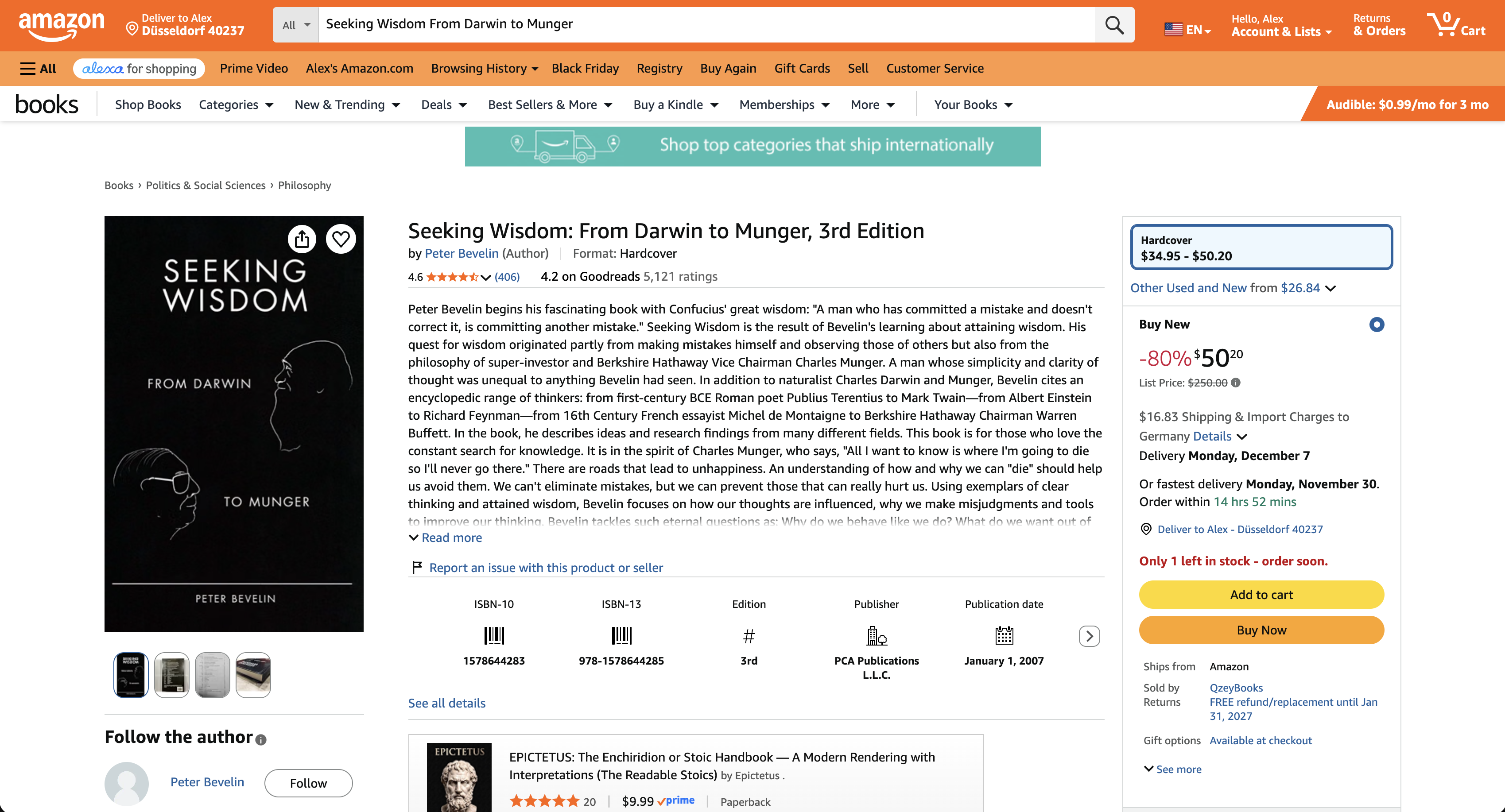
Peter Bevelin brings together ideas from psychology, evolutionary thinking, probability, and multidisciplinary reasoning to explore why people make errors in judgment.
The book emphasizes the importance of understanding the limitations of human perception and the ways in which habits, emotions, incentives, and simplified assumptions influence decisions.
Its strongest contribution is the connection between understanding human behavior and developing better intellectual habits.
Readers should distinguish the book’s practical observations from the empirical strength of the individual claims it discusses.
Strategic takeaway: Better judgment requires understanding the recurring conditions under which our reasoning becomes unreliable.
Apply it: Create a personal checklist of five decision errors you are most likely to make under time pressure.
10. The Art of Thinking Clearly — Rolf Dobelli
Best for: Managers, professionals, and readers seeking an accessible introduction to common reasoning errors.
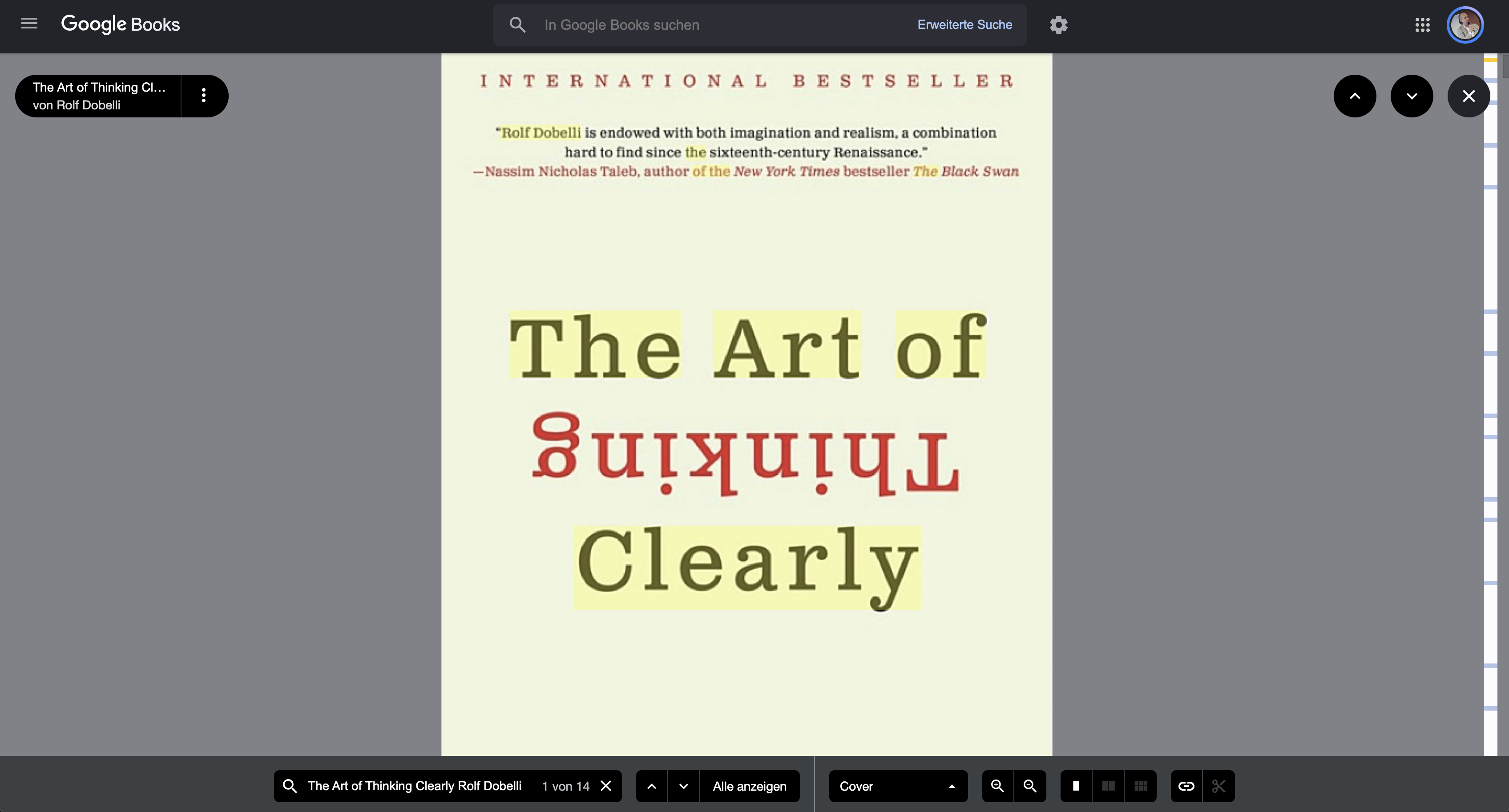
Rolf Dobelli presents short examinations of cognitive biases, logical mistakes, and recurring failures of judgment.
The format makes it easy to recognize familiar patterns such as confirmation bias, sunk-cost reasoning, and overconfidence.
Its usefulness lies primarily in developing awareness. A reader may begin recognizing how a team overvalues recent information or continues an initiative because of resources already committed.
However, recognizing the name of a bias does not automatically provide an effective correction, and individual examples should not be mistaken for universally established behavioral laws.
Strategic takeaway: Awareness of cognitive errors is a starting point for better decisions, but organizational safeguards and evidence remain necessary.
Apply it: Review a recently completed decision and identify whether one common bias may have influenced the discussion.
03: Think Under Uncertainty
Five books for working with incomplete information, probabilities, forecasts, and the limits of confidence.
Strategic decisions are rarely made with complete information.
Market conditions change. Competitors behave unexpectedly. Customer preferences are imperfectly observed. Technological capabilities improve at uncertain rates. Even carefully researched assumptions may prove incorrect.
The objective cannot be to eliminate uncertainty before acting.
Instead, organizations need to reason more carefully about what they know, what they expect, how confident they should be, and which developments would justify revising their position.
These books offer different but complementary perspectives on uncertainty.
11. Thinking in Bets: Making Smarter Decisions When You Don’t Have All the Facts — Annie Duke
Best for: Executives, founders, investors, and professionals evaluating uncertain outcomes.
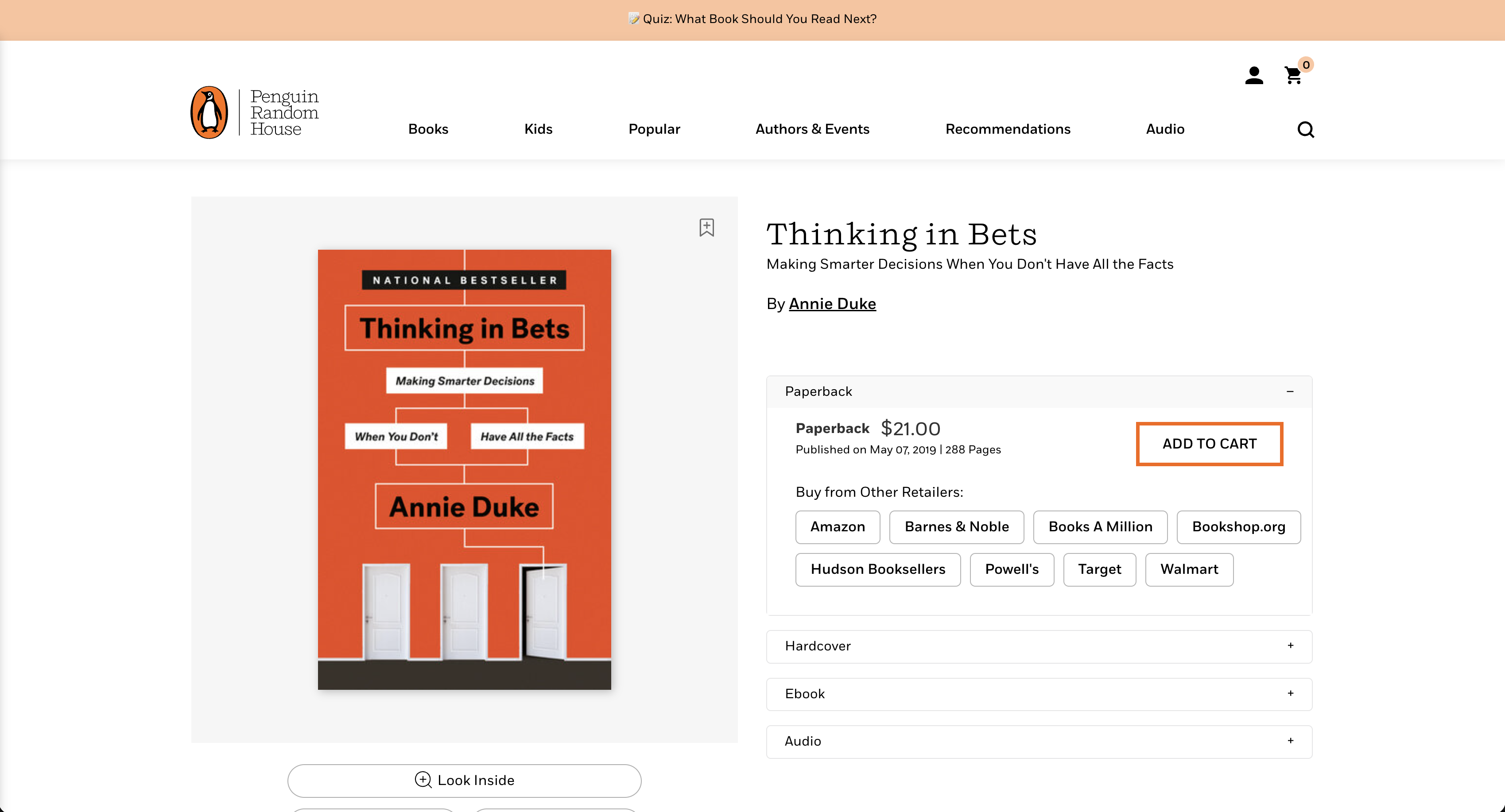
Drawing on her experience in professional poker, Annie Duke explores the relationship between decisions, probabilities, and outcomes.
One of the book’s most useful distinctions is that a favorable result does not necessarily demonstrate that the underlying decision was sound.
An organization can make a well-reasoned choice and encounter an unfavorable outcome. It can also make a poorly justified choice and benefit from circumstances beyond its control.
That distinction matters when evaluating strategy, because organizations often reward successful outcomes without examining the quality of the original reasoning.
Strategic takeaway: Evaluate strategic decisions by the evidence and reasoning available when they were made, not solely by their eventual outcomes.
Apply it: Review one recent success and one failure. Separate decision quality from factors that could not reasonably have been controlled.
12. Superforecasting: The Art and Science of Prediction — Philip E. Tetlock & Dan Gardner
Best for: Strategists, analysts, investors, market intelligence teams, and leaders responsible for forecasts.
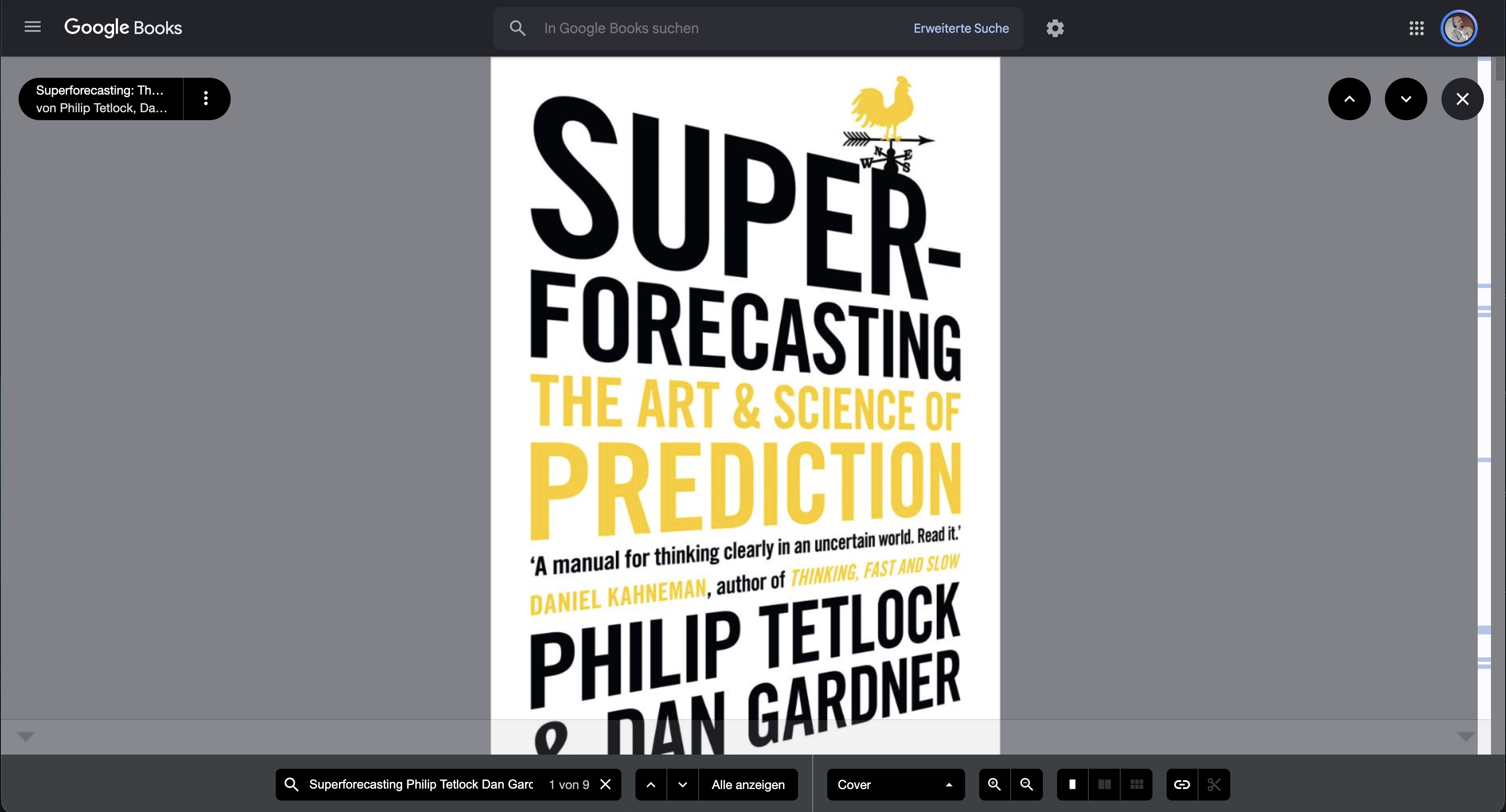
Superforecasting examines why some individuals consistently produce more accurate predictions on appropriately defined forecasting questions.
The book explores practices such as breaking complex questions into smaller components, using numerical probabilities, updating beliefs with new evidence, and maintaining intellectual flexibility.
Its practical contribution is methodological discipline.
Rather than treating forecasts as authoritative statements, organizations can establish questions with measurable outcomes, assign probabilities, document assumptions, and evaluate accuracy over time.
These techniques are particularly useful when events can be clearly defined and assessed.
Strategic takeaway: Forecasting improves when assumptions, probabilities, and updates are made explicit and tested against outcomes.
Apply it: Write three measurable predictions for the next quarter and assign each a probability. Review them when the outcome becomes known.
13. Thinking, Fast and Slow — Daniel Kahneman
Best for: Executives, managers, analysts, and professionals seeking foundational knowledge of judgment and decision-making.
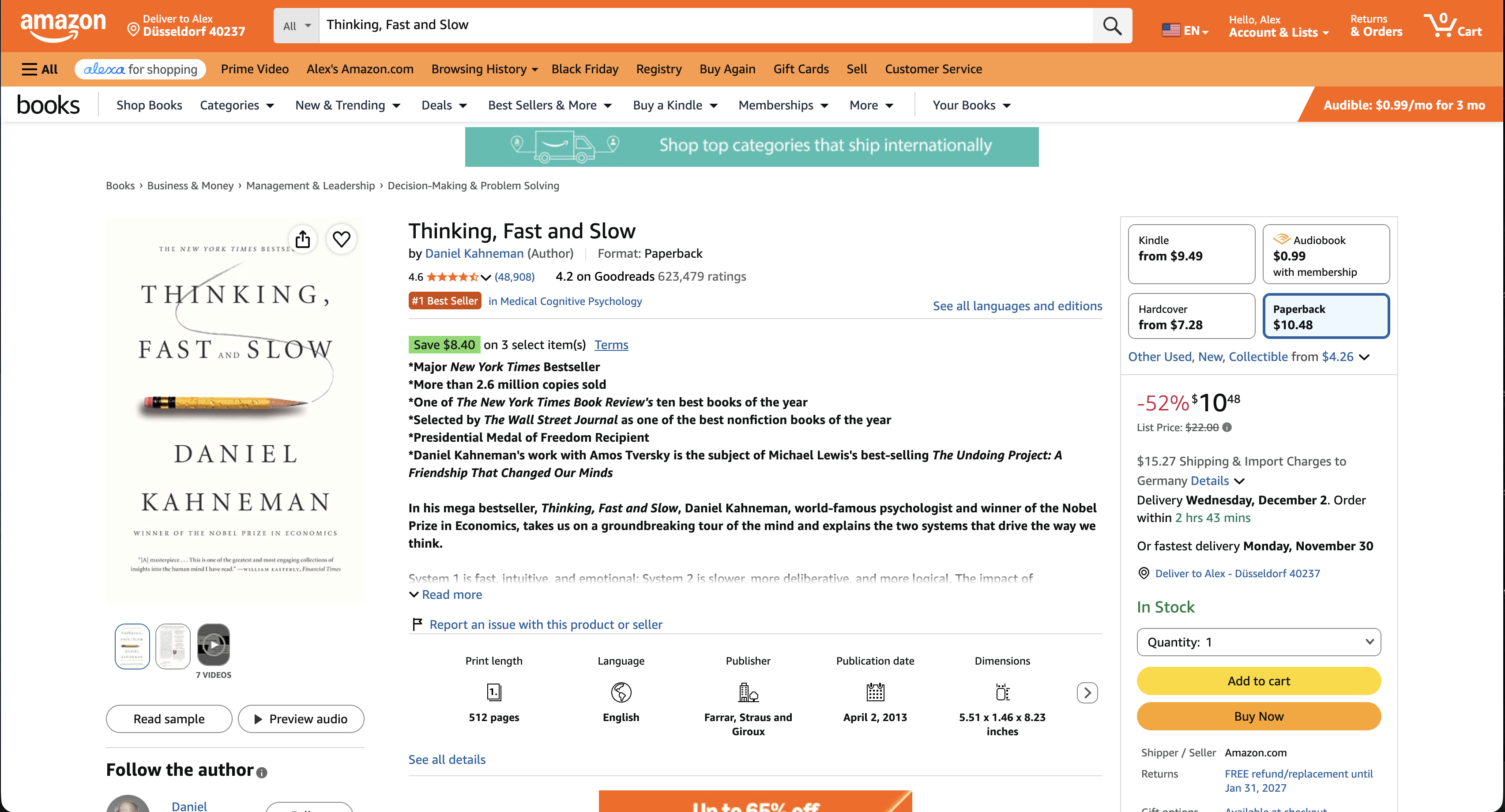
Daniel Kahneman examines the relationship between intuitive and deliberate reasoning, drawing on decades of work in behavioral decision research.
The book explores how mental shortcuts, framing effects, loss aversion, and overconfidence can influence judgment.
Its significance for strategy lies in recognizing that decision-makers do not always evaluate information in the consistent, independent way that formal planning models assume.
Some specific findings in behavioral science have faced replication or interpretation challenges, so the book should be read as an influential foundation rather than a claim that every described effect is universal.
Strategic takeaway: Good strategic processes should account for predictable limitations in human judgment instead of assuming that expertise eliminates them.
Apply it: Before an investment decision, separate the initial intuitive judgment from a structured review of evidence, base rates, and alternative explanations.
14. Noise: A Flaw in Human Judgment — Daniel Kahneman, Olivier Sibony & Cass R. Sunstein
Best for: Executives, investment committees, managers, and organizations making repeated consequential assessments.
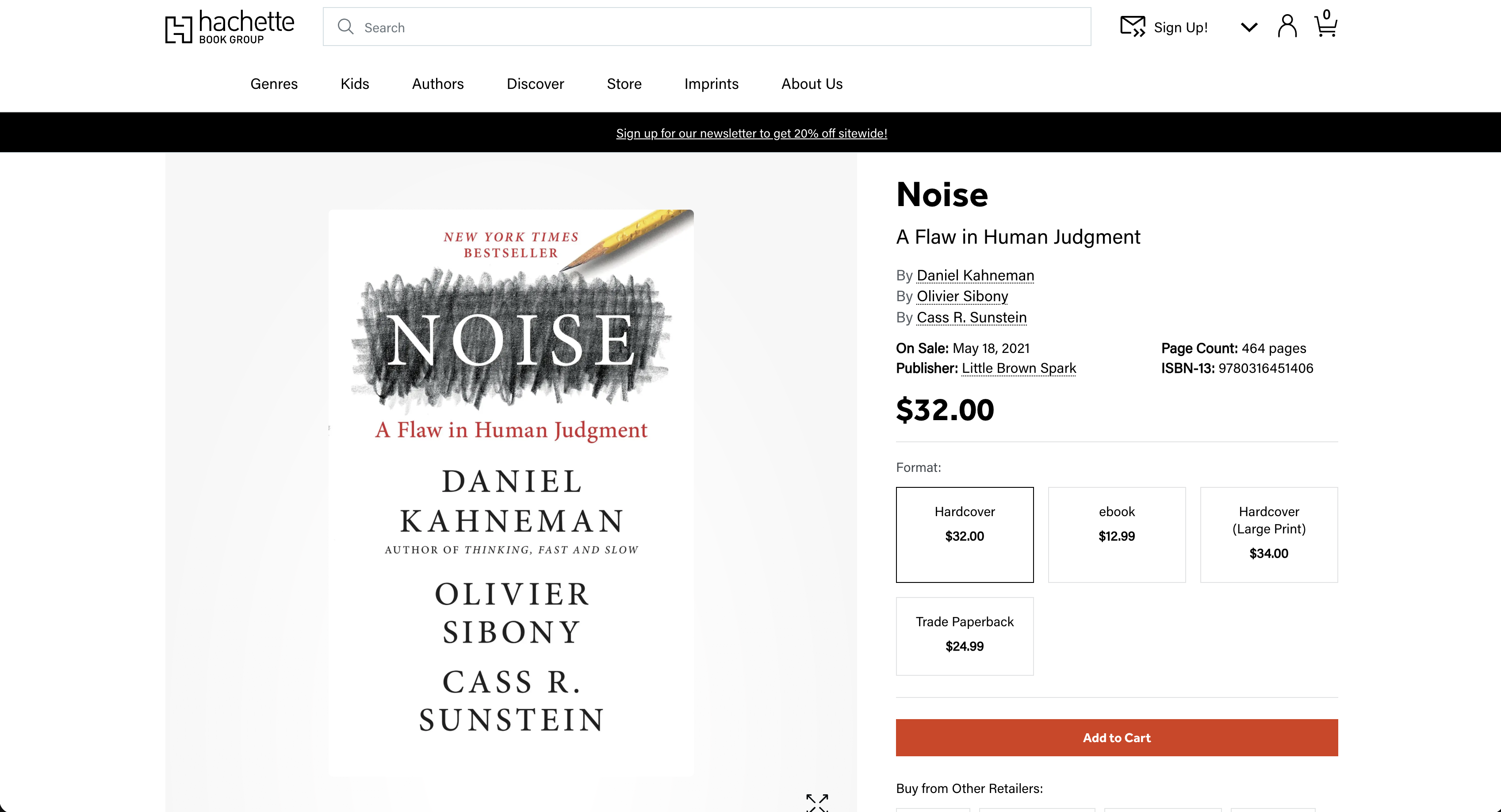
Noise examines unwanted variability in judgments that should ideally be consistent.
Two people evaluating the same evidence may reach different conclusions. The same individual may assess similar cases differently depending on timing, context, or unrelated circumstances.
For organizations, this can create significant problems in hiring, forecasting, risk assessment, project evaluation, and resource allocation.
The book explores methods for making judgment more structured and less dependent on arbitrary variation.
These methods must still leave room for legitimate differences in context and values.
Strategic takeaway: Decision quality depends partly on whether an organization can make comparable judgments consistently and explain meaningful differences.
Apply it: Ask several colleagues to independently assess the same proposal using identical criteria. Compare their conclusions and investigate unexplained variation.
15. The Black Swan: The Impact of the Highly Improbable — Nassim Nicholas Taleb
Best for: Strategists, investors, risk leaders, and executives operating in uncertain or rapidly changing environments.
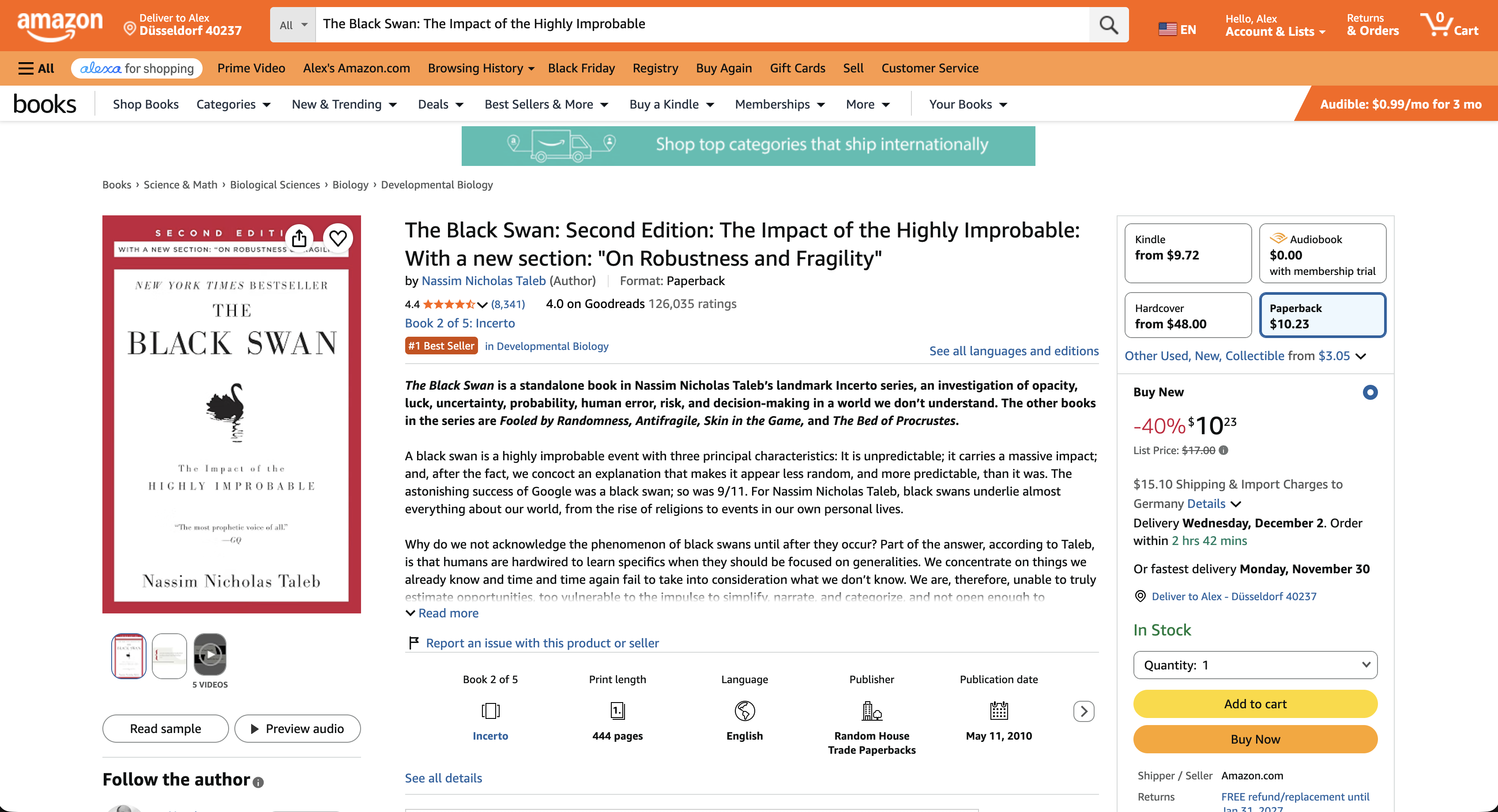
Nassim Nicholas Taleb challenges assumptions about prediction, probability distributions, and the visibility of rare but consequential events.
The book argues that conventional explanations frequently underestimate the importance of uncertainty and construct convincing narratives after unexpected events have already occurred.
Its value for strategic thinking is the reminder that confidence in a forecast may reflect limitations in the model rather than genuine predictability.
In some environments, the more important question is how exposed an organization is to outcomes that its planning assumptions do not adequately represent.
Strategic takeaway: Robust strategy requires examining the consequences of being wrong, particularly when downside outcomes are difficult to predict.
Apply it: Identify one major assumption embedded in your plan and evaluate what would happen if reality differed far more than expected.
04: Make Difficult Choices
Five books for comparing alternatives, understanding trade-offs, avoiding decision paralysis, and knowing when to stop.
A strategic choice involves committing resources to one possibility while declining others.
Organizations often struggle because the decision criteria are unclear, competing priorities remain unresolved, or previous commitments influence the evaluation more than future prospects.
Other decisions are delayed because uncertainty is mistaken for evidence that more analysis will necessarily help.
These books approach decisions as a discipline that can be structured, improved, and reviewed.
16. Decisive: How to Make Better Choices in Life and Work — Chip Heath & Dan Heath
Best for: Managers, leadership teams, founders, and professionals making difficult organizational choices.
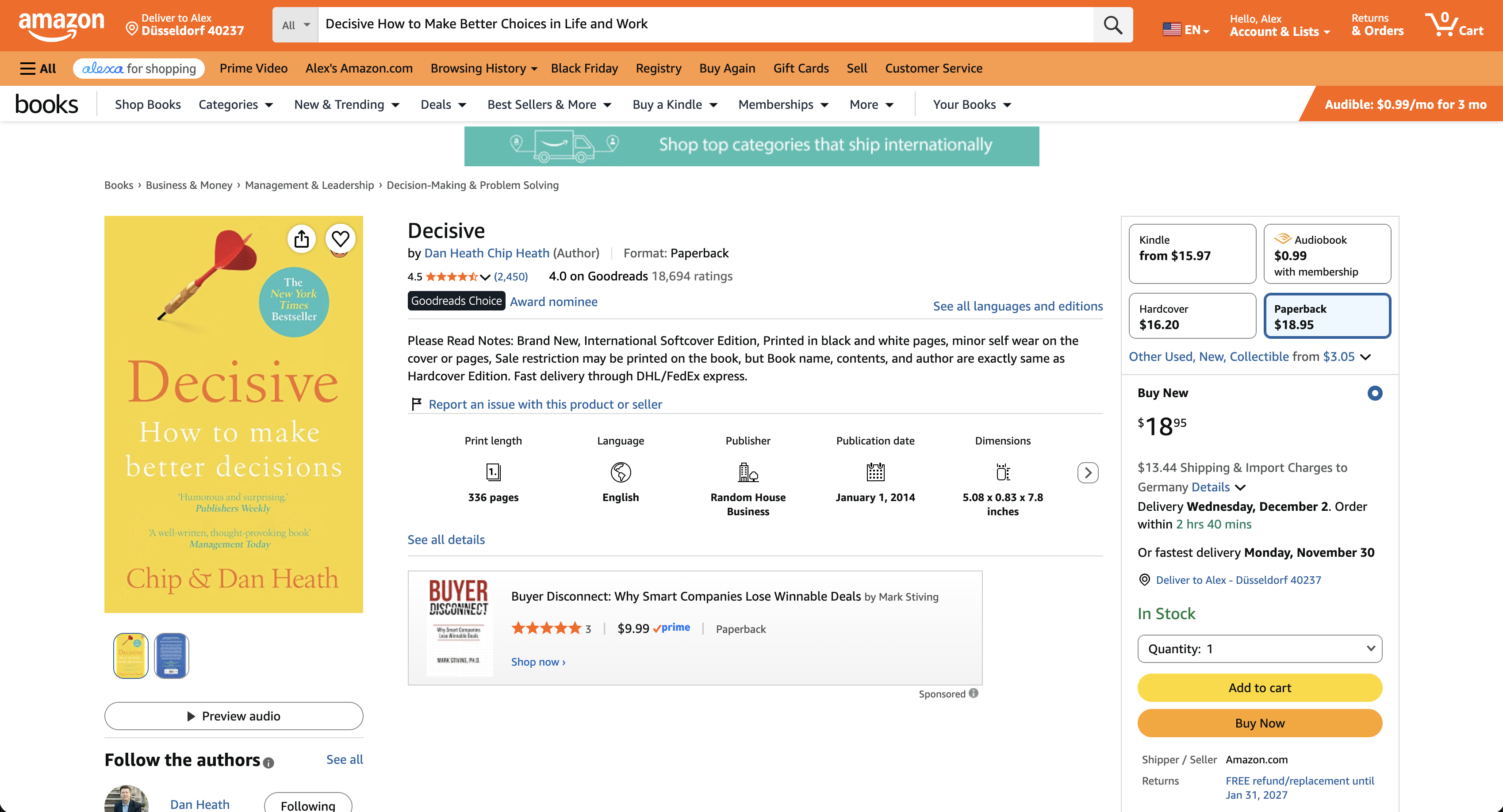
Chip and Dan Heath examine recurring problems in decision-making, including narrow framing, confirmation bias, short-term emotions, and excessive confidence in future outcomes.
Their WRAP framework encourages decision-makers to widen their options, test assumptions against reality, create distance from immediate reactions, and prepare for the possibility of being wrong.
The book is particularly useful for teams that move quickly from a problem to one preferred solution.
Its emphasis on generating alternatives and examining evidence supports a more deliberate decision process.
Strategic takeaway: The quality of a decision often improves when the organization deliberately expands the alternatives and challenges its preferred option.
Apply it: Take a pending decision and generate at least three genuinely different responses before evaluating them.
17. Smart Choices: A Practical Guide to Making Better Decisions — John S. Hammond, Ralph L. Keeney & Howard Raiffa
Best for: Strategy teams, managers, analysts, investment committees, and professionals facing consequential trade-offs.
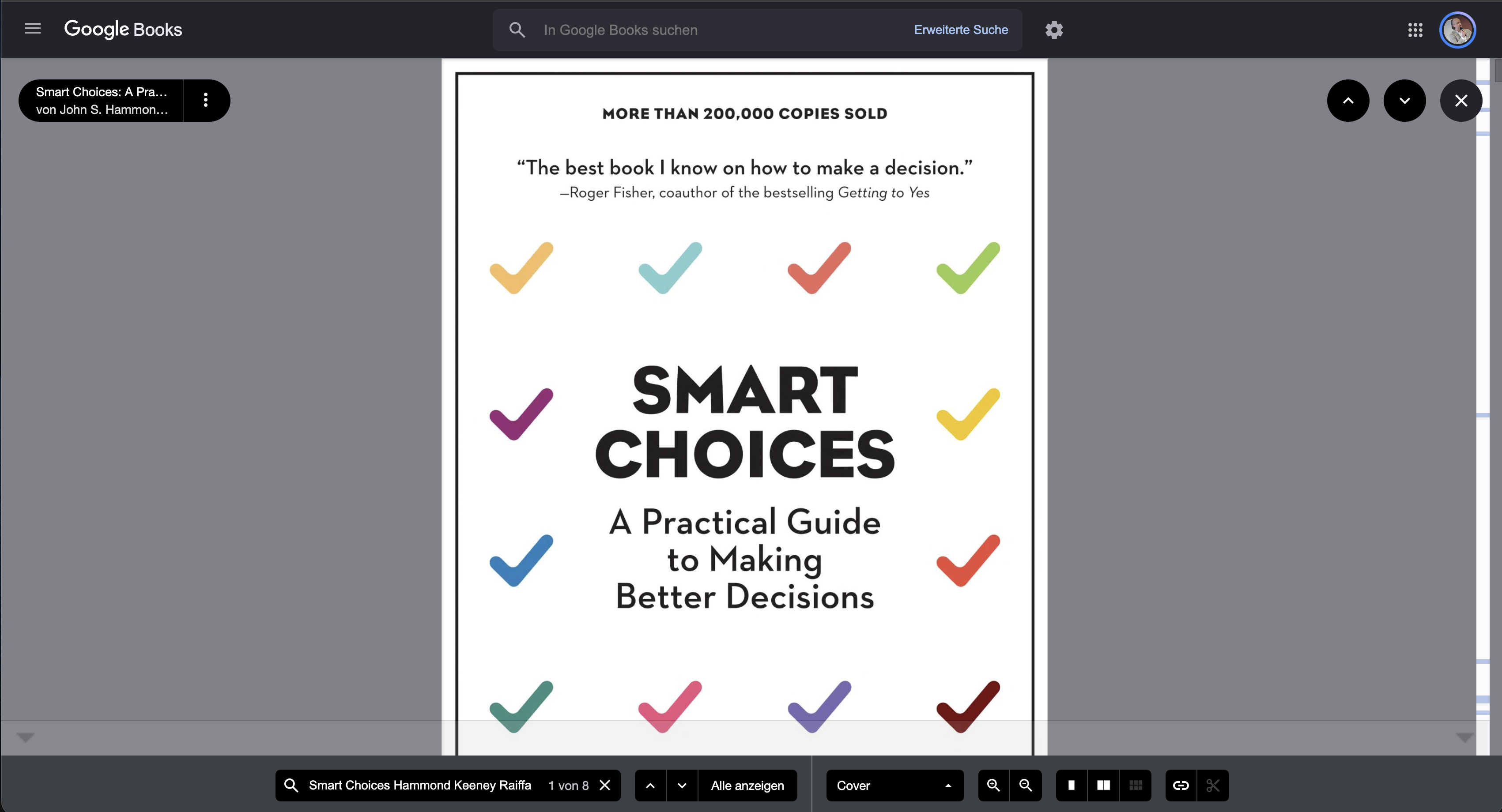
Smart Choices provides a structured approach to decision analysis.
Its framework encourages decision-makers to define objectives, develop alternatives, examine consequences, understand trade-offs, identify uncertainties, and consider linked future decisions.
The value lies in separating the components of a complicated choice.
A team may disagree about a recommendation because members have different objectives, assumptions, risk preferences, or interpretations of the evidence. A structured decision process helps identify which disagreement actually needs to be resolved.
Strategic takeaway: Difficult choices become easier to evaluate when objectives, alternatives, consequences, uncertainties, and trade-offs are made explicit.
Apply it: Create a decision table for one important choice, separating criteria from assumptions and expected outcomes.
18. How to Decide: Simple Tools for Making Better Choices — Annie Duke
Best for: Professionals seeking repeatable decision-making practices rather than abstract theory alone.
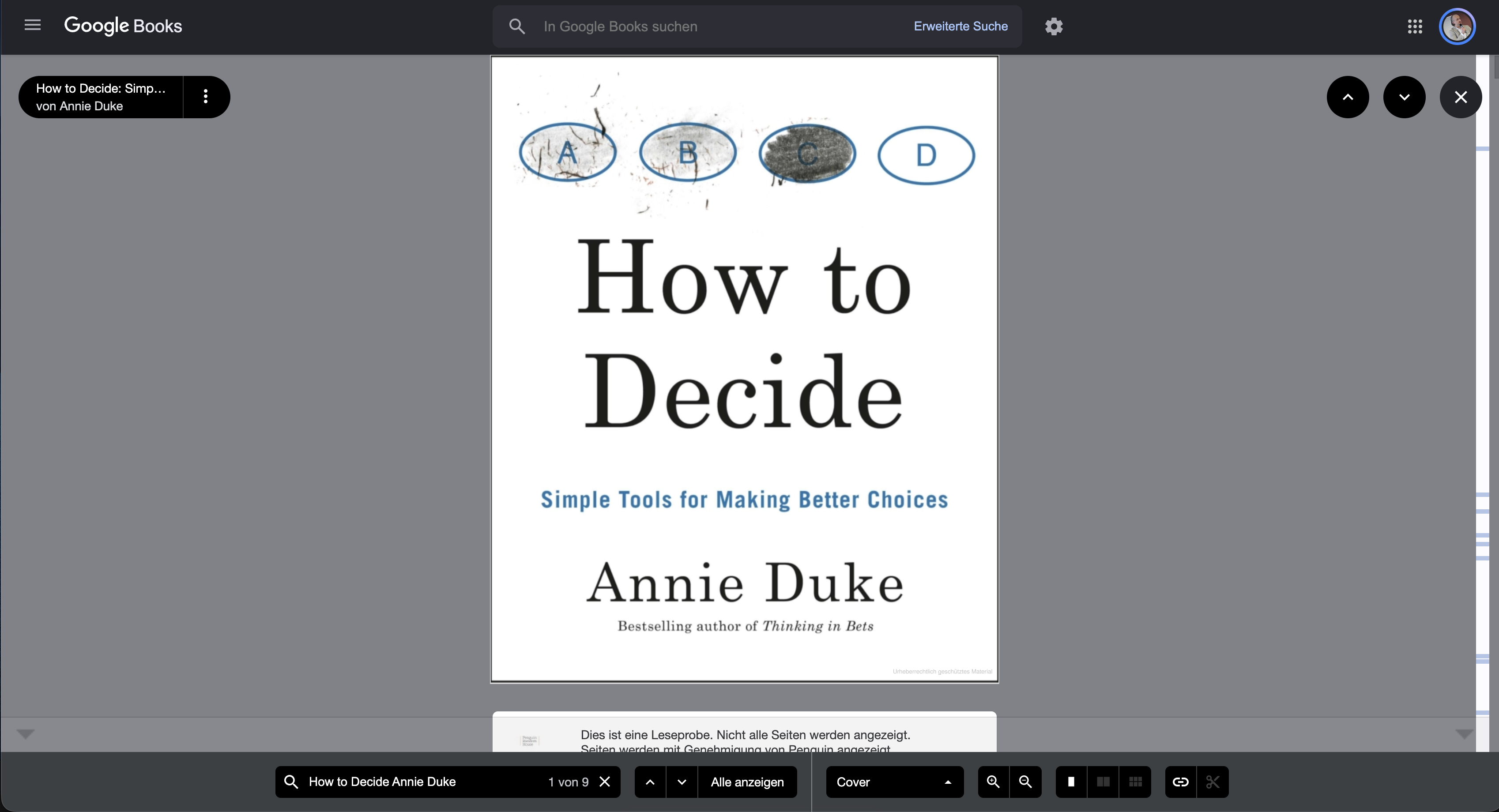
Annie Duke develops practical methods for assessing decisions when future outcomes are uncertain.
The book explores how to recognize decision traps, evaluate available information, and improve the process by which choices are made.
It is especially useful as a working companion to Thinking in Bets.
Where the earlier book develops the distinction between decisions and outcomes, How to Decide concentrates more directly on practical tools that can be applied in professional and personal situations.
For business leaders, this reinforces the importance of preserving the reasoning behind consequential choices.
Strategic takeaway: Decision-making is a process that can be deliberately designed and improved through repeated practice.
Apply it: Create a short decision record containing the choice, alternatives, expected outcomes, confidence, and conditions for review.
19. Quit: The Power of Knowing When to Walk Away — Annie Duke
Best for: Founders, investors, transformation leaders, and executives managing strategic initiatives.
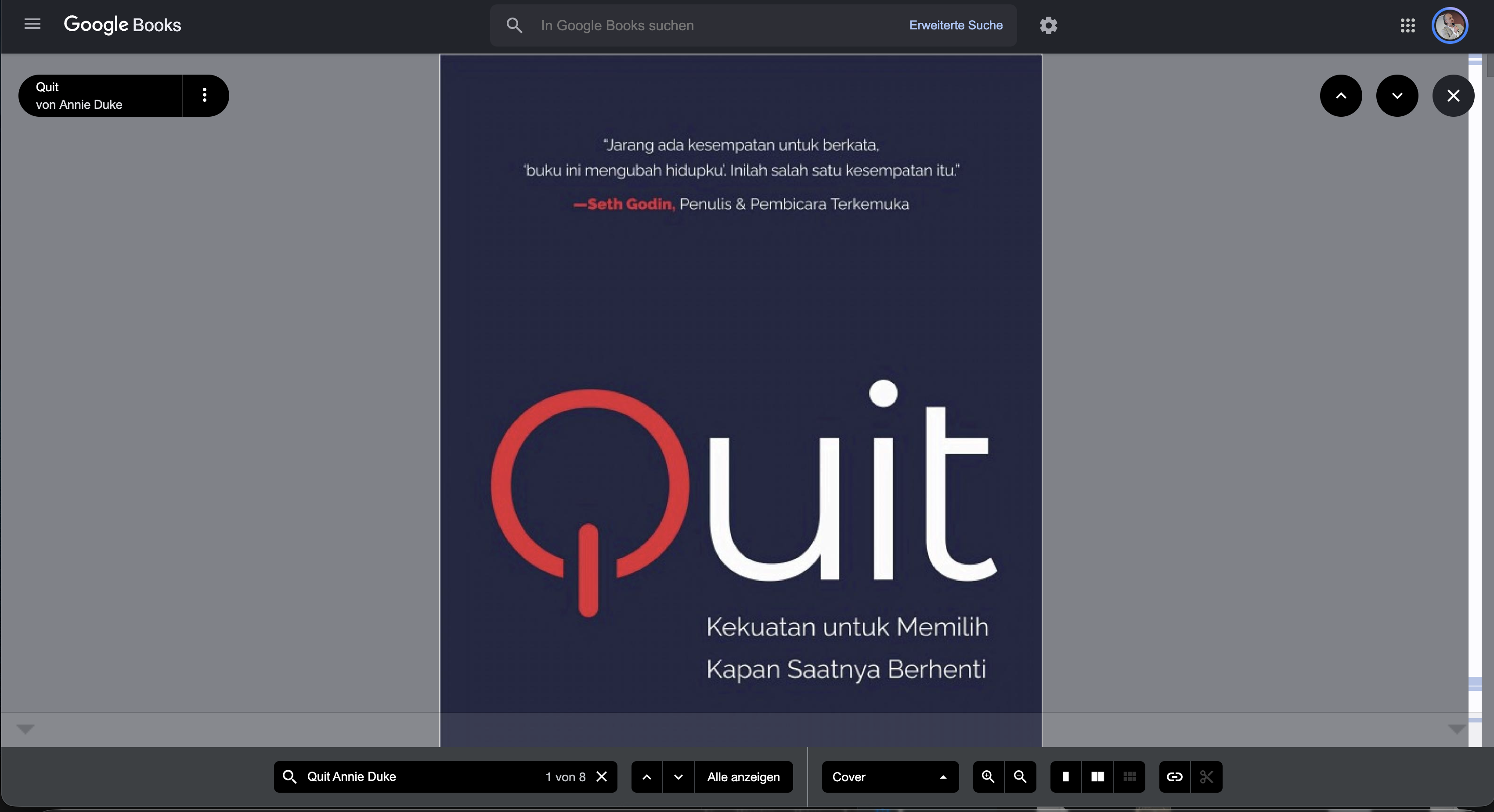
Organizations often treat persistence as an unconditional virtue.
Continuing a project can signal commitment, while stopping may appear to acknowledge failure. But past investments do not determine whether additional resources should be committed.
Annie Duke examines why people struggle to abandon paths that no longer justify their costs and how pre-established conditions can improve stopping decisions.
For strategy, this is particularly relevant to innovation portfolios, transformation programs, market entry, and declining businesses.
The goal is to recognize when persistence remains justified and when the organization’s resources would be better used elsewhere.
Strategic takeaway: A credible strategy includes conditions under which a promising initiative should be reconsidered or stopped.
Apply it: Define three observable conditions that would justify ending, redesigning, or reducing investment in a current initiative.
20. The Art of Strategy: A Game Theorist’s Guide to Success in Business and Life — Avinash K. Dixit & Barry J. Nalebuff
Best for: Strategists, negotiators, founders, and professionals evaluating competitive responses.
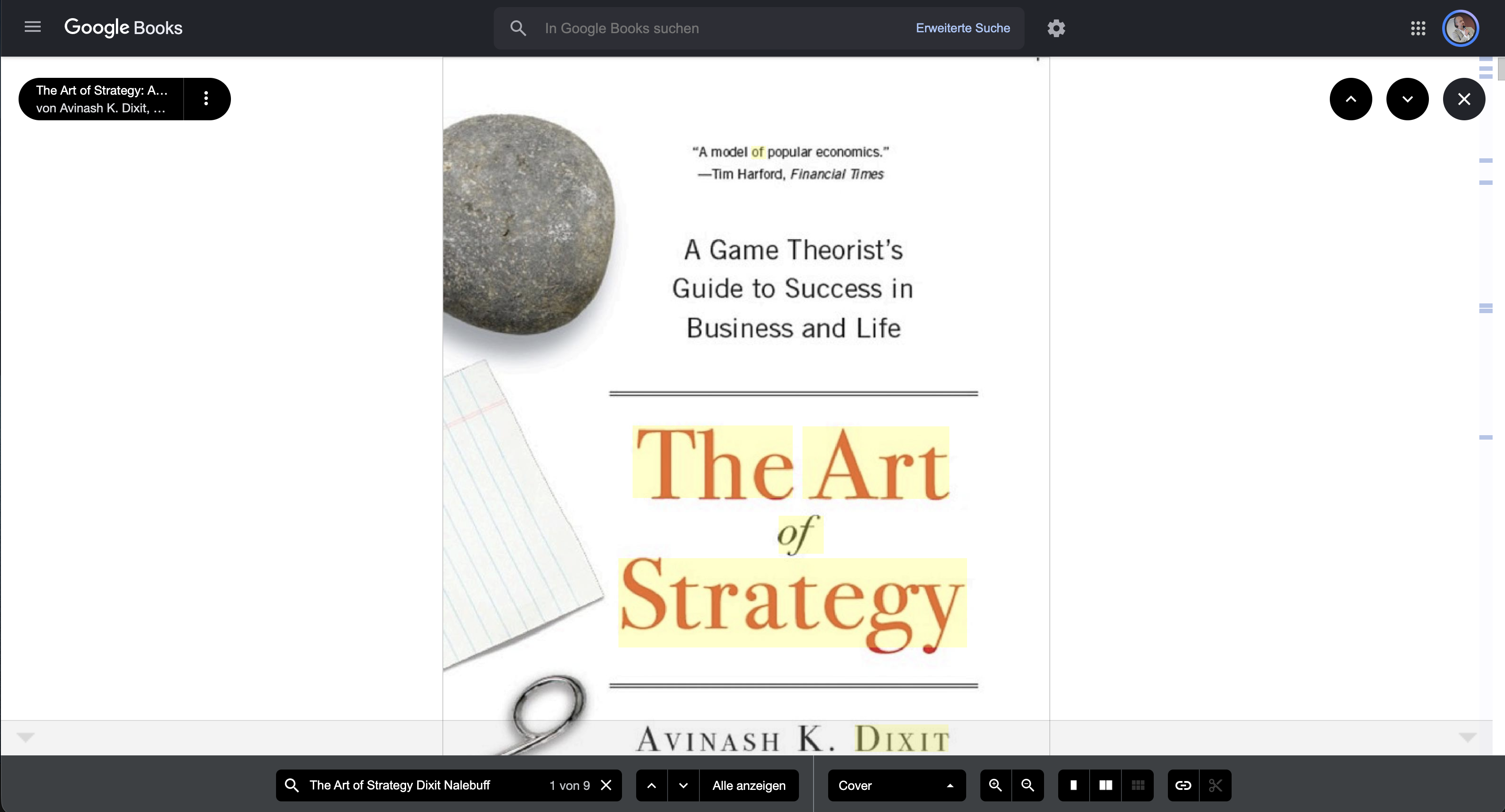
The Art of Strategy introduces game-theoretic reasoning to situations in which outcomes depend on choices made by several participants.
A business decision rarely occurs in isolation. Competitors may respond, customers may change their behavior, suppliers may renegotiate, and partners may alter their incentives.
The book explains why a seemingly attractive move can become unattractive once the likely responses of other participants are considered.
Its contribution is a more disciplined view of strategic interaction.
Strategic takeaway: Evaluate a strategic move in the context of how other participants are likely to respond, not merely its immediate effect.
Apply it: Before committing to a competitive action, map the incentives and plausible responses of customers, rivals, and partners.
05: Understand Complex Systems
Five books for recognizing feedback loops, delayed effects, structural constraints, and unintended consequences.
Organizations are systems of interacting processes, incentives, resources, information, and decisions.
An intervention that improves one activity may create difficulties elsewhere. A performance measure may change employee behavior in ways that undermine the outcome it was intended to improve. A short-term response may reduce an immediate problem while strengthening the forces that produced it.
Linear explanations are often inadequate for these situations.
Systems thinking provides methods for examining relationships, feedback, time delays, and the structures that sustain observable behavior.
21. Thinking in Systems: A Primer — Donella H. Meadows
Best for: Strategists, organizational designers, transformation leaders, and professionals dealing with complex operational problems.
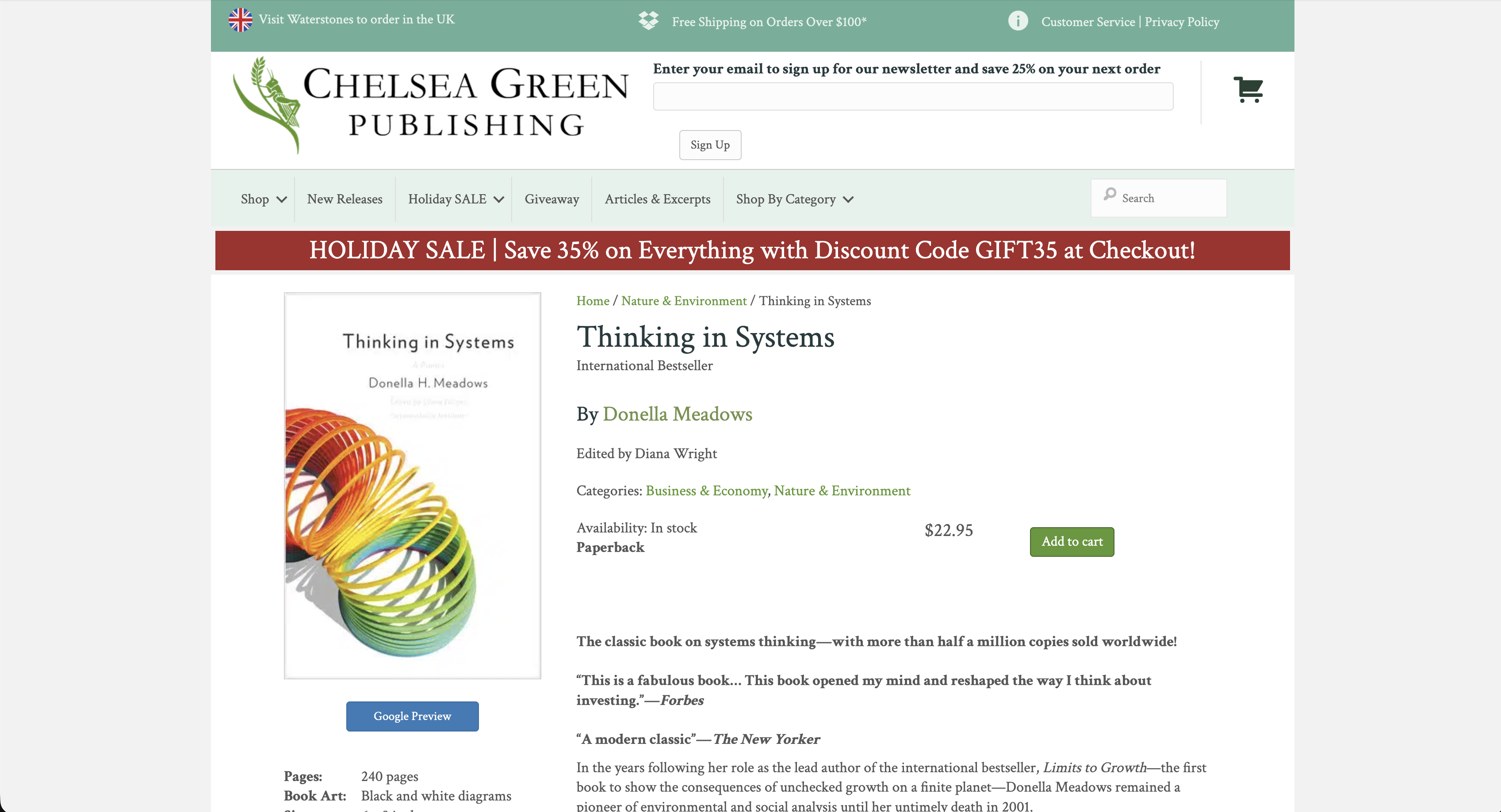
Donella Meadows provides an accessible introduction to systems thinking.
The book explains how stocks, flows, feedback loops, delays, and system purposes influence behavior over time.
Its importance lies in shifting attention from isolated events to the structures that produce recurring patterns.
For organizations, this can reveal why a series of individually reasonable decisions continues to produce disappointing collective outcomes.
The concepts are useful in operations, growth, sustainability, public policy, and organizational change.
Strategic takeaway: Repeated problems often persist because the underlying system continues to reproduce them.
Apply it: Select a recurring business problem and map the feedback loops, delays, and incentives that sustain it.
22. The Fifth Discipline: The Art & Practice of the Learning Organization — Peter M. Senge
Best for: Executives, organizational development leaders, transformation teams, and managers responsible for long-term capability building.
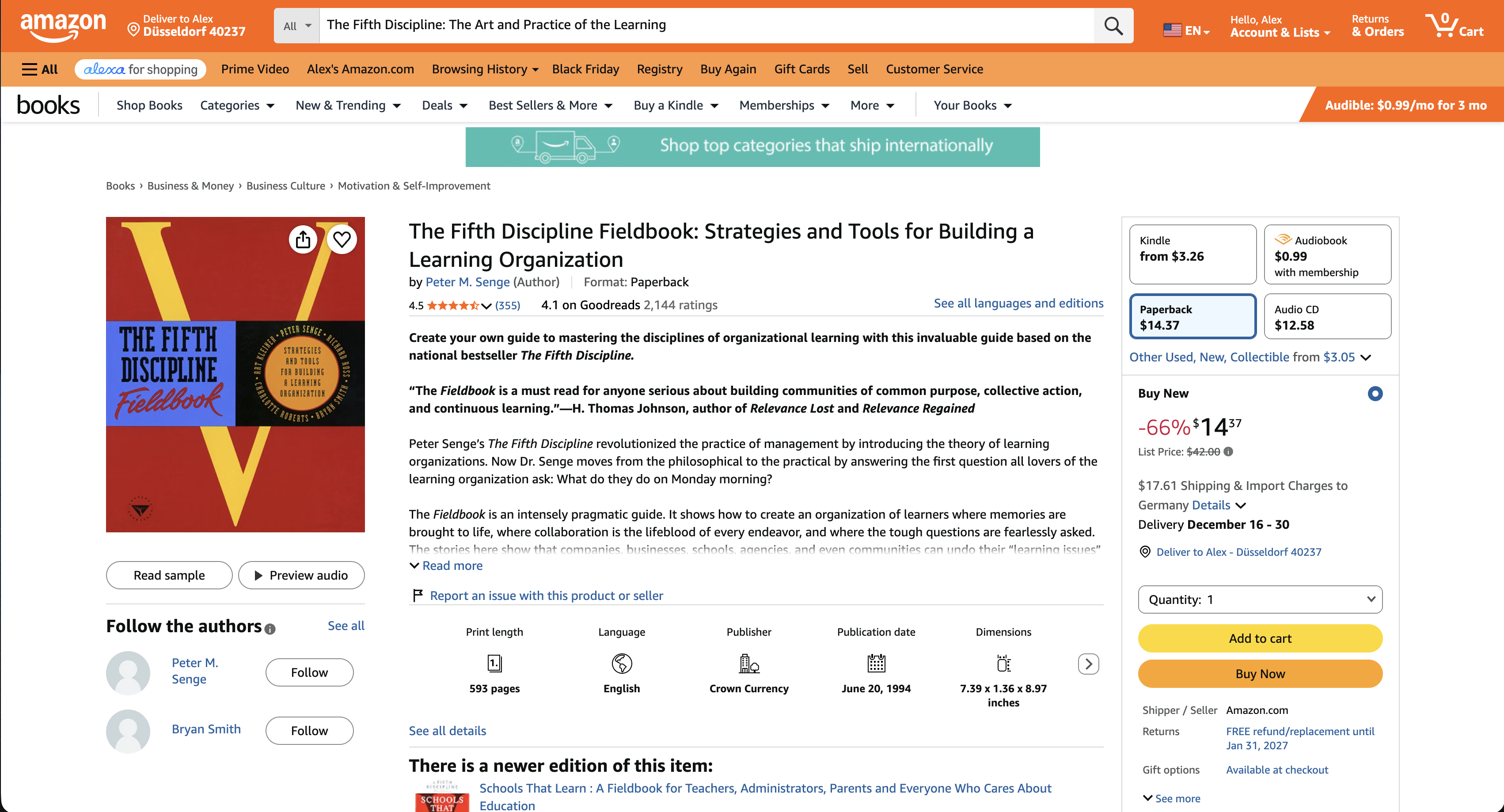
Peter Senge examines organizational learning through systems thinking, shared vision, mental models, team learning, and personal mastery.
The book emphasizes that performance problems frequently emerge from how organizations are structured and how individuals understand their role within those structures.
A team may optimize its own objectives while unintentionally undermining the wider organization.
Senge’s perspective is useful for understanding why improving local competence does not automatically improve collective outcomes.
Strategic takeaway: Organizational learning requires connecting individual understanding, team behavior, and system-level consequences.
Apply it: Identify one situation where a department meets its targets while the organization’s broader outcome deteriorates.
23. The Logic of Failure: Recognizing and Avoiding Error in Complex Situations — Dietrich Dörner
Best for: Senior managers, transformation leaders, systems thinkers, and professionals responsible for complex interventions.
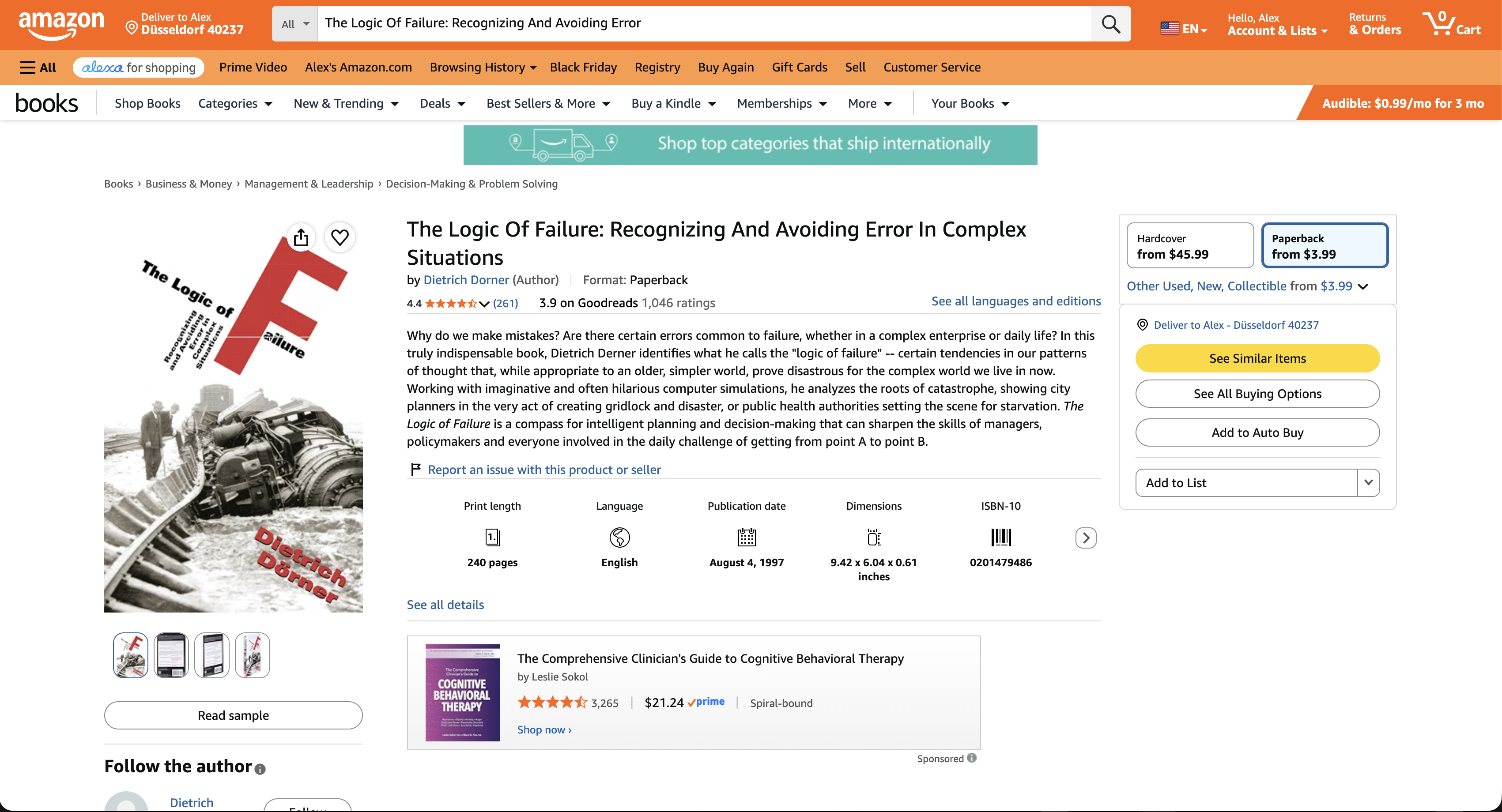
Dietrich Dörner investigates how people behave when attempting to manage complicated, dynamic environments.
Through research involving simulated systems, the book examines common patterns of failure, including insufficient attention to delayed consequences, narrow objectives, and the interaction between multiple variables.
Its relevance to strategy is considerable.
Decision-makers may intervene successfully in the short term without understanding how their actions alter the system’s future behavior.
The book encourages greater attention to dynamic relationships and the limits of intuitive control.
Strategic takeaway: A decision that improves an immediate indicator can still damage the system that produces long-term performance.
Apply it: Examine a proposed operational improvement and identify at least three possible second-order consequences.
24. The Goal: A Process of Ongoing Improvement — Eliyahu M. Goldratt & Jeff Cox
Best for: Operations leaders, executives, process improvement teams, and managers responsible for execution.
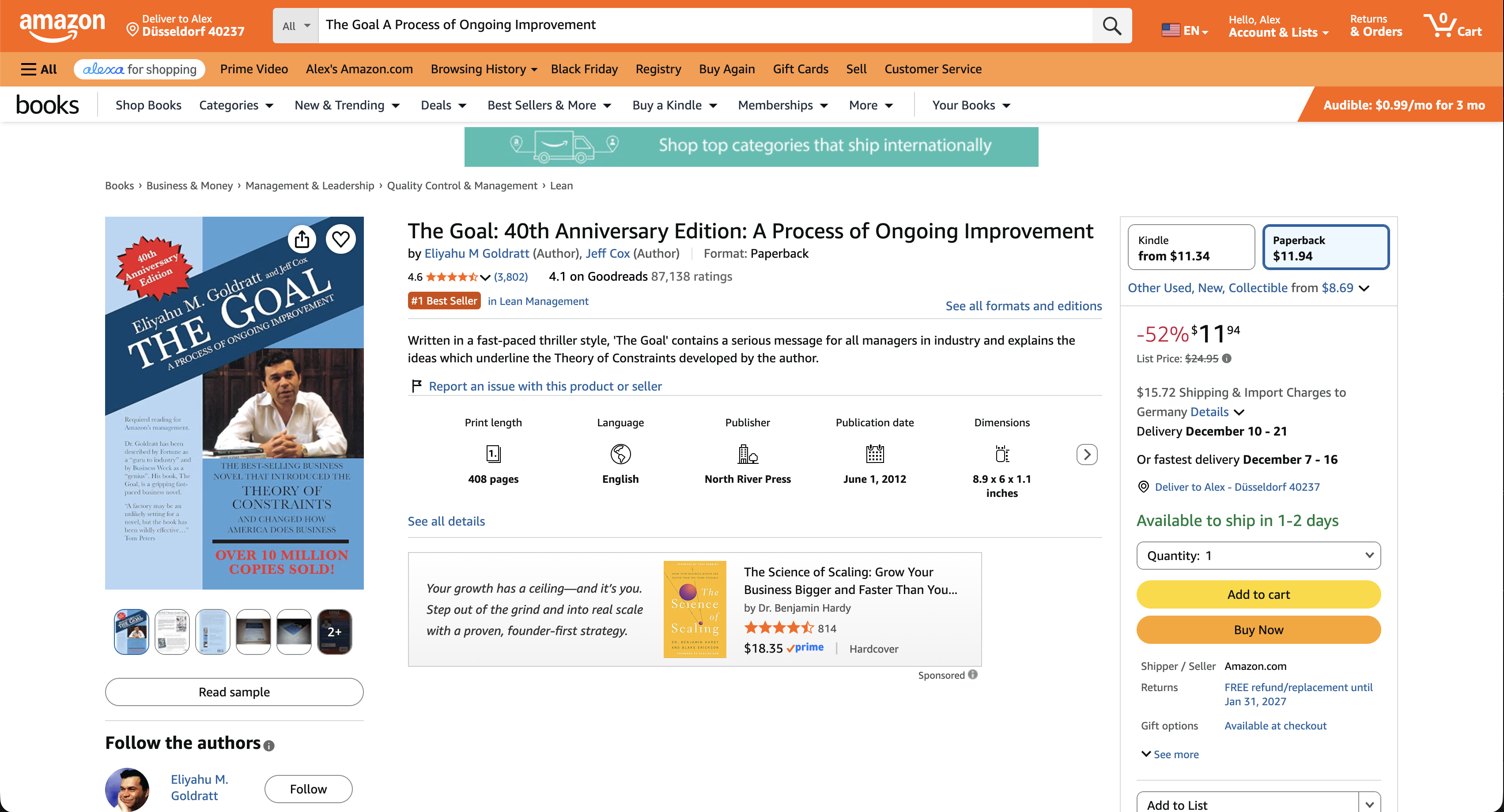
The Goal presents the Theory of Constraints through a business novel about improving an underperforming manufacturing operation.
Its central insight concerns the relationship between local activity and system-level performance.
Improving the efficiency of an individual step does not necessarily improve the throughput of the entire process. The limiting constraint may remain elsewhere.
This offers a useful lesson for organizational strategy, where teams frequently allocate resources to activities that appear inefficient without identifying what actually restricts the intended outcome.
Strategic takeaway: Improvement efforts should concentrate on the constraints that limit system performance rather than optimizing every component independently.
Apply it: Identify the limiting constraint in one recurring workflow and evaluate whether current improvement initiatives address it.
25. Antifragile: Things That Gain from Disorder — Nassim Nicholas Taleb
Best for: Executives, investors, founders, and leaders designing systems exposed to uncertainty.
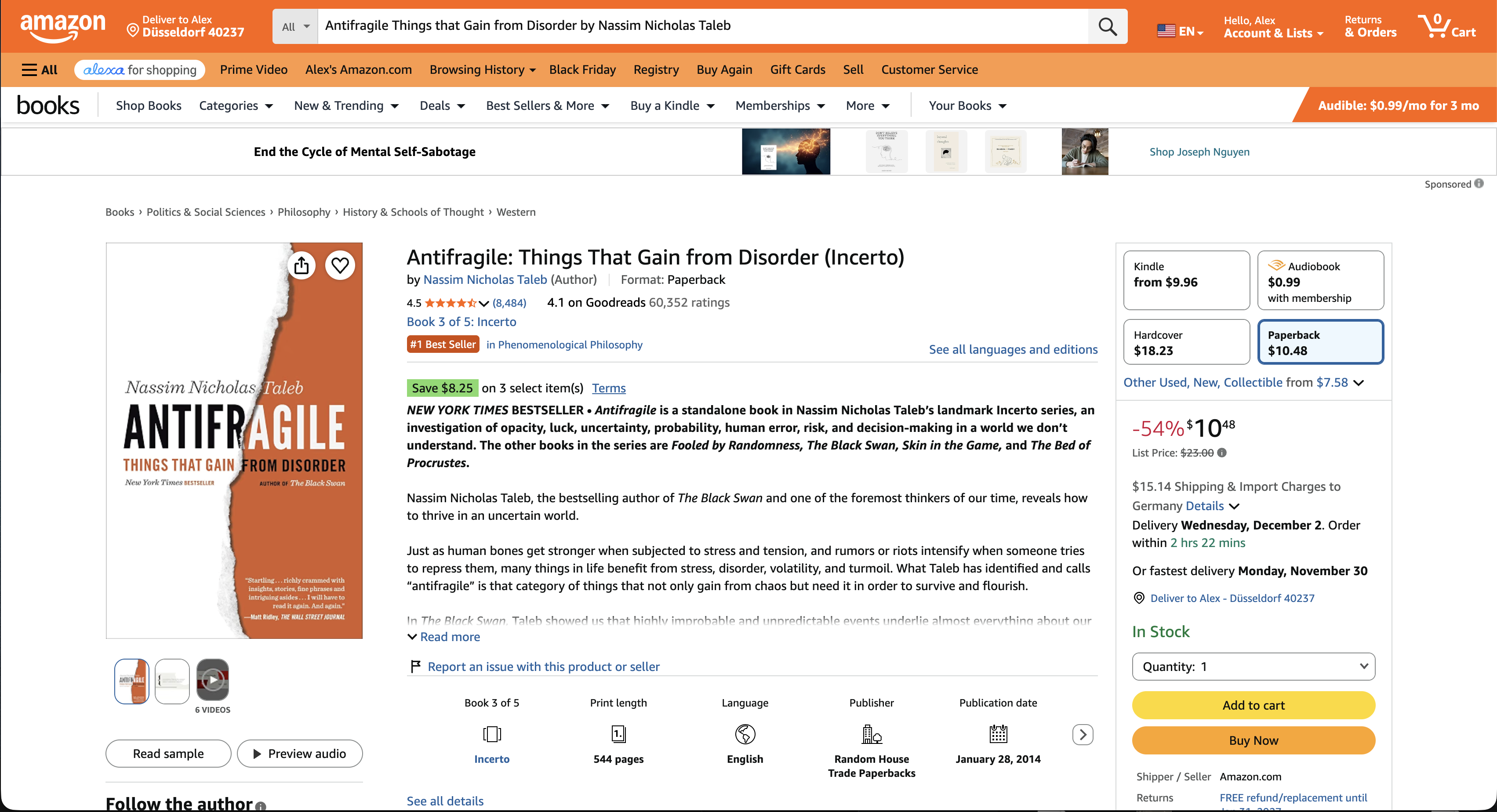
Antifragile explores the distinction between systems that are vulnerable to volatility, those that can withstand disruption, and those that may benefit from certain forms of variability.
For organizations, the book raises questions about dependence, concentration, experimentation, exposure to downside risk, and the value of preserving options.
Its arguments are intentionally provocative and should not be treated as a universal instruction to maximize instability.
Its strategic usefulness lies in examining whether an organization is designed to learn from manageable setbacks without becoming exposed to catastrophic failure.
Strategic takeaway: Resilience and adaptability depend on how an organization is exposed to uncertainty, not simply on its ability to predict events.
Apply it: Identify one strategic dependency that creates concentrated downside risk and consider how to reduce exposure without eliminating useful experimentation.
06: Develop Strategic Foresight and Judgment
Five books for recognizing emerging signals, learning from history, interpreting experience, and preparing for uncertain futures.
Strategic thinking must operate across time.
Organizations make decisions in the present based on imperfect interpretations of what has happened and uncertain expectations about what may happen next.
Forecasting can support those decisions, but it cannot eliminate unexpected developments. Historical analogies can be useful, but they may mislead when superficial similarities conceal important differences.
Experienced judgment can recognize meaningful patterns, yet expertise can also become outdated when the underlying environment changes.
These books help develop a more disciplined relationship with time, evidence, experience, and anticipation.
26. The Art of the Long View: Planning for the Future in an Uncertain World — Peter Schwartz
Best for: Corporate strategists, executives, policy teams, and organizations facing major long-term uncertainty.
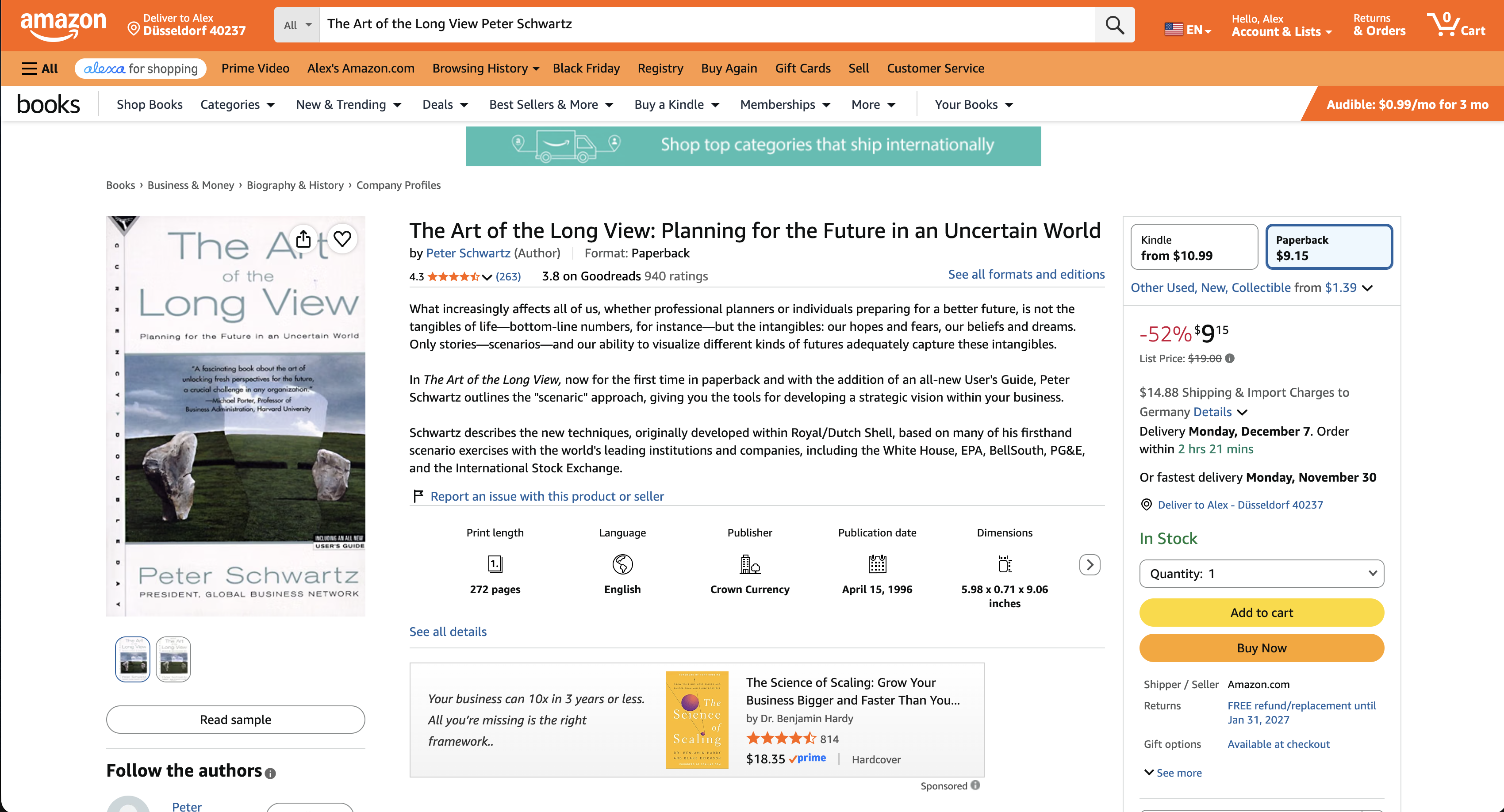
Peter Schwartz introduces scenario planning as a method for exploring alternative futures.
Rather than concentrating exclusively on a single forecast, scenario work develops several plausible environments and investigates what each would imply for present decisions.
The objective is not to determine which story will become reality.
It is to challenge assumptions, recognize uncertainty, and identify choices that remain sensible across different possible developments.
Strategic takeaway: Strategic foresight becomes more useful when leaders prepare for several plausible futures rather than depend on one expected outcome.
Apply it: Develop three contrasting scenarios for a major uncertainty affecting your industry and identify decisions that remain robust across them.
27. The Signals Are Talking: Why Today’s Fringe Is Tomorrow’s Mainstream — Amy Webb
Best for: Innovation strategists, market intelligence teams, technology leaders, and executives monitoring emerging developments.
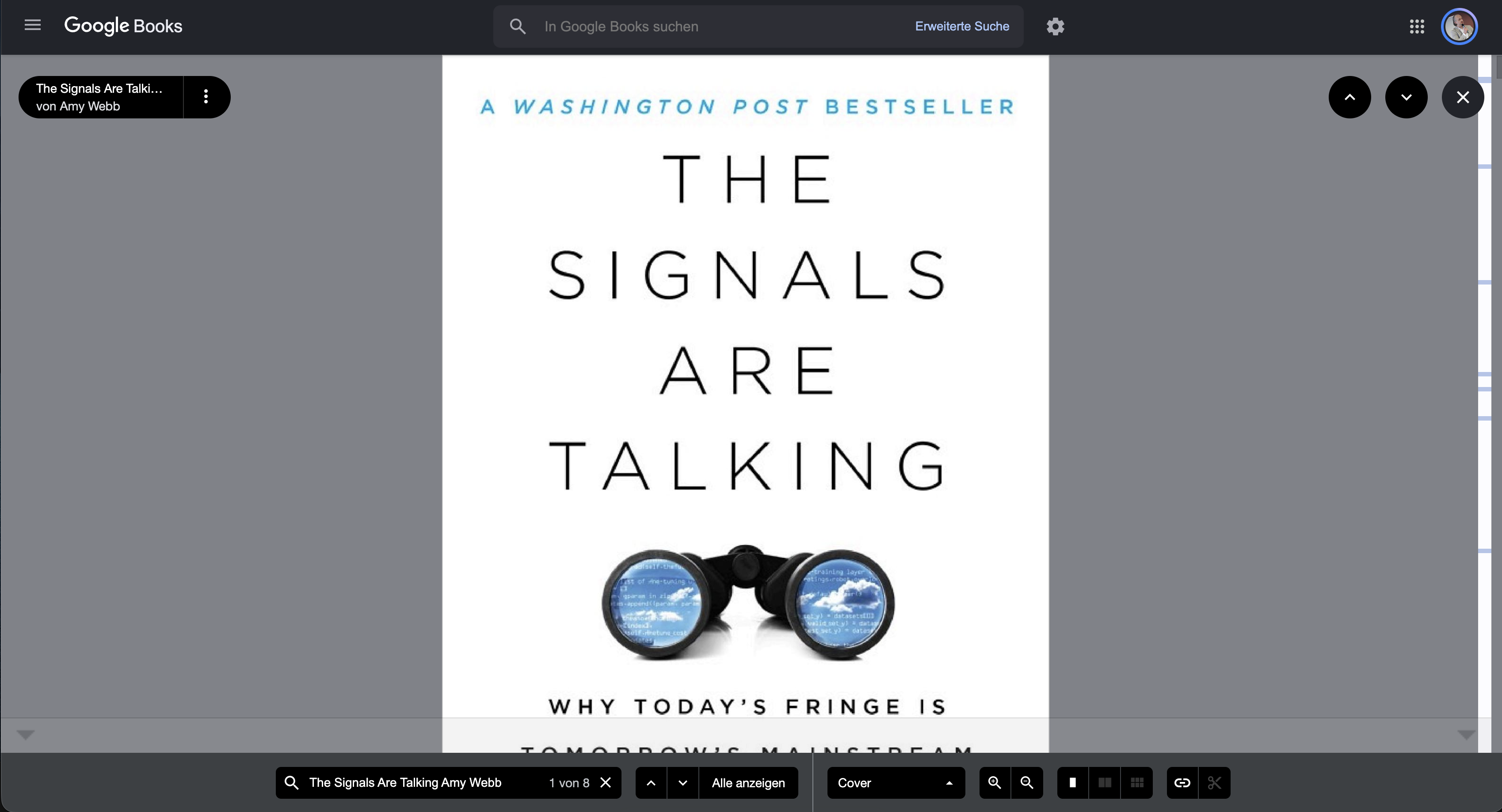
Amy Webb explores the process of identifying and interpreting early signals of change.
Organizations often confuse temporary attention with long-term transformation or overlook developments that initially appear too small to matter.
The book encourages more systematic observation of emerging patterns, including developments outside an industry’s conventional boundaries.
Its relevance is especially clear in technology strategy, where established reporting often concentrates on widely visible announcements rather than the less obvious changes occurring beneath them.
Strategic takeaway: Better foresight depends on distinguishing meaningful emerging patterns from attention-driven trends.
Apply it: Identify five weak signals relevant to your industry and define which additional developments would increase or decrease their strategic significance.
28. Thinking in Time: The Uses of History for Decision Makers — Richard E. Neustadt & Ernest R. May
Best for: Senior executives, strategists, policy professionals, and leaders making consequential decisions.
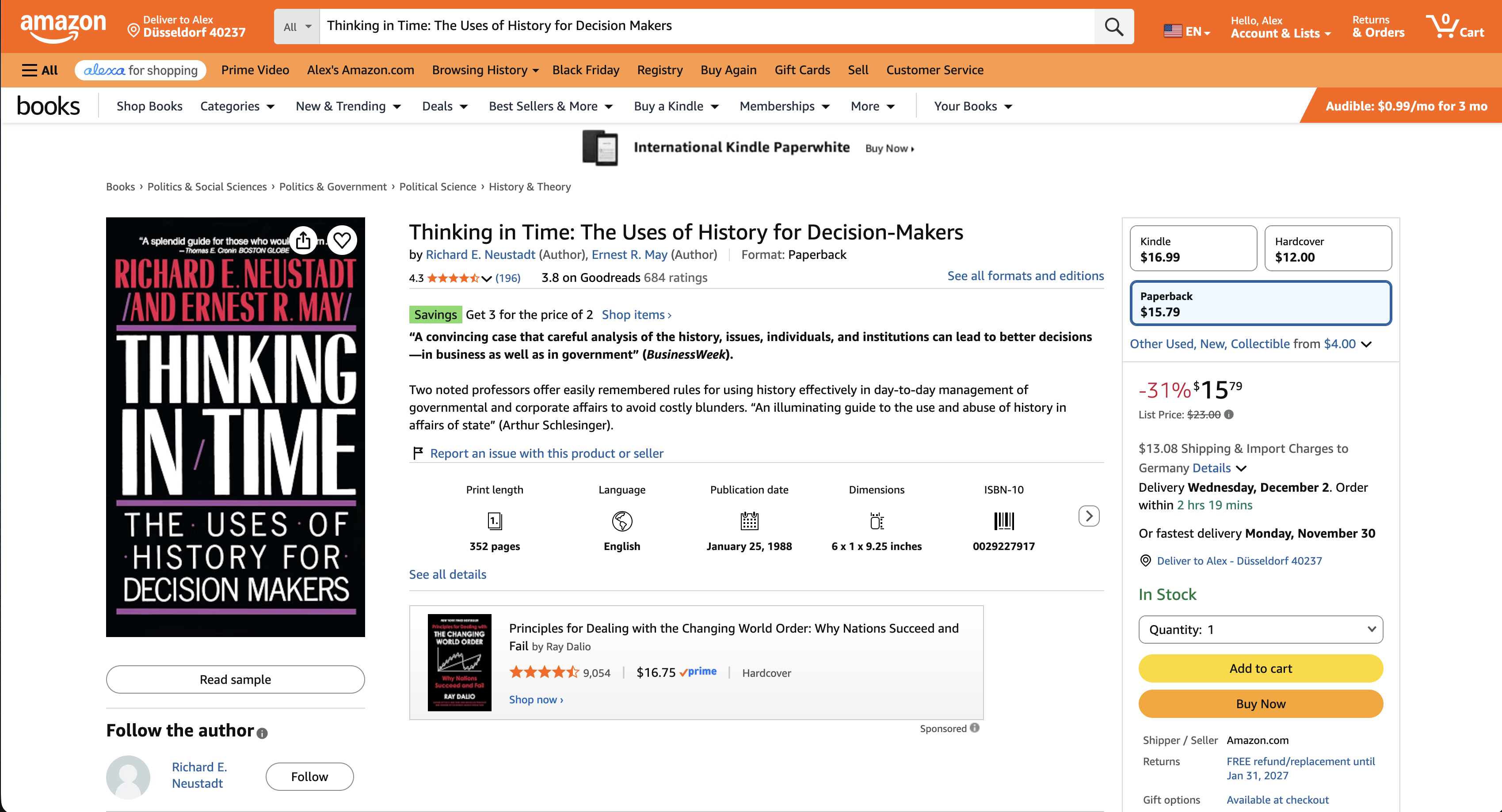
Neustadt and May examine how decision-makers use history to understand present challenges.
Historical examples can illuminate recurring patterns, institutional constraints, and possible consequences. They can also encourage false analogies when leaders assume that a contemporary situation is equivalent to a familiar earlier event.
The book emphasizes careful comparison and attention to important differences between situations.
For business strategy, the lesson is particularly relevant when leaders invoke previous technological transitions, market disruptions, or organizational crises to justify present choices.
Strategic takeaway: Historical experience is useful when treated as evidence to investigate rather than a story that automatically explains the present.
Apply it: Take one historical analogy used in a current strategy discussion and identify the most consequential differences between the two situations.
29. Seeing What Others Don’t: The Remarkable Ways We Gain Insights — Gary Klein
Best for: Strategists, researchers, innovation teams, and professionals seeking to improve insight generation.
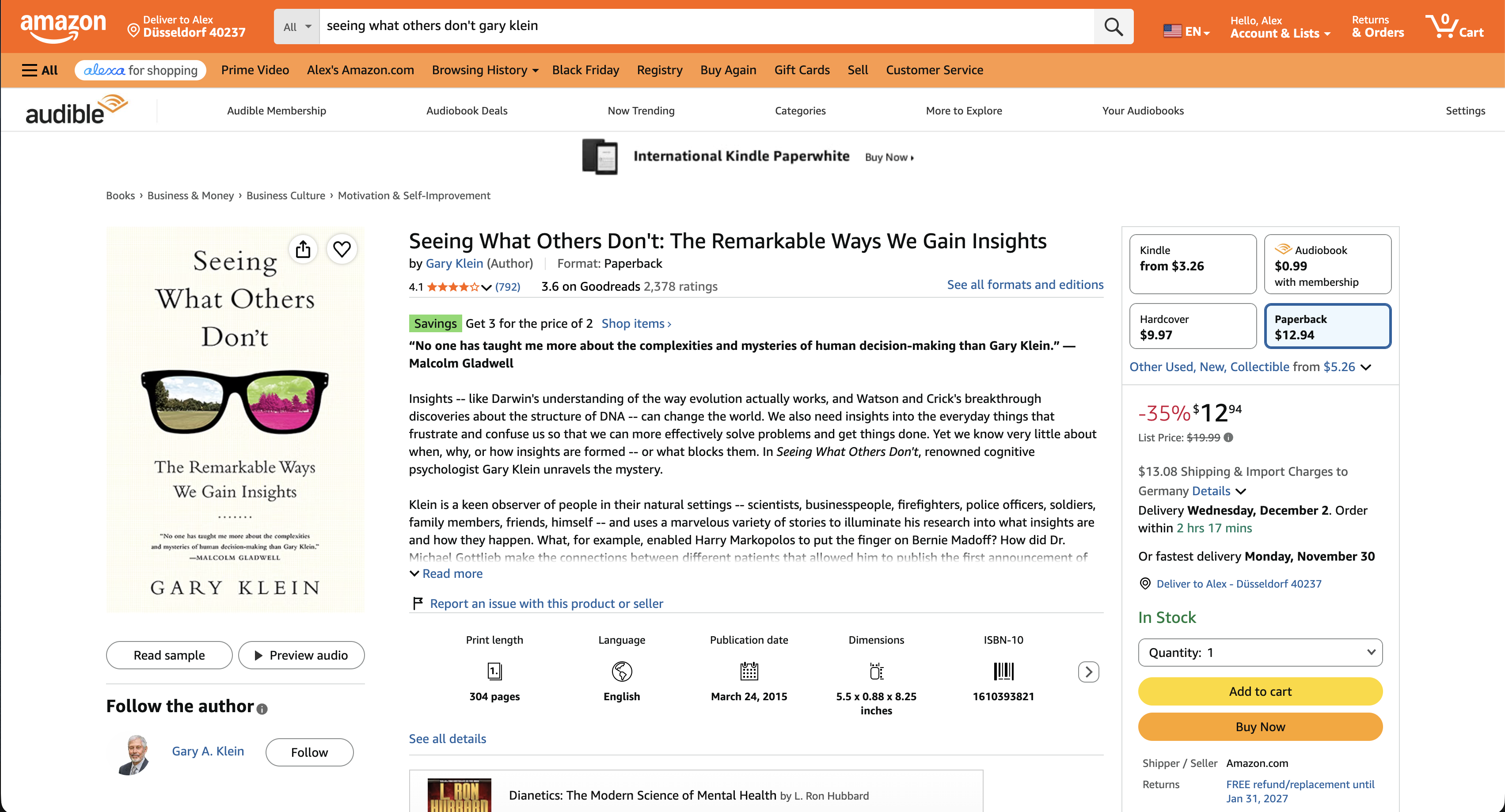
Gary Klein investigates how people recognize insights that change their understanding of a situation.
Insights can emerge through unexpected connections, contradictions, coincidences, and the recognition that an existing explanation is incomplete.
This is important for strategy because additional information does not always produce a better understanding.
Sometimes the critical development is the recognition that previously accepted information should be interpreted differently.
The book provides a useful complement to formal analytical methods by examining how meaningful changes in understanding occur.
Strategic takeaway: Strategic insight often emerges when someone recognizes an important contradiction or connection that existing explanations overlook.
Apply it: Identify a recurring business observation that your current strategy cannot adequately explain. Develop two alternative interpretations.
30. Sources of Power: How People Make Decisions — Gary Klein
Best for: Experienced managers, operators, emergency decision-makers, and leaders working in dynamic environments.
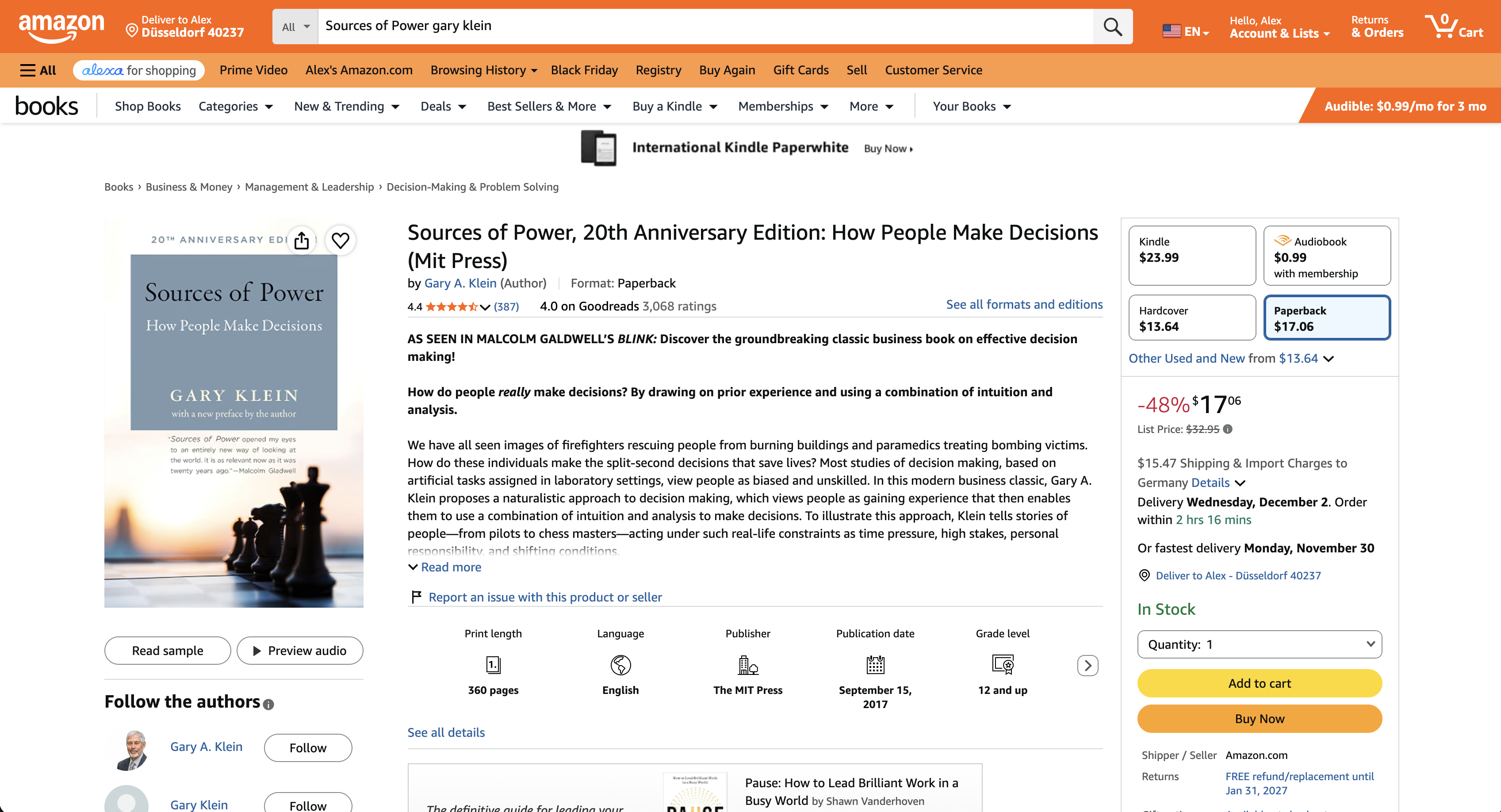
Sources of Power examines how skilled professionals make decisions under time pressure, uncertainty, and operational constraints.
Klein’s work on naturalistic decision-making explores how experience enables people to recognize patterns, identify workable responses, and mentally simulate their consequences.
This offers an important counterpart to formal decision-analysis methods.
Not every professional situation permits lengthy comparison matrices or exhaustive option generation. However, effective intuitive judgment depends on the quality and relevance of experience.
Strategic takeaway: Expertise can support rapid, effective decisions when recognizable patterns and feedback exist, but intuition should be questioned when the environment has fundamentally changed.
Apply it: Identify where experienced judgment is dependable in your organization and where changing conditions require more explicit analysis.
Which Books Should You Read First?
Thirty books provide considerable breadth, but the most useful reading sequence depends on the kind of thinking you want to improve.
I recommend five practical pathways.
Reading Path 01 — The Executive Strategist
For leaders responsible for direction, priorities, and consequential organizational decisions.
Read in this order:
- The Crux — Identify the challenge that deserves strategic attention.
- The Opposable Mind — Examine difficult alternatives without accepting superficial trade-offs.
- Smart Choices — Structure consequential decisions.
- Thinking in Systems — Understand how the organization responds to intervention.
- The Art of the Long View — Prepare for different possible futures.
Outcome: A more integrated approach to strategic diagnosis, choice, organizational consequences, and uncertainty.
Reading Path 02 — The Better Decision-Maker
For managers and professionals seeking more consistent judgment.
Read in this order:
- Thinking, Fast and Slow — Understand common limitations of judgment.
- Thinking in Bets — Separate decision quality from outcome quality.
- Noise — Recognize unwanted inconsistency in organizational assessments.
- Decisive — Improve how alternatives are generated and evaluated.
- How to Decide — Establish practical decision-making habits.
Outcome: A more transparent and repeatable approach to important decisions.
Reading Path 03 — The Systems Thinker
For people dealing with recurring operational problems, organizational complexity, and transformation.
Read in this order:
- Thinking in Systems — Learn the foundations of systems behavior.
- The Goal — Understand constraints and system-level performance.
- The Logic of Failure — Recognize dynamic complexity and unintended consequences.
- The Fifth Discipline — Connect systems thinking with organizational learning.
- Antifragile — Examine uncertainty, exposure, and adaptability.
Outcome: A stronger ability to recognize structural causes and design interventions that improve the wider system.
Reading Path 04 — The Strategic Forecaster
For strategists, investors, and leaders navigating uncertainty.
Read in this order:
- Superforecasting — Develop disciplined probabilistic estimates.
- The Black Swan — Understand the limitations of forecasting.
- The Signals Are Talking — Improve early signal detection.
- The Art of the Long View — Explore alternative futures.
- Thinking in Time — Evaluate historical parallels carefully.
Outcome: Better anticipation without relying on unwarranted certainty.
Reading Path 05 — The Independent Strategic Thinker
For founders, consultants, and professionals who want to challenge conventional reasoning.
Read in this order:
- The Scout Mindset — Improve intellectual independence.
- What’s Your Problem? — Reframe the questions you are trying to answer.
- The Great Mental Models — Build a broader conceptual toolkit.
- The Art of Strategy — Understand how other participants shape outcomes.
- Seeing What Others Don’t — Develop the ability to recognize overlooked insights.
Outcome: A more flexible approach to interpreting unfamiliar problems and identifying opportunities.
The Strategic Thinking Decision Map
An Original TSS Framework for Choosing How to Think
Reading about better decisions is valuable. Applying the right kind of thinking at the right stage of a problem is more difficult.
A leadership team investigating falling margins needs a different approach from one evaluating an uncertain technology investment. A founder determining whether to abandon a product needs different reasoning tools from an executive analyzing a persistent coordination problem.
The following framework connects six recurring strategic questions with the thinking capabilities needed to answer them.
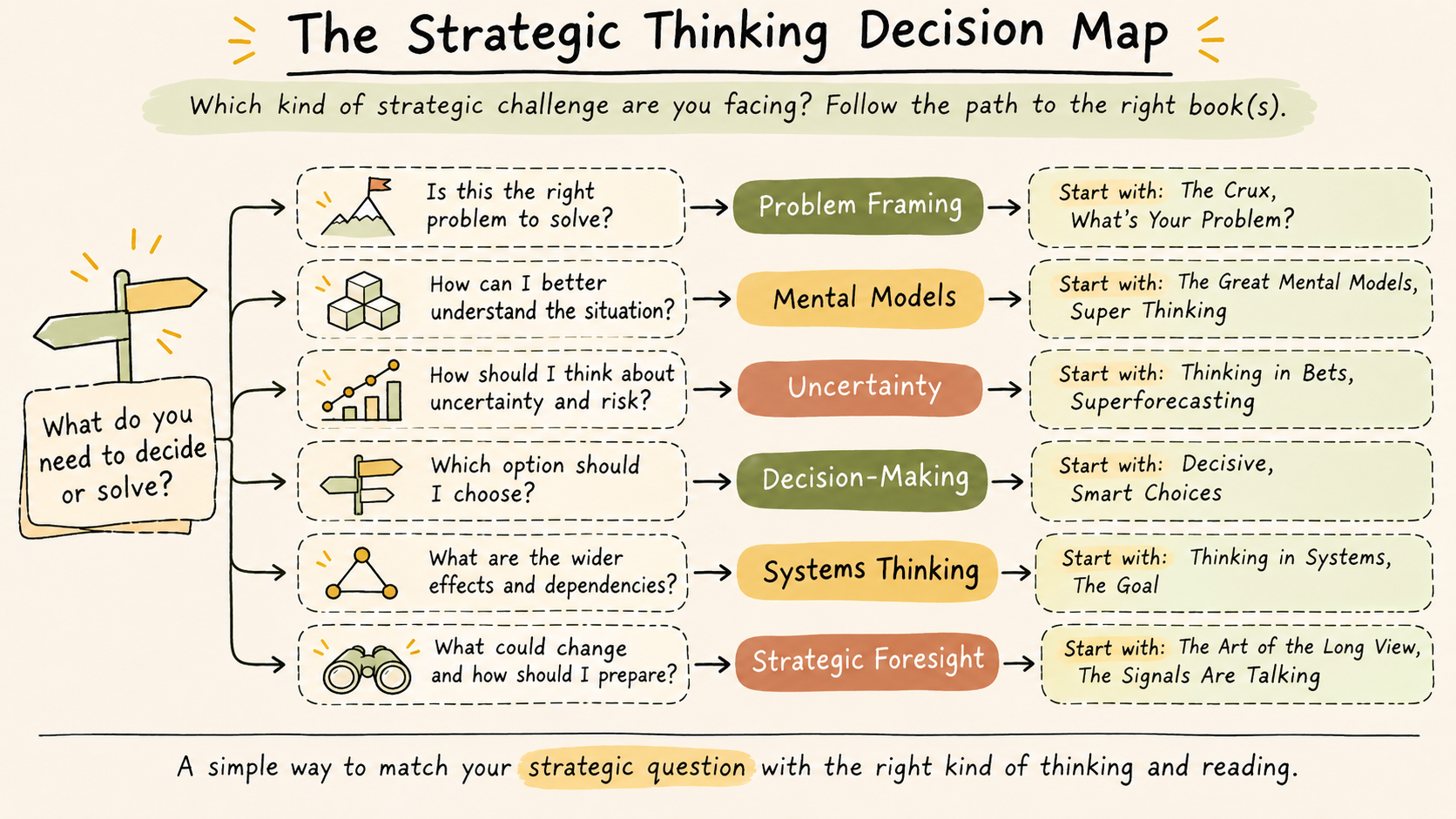
How to use the framework
Begin by writing down the strategic decision you need to make.
Identify which of the six questions creates the greatest difficulty. Then select one or two corresponding reading resources.
Do not attempt to apply every model simultaneously. The purpose is to improve the reasoning that currently constrains progress.
After using the chosen method, record whether it changed the problem definition, evidence requirements, alternatives, expected consequences, or conditions for future review.
The result should be a better decision process, not simply a more elaborate analysis.
Five Questions That Reveal Weak Strategic Thinking
The most consequential weaknesses in strategic reasoning are not always visible in the final recommendation.
A plan may look coherent because its assumptions have never been challenged. A decision memo may appear rigorous because it contains extensive analysis, even though the alternatives were never genuinely compared.
Before committing to an important direction, ask five questions.
1. Have we examined the problem from more than one perspective?
If the initial framing is incorrect, better execution may simply produce the wrong outcome more efficiently.
Identify alternative explanations and establish what evidence would distinguish them.
2. Are we confusing evidence with interpretation?
An observed market development can support several different conclusions.
Preserve the distinction between what happened, what you believe it means, and what remains uncertain.
3. Are the alternatives genuinely different?
A list of three initiatives is not a strategic choice if all three depend on the same assumptions and produce similar outcomes.
Develop alternatives that involve meaningful differences in positioning, resource allocation, timing, or risk.
4. Have we considered how the system will respond?
A strategic intervention changes incentives, resources, behavior, and the decisions available to others.
Examine likely responses, feedback effects, and unintended consequences rather than evaluating only the immediate intended benefit.
5. Have we defined what would make us reconsider?
Strategic commitments should be sufficiently stable to coordinate action, but not so rigid that contradictory evidence becomes irrelevant.
Record the assumptions, thresholds, and developments that justify review.
These five questions are not a substitute for detailed analysis. They establish whether the basic conditions for sound strategic reasoning are present.
A Seven-Day Strategic Thinking Sprint
Turn One Business Decision into a Practical Learning Exercise
The following exercise is designed to make the ideas in this collection actionable without requiring a lengthy training program.
Choose one consequential but manageable business decision. It could involve investing in an AI capability, entering a new customer segment, changing a pricing model, improving an operational process, or deciding whether to continue an initiative.
Avoid selecting a decision that has already been made and cannot realistically be reconsidered.
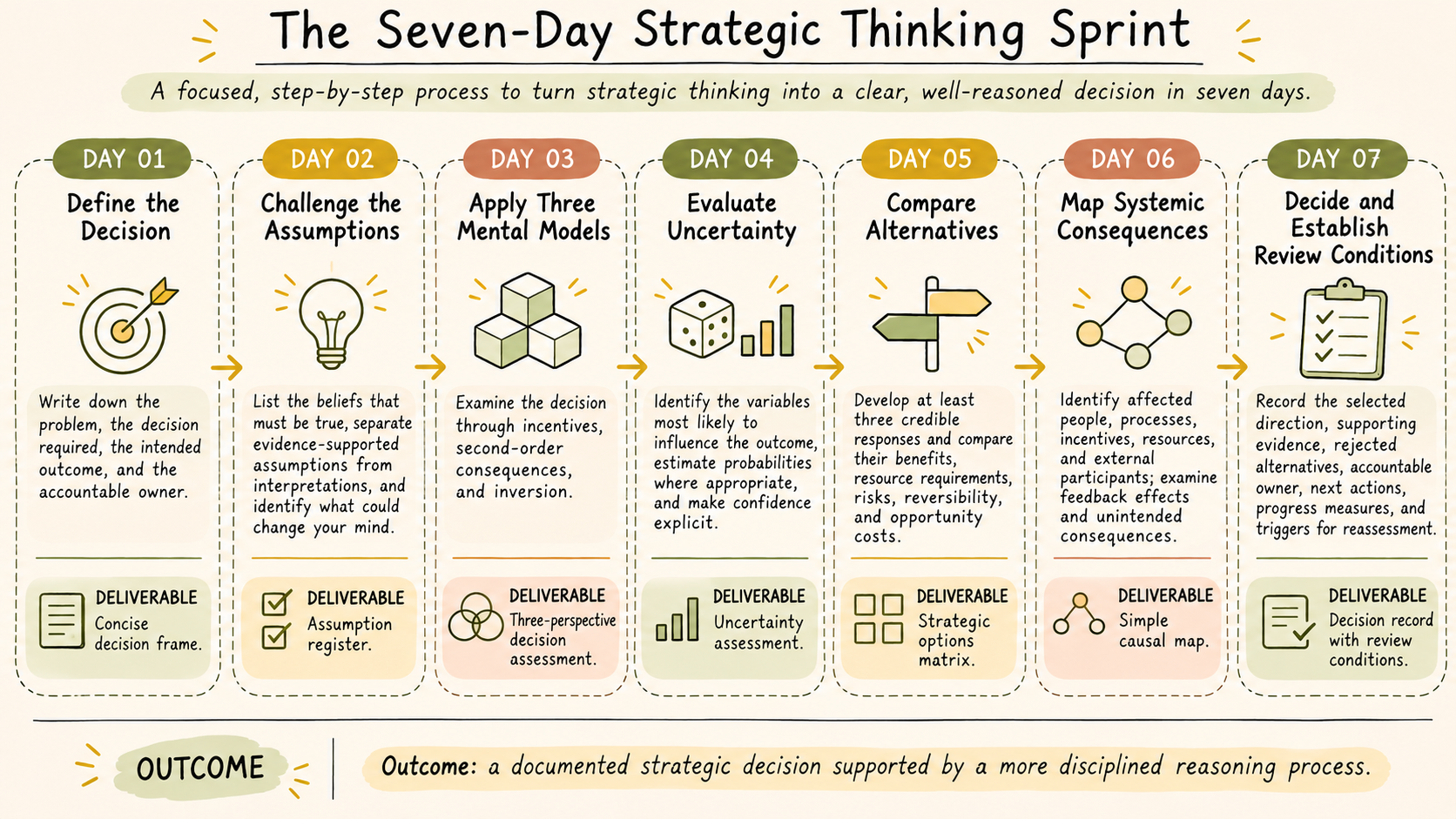
Day 01: Define the Decision
Write down the current problem, the decision required, the intended outcome, and the person accountable.
Use The Crux or What’s Your Problem? to challenge whether the stated problem reflects the underlying issue.
Deliverable: A concise decision frame.
Day 02: Challenge the Assumptions
List the beliefs that must be true for your preferred direction to succeed.
Distinguish evidence-supported assumptions from plausible but unverified interpretations.
Use The Scout Mindset to identify information that could change your position.
Deliverable: An assumption register.
Day 03: Apply Three Mental Models
Examine the decision through incentives, second-order consequences, and inversion.
Consider what the different models reveal, which assumptions they challenge, and where their explanations conflict.
Deliverable: A three-perspective decision assessment.
Day 04: Evaluate Uncertainty
Identify the variables most likely to influence the outcome.
Estimate relevant probabilities where the question permits meaningful estimation, and record the basis for those judgments.
Use Thinking in Bets or Superforecasting to make confidence and uncertainty explicit.
Deliverable: An uncertainty assessment.
Day 05: Compare Alternatives
Develop at least three credible responses.
Evaluate their expected benefits, resource requirements, risks, reversibility, and opportunity costs.
Use Smart Choices to structure the comparison.
Deliverable: A strategic options matrix.
Day 06: Map Systemic Consequences
Identify the people, processes, incentives, resources, and external participants affected by the preferred option.
Examine feedback effects and possible unintended consequences.
Use Thinking in Systems to investigate relationships that the original analysis may have overlooked.
Deliverable: A simple causal map.
Day 07: Decide and Establish Review Conditions
Record the selected direction, supporting evidence, rejected alternatives, accountable owner, and next actions.
Specify what would demonstrate progress and which developments should trigger reassessment.
Deliverable: A decision record with explicit review conditions.
At the end of seven days, you should have a documented strategic decision supported by a more disciplined reasoning process.
The exercise may not produce a different final choice.
It should make the original choice easier to explain, challenge, implement, and revisit.
From Strategic Thinking to AI Monetization
Better strategic decisions begin with understanding customer needs, evaluating competing business models, and recognizing the assumptions behind commercial opportunities. As AI changes how products and services are developed and delivered, these capabilities become particularly important.
Building a viable AI business requires making deliberate choices about the value customers receive, their willingness to pay, pricing architecture, delivery costs, and sustainable unit economics. Each decision involves uncertainty, trade-offs, and assumptions that must be tested against real market evidence.
The AI Monetization Playbook translates these considerations into a practical 95-page guide covering AI pricing models, customer value validation, delivery economics, worked financial scenarios, and a structured 90-day roadmap for developing commercially viable AI business models.
Included with The Strategy Stack paid membership.
The Strategic Thinking Toolkit: What to Keep After Reading
The lasting value of these 30 books does not depend on remembering every concept.
A useful result is a small set of recurring habits that improve decisions over time.
For individual professionals, that means making assumptions visible, recognizing when a problem requires reframing, and treating uncertainty with greater discipline.
For teams, it means developing shared ways to compare options, challenge evidence, document decisions, and reconsider commitments.
For organizations, it means connecting strategic reasoning with the operational systems responsible for turning decisions into outcomes.
The most useful working toolkit is therefore relatively small:
- A decision frame describing the problem, objective, and alternatives.
- An assumption register separating evidence from beliefs.
- A mental-model review examining the problem from different perspectives.
- An uncertainty assessment documenting confidence and possible outcomes.
- A systems map identifying dependencies and feedback effects.
- A decision record preserving the chosen direction and conditions for review.
These artifacts do not eliminate the need for judgment. They make judgment easier to inspect and improve.
Final Perspective — Better Strategy Begins Before the Decision
Organizations invest heavily in strategic planning, analytics, management systems, and technologies intended to improve decision-making.
Those investments can provide substantial value. But they cannot compensate for fundamental weaknesses in how important questions are framed and interpreted.
A sophisticated forecasting model is of limited use when the organization is investigating the wrong market. An impressive strategy presentation cannot resolve an unacknowledged conflict between objectives. Faster access to information does not automatically produce better judgment.
The books in this collection approach these problems from different disciplines.
Some explain how to ask better questions. Others provide concepts for understanding complexity. Several investigate how people reason under uncertainty, why decisions become inconsistent, or how experience supports judgment. Others show how systems respond to interventions and how leaders can prepare for uncertain futures.
Their common contribution is the ability to make reasoning more deliberate.
Strategic thinking improves when people become more capable of distinguishing observations from assumptions, examining alternative explanations, evaluating consequences, and revising beliefs when evidence changes.
Those habits matter whether the decision concerns a single project, a new business model, a major technology investment, or the future direction of an organization.
The objective is not to become someone who knows thirty books about thinking.
It is to become someone who makes better decisions because the way they think has changed.