30 practical resources for discovering AI opportunities, assessing business value, evaluating feasibility, managing risks, and deciding which AI initiatives deserve investment.
By Alex Pawlowski
Published: 2026-11-20
URL: https://thestrategystack.substack.com/p/ai-use-case-prioritization-frameworks


THE STRATEGY STACK · FIELD GUIDE · NOVEMBER 2026
Artificial intelligence has created an unusual strategic problem for organizations: the number of potential applications is expanding faster than their ability to evaluate, prioritize, and implement them.
Almost every department can identify tasks that AI might accelerate. Customer service teams want intelligent assistants. Finance departments are exploring automated analysis and reporting. Product teams are investigating AI-enabled features. Operations leaders see opportunities to redesign workflows, while executives are increasingly considering autonomous agents capable of coordinating complex activities.
The challenge is no longer finding something AI could do. It is determining which applications deserve scarce capital, management attention, organizational capacity, and operational responsibility.
A technically impressive use case may have limited commercial value. A financially attractive opportunity may depend on data the organization cannot reliably access. A promising automation may introduce unacceptable operational risk or require more human oversight than anticipated.
Meanwhile, smaller opportunities with relatively modest technological requirements can sometimes create substantial value because they address frequent, expensive, and well-understood business problems.
This creates a fundamental allocation problem.

How should organizations decide where to apply AI first, what to invest in next, and which opportunities to reject or postpone?
A credible answer requires more than a list of use cases or a simple impact-versus-effort matrix. It requires a structured understanding of strategic relevance, economic potential, technical feasibility, operational readiness, uncertainty, and the organization’s ability to capture the resulting value.
That is why I assembled this library of 30 practical AI use case prioritization resources.
The collection draws on frameworks, assessment tools, decision matrices, implementation guidance, and research from organizations including OpenAI, Microsoft, Google Cloud, AWS, NIST, Gartner, the OECD, and independent specialists.
Together, these resources provide a practical foundation for moving from an expanding list of AI ideas toward a focused, defensible portfolio of AI investments.
Explore The Strategy Stack
Practical frameworks for navigating AI, technology, and strategic change.
- Start Here — Discover the publication and our most useful resources.
- Watch on YouTube — Conversations and insights on strategy, innovation, and AI.
- Follow on Instagram — Visual cheat sheets, frameworks, and practical ideas worth saving.
How to Use This AI Use Case Prioritization Library
The library is organized into six stages of AI opportunity assessment:
- Discover opportunities: Identify operational problems and applications with meaningful business potential.
- Assess strategic value: Evaluate alignment with business objectives, competitive priorities, and economic outcomes.
- Evaluate feasibility: Examine data readiness, implementation complexity, technological suitability, and organizational capacity.
- Prioritize investments: Compare competing opportunities with consistent scoring systems and decision matrices.
- Account for risk: Incorporate governance, reliability, privacy, accountability, and responsible AI requirements.
- Build the roadmap: Translate priorities into experiments, investment decisions, implementation sequences, and scale-up plans.
The resources serve different purposes. Some offer ready-to-use assessment matrices or worksheets. Others provide strategic methodologies, technical decision guidance, or governance frameworks that can inform an organization’s own scorecard.
Not every resource is a downloadable template, and not every framework is equally suited to every industry or organization.
The objective is to select a combination that improves the quality of your investment decisions.

01 — Discover AI Opportunities
Identify the business problems, workflows, and decisions where AI might create meaningful value.
AI opportunity discovery is often treated as an exercise in collecting suggestions from employees or identifying promising technologies.
That can produce a large inventory of ideas, but it provides little evidence about their value.
A more effective approach starts by examining how the organization creates value, where work becomes constrained, which decisions are difficult or expensive, and which activities require disproportionate human effort.
The first five resources help establish that foundation.
01. Identifying and Scaling AI Use Cases — OpenAI
Provider: OpenAI
Format: Practical guide with use case prioritization matrix
Best for: Strategy teams, innovation leaders, and enterprise AI programs.

OpenAI’s guide provides a structured approach to finding AI opportunities across business functions and evaluating them according to their potential value and implementation effort.
Its prioritization matrix distinguishes relatively accessible opportunities from more demanding initiatives with potentially transformative impact.
The framework is particularly helpful for organizations moving beyond isolated experimentation toward a coordinated portfolio of AI applications.
Why it matters: Opportunities should be evaluated against their expected organizational contribution, rather than technological novelty.
Use it to: Build an initial AI opportunity inventory and distinguish quick wins from longer-term transformation initiatives.
02. AI Use Case Discovery and Prioritizer — OpenAI Academy
Provider: OpenAI Academy
Format: Practical assessment resource
Best for: AI champions, functional managers, and internal innovation teams.

This resource helps teams identify a specific workflow problem and evaluate whether AI represents a credible opportunity.
It encourages users to document the existing process, business objectives, constraints, assumptions, and relevant stakeholders before proposing an AI solution.
That discipline is valuable because organizations frequently confuse an attractive technology demonstration with a problem worth solving.
Why it matters: A clearly defined workflow problem is a stronger starting point than a proposed AI feature.
Use it to: Turn employee suggestions and departmental improvement ideas into structured opportunity descriptions.
03. How Can Organizations Identify and Prioritize Valuable AI Use Cases? — APQC
Provider: APQC
Format: Process-management and prioritization guidance
Best for: Process excellence teams, COOs, and transformation offices.

APQC approaches AI opportunity identification through the structure of business processes.
Rather than beginning with tools or models, its guidance emphasizes understanding the existing process, identifying improvement opportunities, assessing readiness, and evaluating expected outcomes.
This is especially useful for organizations with established process architectures and performance metrics.
Why it matters: AI’s economic potential often becomes clearer when examined at the level of activities, decisions, and process outcomes.
Use it to: Identify promising opportunities within existing operational workflows and process improvement programs.
04. 101 Real-World Generative AI Use Cases with Technical Blueprints — Google Cloud
Provider: Google Cloud
Format: Use case examples and technical blueprints
Best for: Innovation teams, solution architects, and business-unit leaders.

Google Cloud provides a collection of generative AI applications and accompanying technical patterns.
The resource helps organizations investigate how AI is being applied to recognizable business activities, rather than assessing opportunities exclusively through abstract capabilities.
The examples also provide useful starting points for understanding what different implementations might require.
These are reference examples, not guarantees of transferability or commercial success.
Why it matters: Real-world implementation patterns help translate broad AI ambitions into more specific and testable opportunities.
Use it to: Benchmark your opportunity inventory against existing applications and identify possible implementation approaches.
05. AI Use Cases for Business — IBM
Provider: IBM
Format: Business application and industry reference guide
Best for: Business leaders, consultants, and enterprise transformation teams.

IBM’s resource explores applications of artificial intelligence across business activities and organizational functions.
It helps decision-makers recognize recurring opportunities in operational optimization, customer experience, automation, analytics, and decision support.
The resource is most useful as an opportunity-discovery reference. Each example still needs to be assessed against the organization’s circumstances.
Why it matters: Understanding the range of established AI applications can reveal improvement opportunities that individual departments overlook.
Use it to: Expand and organize an initial AI use case inventory by business function.
Read next
The number of potential AI applications is expanding rapidly. The resources required to implement them, however, remain limited.
Identifying a promising AI use case does not automatically make it a worthwhile investment. A technically feasible application may have little strategic relevance, while an opportunity with substantial economic potential may depend on unavailable data, organizational capabilities, or unacceptable implementation risks. Without a consistent approach to evaluation, organizations risk funding disconnected experiments rather than building a coherent portfolio of AI investments.
The resources in this AI Use Case Prioritization Library help address that challenge. But choosing the right opportunities is only the beginning. Organizations must also validate their financial assumptions, translate selected use cases into operational workflows, develop implementation capabilities, and establish the governance required to deliver measurable results.
These collections are free to read:
- The AI ROI Library: 30 Business Cases, Calculators, and Frameworks for Measuring AI Value — Financial calculators, business-case frameworks, cost models, and measurement methods for determining whether prioritized AI initiatives can generate meaningful economic returns.
- The AI Workflow Library: 30 Real-World Examples for Business Teams — Thirty practical AI workflows for translating promising opportunities into operational applications, identifying automation potential, designing human oversight, and improving business performance.
- The AI Research Stack: 30 Free Tools for Finding Better Answers — Research tools for investigating markets, evaluating technologies, benchmarking existing applications, validating assumptions, and strengthening the evidence behind AI investment decisions.
- The Enterprise AI Playbook Library: 30 Free Guides, Frameworks and Implementation Resources — A curated library covering enterprise AI strategy, organizational readiness, operating models, implementation planning, governance, and value realization, including practical frameworks and a 90-day roadmap.
Turn AI opportunities into strategic investments
- Operator Vault — 120+ PDFs, practical frameworks, implementation kits, and reusable templates for AI strategy, opportunity assessment, investment prioritization, business-case development, organizational transformation, and strategy execution.
- Stack Atlas — Explore how AI opportunities, strategic choices, competitive advantage, organizational capabilities, investment decisions, and emerging technologies connect across The Strategy Stack.
Essays and curated resource collections remain free. Operator provides deeper implementation materials for leaders who want to turn AI opportunities into disciplined investment and execution processes, including strategic assessment frameworks, prioritization matrices, decision records, operating-model templates, implementation roadmaps, and performance measurement tools.
The complete AI Use Case Prioritization Library brings together 30 frameworks, scorecards, decision matrices, assessment tools, and practical guides across six essential capabilities: discovering AI opportunities, assessing strategic value, evaluating technical and organizational feasibility, prioritizing investments, incorporating risk and governance, and building actionable implementation roadmaps.
Subscribe free to The Strategy Stack to unlock the remaining 25 resources, the original TSS AI Use Case Prioritization Scorecard with seven weighted evaluation dimensions, a worked comparison of three competing AI investments, and a practical 90-Day AI Use Case Prioritization Roadmap.
You’ll also discover how to distinguish technically interesting applications from strategically valuable opportunities, compare competing investments using consistent criteria, identify feasibility constraints and organizational dependencies, account for governance risks, and determine which AI initiatives should be pursued now, prepared for later, or rejected altogether.
02 — Assess Strategic Value
Determine whether an AI opportunity supports the organization’s most important objectives.
Identifying a technically feasible application is only the beginning. The next question is whether implementing it would improve the organization’s strategic position or operating performance.
Two opportunities might save similar amounts of employee time but differ significantly in economic value.
One may accelerate a process that constrains revenue generation. Another may make a low-impact administrative activity more convenient without materially changing costs, customer outcomes, or organizational capacity.
Strategic prioritization therefore requires more than forecasting productivity improvements. It requires understanding how proposed applications support revenue growth, cost efficiency, risk reduction, customer value, or competitive differentiation.
06. Plan for AI Adoption — Microsoft Cloud Adoption Framework
Provider: Microsoft
Format: Enterprise AI adoption and prioritization framework
Best for: CIOs, enterprise architects, and transformation leaders.

Microsoft’s Cloud Adoption Framework provides guidance for planning AI initiatives and comparing opportunities according to business impact, technical complexity, resource requirements, and alignment with organizational goals.
It also connects prioritization with organizational readiness and implementation planning.
Why it matters: AI priorities should reflect both the organization’s strategic objectives and its capacity to execute.
Use it to: Establish a consistent enterprise-level process for evaluating proposed AI investments.
07. How to Build an Effective AI Strategy — Google Cloud
Provider: Google Cloud
Format: Strategic planning guide and prioritization matrix
Best for: Executives, strategy teams, and innovation leaders.

Google Cloud’s framework emphasizes evaluating AI opportunities through business value, feasibility, and actionability.
Its prioritization approach helps decision-makers distinguish opportunities that might generate substantial value from those the organization can realistically pursue with its existing capabilities.
Why it matters: The most attractive theoretical opportunity is not necessarily the most valuable investment to make today.
Use it to: Compare strategic ambition with near-term implementation potential.
08. Evaluating and Prioritizing an AI Use Case — Microsoft Business Envisioning
Provider: Microsoft
Format: Business, experience, and technology assessment framework
Best for: Product leaders, software companies, and AI investment teams.

Microsoft’s business envisioning guidance examines proposed AI applications through business viability, user desirability, and technological feasibility.
It provides a more structured approach than assigning a single subjective score to each opportunity.
The framework is particularly useful when AI investments affect both internal economics and the experience of customers or employees.
Why it matters: Commercially attractive AI solutions must also be usable, desirable, and technically achievable.
Use it to: Evaluate competing AI product and workflow opportunities across multiple dimensions.
09. Capturing Central Europe’s AI Opportunity — McKinsey
Provider: McKinsey / QuantumBlack
Format: Enterprise AI strategy and transformation analysis
Best for: CEOs, strategy leaders, and enterprise transformation executives.

McKinsey’s analysis emphasizes taking an enterprise-wide view of AI opportunities and identifying a limited number of initiatives with substantial organizational impact.
It highlights the importance of aligning business, technology, and risk stakeholders around a shared prioritization process.
The relevant lesson extends beyond the region examined: transformation portfolios become more coherent when opportunities are evaluated against strategic outcomes rather than departmental enthusiasm.
Why it matters: A portfolio of isolated AI applications can consume substantial resources without producing meaningful enterprise-level change.
Use it to: Identify a smaller set of potentially transformative opportunities linked to organizational priorities.
10. AI Use Case Prioritization Framework — Gartner
Provider: Gartner
Format: R&D-focused prioritization framework
Best for: Innovation managers, R&D leaders, and technology strategists.

Gartner’s framework is designed to help R&D organizations evaluate AI opportunities according to their value, feasibility, and alignment with strategic objectives.
Its relevance extends to other functions that must allocate limited investment capacity across competing initiatives.
Access to the complete research may require Gartner entitlements.
Why it matters: Prioritization frameworks become more valuable when their evaluation criteria reflect the actual objectives of the business function.
Use it to: Inform the design of a function-specific AI investment scorecard.
03 — Evaluate Feasibility and Readiness
Determine whether the organization can implement the opportunity with acceptable cost, complexity, and risk.
A potentially valuable AI application may still be a poor immediate investment.
The required data might be inaccessible or unreliable. Integration could depend on legacy systems that are expensive to modify. The organization may lack the necessary expertise, or the proposed technology may perform inconsistently under real operational conditions.
These constraints matter because feasibility directly affects implementation cost, delivery time, reliability, and the probability of capturing expected value.
A disciplined assessment should distinguish problems that can be addressed through a limited pilot from structural constraints requiring significant preparation.
11. Evaluate and Define Your Generative AI Business Use Case — Google Cloud
Provider: Google Cloud
Format: Business use case evaluation guide
Best for: Solution architects, business analysts, and AI product teams.

Google Cloud provides a business-value-driven process for evaluating and defining potential generative AI applications.
It connects measurable business needs with application design, expected user experience, and technological requirements.
Why it matters: A use case becomes easier to evaluate when its business objective and expected operating behavior are explicitly defined.
Use it to: Translate a high-level opportunity into a sufficiently detailed implementation hypothesis.
12. Organizational Readiness for AI Agents — Microsoft
Provider: Microsoft
Format: Organizational readiness and adoption framework
Best for: Enterprise AI leaders, transformation offices, and agentic AI teams.

Microsoft’s guidance examines the organizational conditions needed to adopt AI agents successfully.
It connects use case prioritization with business impact, user desirability, technical feasibility, and operational readiness.
This is particularly important for applications involving agents that access organizational information, interact with systems, or execute actions.
Why it matters: An autonomous workflow requires a different level of operational preparation from a standalone AI assistant.
Use it to: Identify organizational capabilities and dependencies that could prevent successful deployment.
13. Making Government Datasets Ready for AI — UK Government
Provider: UK Government
Format: Data readiness guidelines and self-assessment checklist
Best for: Data leaders, AI engineers, and governance teams.

This guidance provides a structured approach to assessing whether datasets are suitable for AI applications.
It considers foundational data-readiness requirements and their relevance to different AI model families and tasks.
Although developed for public-sector contexts, its assessment principles can inform organizational data-readiness reviews more broadly.
Why it matters: Data suitability can determine whether an otherwise promising AI application is feasible.
Use it to: Evaluate critical data dependencies before approving an AI pilot.
14. Generative AI Workload Assessment — AWS
Provider: Amazon Web Services
Format: Workload assessment and use case questionnaire
Best for: Enterprise architects, platform teams, and technical program managers.

\German version, english version currently not available\
AWS provides structured questions for assessing proposed generative AI workloads.
The guidance covers use case goals, data characteristics, expected business outcomes, implementation requirements, and projected financial returns.
Why it matters: Technical feasibility becomes easier to assess when business objectives and workload requirements are documented together.
Use it to: Prepare a preliminary technical assessment for shortlisted AI initiatives.
15. When to Use Generative AI or Traditional AI — Google Cloud
Provider: Google Cloud
Format: AI technology selection decision guide
Best for: Technical decision-makers and solution architects.
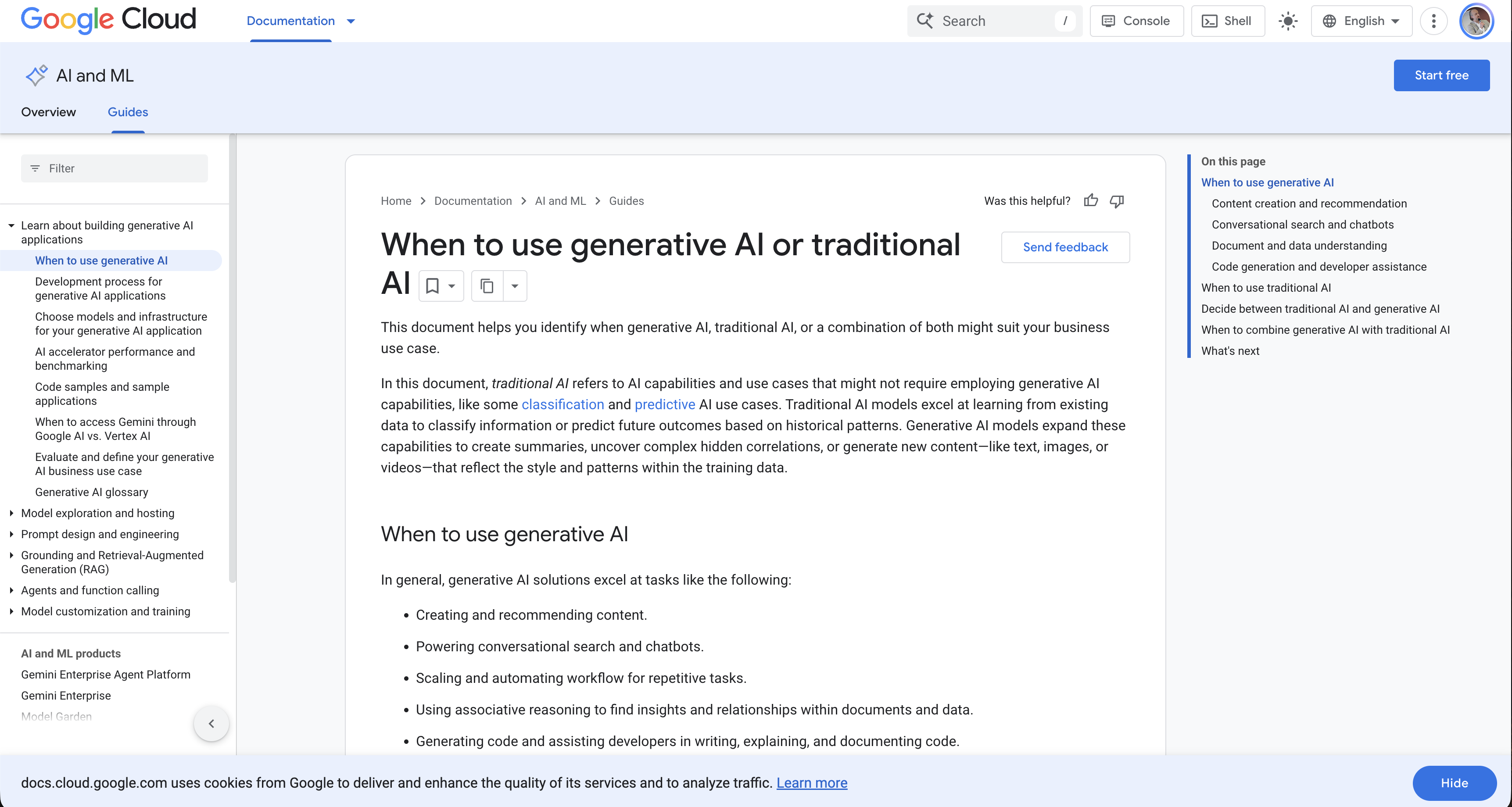
This resource helps distinguish situations where generative AI, conventional machine learning, or a combination may be appropriate.
The distinction matters because organizations sometimes select generative AI for problems that could be solved more reliably or economically through established technologies.
Why it matters: Choosing the wrong technological approach can make a viable business problem unnecessarily expensive to solve.
Use it to: Challenge technology assumptions before committing to a proposed implementation.
04 — Prioritize AI Investments
Translate competing opportunities into a defensible sequence of investment decisions.
Once opportunities have been identified and assessed, leadership must compare them.
A simple value-versus-effort matrix is a useful starting point, but more consequential decisions usually require additional dimensions.
Strategic alignment, uncertainty, data readiness, implementation complexity, adoption likelihood, time to value, and risk can all influence which opportunity deserves funding first.
The objective is not to produce a mathematically precise ranking from subjective assumptions. It is to make evaluation criteria explicit, expose disagreements, and create a transparent basis for decision-making.
16. AI Workflow Discovery and Prioritization Matrix — OpenAI Academy
Provider: OpenAI Academy
Format: Practical prioritization matrix
Best for: AI champions, operational managers, and internal innovation teams.

OpenAI Academy provides a matrix for comparing AI workflow opportunities according to impact or value and complexity or effort.
The approach helps teams identify opportunities suitable for immediate experimentation while distinguishing more complex initiatives that may require additional preparation.
Why it matters: A simple, consistently applied matrix can substantially improve the quality of early portfolio discussions.
Use it to: Create an initial ranking of AI opportunities collected from different departments.
17. Prioritization Frameworks — Atlassian
Provider: Atlassian
Format: Guide covering RICE, value-versus-effort, Kano, MoSCoW, and other frameworks
Best for: Product managers, portfolio managers, and strategy teams.

Atlassian’s guide explains several established approaches to prioritizing competing opportunities.
Although these frameworks were not developed specifically for AI, their principles can be adapted to compare AI investments.
RICE, for example, incorporates reach, impact, confidence, and effort. Other methods emphasize customer needs, urgency, or relative value.
Why it matters: AI portfolios can benefit from mature decision-making methods already used in product and innovation management.
Use it to: Select a prioritization model that matches the nature of your AI investment portfolio.
18. AI Use Case Prioritization Framework — Salesforce
Provider: Salesforce
Format: Downloadable prioritization matrix
Best for: Business leaders and enterprise AI program managers.

Salesforce provides a visual framework for plotting AI opportunities within a two-dimensional prioritization matrix.
The tool can support workshops in which decision-makers compare opportunities and discuss their relative attractiveness.
Its simplicity makes it suitable for an initial screening exercise before more detailed financial or technical evaluation.
Why it matters: Visual prioritization makes trade-offs easier to discuss across business and technical stakeholders.
Use it to: Facilitate an AI portfolio workshop and identify initiatives requiring deeper assessment.
19. Business Plan for AI Agents — Microsoft
Provider: Microsoft
Format: AI agent business planning and scoring framework
Best for: Enterprise AI teams and agentic transformation leaders.

Microsoft’s guidance provides a structured scoring approach across business impact, technical feasibility, and user desirability.
It also addresses how proposed agents relate to existing organizational processes, strategic goals, and measurable performance objectives.
Why it matters: Agentic AI investments require a defensible business rationale before technical architecture and autonomy decisions are made.
Use it to: Evaluate and compare proposed AI agent deployments using consistent scoring dimensions.
20. AI Use Case Prioritization Matrix — InitializeAI
Provider: InitializeAI
Format: AI opportunity assessment template
Best for: Consultants, transformation leaders, and AI portfolio managers.
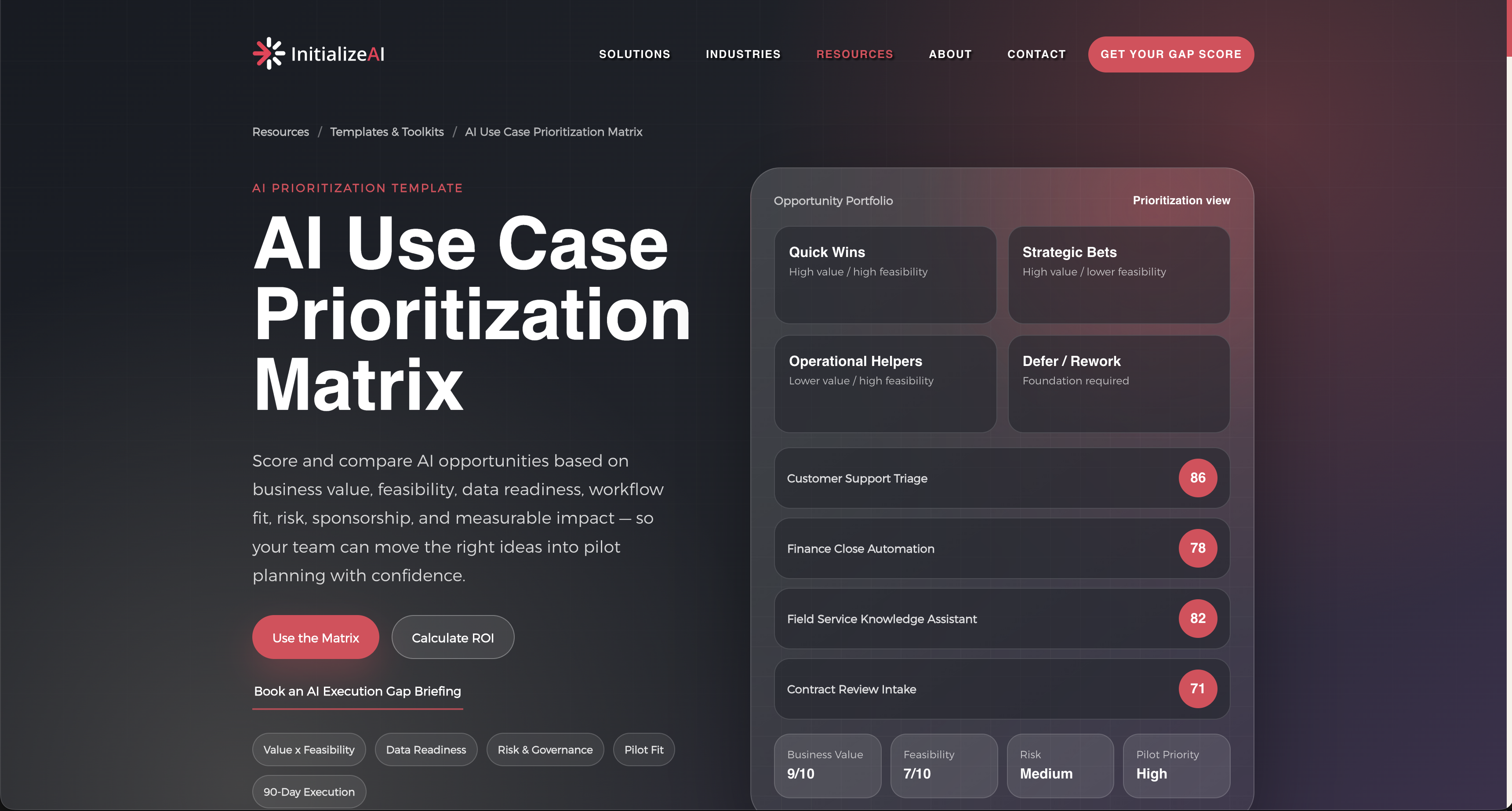
This resource provides a focused framework for evaluating AI opportunities through business value, feasibility, data readiness, workflow suitability, risk, and sponsorship.
It also connects prioritization with near-term execution considerations.
Why it matters: A useful prioritization model should examine whether an opportunity can progress beyond approval into operational implementation.
Use it to: Compare candidate initiatives and identify those ready for pilot planning.
05 — Account for Risk and Responsible AI
Incorporate uncertainty, governance requirements, and operational exposure into investment decisions.
Traditional investment frameworks often treat risk as an adjustment to expected financial returns.
For AI applications, that may be insufficient.
Some risks affect implementation cost and performance reliability. Others involve privacy, discrimination, security, legal obligations, inappropriate autonomy, or the potential consequences of incorrect decisions.
An opportunity with attractive expected returns may still be unsuitable if its risks cannot be reduced to an acceptable level.
This means governance should influence prioritization before implementation begins.
21. Incorporating Responsible AI into Generative AI Project Prioritization — AWS
Provider: Amazon Web Services
Format: Risk-informed prioritization methodology with example
Best for: Enterprise AI leaders, risk teams, and program managers.

AWS demonstrates how responsible AI considerations can influence the relative attractiveness of competing projects.
The guidance shows why projected business value and implementation difficulty alone may produce misleading rankings when risk-mitigation requirements are excluded.
Why it matters: The resources required to control AI risks can materially change which initiative deserves investment.
Use it to: Include risk assessment and mitigation effort within AI investment comparisons.
22. AI Risk Management Framework Playbook — NIST
Provider: National Institute of Standards and Technology
Format: AI risk management framework and practical playbook
Best for: Governance officers, risk managers, and enterprise AI programs.

NIST’s AI Risk Management Framework organizes risk management through four interconnected functions: Govern, Map, Measure, and Manage.
Its companion playbook provides suggested activities for incorporating risk management into AI development, deployment, and operational oversight.
Why it matters: Risk evaluation should be a continuous part of the AI investment lifecycle rather than a final compliance review.
Use it to: Establish consistent risk assessment requirements for shortlisted AI applications.
23. Data and AI Ethics Framework — UK Government
Provider: UK Government
Format: Ethics framework and associated self-assessment guidance
Best for: Governance teams, policy leaders, and organizations deploying consequential AI applications.
The framework helps organizations consider ethical implications throughout the lifecycle of data-driven and AI systems.
It addresses issues relevant to the responsible development, procurement, and deployment of AI applications.
Why it matters: An apparently attractive use case can create costs or harms that are invisible in a conventional productivity assessment.
Use it to: Evaluate ethical and governance considerations before approving AI development or deployment.
24. AI Playbook for the UK Government
Provider: UK Government
Format: Comprehensive AI adoption and governance playbook
Best for: Public-sector leaders and enterprise governance teams.

The AI Playbook provides principles and practical guidance for responsible AI adoption, including evaluating opportunities, understanding limitations, and establishing appropriate oversight.
One of its useful lessons is that AI should not automatically be selected when established technologies or alternative processes could solve the problem more effectively.
Why it matters: Rejecting an unsuitable AI application can be as strategically valuable as selecting a promising one.
Use it to: Establish screening criteria for sensitive, high-risk, or operationally consequential applications.
25. Making Agentic AI Work for Government: A Readiness Framework — World Economic Forum
Provider: World Economic Forum
Format: Agentic AI readiness framework and practical toolkit
Best for: Public-sector transformation leaders and organizations evaluating agentic systems.

The World Economic Forum’s framework examines conditions relevant to adopting agentic AI, particularly within public institutions.
Although sector-specific, it offers useful considerations for organizations assessing applications that combine autonomous actions, complex workflows, and institutional accountability.
Why it matters: Increasing system autonomy changes the readiness and oversight requirements that should influence investment decisions.
Use it to: Inform a readiness assessment for higher-autonomy AI initiatives.
06 — Build the AI Investment Roadmap
Turn priorities into experiments, implementation decisions, and measurable results.
A ranked list of use cases is not an implementation strategy.
Organizations still need to determine which assumptions must be tested, what resources should be allocated, who is accountable for results, and which evidence will justify further investment.
A useful roadmap should distinguish opportunities ready for implementation from those that require additional data, infrastructure, organizational preparation, or risk mitigation.
The final five resources help connect prioritization with execution.
26. AI Opportunity Sequencing Worksheet — OpenAI Academy
Provider: OpenAI Academy
Format: Practical opportunity sequencing worksheet
Best for: AI program managers, business leaders, and transformation teams.
The worksheet helps teams compare AI opportunities against a defined business priority and determine which should move forward first.
It encourages clarity around investment decisions, organizational ownership, leadership approvals, and the actions required over an initial 90-day period.
Why it matters: Prioritization creates value only when it changes how the organization allocates resources and makes decisions.
Use it to: Convert a shortlist of AI opportunities into a sequenced execution plan.
27. AI Use Case Prioritization Agent — Microsoft Copilot Studio Gallery
Provider: Microsoft
Format: AI-assisted assessment solution
Best for: Enterprise AI program managers and organizations managing larger opportunity portfolios.

Microsoft’s gallery describes an AI-assisted solution that supports consistent use case evaluation through defined scoring criteria, assessment records, and comparative views.
It demonstrates how parts of the prioritization process itself can be supported by structured AI workflows.
Why it matters: Large AI portfolios benefit from consistent evaluation records, comparable evidence, and transparent decision criteria.
Use it to: Explore how standardized AI assessments might be supported through a dedicated internal application.
28. Translating Assessment Insights into Actionable Outcomes — AWS
Provider: Amazon Web Services
Format: Workload assessment and implementation planning framework
Best for: Enterprise architects, AI delivery teams, and program managers.

AWS’s guidance explains how assessment findings can inform implementation choices, technical requirements, and development roadmaps.
It connects information collected during opportunity assessment with the practical decisions needed to move toward deployment.
Why it matters: Assessment findings should directly influence project scope, implementation sequencing, and resource allocation.
Use it to: Translate use case evaluations into practical delivery plans.
29. Capture and Share AI Use Cases and Impact — OpenAI Academy
Provider: OpenAI Academy
Format: Use case validation and documentation guide
Best for: AI champions, transformation teams, and operational managers.

This resource helps organizations document AI applications that have been tested in real work and demonstrate observable improvements.
It emphasizes collecting credible evidence, describing successful workflows clearly, and sharing validated practices so they can be replicated.
Why it matters: The strongest candidates for expansion are those supported by operational evidence rather than demonstrations or optimistic forecasts.
Use it to: Establish standards for documenting pilot results before approving broader deployment.
30. Measure the Value and Impact of Your AI — Google Cloud
Provider: Google Cloud
Format: AI value measurement framework
Best for: CFOs, transformation offices, and AI investment leaders.

Google Cloud provides guidance for measuring the business value of AI applications, connecting technical investments with operational and commercial outcomes.
The resource highlights the importance of evaluating value beyond infrastructure expenditure or technology adoption.
Why it matters: The final test of prioritization quality is whether selected initiatives deliver the business outcomes that justified their investment.
Use it to: Define performance measures and validate whether prioritized AI initiatives create meaningful value.
The TSS AI Use Case Prioritization Scorecard
An original assessment model for comparing AI investment opportunities.
The 30 resources above provide complementary perspectives. Some emphasize business value, others examine feasibility, risk, or organizational readiness.
For practical decision-making, organizations need a common assessment structure that combines these perspectives.
The following scorecard is a suggested TSS synthesis, rather than an externally validated or universally applicable model.
Its purpose is to make investment assumptions explicit and help leadership teams compare opportunities consistently.
From Prioritizing AI Opportunities to Building Viable Business Models
Identifying a promising AI opportunity is an important investment decision. Turning that opportunity into a commercially sustainable product or service requires further work: understanding what customers value, determining how to price the offering, evaluating delivery economics, and validating whether the business model can generate attractive returns.
The AI Monetization Playbook brings these decisions together in a practical 95-page guide covering pricing architecture, customer value evidence, AI delivery economics, and a structured commercial validation roadmap.
Included with The Strategy Stack paid membership.
Seven Dimensions of AI Opportunity Assessment
Evaluate each proposed AI use case against seven criteria, assigning a score from 1 to 5.

Scoring scale
- 1 — Very weak: Major barriers or limited supporting evidence.
- 2 — Weak: Significant uncertainties or dependencies.
- 3 — Moderate: Plausible opportunity with manageable constraints.
- 4 — Strong: Favorable conditions with credible supporting evidence.
- 5 — Very strong: Clear business relevance and well-supported implementation conditions.
Calculate the weighted score by multiplying each rating by its assigned weight and adding the results.
The resulting score ranges from 1 to 5.
Important: Risk and governance readiness carries a numerical weight in this model, but unacceptable legal, safety, privacy, or operational risks should act as exclusion gates. A strong economic score must never override an unresolved critical risk.
Similarly, these weights should be adapted to the organization’s objectives and operating context. The scorecard is a decision-support method, not a substitute for a business case or independent risk assessment.
Worked Example: Comparing Three AI Opportunities
Consider a hypothetical professional services organization evaluating three proposals:
Opportunity A — AI Research Assistant
An internal assistant that accelerates market research, document analysis, and preparation of client briefings.
Opportunity B — Automated Proposal Development
A workflow that assembles initial client proposals from approved templates, requirements, and organizational knowledge.
Opportunity C — Autonomous Client Delivery Agent
An agentic system intended to execute several stages of client delivery with limited human intervention.
Using the TSS assessment dimensions, an illustrative evaluation might look like this:

These are hypothetical assessments illustrating the method, not empirical performance results.
The proposal automation workflow ranks first because it combines substantial business relevance with relatively favorable implementation conditions.
The research assistant follows closely and could be an attractive early pilot because of its accessibility and speed to value.
The autonomous delivery agent offers greater theoretical economic potential but scores lower because of implementation complexity, data dependencies, organizational readiness, and uncertainty.
The appropriate decision would not necessarily be to abandon that third initiative. It might instead be to conduct a limited feasibility assessment, prepare the necessary capabilities, and revisit the opportunity once its constraints have been reduced.
This distinction is important: Prioritization determines what to do now, what to prepare for later, and what should not receive investment.
A 90-Day AI Use Case Prioritization Roadmap
The following sequence provides a practical starting point for organizations seeking to move from AI experimentation toward a more disciplined investment process.

Days 1–15: Discover and Define
Begin with the organization’s most important strategic and operational objectives.
Identify expensive processes, decision bottlenecks, unmet customer needs, growth constraints, and recurring operational problems.
Collect candidate AI opportunities from relevant business functions, but require each proposal to identify a specific problem, expected outcome, business owner, and preliminary success measure.
Output: A documented AI opportunity inventory.
Days 16–30: Assess and Prioritize
Apply a consistent assessment framework across the inventory.
Evaluate strategic relevance, economic potential, technical feasibility, data readiness, organizational capacity, implementation requirements, and risk.
Identify critical exclusions before calculating comparative scores. Review uncertain assumptions with relevant subject-matter experts.
Output: A ranked portfolio of opportunities with documented evidence, dependencies, and decision criteria.
Days 31–45: Build Investment Cases
Select a limited number of promising opportunities for deeper evaluation.
Estimate baseline operating costs and performance, projected benefits, implementation expenditure, ongoing costs, and the investment required for risk mitigation.
Establish what must be demonstrated before additional resources can be committed.
Output: Preliminary business cases and measurable validation criteria.
Days 46–75: Run Controlled Pilots
Test shortlisted opportunities in bounded operational environments.
Measure actual performance against the established baseline. Track quality, accuracy, exception handling, employee involvement, adoption, implementation effort, and operational reliability.
Document differences between expected and observed results.
Output: Evidence-based assessments of value, feasibility, and operating requirements.
Days 76–90: Make Portfolio Decisions
Review pilot results and update opportunity scores using the evidence collected.
Decide which initiatives should advance, which require modification or further experimentation, and which should be deferred or discontinued.
Assign accountable owners, approve appropriate resources, and establish performance monitoring for initiatives entering production.
Output: An evidence-informed AI investment roadmap with clear decisions, responsibilities, and next steps.
The central principle is that prioritization should remain dynamic.
An opportunity that is unattractive today may become viable as technology improves, data becomes available, or organizational capabilities develop. Conversely, an initially attractive initiative may lose its justification when testing exposes higher costs, lower adoption, or limited measurable benefits.
The purpose of the process is to continuously improve capital allocation as evidence accumulates.
Continue Exploring the TSS Resource Libraries
AI use case prioritization is one stage of a broader strategic process.
Once organizations have identified and evaluated their opportunities, they must understand the economics, design the workflows, develop the required capabilities, and connect implementation with longer-term competitive objectives.
The Strategy Stack provides complementary collections for each of these activities.
The AI ROI Library: 30 Business Cases, Calculators, and Frameworks for Measuring AI Value
Prioritization determines which opportunities deserve further attention. The AI ROI Library provides the tools for assessing whether those investments can create measurable economic value.
It covers business cases, financial calculators, cost models, performance metrics, empirical evidence, and investment governance.
The AI Workflow Library: 30 Real-World Examples for Business Teams
After selecting a promising opportunity, the next challenge is designing the actual work.
This collection provides 30 practical workflow blueprints across business functions, including triggers, execution logic, expected outputs, human checkpoints, and performance measures.
The AI Research Stack: 30 Free Tools for Finding Better Answers
A strong AI investment case depends on credible information.
The AI Research Stack provides tools for investigating markets, technologies, competitors, academic evidence, and emerging developments.
The AI Prompt Library for Work: 50 Templates That Solve Real Problems
Before committing to significant implementation expenditure, organizations can often explore assumptions through structured prompting and small-scale experimentation.
The AI Prompt Library provides reusable templates for research, analysis, decision preparation, planning, and business problem-solving.
The Strategy Stack Knowledge Hub
For a deeper understanding of the concepts underlying AI investment decisions, explore the Strategy Stack Knowledge Hub.
It connects frameworks and concepts across strategic positioning, competitive advantage, organizational capabilities, decision-making, AI operating models, and business economics.
From AI Opportunities to Strategic Advantage
The most consequential AI investment decisions are rarely about selecting the most impressive technology.
They concern the allocation of organizational resources toward opportunities that can improve performance, strengthen capabilities, and create value that the organization can actually capture.
A company may identify dozens of plausible AI applications. That does not mean it should pursue dozens of implementations.
Each initiative competes for investment capacity, technical expertise, management attention, operational support, and the organization’s ability to absorb change.
Successful prioritization therefore requires discipline: understanding the business problem, evaluating the strategic and economic case, testing feasibility, accounting for risk, and continuously updating decisions as evidence becomes available.
The 30 resources in this library provide a foundation for that process.
Used together, they help organizations move from an expanding inventory of AI possibilities toward a focused portfolio of decisions that can be explained, tested, and improved.
The quality of an organization’s AI strategy depends as much on the opportunities it declines as on the technologies it adopts.