AI is quietly redistributing authority inside organizations. The challenge is making decision rights, managerial accountability, and the design of work catch up.
By Alex Pawlowski
Published: 2026-10-27
URL: https://thestrategystack.substack.com/p/ai-strategy-org-chart-decision-rights


Guest essay · Matt Perry is the co-founder and CEO of Average Robot, an AI transformation and change management firm, and founder of Above Average Consulting. Previously holding senior leadership roles at M&C Saatchi, WPP, Omnicom, and Genero, he brings decades of experience in organizational transformation, business strategy, and technology adoption. His work focuses on closing the gap between AI investment and measurable business performance.
Guest essay · Rob Cannon, PhD is an organizational psychologist, coach, consultant, and co-founder of Average Robot. Combining organizational psychology with extensive experience in creative and knowledge-intensive industries, he advises leaders and teams on organizational culture, sustainable performance, and human-centered AI transformation. His work examines how organizations can redesign work, strengthen judgment, and help people thrive alongside emerging technologies.
The Strategy Stack is a reader-supported publication. To receive new posts and support my work, consider becoming a free or paid subscriber.
Together, Matt and Rob are the co-authors of The Elephant in the Algorithm, a leadership playbook exploring how organizations can turn AI transformation into sustainable growth while keeping people at the center of change.
Your organizational chart tells you who runs finance, who leads marketing, and who reports to the chief executive. It probably doesn’t tell you who decides that AI should produce the first version of a financial forecast, who decides whether to distribute it or shelve it, or what benchmark they used to do so.
But those decisions are already being made, whether you know it or not. An employee experiments with a tool, then a manager accepts its output. A procurement decision makes one capability available to staff but excludes another. Over time, individual choices become the way work gets done, and while the formal structure stays the same, the practical distribution of authority starts to drift.
This tension between the formal organizational structure and the real distribution of authority is frequently overlooked. As AI changes the allocation of work, empowers the more prolific AI users, and anoints the new guardians of quality control, a senior director may remain accountable for an outcome with barely any visibility into—let alone discretion over—the choices that now shape it.
Whether AI pays off will depend on operating-model decisions many organizations have yet to make: who holds AI decision rights, where those decisions sit, what managers control, and how roles change.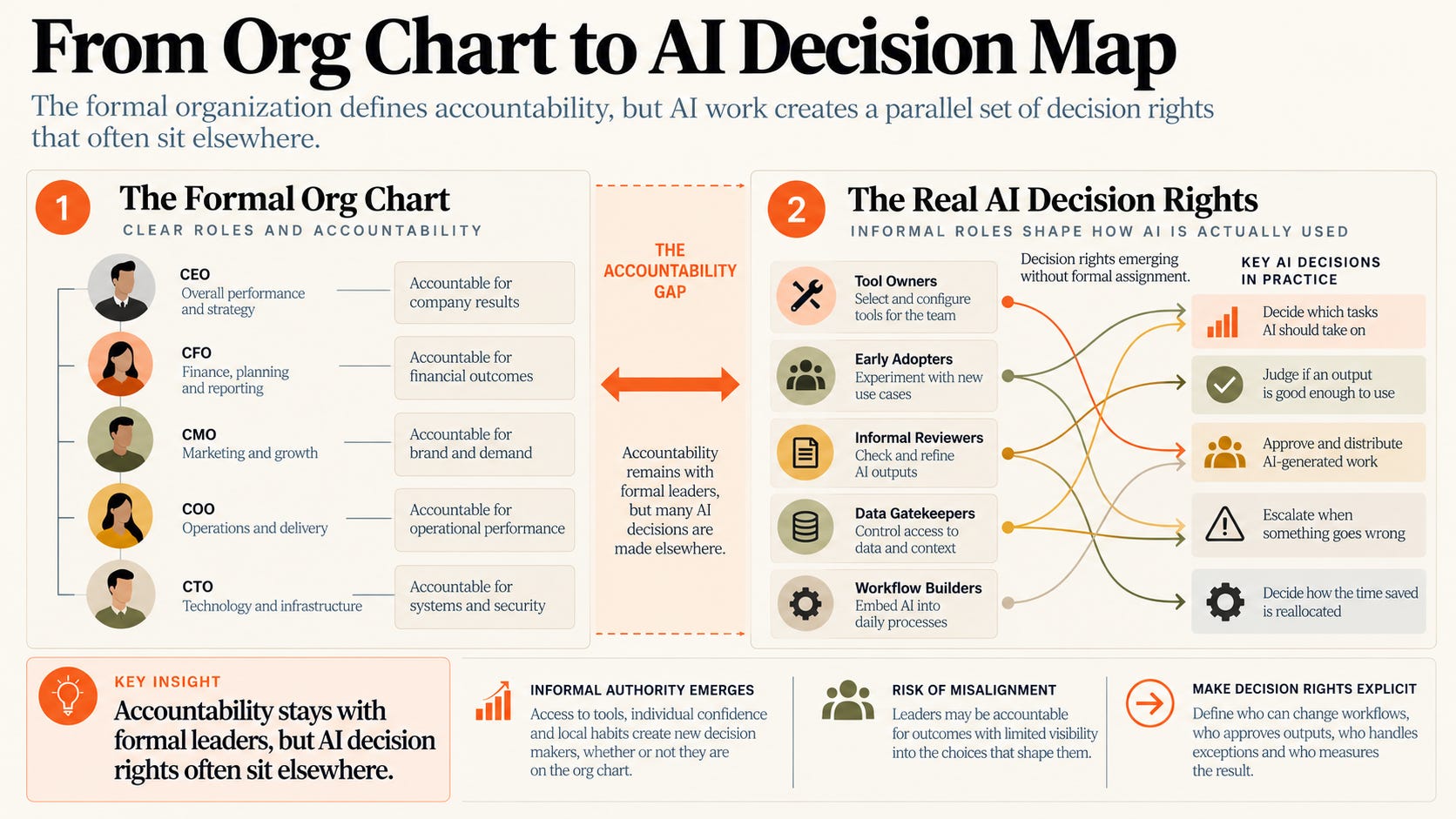
Someone is making the call. Have you chosen who?
Two decisions sit at the heart of any AI-enabled workflow: which work AI should take on, and who decides whether its output is good enough to use.
Leaving those questions unanswered simply delegates them informally. The most enthusiastic early adopter may end up defining the team’s approach. The tools approved through an IT buying process may determine which tasks get automated. A colleague known for being good with AI may become the unofficial reviewer, despite having neither the authority nor the subject-matter expertise—nor indeed the time—that this responsibility requires.
These people may well make sensible and well-intentioned choices, but their authority is accidental, and its limits are unclear. And when something goes wrong, nobody clearly owns it.
The first fix is to name an owner for the workflow, with explicit authority to approve how AI is used, and responsibility for the resulting performance. Leaders should also specify who can green-light or reject an output, who else can challenge it, and what situations must be escalated.
Buying the tool and approving the output are different decisions. An organization needs to know who owns each.
AI Champions Big Virtual Conference, 29 October
On 29 October, AI practitioners from Amazon, Samsung, DoorDash, Duolingo, Expedia Group, Miro and Zapier show how AI actually works inside their companies.
4 hours, 16 speakers and moderators, one track of real cases: long-running AI agents, AI pilots that stick, AI adoption across a large organisation and measuring the impact of AI training.
Online on Zoom, free.
9 AM PT | 12 PM ET | 4 PM GMT | 5 PM CET.
Decide what belongs in the center
Once you’re clear about who makes the AI decisions, the next question is where exactly those decisions sit on the org chart—centrally or within each business function.
A central AI team offers expertise and consistency, providing a common set of rules for where and how AI use should be handled. Data access, approved tools, and minimum assurance requirements will often need central ownership.
But if every proposed use, adjustment, and exception needs its attention, it can become a bottleneck through which the entire organization must squeeze.
Furthermore, deciding how AI fits into a particular workflow is usually best left to the people closest to that workflow. Local decisions may make sense individually, but can create gaps across a process that crosses several departments, or develop incompatible approaches to data access, testing, and review. Processes that cross functions need an owner who can resolve disagreements between them.
The most helpful distinction is between decisions that require common rules and decisions that require knowledge of the work. A central team can set that basis and support its application, while functional leaders must still own the consequences of using AI in their work.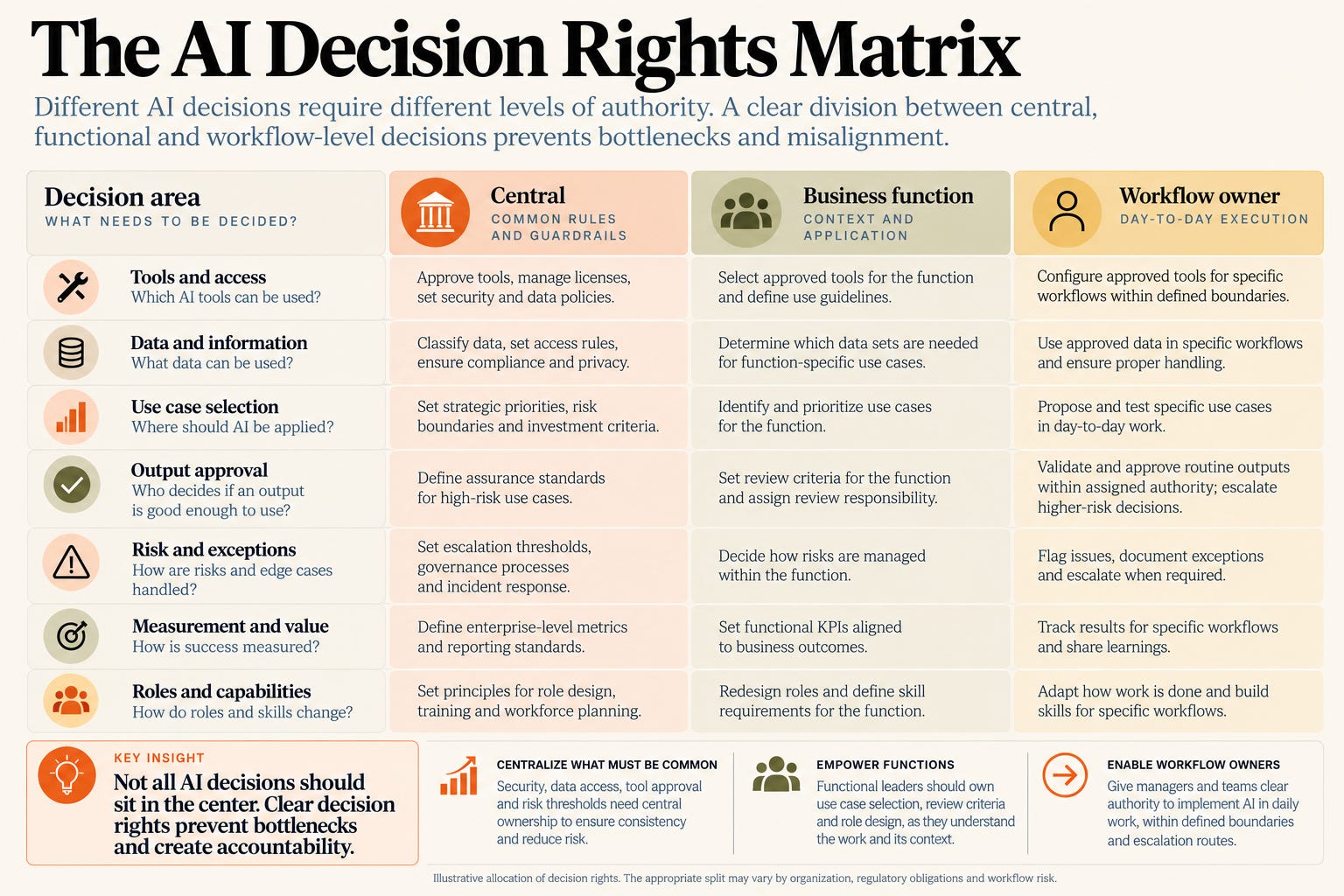
The U.S. federal government provides a useful example of this balance. Under White House guidance issued in 2025, the government requires every federal agency to have a Chief AI Officer; these officers are then coordinated through a central council led by the Office of Management and Budget.
Give managers authority over the work, and change what they measure
Managers sit on the org chart as accountable for results, but often have no say over how AI changes their team’s work. Holding them accountable while allowing a central technology program to dictate every task change creates responsibility without control.
Team managers need real authority over the allocation of work. That authority needs boundaries, including clear escalation routes for higher-risk changes. Within those boundaries, managers must be able to redesign the work they are expected to lead.
It is the manager’s job to decide how to measure what the work is meant to produce. Usage-based metrics—such as draft volume or token burn—say very little about value.
What matters is what all that activity actually delivers. That might mean the time required to reach a usable decision, the proportion of customer problems resolved, or the amount of rework needed before an output can be accepted.
Speed matters, but quality and the full cost of getting work finished matter more.
Rewrite the role before delivering the training
AI programs tend to start with training on the new tools. Employees often then return to essentially unchanged jobs. They’ve learned how to use the tools to produce a summary, analyze a document, or generate a presentation, but what remains unclear is which parts of their job are changing, where they should continue to direct their attention and judgment, and what they should do with the time saved.
Explicit role design gives training a purpose. If an analyst now spends more time testing assumptions, investigating anomalies, and explaining implications than they do writing briefs, that shift needs to be recognized.
These activities should appear in their responsibilities, workload, and performance expectations. Otherwise, the organization is asking them to invent a new job while continuing to satisfy the old one.
The revised role also needs to recognize the work AI introduces. Checking sources, resolving exceptions, and judging whether an output is fit for use all take time and skill.
Redesign the role first: what the person decides, what they review, what the AI model drafts, and who they answer to. Training can then prepare people for responsibilities the organization has actually chosen.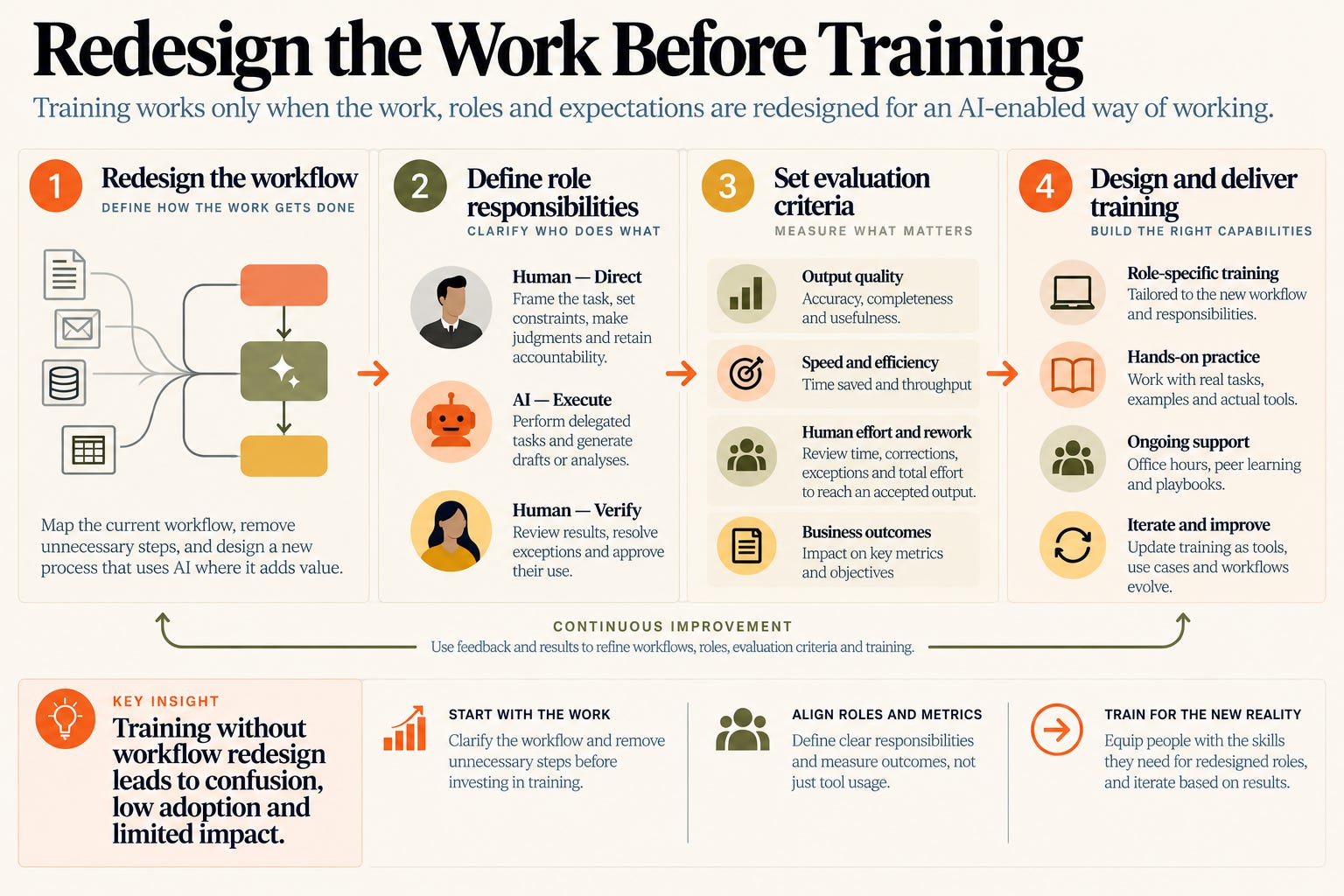
Redesign before you train and before you cut roles. The cost of getting the order wrong can arrive quickly.
In July 2025, Commonwealth Bank of Australia announced that 45 customer-service roles would go, claiming that the use of an AI voice bot had led to a fall of 2,000 calls a week. The Finance Sector Union pushed back, saying that the volume of calls had actually increased. Within weeks the bank reversed course and admitted that its assessment had been an error.
From the outside, it appears that the bank announced the cuts before the work had been redesigned around the bot.
The Strategy Stack is a reader-supported publication. To receive new posts and support my work, consider becoming a free or paid subscriber.
Make the real distribution of authority visible
An AI strategy becomes operational through a series of choices: who can change a workflow, who accepts the output, who handles exceptions, who measures the result, and who directs the capacity released.
If leaders leave those choices implicit, a new operating model will still emerge, shaped by access to tools, individual confidence, local habits, and the defaults built into software.
The org chart may continue to show one distribution of authority while daily work follows another. Closing that gap requires making decision rights explicit, establishing a balance between centralized oversight and function-based action, giving managers authority that matches their accountability, and revising roles around the work people are now expected to do.
An org chart becomes an AI strategy when it describes who can make these decisions—and the organization works that way in practice.