When building software becomes cheap, competitive advantage shifts from functionality to expertise, execution, data, and trust.
By Alex Pawlowski
Published: 2026-10-14
URL: https://thestrategystack.substack.com/p/generatable-software-saas-defensibility

Guest essay · Aditya Vithaldas is the founder of Decision Axis - a boutique product firm building insights and intelligence solutions for eCommerce and SaaS businesses. He writes at Decision Axis on Substack and on X.
Published on The Strategy Stack as a guest essay. If you’re a product or platform strategist deciding build vs buy vs delegate for AI-era software, this pairs with our pieces on
Over the weekend, a massive debate emerged about the future of software. One group, led by a popular indie developer - Pieter, took the stance that software was dead and personal software being the clear way forward.
That led to strong pushback, many who felt that people and businesses want their problems solved without taking on the job of building and maintaining software. Amir, CEO of Todoist, pointed out that they are doing better than ever, even as the industry changes shape.
While one can argue either side of this, one thing is abundantly clear: tomorrow’s software winners will look nothing like today’s software.
The traditional roles of software
Traditional software has broadly served three purposes. Each product plays one or more roles:
-
Systems of record - databases, CRMs, and ERPs : they hold the source of truth that people and other systems rely on.
-
Workflow software moves work through a sequence, such as a CRM or a document management suite.
-
Task software helps someone accomplish something specific: maintain to-dos, find inventory, search for information, find a product to buy, or book a cab.
These jobs will continue to matter. But any company relying on these constructs alone is likely to become redundant fairly quickly.
Take email marketing or newsletter software. If the proposition is simply to send emails and track opens and success rates, multiple builders could recreate that in a weekend - and many already have.
The next winners would look nothing like the previous ones
Software has traditionally progressed one dimension at a time. When we moved from a command-based approach to a GUI-based approach, most firms took the underlying workflows and adapted them to the visual interface. Moving from the desktop era to the cloud era expanded connectivity.
But the move from the cloud era to the intelligence era may look dramatically different - because how exactly do you even define intelligence?
The overhang capabilities span input (voice instead of text), intelligence (the computer making decisions on your behalf), output (generation), and the changing role of people in the process (the human being the assignee of work as against the one assigning work).
The transition is unlikely to unfold uniformly. As AI-assisted software development becomes more accessible, companies may move through overlapping periods of experimentation, operational complexity, and competitive restructuring. Meanwhile, specialized AI providers are already emerging alongside traditional software companies.
The following framework outlines three plausible phases of this market reconfiguration.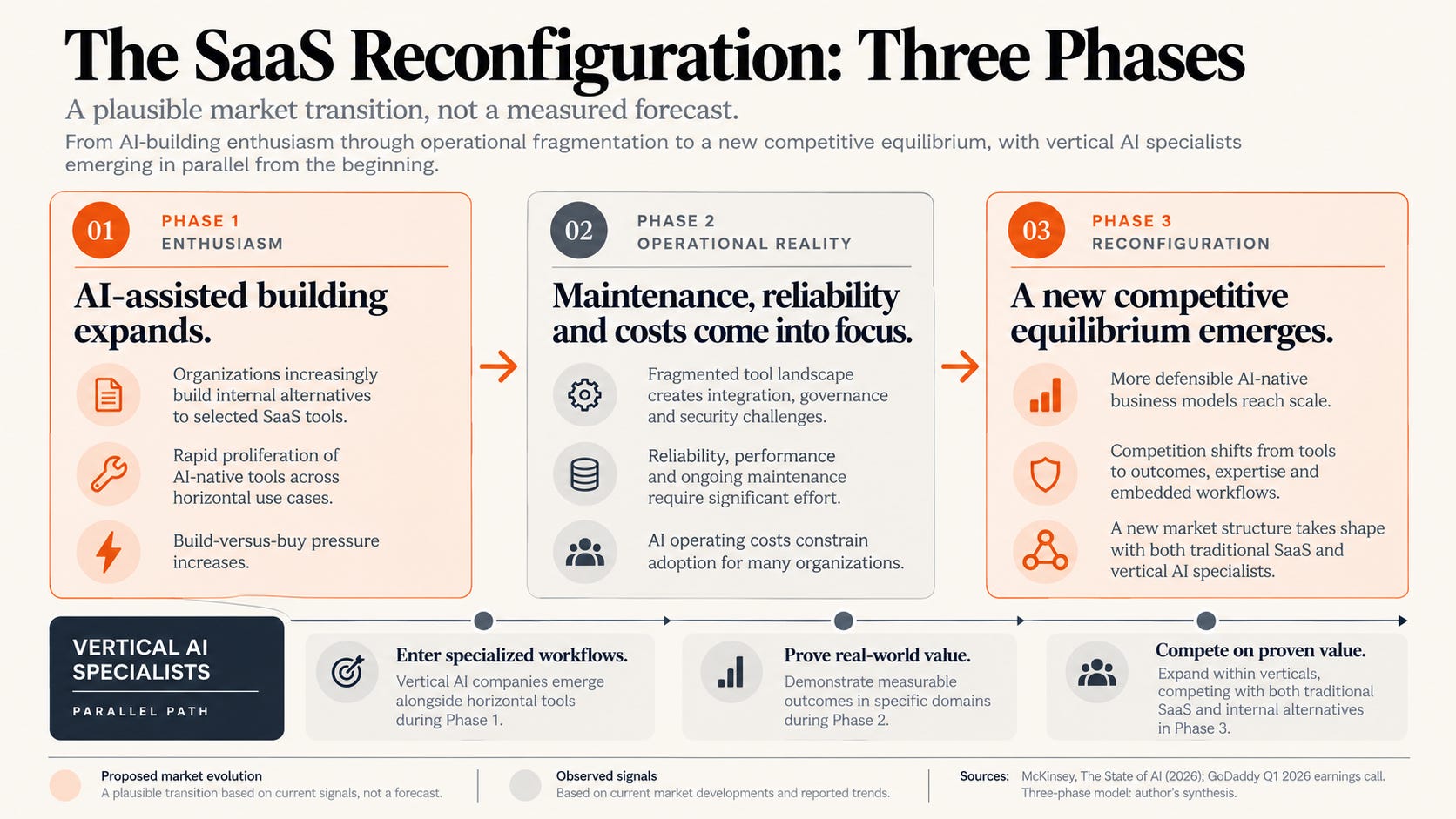 Framework for discussion - not a forecast or market prediction.
That is why everyone is in a mad race to figure out what the next phase looks like. And it would be a messy one - starting with…
Phase 1: Euphoria and enthusiasm
This is where companies start believing they can pull off almost anything. They start bringing selected software in-house while keeping their main systems of record and core production workflows in place.
GoDaddy captures this shift clearly. In its Q1 2026 earnings remarks, the company said: “We are also testing the replacement of smaller third-party SaaS tools with internally built solutions on Airo AI Builder.”
The shift is broader than individual examples. McKinsey’s 2026 survey found that 32% of respondents had decided against buying at least one software product or feature because they could build it internally using agentic coding tools.
That creates tension in contract negotiations. Buyers replace a few vendors, and try to push contract values down for others, while the vendors seek to charge more for AI capabilities. Salesforce, for example, announced an average 6% list-price increase for specified Enterprise and Unlimited editions, effective August 2025.
Thin tools become easier to question, platforms seek higher prices, and competition intensifies. Early wins that companies have gives everyone a (sometimes unreasonable) confidence that they can build their own alternatives may move faster than their understanding of what it takes to maintain them. Most companies are presently in this phase.
Phase 1b: The evolution of vertical software
Seeing the huge opportunity and the capability overhang, a lot of startups start investing heavily in vertical software. Harvey, for example, now reports adoption by over 75% of the 100 highest-grossing US law firms, with more than 200,000 lawyers across 2,400 organisations globally using its platform. Customer-service specialist Parloa surpassed $50 million in annual recurring revenue in December 2025.
With software creation becoming cheaper, these companies see an opportunity to extract more value by offering specialised capabilities and getting customers to the “wow” moment faster. While still smaller than established incumbents, they are gaining traction in specific workflows. The shift has already started in areas such as legal services and customer care, and the buildout across industries is likely to grow at different paces across industries - but nevertheless rapidly for everyone.
Phase 2: Chaos. Companies realise that building an MVP is easy; running it isn’t.
Companies that start taking software inhouse start realising that building an MVP is easy. Building a robust, reliable system and keeping it running, is hard. Issues start getting complex (and systems buggy), and fragmented internal tools become real problems.
Better approaches to system architecture will begin to evolve, but not every team will adopt them at the same pace.
Costs also start attracting scrutiny. Uber introduced a $1,500 monthly spending cap per employee, per AI coding tool, while selected JPMorgan employees reportedly received a $2,000 monthly Claude limit. Zoho’s Sridhar Vembu described rapidly increasing AI usage as “leading to much higher expenses, which we are trying to control.”
The enthusiasm for building gives way to harder questions about reliability, ownership, and cost. And question whether everything should be internal after all.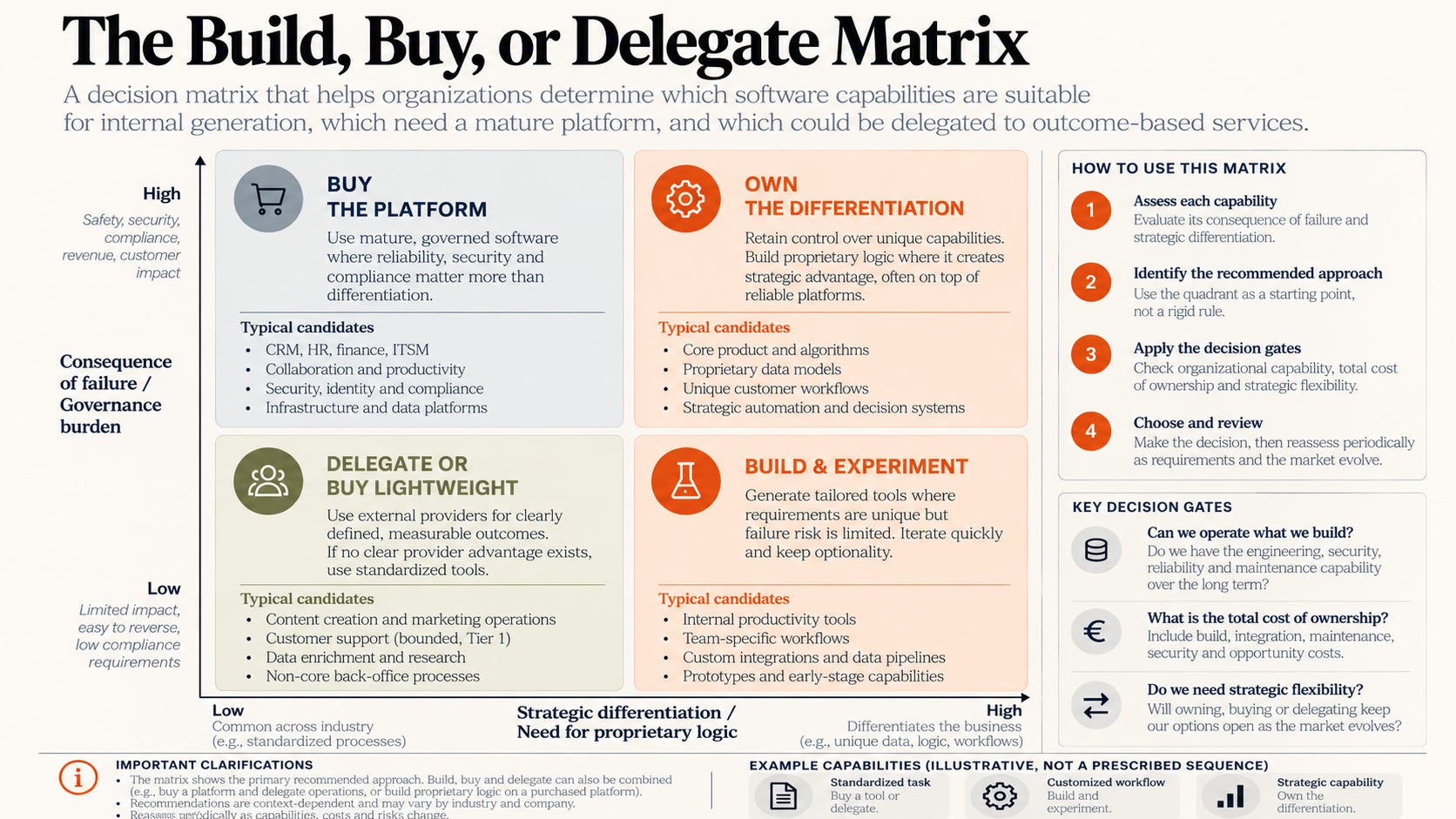
Phase 3: The fallout, the winning and losing use cases, and the crystallisation of the new avatar
This is when the real use cases start to emerge. Similar to the dot-com boom, when every dog-food startup was getting funded, shallow and gimmicky use cases start giving way to more substantial ones. An AI that generates marketing copy may struggle to stand out; one that runs campaigns and consistently improves conversion has a clearer case. An AI that summarises support calls may be useful; one that reliably resolves customer problems offers a more compelling outcome.
Companies that have figured out how to build reliable, robust systems at scale and iterate rapidly start ruling the roost. That is unlikely to be the biggest differentiator, but it will be a key one.
What is likely to define the winners? While it is too early to make that call, there are a few hypotheses.
As software becomes increasingly generatable, competitive advantage begins to migrate away from functionality itself. The next generation of defensible software businesses will combine domain expertise, autonomous execution, measurable outcomes, learning effects, customer relationships, and embedded trust.
The New SaaS Defensibility Stack brings these six sources of advantage together. Rather than describing a fixed sequence of development, it illustrates the capabilities that can reinforce one another as the underlying software foundation becomes easier to replicate.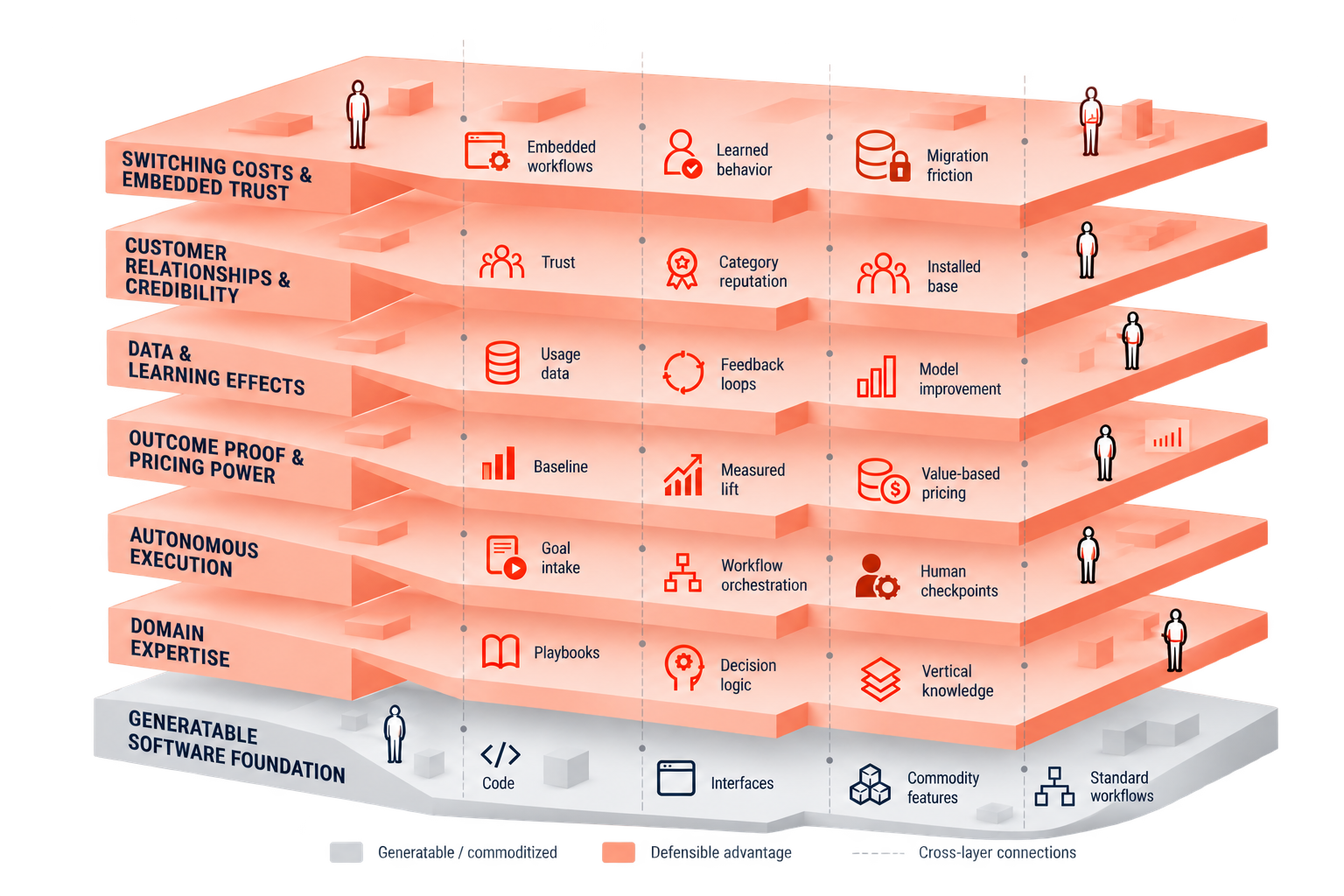
Criterion 1: Expertise, not just workflows
When software can be written by almost anybody, what you build becomes really important. Companies will need to evolve towards a higher-order way of thinking. A document management system for a legal firm should go beyond storing documents to helping determine what to do in a particular case. Marketing software should go beyond sending emails to recommending channels that will produce better outcomes. And executing it themselves, and iterating on the results themselves as well.
Criterion 2: Proving outcomes - and pricing accordingly
When you sell expertise, how does a customer know whether that expertise really is any good? Companies confident in their capabilities start demonstrating improvement against an agreed baseline or control group and align their pricing with those results.
Intercom describes the proposition clearly: “you only pay when AI resolves a customer’s problem.”
Similarly Brett Taylor, CEO of Sierra and Board Member for OpenAI says
Outcome-based pricing gives companies a way to back up their claims about expertise. Per-seat and per-process pricing may remain relevant, but customers will increasingly question whether those measures reflect the value delivered.
Criterion 3: Owning the work, coordinating with people
The next generation of software probably starts with taking a goal, determines what needs to happen, and carry the work through to completion. People will increasingly set direction, approve consequential decisions, and handle exceptions. The product’s value will depend on knowing when to act independently, when to ask, and when to hand work back to a person.
For example, marketing software could identify an underperforming campaign, propose and generate alternatives, run approved experiments, and bring the results back - asking for human input where needed.
Criterion 4: Scale and data effects
Solutions can get better with data. When customer usage helps improve a product’s decisions and outcomes, more customers can create a compounding advantage.
As Dan Hockenmaier writes in Lenny’s Newsletter: “The more usage a product has, the more data it generates.”
The early race for customers could therefore create a reinforcing cycle: more usage generates useful data, better outcomes attract more customers, and the cycle continues. But this depends on whether companies can turn that data into measurable improvements. Simply collecting more data is not enough.
Criterion 5: Customer relationships and credibility
If you already have customer relationships, credibility in the space, and a reputation for doing something well in the sector, you have a significantly higher likelihood of being chosen - provided your offering is as good as others in the market.
There may be 10,000 companies building the same software. The one most likely to be heard is the one with an established voice and those relationships.
Criterion 6: Switching costs
Nobody likes disruption or having to settle into something new, and the current wave is already disorienting for many customers.
Once customers have fed in their data, learned the product’s capabilities, gained confidence in its outcomes, and built workflows around it, replacing it becomes a much bigger decision. The cost goes beyond migrating data: it includes relearning the system, rebuilding workflows, and establishing trust in its results.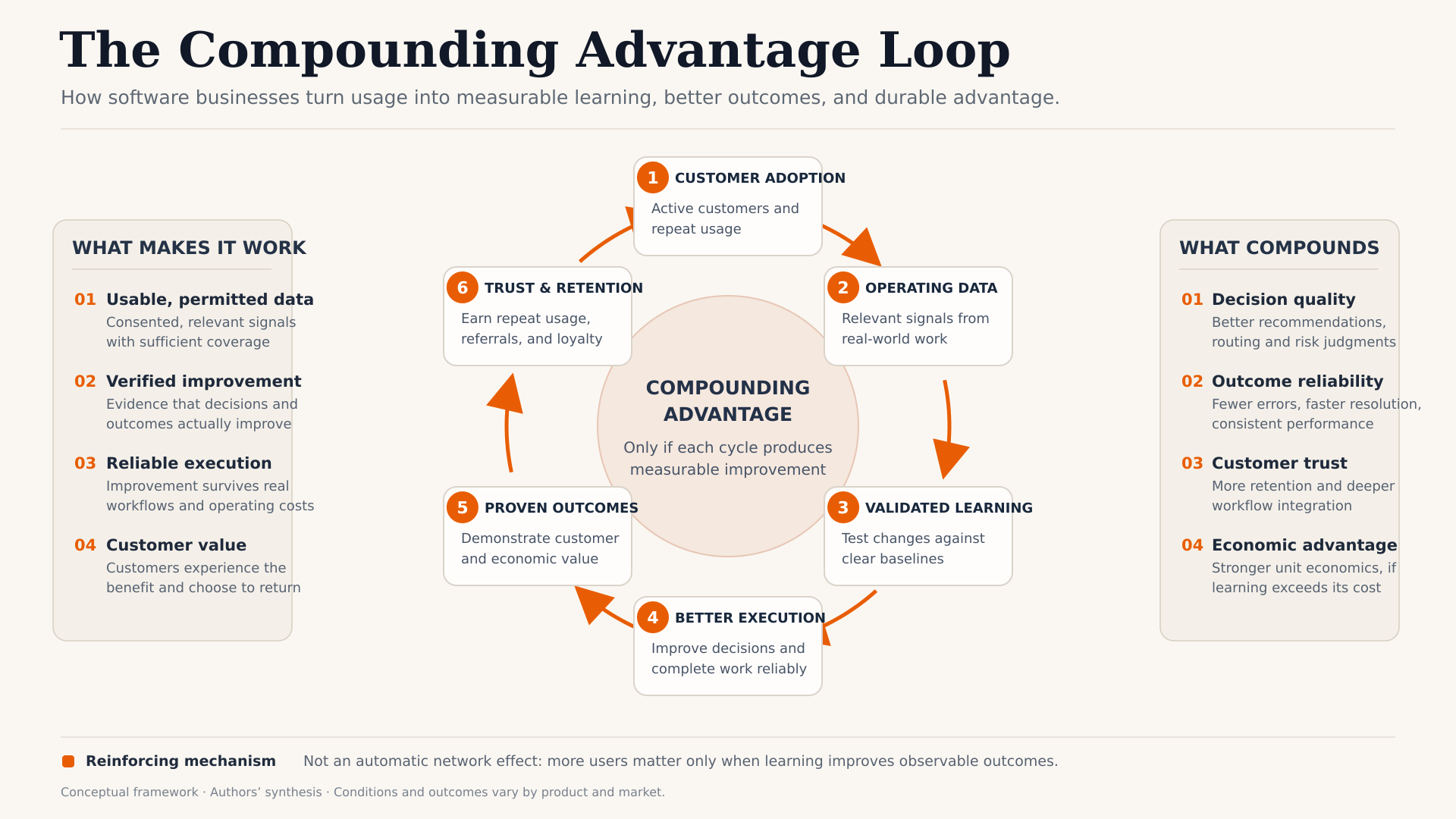
Some of the fundamentals of product building have always been, and will always be, the same: build something people want, talk to your users, start small and focused, and solve for retention first. That said, the new principles are likely to be additional elements that product builders will need to succeed in this new world.
FAQ
What is generatable software?
Software whose core functionality - interfaces, workflows, and features - can be produced quickly with AI-assisted development, making generic capability easier to replicate and shifting advantage to expertise, execution, and proof of outcomes.
What is left to defend when software is easy to build?
Defensibility moves to domain expertise, autonomous execution with human gates, outcome-based pricing, learning effects from usage, customer credibility, and switching costs - not the feature list alone.
Build, buy, or delegate: how should companies choose in 2026?
Use consequence of failure and strategic differentiation: buy governed platforms for commodity work, own what creates advantage, delegate low-stakes outcomes, and experiment only where failure is cheap - then revisit as AI operating costs and reliability realities set in.
About the author
Aditya Vithaldas is the founder of Decision Axis, a boutique product firm focused on insights and intelligence solutions for eCommerce and SaaS businesses. Read more on Decision Axis or follow him on X. Decision AxisPractical AI, voice, and agents—and where we’re headed.By Aditya Vithaldas
