Inside Klarna's business model: how checkout, underwriting, payments, deposits and AI turn BNPL into a consumer finance network.
By Alex Pawlowski
Published: 2026-10-03
URL: https://thestrategystack.substack.com/p/klarna-strategy-teardown


Status: Data current through Q2 2026 unless otherwise stated.
Hi - Alex here.
Most people still describe Klarna as a buy-now-pay-later company.
That description now explains less of the business than it hides.
Klarna’s real bet is structural: own the moment of purchase decision, then expand outward from it while checkout acquires the transaction and real-time underwriting prices the risk. The app, card, deposits, financing and memberships deepen the relationship and merchant integrations keep feeding new transactions back into the machine.
The result increasingly resembles a consumer-finance network whose front door happens to be checkout.
That distinction matters because the economics have begun to catch up with the architecture. Klarna generated $127.9 billion of GMV and $3.5 billion of revenue in FY2025. By Q2 2026, it had more than 120 million active consumers and 1.2 million merchants, while quarterly transaction margin dollars grew 42% year over year, faster than both revenue and GMV.
After listing on the NYSE in September 2025 at $40 per share under ticker KLAR, Klarna is no longer being valued only on growth narratives. Public markets can now inspect the machinery underneath them.
That is the purpose of this new series.
Strategy Stack Teardowns breaks companies apart into the product, technology and economic systems that actually create their advantage.
Klarna is a good place to start because its strategy asks a deceptively simple question:
When distribution moves inside the cart, who captures the economics - the bank, the merchant, the network, or the interface?
TL;DR
-
Klarna is evolving from a payments interface into an everyday-finance network.
-
Core mechanism: merchant checkout → real-time underwriting → consumer relationship → card, financing, savings, memberships and repeat commerce.
-
Scale: FY2025 GMV reached $127.9B with $3.5B revenue. Q2 2026 alone produced $36.6B GMV and $1.042B revenue. Klarna Group
-
Structural edge: merchant distribution plus transaction-level intent data gives Klarna the opportunity to originate credit at the precise moment demand exists.
-
Deepening evidence: revenue per active consumer increased 24% YoY in Q2 2026; Klarna Card reached 6.5M active users, while paid Memberships reached 2M subscribers. Klarna Group
-
Economics: Q2 transaction margin dollars reached $446M, +42% YoY, versus revenue growth of 27% and GMV growth of 18%. Provisions for credit losses were 0.52% of GMV, down from 0.56% a year earlier. Klarna Group
-
Strategic risk: longer-duration financing, funding competition, wallet/platform bundling and merchant fee compression can all attack the economics even while GMV continues growing.
-
CSO takeaway: value migrates toward whoever controls conversion at the point of decision and can convert that control into defensible unit economics.
In this teardown
-
Teardown snapshot
-
How Klarna makes money
-
Checkout as the control point
-
How the stack works: product, technology and economics as one machine
-
Distribution: embed where purchase intent is highest
-
Underwriting: credit as a per-transaction product decision
-
Consumer surface: from checkout to financial relationship
-
Operating leverage: AI as economics, not theatre
-
Klarna vs. Affirm: same aisle, different architecture
-
Geography as product strategy: one stack, different maturity curves
-
What the market should actually price
-
What could break the thesis
-
What everyone will copy wrong
-
Three decisions for your company
-
The larger lesson
1. Teardown snapshot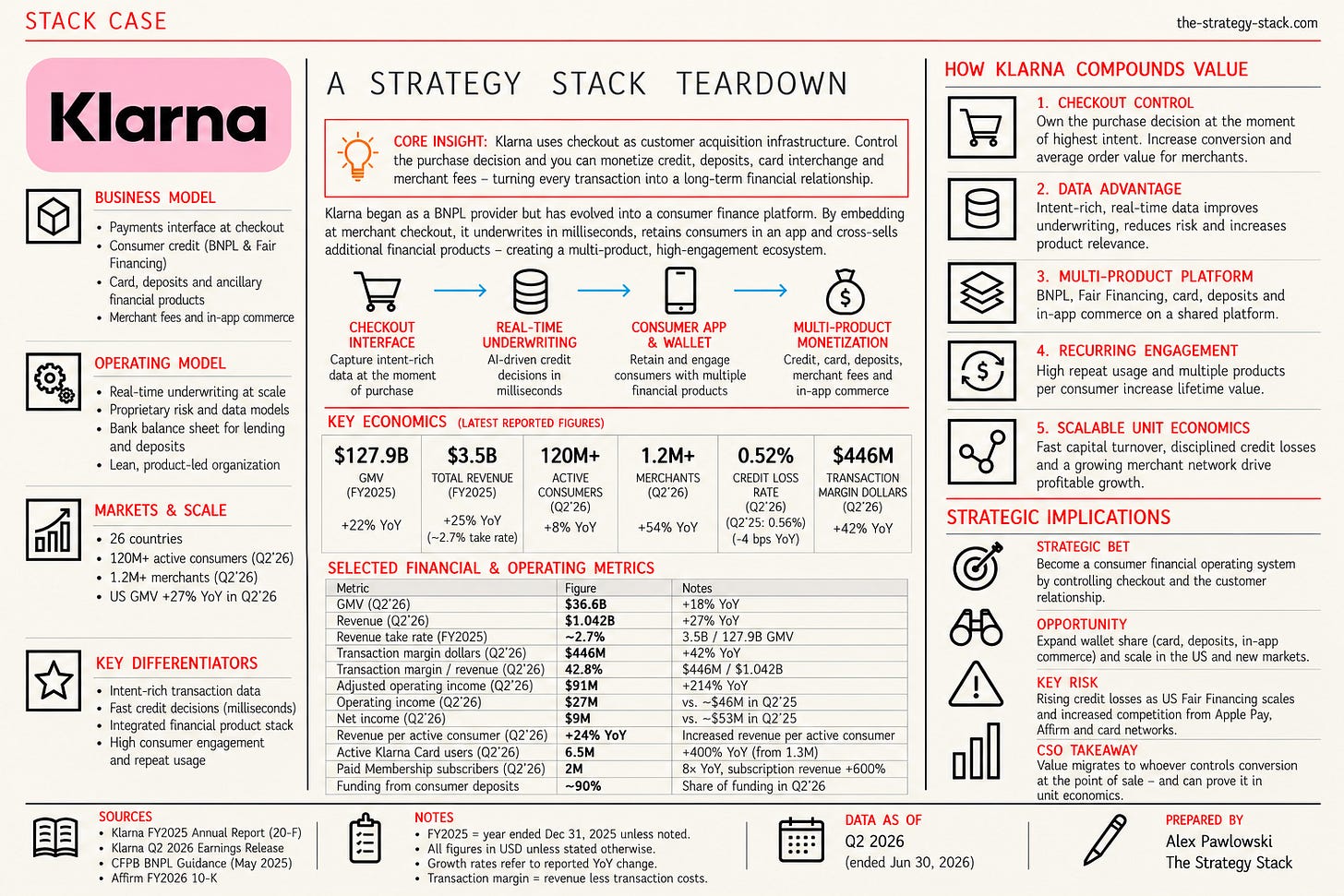
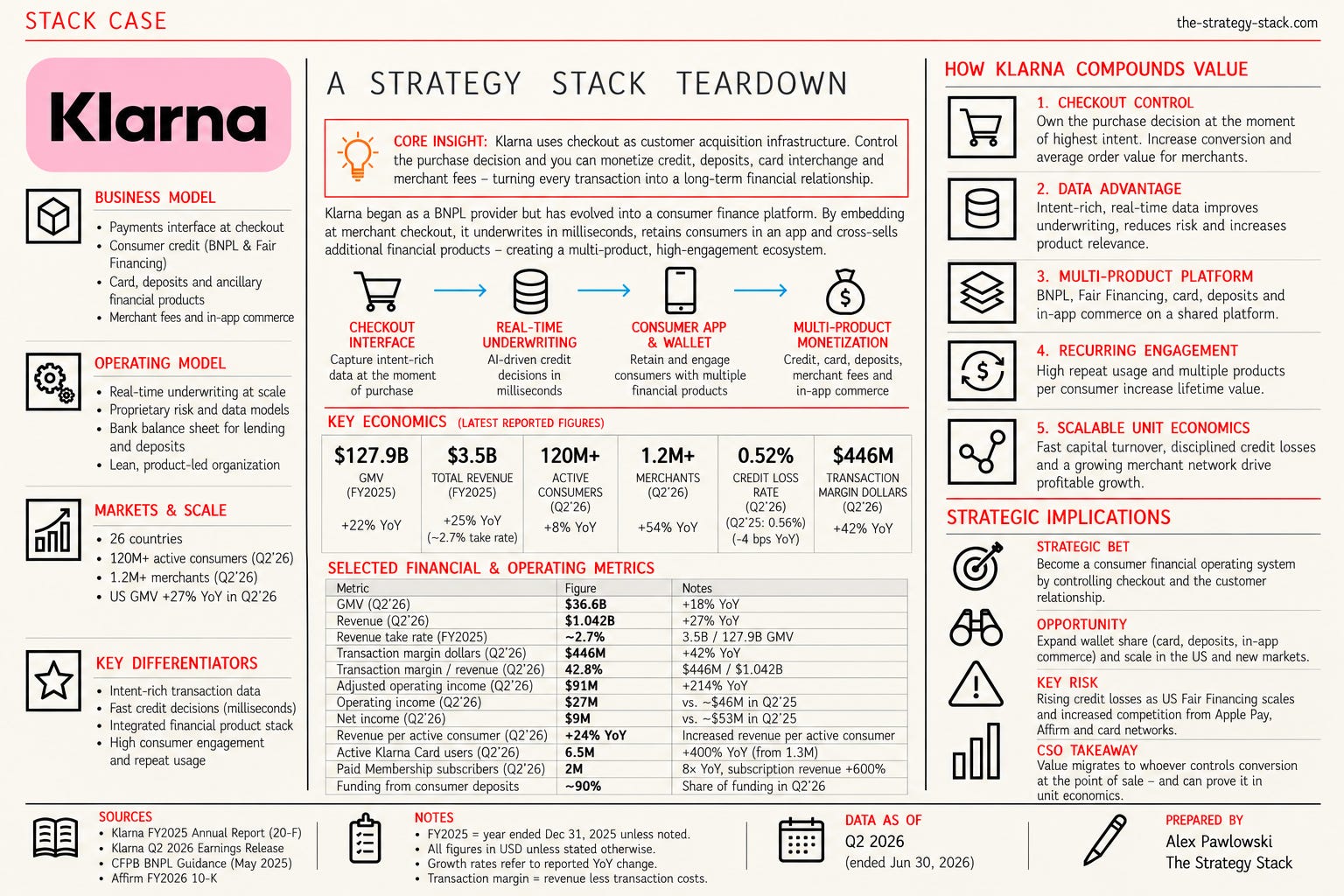
2. How Klarna makes money
Klarna makes money by monetizing transaction flow in several ways rather than depending on one product.
Merchant-related transaction revenue remains central as Klarna gets paid when it helps merchants convert purchases. Longer-duration financing creates interest income while the card adds interchange economics, all leveraged by the consumer relationship that creates opportunities for savings, subscriptions, commerce and additional financial products.
The important point is that those revenue streams should not be understood independently, here’s why:
Starting from distribution Klarna acquires the transaction and underwriting determines which transaction Klarna can finance. Consumer products increase frequency and revenue per user while the funding architecture determines how economically the credit can be supplied.
That is the full system in a nutshell - let’s now take a more detailed look.
Klarna’s FY2025 numbers already showed the scale transition: $127.9B GMV, $3.5B revenue, 118M active consumers and 966K merchants. By Q2 2026, active consumers had moved above 120M and the merchant network above 1.2M. Klarna Group
More important than raw scale, however, is what happened inside the economics.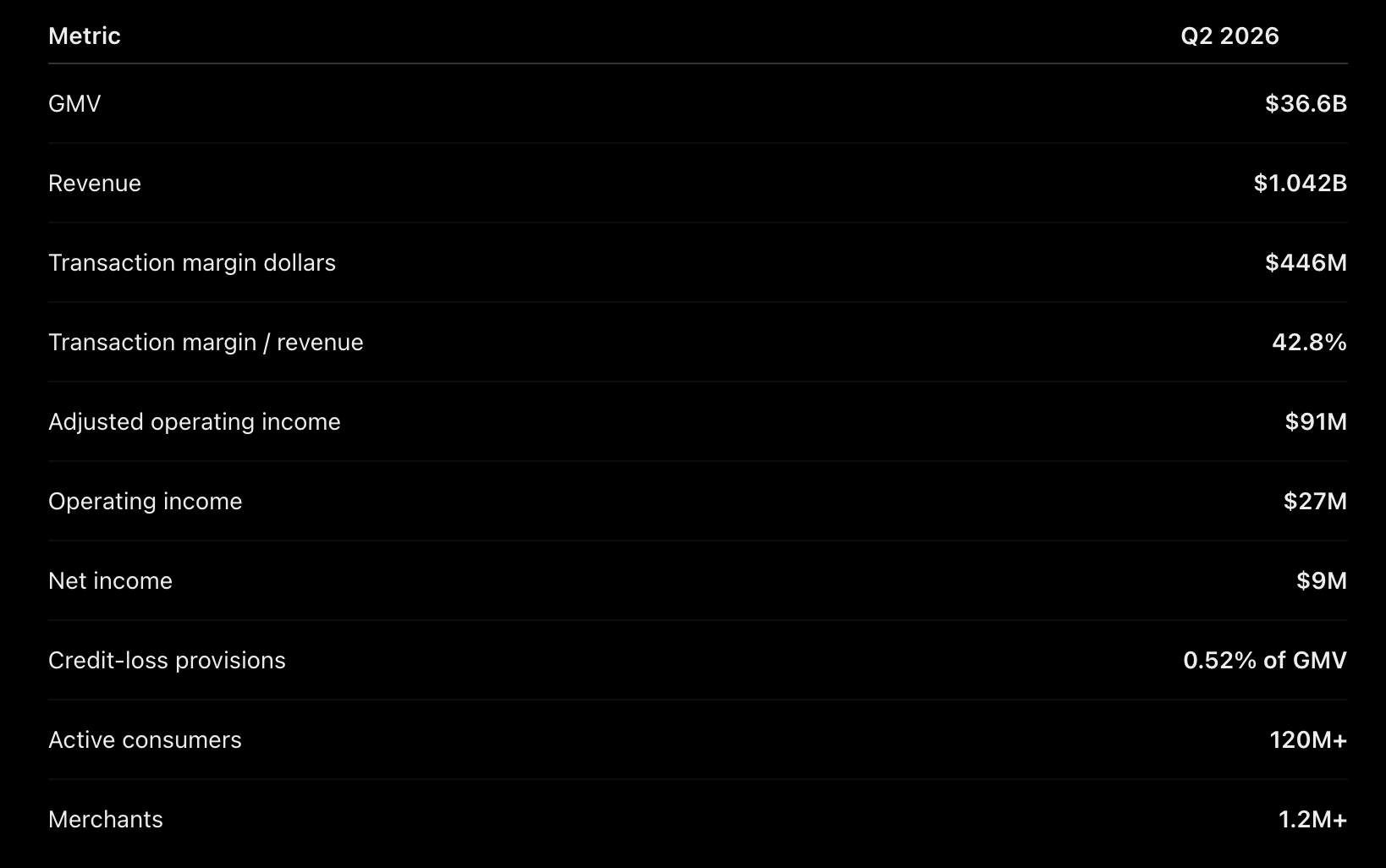
Revenue grew 27%; transaction margin dollars grew 42% which means that spread is more strategically important than GMV growth alone because it suggests the system was capturing more economics from each layer of transaction activity.
3. Checkout as the control point
Every durable platform makes one structural bet that subordinates product roadmaps, technology architecture and capital allocation.
Klarna’s is this:
The checkout interface is one of the most valuable control points for consumer-finance origination because it captures demand at the moment it becomes actionable.
Traditional banking historically begins with the financial relationship: account, balance, credit line, mortgage, branch, card.
Commerce begins somewhere else: intent.
The consumer already wants the product and the merchant already wants conversion so the question is whether financing can remove the last piece of friction quickly enough to complete the transaction. That changes underwriting from a separate financial process into a product decision embedded in commerce.
Klarna can observe signals around the transaction, combine them with repayment history and risk infrastructure, and make a decision while the basket still exists.
That is strategically different from acquiring a borrower first and subsequently finding a use for the credit.
The consumer does not experience this:
Apply for loan → receive credit → find something to purchase.
They experience this:
Want product → choose payment method → receive financing decision.
Credit essentially moves inside the purchase flow and once the credit decision sits inside the purchase flow, the checkout becomes more than a payments endpoint.
It becomes an acquisition channel for a financial relationship.
Now, let’s put it all together.
4. How the stack works: product, technology and economics as one machine
The mistake is treating Klarna’s BNPL products, consumer app, bank balance sheet and AI program as four separate stories while they actually form a coupled one.
Each layer changes the economics available to the next as seen in the following: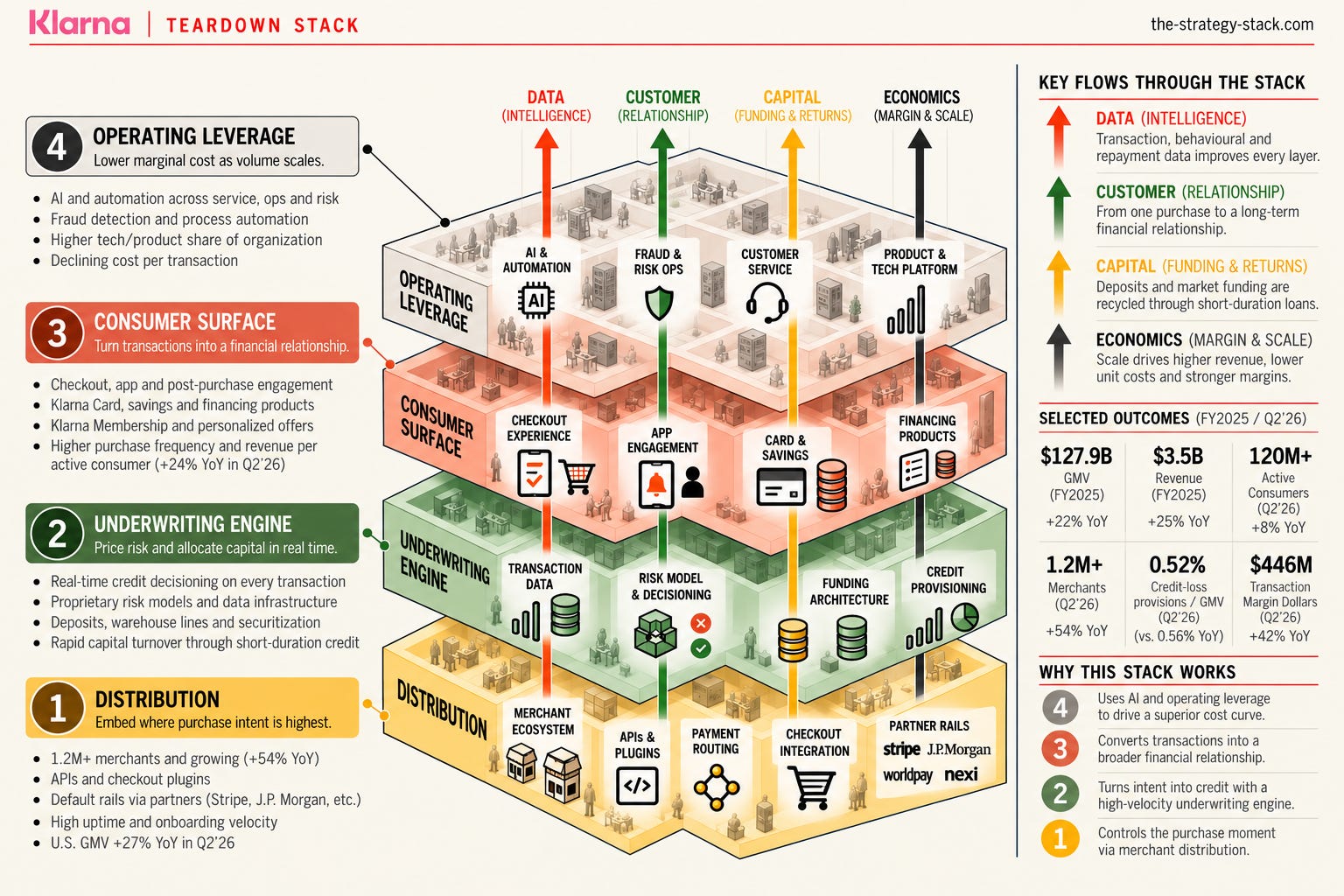
5. Layer 1 — Distribution: embed where purchase intent is highest
Klarna’s distribution advantage is increasingly its merchant network and integration layer, not merely its consumer brand. FY2025 ended with 966,000 merchants and only six months later, Klarna reported more than 1.2 million, up 54% year over year.
The strategically interesting part here is how that network is being built as distribution increasingly arrives through payment infrastructure itself.
J.P. Morgan Payments went live with Klarna in 2026, allowing merchants using its acquiring platform to offer Klarna’s payment products without each merchant building an independent Klarna integration. Klarna says these payment-platform integrations are helping switch on flexible payments with little or no additional merchant integration work.
That is important as it changes the product objective from:
be offered by many merchants.
to:
become part of the default commerce infrastructure through which merchants already operate.
Every integration step removed lowers the marginal cost of merchant acquisition where every merchant acquired creates another opportunity to acquire a consumer transaction.
As a result distribution compounds.
6. Layer 2 — Underwriting engine: credit as a per-transaction product decision
As we learned distribution explains where Klarna meets demand so where does underwriting fit in because that determines wether it can profitably monetize that demand.
Klarna has operated as a licensed European bank since 2017 and that matters because deposits and banking infrastructure are not peripheral to the model: they help determine the cost and scalability of credit origination. In Q2 2026, Klarna said roughly 90% of its funding was supported by low-cost consumer deposits.
In July 2026, Klarna established a €900 million German forward-flow and warehouse facility designed to support up to €5 billion of Fair Financing expansion. Klarna sells qualifying receivables on a rolling basis while retaining underwriting and consumer servicing which is strategically important as the model begins to separate:
customer ownership
from
capital ownership.
Klarna can originate the relationship, make the underwriting decision and service the consumer without necessarily retaining every euro of credit exposure on its own balance sheet.
That creates another form of operating leverage because the valuable asset becomes less “we own the loan” and more:
we own the distribution, decisioning and customer relationship that create the loan.
Klarna also applied in July 2026 to establish Klarna Bank USA, a proposed Utah-chartered industrial bank. The application remains an application rather than an approved charter, but the strategic direction is clear: Klarna is trying to deepen control over the financial infrastructure beneath the U.S. business as well.
Credit risk, however, remains real as Q2 provisions for credit losses were 0.52% of GMV, versus 0.56% a year earlier. That is encouraging while volume expands, but the test becomes harder as the product mix moves further into longer-duration Fair Financing.
7. Layer 3 — Consumer surface: from checkout widget to financial relationship
As we learned Layer 1 acquires the transaction and Layer 2 prices the risk so Layer 3 now determines whether Klarna owns the consumer relationship or keeps renting it from merchants.
The sequence is becoming increasingly visible.
1. Checkout - A consumer chooses Klarna and Klarna acquires a high-intent transaction.
2. Re-engagement - The consumer returns through the app for purchase management, offers and financial functionality.
3. Deepening - Card, savings, financing and Membership give Klarna reasons to participate in transactions that did not originate inside a Klarna-branded checkout.
4. Compounding - More financial activity produces more revenue per active consumer and makes the relationship less dependent on any one merchant.
The 2026 evidence for that dynamic is much stronger than it was a year ago:
-
In Q2, Klarna reported 6.5 million active Klarna Card users across 16 countries, up from 1.3 million a year earlier and
-
Paid Klarna Memberships reached 2 million subscribers, eight times the prior-year figure, while subscription revenue increased more than 600%.
-
Most importantly, revenue per active consumer grew 24% year over year.
In my opinion that is what consumer deepening should look like economically and not vanity metrics such as more app opens or a larger marketing audience.
More financial value captured per relationship.
At Q4 2025, Klarna also disclosed that consumers using its broader banking products generated materially more revenue than the average consumer, reinforcing the same architecture: payments acquire the relationship; banking products monetize its depth.
The shopping app is therefore not primarily a lifestyle bet but more akin to re-engagement infrastructure, the card is essentially a way to extend Klarna’s economic surface beyond merchant checkouts and the Membership is another mechanism for increasing relationship density.
All three solve the same strategic problem:
How does Klarna remain present after the original transaction disappears?
8. Layer 4 — Operating leverage: AI as economics, not theatre
Klarna became one of the most visible corporate examples of aggressive AI adoption due to its operating leverage and it is easy to reduce it instead to headcount headlines.
The more useful strategic question is:
Does technology cause the marginal cost of processing another transaction, consumer or merchant to decline?
The evidence increasingly suggests that something structurally significant has happened to the cost base.
Klarna reported in early 2026 that, since Q4 2022, revenue had increased 104% while operating expenses declined 8%. Revenue per employee had risen to $1.24 million, 3.6 times its 2022 level, alongside a 49% reduction in headcount.
By Q2 2026, the business produced:
$446M transaction margin dollars
$91M adjusted operating income
$27M operating income
$9M net income
while GMV expanded 18%.
That is the correct CSO frame.
Not:
How many employees did AI replace?
But:
Does the technology architecture allow revenue and transaction margin to scale faster than the operating resources required to produce them?
Most importantly here: AI matters when it moves that equation.
9. Klarna vs. Affirm: same aisle, different architecture
Klarna and Affirm are frequently grouped together because both appear at checkout and that can obscure how different their economics are.
Affirm’s FY2026 GMV reached $50.2B and revenue reached $4.26B, implying revenue equivalent to roughly 8.5% of GMV. Klarna’s FY2025 GMV was $127.9B against $3.5B revenue, or roughly 2.7%. The fiscal periods differ, so this is not a perfect like-for-like comparison, but the magnitude of the difference is strategically meaningful.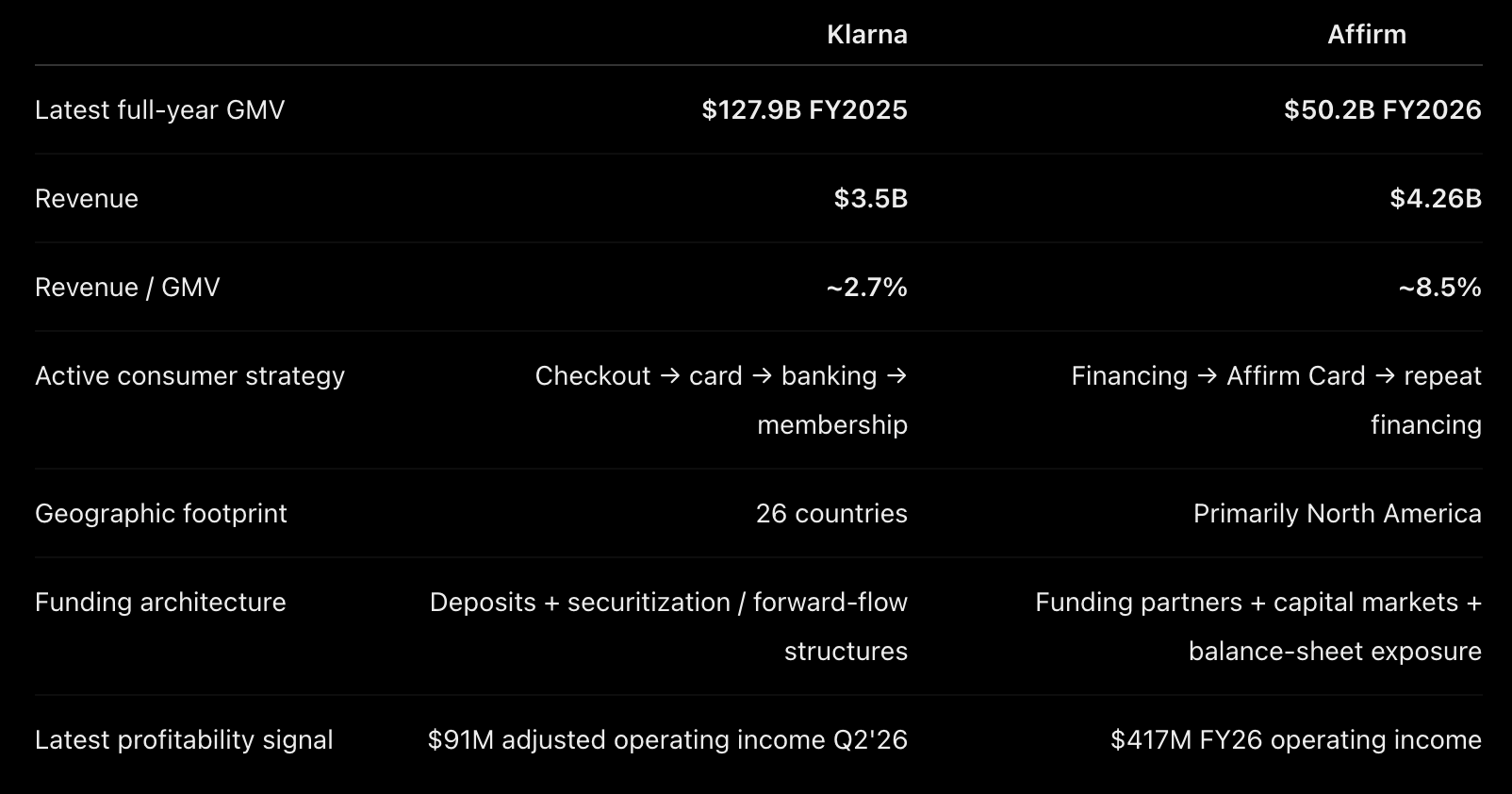
Affirm generated more revenue from much less transaction volume because the product mix and financing economics are different. Its FY2026 revenue included more than $2.0B of interest income, alongside merchant, card-network, loan-sale and servicing revenue.
Klarna has historically optimized for broader transaction throughput and lower take-rate economics.
They monetize different combinations of merchant economics, consumer financing, funding and duration so in summary the important lesson here is that “BNPL” does not describe the economic model.
It describes a product interface.
10. Geography as product strategy: one stack, different maturity curves
Klarna now operates across 26 countries, but the economics of that footprint are not uniform. Mature markets show what the model looks like after distribution density, consumer familiarity and funding infrastructure have had time to compound.
The United States shows something different: scale without comparable maturity when in Q2 2026 U.S. GMV grew 27% year over year, faster than the group. Yet U.S. transaction margin represented about 23% of revenue, compared with 54% outside the U.S. and close to 60% in some mature markets.
That gap is strategically useful because it tells us the key question is no longer merely:
Can Klarna grow in America?
Obviously It can but the harder question here:
Can U.S. transaction economics mature toward the levels produced by older markets?
If they do, today’s lower-margin growth becomes tomorrow’s operating leverage and if they do not, geography becomes a source of permanent mix dilution which is why regional transaction economics matter more than headline GMV.
Regulation: compliance as infrastructure, not checkbox
The regulatory story is a particularly complicated one after the original version of this teardown.
In May 2024, the U.S. Consumer Financial Protection Bureau issued an interpretive rule treating certain BNPL digital accounts under credit-card provisions of Regulation Z. A year later, on May 12, 2025, the CFPB withdrew that interpretive rule along with numerous other guidance documents.
The conclusion should not be that BNPL regulation disappeared because the rules surrounding digital credit remain politically and institutionally fluid.
For a company operating at Klarna’s scale, the ability to modify disclosures, dispute handling, underwriting processes and compliance infrastructure becomes a product capability.
Europe on the other hand is moving in a more defined direction where Directive (EU) 2023/2225 replaces the previous Consumer Credit Directive framework, with national measures applying from 20 November 2026. The new framework expands consumer-credit requirements, including creditworthiness assessment and standardized information obligations.
For Klarna, compliance therefore sits at the center where very new product, market and financing structure inherits regulatory logic. At sufficient scale, the fixed cost of building that infrastructure can itself become a barrier to smaller competitors.
11. What the market should actually price
Klarna listed on the NYSE in September 2025 at $40 per share, making its business architecture observable quarter by quarter rather than primarily through private-market narratives. 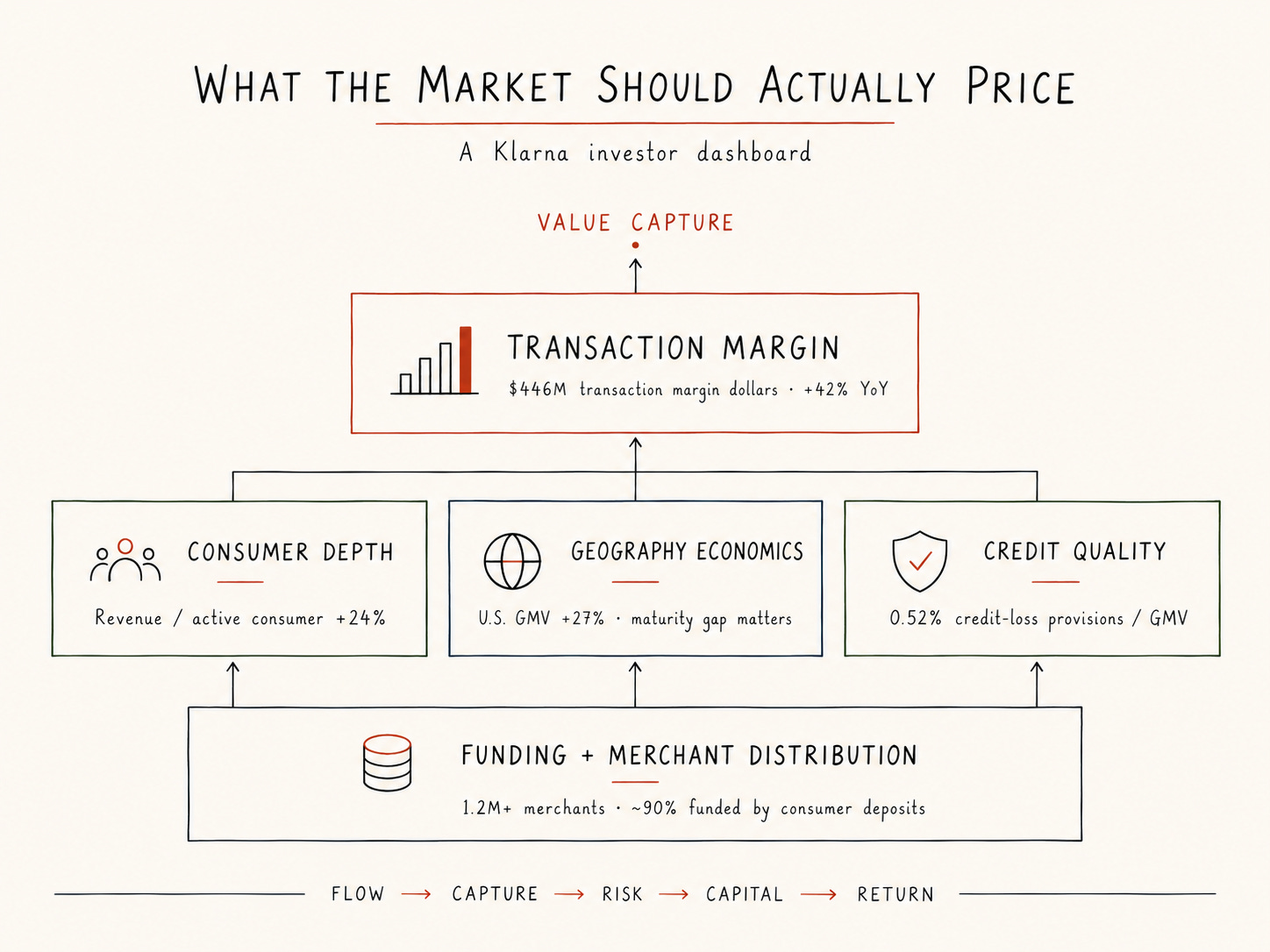
The metrics worth watching are the following:
Transaction margin dollars
Can Klarna make the economic output of transactions grow faster than transaction volume?
Q2 2026: +42% versus GMV +18%.
That is currently moving in the right direction.
Revenue per active consumer
Does the consumer relationship actually deepen?
Q2: +24% YoY.
Again, yes.
Credit losses
Does deeper lending create disproportionately more risk?
Q2 provisions were 0.52% of GMV, down from 0.56% a year earlier.
Transaction margin by geography
Does U.S. maturity close the profitability gap with older markets?
That remains unresolved.
Funding architecture
Can Klarna scale Fair Financing without continuously expanding its own capital intensity?
Forward-flow transactions in markets such as Germany suggest management is actively redesigning that constraint.
Merchant distribution
Does Klarna continue moving from individual merchant integrations into infrastructure-level distribution through acquirers, wallets and platforms?
If yes, merchant acquisition becomes progressively less linear.
12. What could break the thesis
The bull case is easy to understand: checkout creates distribution that in turn creates data and that improves underwriting. Underwriting creates financing which deepens the consumer relationship and a deeper relationship creates more revenue. All of that is carried by technology and that lowers marginal cost.
1. Credit duration outruns underwriting discipline
Fair Financing expands revenue opportunity but introduces longer-duration exposure.
If credit losses increase faster than pricing and underwriting improve, growth can remain strong while transaction economics deteriorate.
2. Funding becomes more expensive
Klarna currently benefits from a large consumer-deposit base and increasingly diversified funding structures but as we know funding is never free.
Deposit competition, securitization spreads and capital-market conditions can compress economics even when customer demand remains healthy.
3. Merchant economics commoditize
Checkout financing increasingly becomes available through payment processors, wallets, card networks and competing providers where the visible toggle will commoditize.
Klarna therefore has to defend what sits behind it:
distribution density + underwriting + funding + consumer relationship + data.
4. Platforms own the interface
Apple, Google, payment processors and card networks already occupy critical layers between consumer and merchant.
Klarna’s risk is not necessarily that consumers stop using installments but that another interface becomes the default place where installments are selected.
The company increasingly counters that risk by being inside those ecosystems rather than outside them, including Apple Pay and Google Pay availability.
5. Banking expansion increases complexity faster than value
Every new card, deposit product, membership tier, financing structure and regulatory license increases the surface area of the organization.
The consumer-financial-OS thesis works only if the products reinforce one another because otherwise the stack becomes a portfolio of unrelated features and that is the real execution risk.
13. What everyone will copy wrong
1. “Add BNPL and call it a platform.”
Installments are a feature and the functioning exists only when distribution, underwriting, funding and repeat consumer relationships reinforce one another.
A checkout toggle alone is not a moat.
2. “The consumer brand is the moat.”
A Brand helps but merchant distribution creates the transactions from which much of the relationship originates.
Without distribution density, the consumer brand has much less economic machinery underneath it.
3. “AI means fewer employees.”
This is probably the biggest misunderstanding and it is mainly due to abstraction.
I feel the useful question is whether technology changes: revenue per employee, cost per transaction, loss rates, onboarding speed, decision accuracy, merchant servicing cost.
Important here: headcount is an input but economics are the output.
4. “The balance sheet should own everything.”
Not necessarily.
Klarna’s evolving forward-flow strategy suggests a more sophisticated possibility:
own the customer and the underwriting decision without necessarily owning every asset for its entire duration.
That can be strategically more valuable than maximizing balance-sheet size.
5. “More consumers means a stronger platform.”
Only if engagement deepens.
The more interesting Q2 statistic is not 120 million consumers but the revenue per active consumer +24%.
That converts audience growth into economic evidence.
14. Three decisions for your company
The Klarna case becomes more useful once you abstract the mechanism away from fintech. The practical test is whether your company can identify a control point, connect it to economic outcomes, and then apply AI where it creates real operating leverage.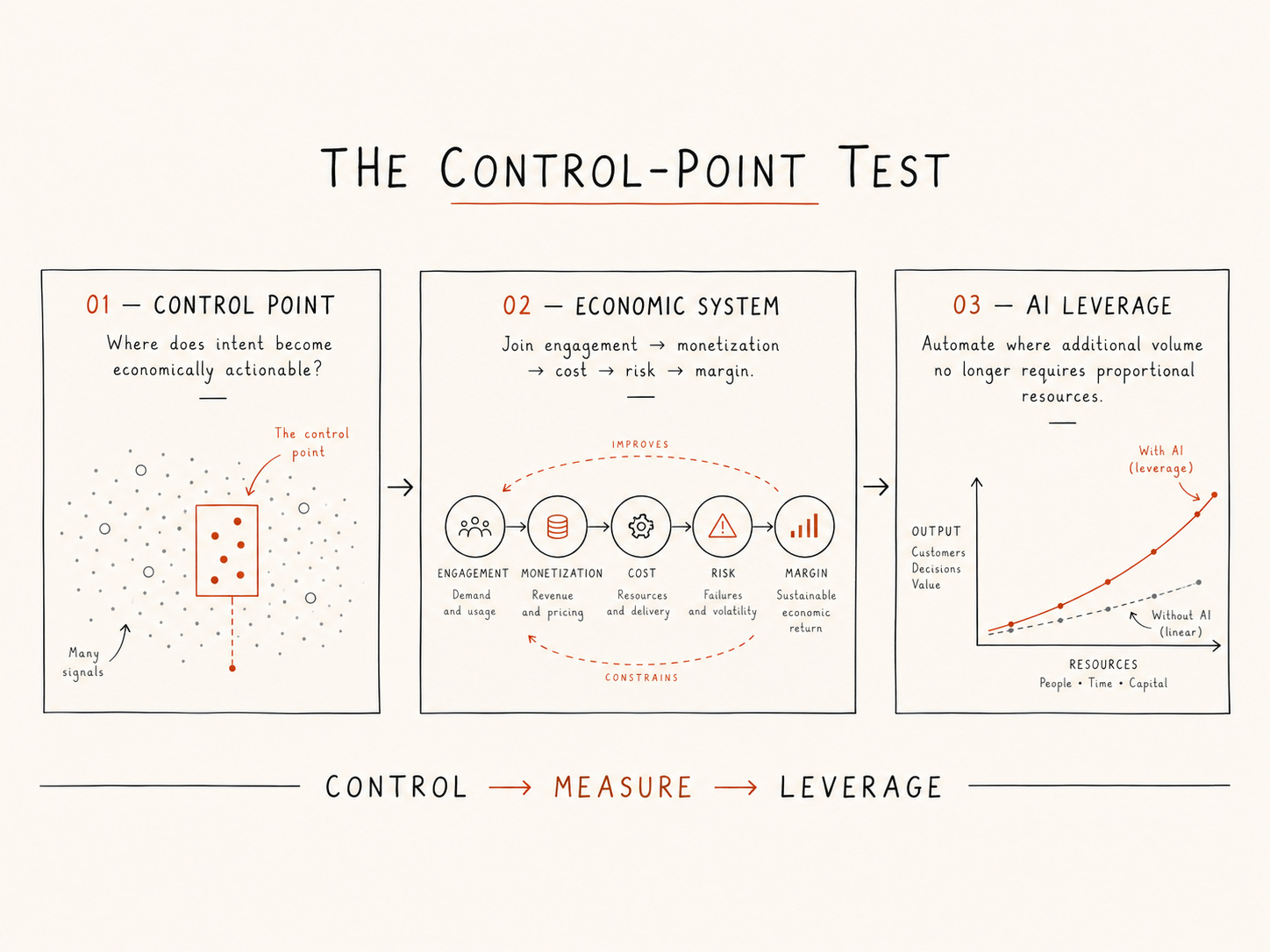
1. Name your control point
Klarna’s is the purchase decision.
Where in your own value chain does customer intent become economically actionable?
That may be: workflow, transaction, search, approval, a dataset, a marketplace interaction, or a distribution endpoint.
If you cannot identify it, your platform strategy may be a collection of features rather than a system.
2. Join product metrics and financial metrics
Active users alone tell you almost nothing about strategic quality.
The interesting relationship is the following sequence:
engagement → monetization → cost → risk → margin.
Klarna’s Q2 numbers illustrate the point elegantly: GMV (+18%), Revenue (+27%), Transaction margin dollars (+42%), Revenue per consumer (+24%).
Pro tip: build a dashboard that lets your organization see the dynamics and relationship.
3. Invest in AI where marginal economics improve
Klarna’s useful AI lesson is not that a chatbot can answer customer questions but that technology can change the relationship between scale and operating resources.
Ask yourself the following:
-
Where does additional volume currently require additional people?
-
Where can decision quality be measured?
-
Where are mistakes visible and reversible?
-
Where does automation reduce unit cost without increasing strategic risk?
15. The larger lesson
On the surface, Klarna's story looks like fintech but underneath, the strategy is much broader. It built technology, risk infrastructure, capital and consumer products around that control point with the visible part of BNPL and deeper asset being distribution. The long-term opportunity is turning that distribution into a recurring financial relationship whose economics improve with scale.
That is why the most important question for Klarna’s next decade is:
How much financial value can Klarna capture once checkout is no longer the product, but the acquisition layer?
Enjoying Strategy Stack Teardowns?
Forward this to a strategist, operator or founder thinking about platform economics, distribution or financial infrastructure.
And subscribe to catch Teardown #02.
16. Sources
Klarna primary financial reporting
Klarna Q2 2026 Results — August 18, 2026
Primary source for Q2 GMV, revenue, transaction margin dollars, profitability, consumers, merchants, card adoption, Memberships, credit losses, funding mix and geographic transaction margins. Klarna Group
Klarna FY2025 Results — February 26, 2026
Primary source for FY2025 GMV, revenue, adjusted operating profit, consumers and merchants. Klarna Group
Klarna 2025 Form 20-F / Annual Report
Primary audited annual filing for the business model, financial statements, risk disclosures, funding and operating metrics. Klarna Group
Klarna Investor Relations overview
Current operating footprint: consumers, merchants, markets and reported GMV. Klarna Group
Capital and banking architecture
€900M German financing facility — July 9, 2026
Evidence for Klarna’s forward-flow / warehouse structure supporting up to €5B of German financing while Klarna retains underwriting and servicing. Klarna Group
Klarna Germany Capital Efficiency Facility
Klarna U.S. banking-license application — July 6, 2026
Evidence for the proposed Klarna Bank USA Utah industrial-bank charter and U.S. banking strategy. Klarna Group
Klarna U.S. Banking License Application
Klarna operating leverage
Klarna Q4 2025 operating update — February 19, 2026
Source for U.S. growth, banking-consumer economics, Fair Financing growth, revenue-per-employee development and AI-linked operating leverage. Klarna Group
Klarna Q4 2025 Operating Update
IPO
Klarna IPO completion — September 11, 2025
Confirms the $40 IPO price, NYSE listing and KLAR ticker. Klarna Group
Competitor comparison
Affirm FY2026 Form 10-K — August 27, 2026
Primary source for Affirm’s $50.2B FY2026 GMV, $4.261B revenue, operating results and revenue composition. Affirm Holdings, Inc.
Regulation
CFPB — Buy Now, Pay Later products
Confirms that the CFPB withdrew its 2024 BNPL interpretive rule on May 12, 2025. Consumer Financial Protection Bureau
CFPB — Withdrawn Guidance
Official record identifying the 2024 Regulation Z BNPL interpretive rule as withdrawn. Consumer Financial Protection Bureau
Directive (EU) 2023/2225 — Consumer Credit Directive
Primary EU legal text. Member States apply the new measures from 20 November 2026. EUR-Lex