Market architecture and strategic positioning - ten frameworks for mapping markets, shaping belief, aggregating demand, and capturing value with structural intent
By Alex Pawlowski
Published: 2026-09-24
URL: https://thestrategystack.substack.com/p/market-architecture-strategic-positioning
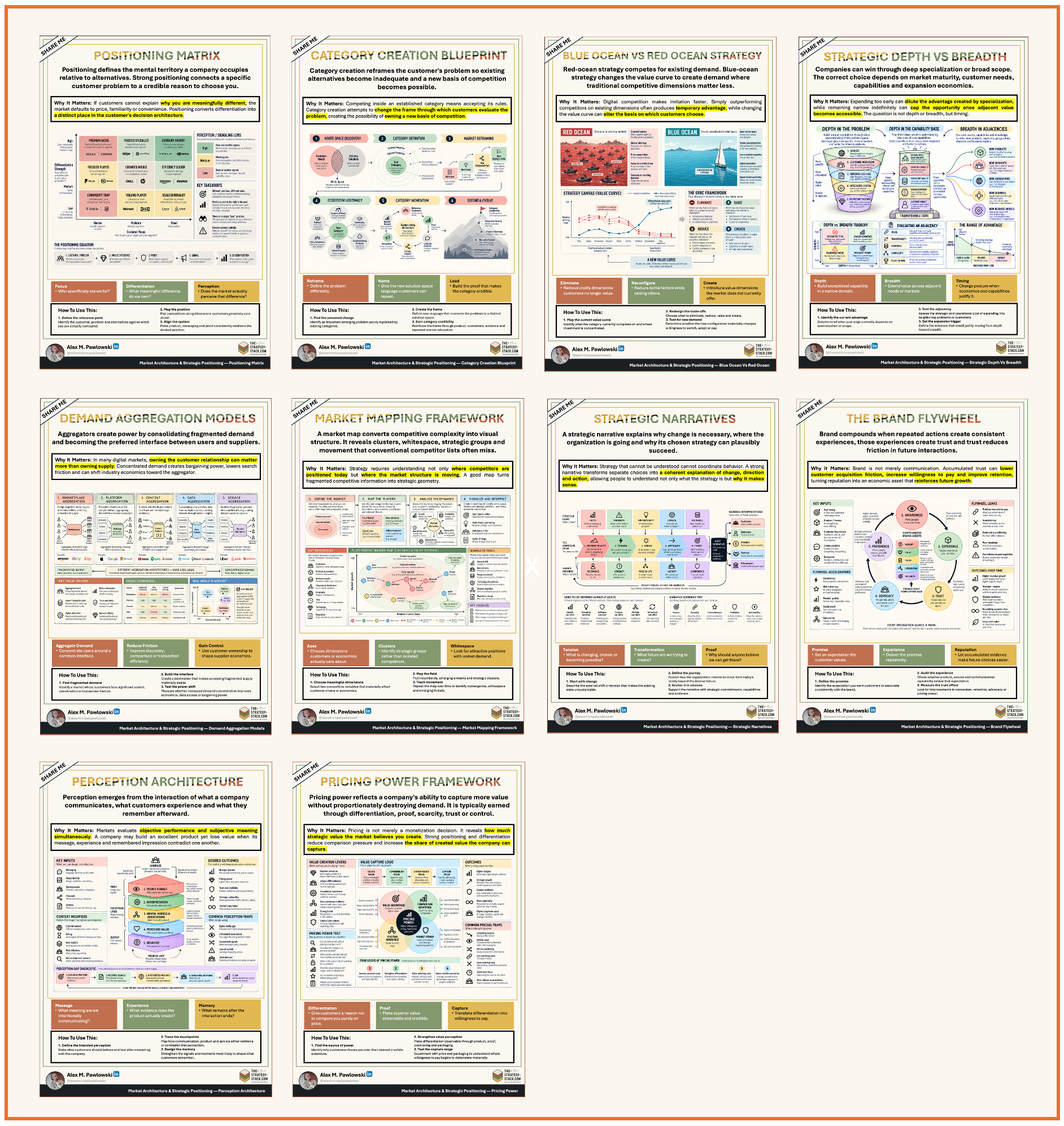
If positioning feels like adjective selection, category creation feels like rebranding, or pricing feels disconnected from how buyers perceive you, the problem is often missing market architecture - not missing messaging budget.
The Strategy Stack curriculum builds from foundations through scale, ecosystems, and intelligence. Alongside those phases, standalone clusters address operator-critical domains where strategy fails in practice - not from weak execution, but from weak structural thinking.
Market Architecture & Strategic Positioning is one of those clusters.
It maps how markets are structured, how belief is shaped, how demand concentrates, and how price authority is earned - before product roadmaps and growth campaigns consume the quarter.
This article is the map.
Why This Collection Exists
Most go-to-market failures are architecture failures in disguise.
Teams confuse:
-
Positioning slogans with coordinates on a competitive map
-
Category labels with category creation
-
Blue ocean language with red ocean economics
-
Depth with distraction - and breadth with strategy
-
Traffic with demand aggregation power
-
TAM slides with market structure
-
Brand awareness with compounding trust
-
Perception with reality - or reality with perception management
-
Pricing spreadsheets with pricing power
This collection dismantles those confusions.
It establishes shared logic for how digital businesses see the market they play in, shape how buyers understand it, and capture value consistent with that structure.
If these frameworks do their job, positioning stops being a messaging exercise - and becomes infrastructure that product, pricing, and distribution reinforce.
The Ten Frameworks of Market Architecture & Strategic Positioning
Each cheat sheet answers a specific strategic question. Individually they are useful. Together, they form a coherent system.
Positioning Matrix
Where do you win in the landscape?
Plot competitors and your offer on the axes buyers actually use - not the axes your pitch deck prefers.
Category Creation Blueprint
When should you name the game - not just play it?
Four stages: problem naming, criteria definition, reference customer, ecosystem pull.
Blue Ocean vs Red Ocean Strategy
Compete on structure or within structure?
Restructure value curves or win a defined segment - with honest tests for which ocean matches your capital and capabilities.
Strategic Depth vs Breadth
When to narrow - when to expand?
Depth wins wedges; breadth wins scale - sequencing matters more than ideology.
Demand Aggregation Models
Who owns the customer relationship?
Search, feed, marketplace, and interface aggregation - and where power concentrates in each.
Market Mapping Framework
What does the terrain look like?
Segments, value chains, control points, and substitution paths - the base map beneath positioning.
Strategic Narratives
What story structures the market?
Old world, inflection, stakes, new world, your role - narrative as market infrastructure.
The Brand Flywheel
When does reputation compound?
Signal → experience → trust → distribution → proof - design the loop, not the logo.
Perception Architecture
What does the market believe is true?
Align signal surface, proof layer, and experience core so belief matches strategy.
Pricing Power Framework
When will the market accept your price?
Differentiation, switching cost, reference control, and value metric alignment - four sources of price authority.
What This Collection Gives You
Taken together, pages 79–88 provide:
-
A coordinate system for competitive positioning - not adjective lists
-
Category creation logic with stage gates - not vocabulary rent
-
Ocean choice and depth/breadth sequencing for expansion decisions
-
Demand aggregation models tied to modern interface power
-
Market mapping that precedes TAM theater
-
Strategic narrative architecture aligned with product and pricing
-
Brand and perception design that compounds trust into distribution
-
Pricing power diagnostics connected to value architecture
This collection does not tell you which competitor to copy.
It tells you how to design the market logic your company operates inside - so execution has something structural to reinforce.
How to Use This Collection
Founders entering crowded markets: Start with p.79 Positioning Matrix and p.84 Market Mapping Framework
Category challengers: Start with p.80 Category Creation Blueprint and p.85 Strategic Narratives
Brands competing against aggregators: Start with p.83 Demand Aggregation Models and p.87 Perception Architecture
Leaders with pricing pressure: Start with p.88 Pricing Power Framework - then audit p.86 Brand Flywheel and p.82 Depth vs Breadth
Return to these sheets whenever:
-
Positioning workshops produce adjectives, not coordinates
-
“New category” language outruns customer proof
-
Expansion dilutes the wedge that produced initial wins
-
A single aggregator or platform can change your economics overnight
-
Brand spend rises but inbound trust does not
-
Price increases trigger churn surprises
That is usually a signal that market architecture - not campaign intensity - is the missing layer.
Sequential path: 79 → 80 → 81 → … → 88
Best when auditing the full positioning stack from map to price.
By constraint: Jump to the sheet that matches the problem - positioning matrix if collision is invisible; demand aggregation if access is rented; pricing power if discounts are the default close.
With Phase II and III: Connect to Architecting Digital Models (Levels 13–24) for distribution and demand systems, and Scaling and Defensibility (Levels 25–36) for pricing value architecture and aggregator logic.
Go Deeper (Essays)
These cheat sheets distill operator logic from longer essays:
Platform Strategy 2025: Living Economies
Cross-side effects, liquidity, governance, value exchange
Platforms, Aggregators & the Power Laws of Distribution
Demand capture, interface power, chokepoints
Pricing Psychology and Value Architecture
Frame, meter, package, capture
The Distribution Control Map
Owned vs rented access, embeddedness, gatekeeper risk
Closing Thought
Markets feel discovered because we enter them late.
In practice, every durable company designs how buyers see the problem, the alternatives, and the price that feels fair.
Market Architecture & Strategic Positioning exists to make that design deliberate - so product, narrative, and economics pull in the same direction.
👉 Unlock the Strategy Stack
…and access the Business Model Series, advanced Cheat Sheets, the Operator Vault, and various essays at the intersection of strategy and technology.
Start here →
Phase IV →
Phase III →