Separate workloads, metrics, and capacity decisions on shared infrastructure - training vs inference on one page
By Alex Pawlowski
Published: 2026-09-21
URL: https://thestrategystack.substack.com/p/training-vs-inference-economics
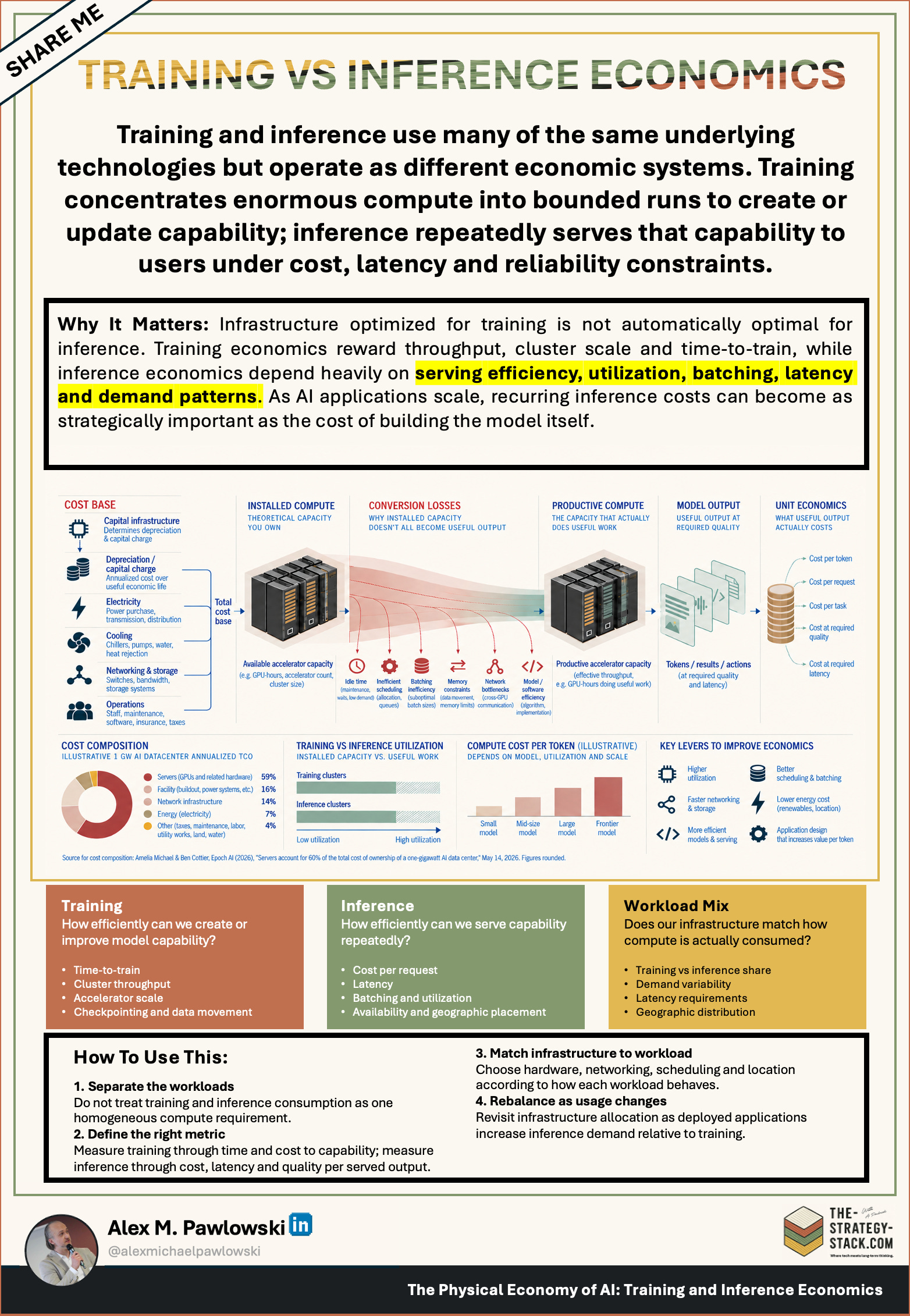
Teams often run one mental model for “AI compute” while operating two distinct businesses.
Training optimizes for throughput, convergence, and time-to-capability - bursty, batch-oriented, tolerant of queueing if the run completes.
Inference optimizes for latency, availability, cost per request, and quality at scale - always-on, spiky, customer-visible when it fails.
Blending them in one utilization target and one unit-economics line produces bad capital decisions and bad product promises.
Side-by-side logic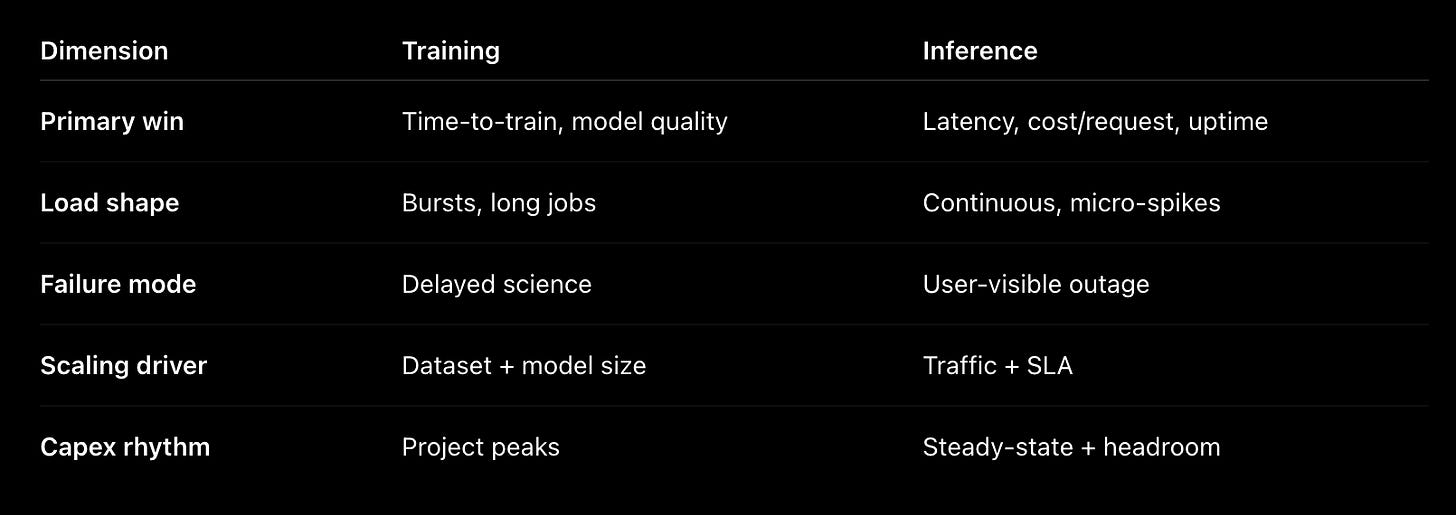
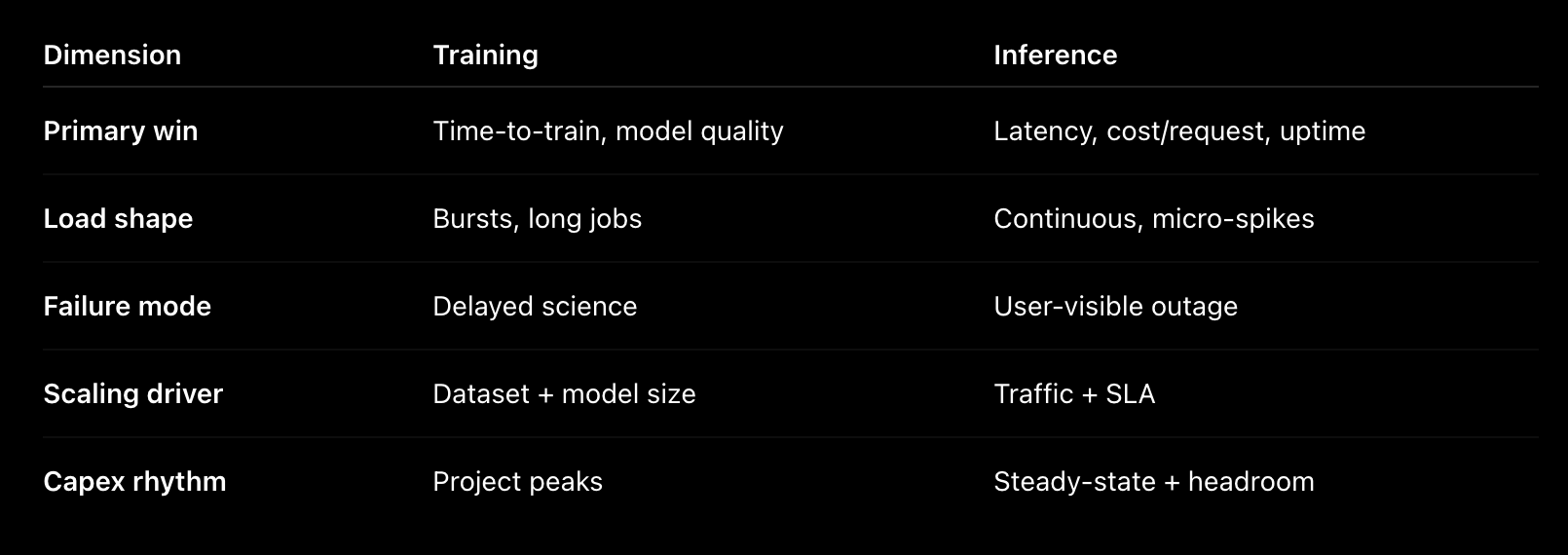
Shared cost base (power, facility, network) still needs split accountability for scheduling priority and ROI.
Where blended economics fail
-
Inference SLAs starved by training backfill - “we had utilization”
-
Training queued behind inference - capability roadmap slips quietly
-
One $/GPU-hour metric - hides 10× spread between workloads
-
Autoscaling inference like batch jobs - cold starts punish UX
-
Model releases without inference cost model - margin surprise at scale
How to use this framework
1. Split dashboards
Training: job completion, $/experiment, time-to-checkpoint. Inference: p95 latency, $/1M tokens, error budget.
2. Partition capacity or priority rules
Hard pools, quotas, or time windows - document the policy.
3. Price products separately
Internal chargeback or product P&L must reflect inference marginal cost.
4. Plan capex on inference growth curve
Training can be project-funded; inference often becomes structural opex/capex.
Diagnostic questions:
-
If training paused 30 days, would inference economics improve or worsen?
-
Which workload subsidizes the other today - by design or accident?
-
Do product roadmaps assume inference cost flat while traffic doubles?
👉 Unlock the Strategy Stack
…and access the Business Model Series, advanced Cheat Sheets, the Operator Vault, and various essays at the intersection of strategy and technology.
In this series →
https://thestrategystack.substack.com/p/physical-economy-ai-collection
Read next →
https://thestrategystack.substack.com/p/from-compute-to-ai-value
Go deeper →