Demand aggregation models - map who owns intent, how supply is commoditized, and where data gravity compounds before you build on someone else's interface
By Alex Pawlowski
Published: 2026-09-18
URL: https://thestrategystack.substack.com/p/demand-aggregation-models
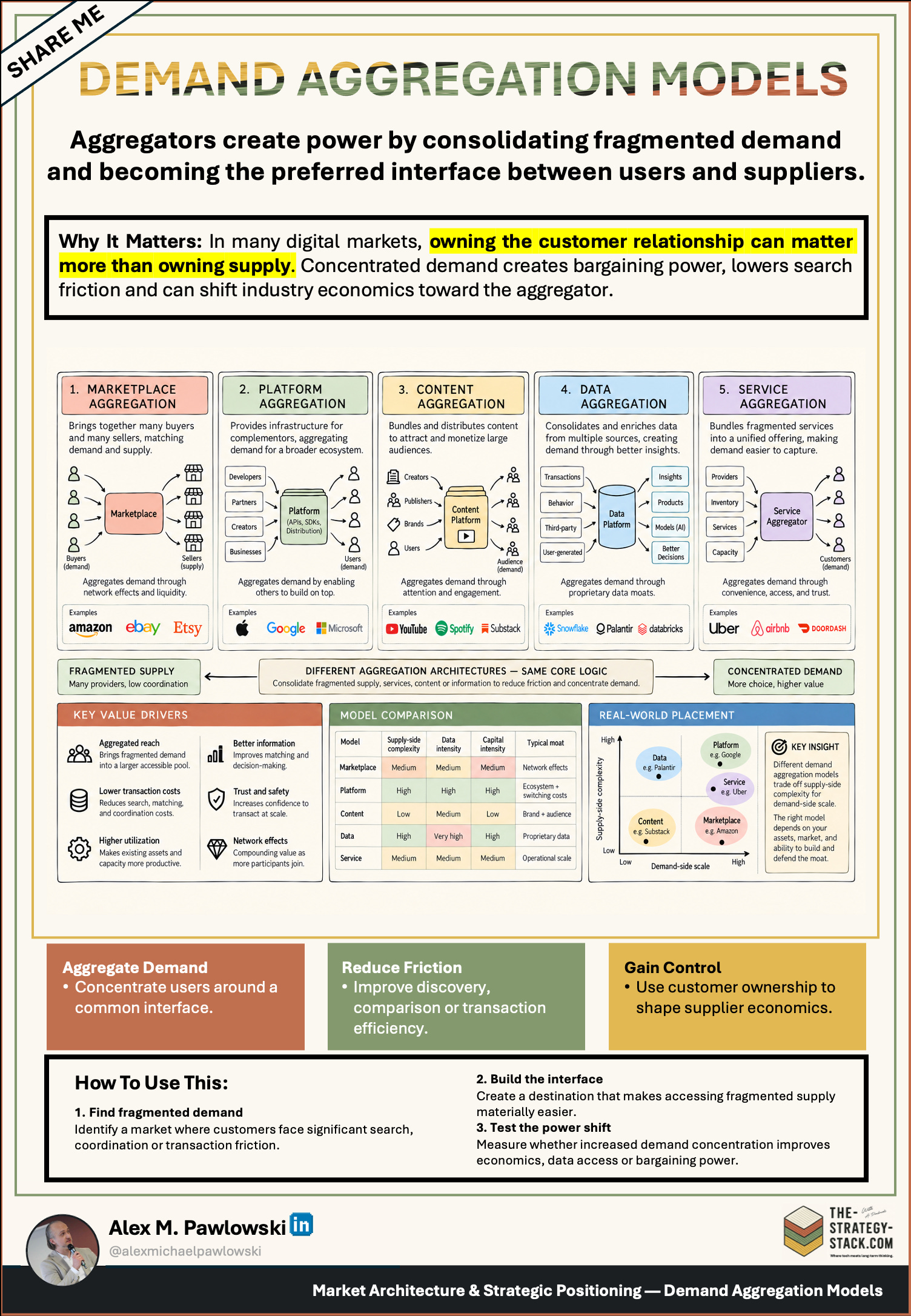
If platforms organize supply, aggregators orchestrate demand.
That distinction is not academic. It determines who sets terms, who captures margin, and who becomes interchangeable. A supplier optimized for aggregator dynamics plays a different game than a platform building two-sided liquidity - or a brand owning direct relationships.
Demand aggregation models describe how intent is captured, how supply is modularized, and how feedback loops compound at the interface layer. Misidentify the model and you optimize for the wrong moat - tooling when you need habit, or openness when you need concentration.
Four Aggregation Archetypes
Search aggregation - intent is explicit
Users arrive with a query. The aggregator ranks modularized supply and captures the click, transaction, or ad. Power comes from query volume and ranking quality. Supply is substitutable; the interface is not.
Examples: Google, Amazon search, vertical search engines with dominant category share.
Feed aggregation - intent is inferred
Users arrive for discovery. The aggregator predicts desire from behavior signals. Power comes from attention retention and recommendation precision. Content and creators become fuel; the graph is the asset.
Examples: TikTok, Instagram Reels, LinkedIn feed.
Marketplace aggregation - intent is transactional
Users arrive to buy or hire. The aggregator matches supply to demand with trust infrastructure. Power comes from liquidity and habit - buyers return because sellers are there, sellers stay because buyers convert.
Examples: Uber, Airbnb, Upwork - when the app owns the relationship.
Interface aggregation - intent is delegated
Users arrive with a task, not a query. The aggregator composes capability from modular supply - often invisibly. Power comes from default status and switching friction. Supply is API-fuel; the model layer owns the outcome.
Examples: ChatGPT, Perplexity, default AI assistants mediating access to tools and content.
Each archetype creates different supplier dependence. Search suppliers need ranking; feed suppliers need distribution; marketplace suppliers need liquidity; interface suppliers need integration approval.
The Aggregation Power Loop
Modern aggregators compound through three reinforcing dynamics:
Demand capture - control the first point of contact; whoever owns the interface owns intent
Supply commoditization - producers become interchangeable inputs to the aggregator’s experience
Data gravity - every interaction improves matching, ranking, or inference - deepening dependency without contractual lock-in
The loop is why aggregation power has migrated up the stack - from websites to feeds to model-layer orchestration. The chokepoint is where users start, not where value is originally created.
Strategic Implications
If you are the aggregator: optimize habit, inference quality, and supplier substitutability. Metrics: share of starting intent, retention, supplier multi-homing cost.
If you supply an aggregator: differentiate where commoditization is weakest - brand, vertical depth, direct relationships, or infrastructure the aggregator cannot replicate quickly.
If you are neither: build embedded distribution and owned relationships so aggregation is one channel - not your entire access layer.
The worst position: high-quality supply entirely dependent on a single aggregator interface with no direct buyer relationship and no bypass path.
How to Use This Framework
1. Identify who captures intent in your market
Where does the buyer journey start - search, feed, marketplace, or delegated interface?
2. Map supplier substitutability
How quickly could the aggregator replace you with a similar option?
3. Trace data gravity
Who learns from each transaction - and does that learning change outcomes?
4. Design bypass or embed paths
Direct relationships, niche depth, or infrastructure behind the interface.
5. Align economics to model
Take rates, ads, subscriptions, and tooling must match where power accrues.
Diagnostic questions:
-
Are you building aggregation power - or renting access to someone else’s?
-
If the dominant aggregator changed terms tomorrow, what percentage of revenue is at risk?
-
Does your strategy assume supply-side logic in a demand-aggregated market?
👉 Unlock the Strategy Stack
…and access the Business Model Series, advanced Cheat Sheets, the Operator Vault, and various essays at the intersection of strategy and technology.
In this series →
https://thestrategystack.substack.com/p/market-architecture-strategic-positioning
Read next →
https://thestrategystack.substack.com/p/market-mapping-framework
Go deeper →