How to map supply, demand, data, and governance as interlocking layers before you scale features or chase network effects
By Alex Pawlowski
Published: 2026-09-13
URL: https://thestrategystack.substack.com/p/platform-stack-blueprint
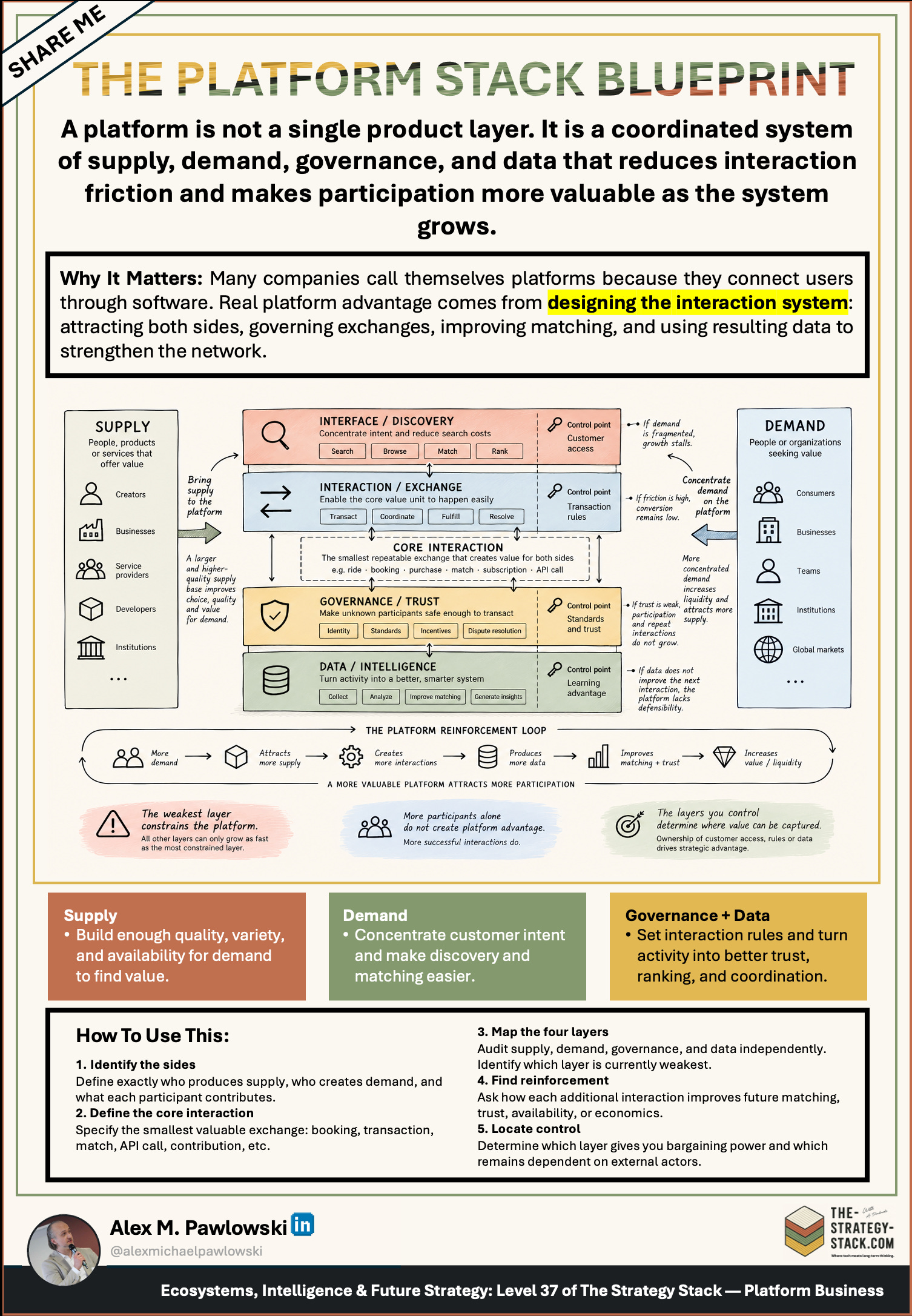
Most platform strategy decks describe a product with two sides.
That is not a platform stack.
A platform stack is the layered architecture that lets independent participants create and exchange value - with rules, data flows, and governance that hold the system together as it scales. Miss a layer and growth exposes the gap: supply without demand density, demand without quality supply, transactions without data compounding, scale without governance that preserves trust.
The Platform Stack Blueprint maps four layers every durable platform must design explicitly - not assume into existence.
The Blueprint: Four Interlocking Layers
Supply layer - who creates value
Producers, developers, sellers, content creators, service providers. The supply layer defines onboarding friction, quality standards, tooling, and economic incentives for participation. Weak supply architecture means the platform must subsidize inventory forever.
Demand layer - who consumes and discovers
Users, buyers, audiences, enterprises seeking outcomes. The demand layer covers discovery, trust signals, habit formation, and conversion paths. Without demand concentration, supply treats the platform as one channel among many.
Data layer - what the platform learns
Behavior, transactions, preferences, performance, network topology. The data layer is not a warehouse - it is the intelligence substrate that improves matching, pricing, ranking, and product evolution. Platforms that cannot learn from interactions compete on features alone.
Governance layer - how rules evolve
Policies, dispute resolution, quality enforcement, API terms, revenue share, ecosystem standards. Governance decides who can participate, how value is allocated, and how the platform adapts without breaking participant trust.
These layers are interdependent. Strong supply without demand aggregation is a developer tool. Demand without data compounding is an aggregator one step from bypass. Data without governance becomes extraction. Governance without economic alignment becomes bureaucracy.
Where Blueprints Collapse
Platform stacks fail predictably when:
-
One layer is designed as a product feature instead of an ecosystem mechanism
-
Supply quality degrades as onboarding scales - and governance has no enforcement path
-
Demand is rented through ads or partnerships rather than owned through habit and trust
-
Data stays siloed in dashboards instead of feeding matching, ranking, or product decisions
-
Governance is legal boilerplate - not a living system participants can predict and influence
The diagnostic: if removing any single layer would not change strategic outcomes, you mapped labels - not architecture.
Signals in Practice
Stripe - supply (merchants, developers), demand (payers, enterprises), data (fraud signals, payment patterns), governance (compliance, API policy). Power compounds in the data layer as transaction volume grows — not in any single checkout widget.
Apple App Store - supply (developers), demand (users), data (usage, ratings, purchase history), governance (review, revenue share, privacy rules). Governance is the contested layer — but data and demand habit make the stack durable.
LinkedIn - supply (professionals, employers, creators), demand (recruiters, buyers, readers), data (graph, engagement, skill signals), governance (trust, content policy, API access). The professional graph is a data layer asset competitors cannot replicate by cloning features.
The pattern: durable platforms make each layer stronger as the others grow - not optimized in isolation. Weak platforms optimize one layer while starving the others - discount supply to fill demand, or chase data without governance participants trust.
Mapping Your Stack
1. Name the sides
Who creates value? Who consumes it? Who intermediates? List every participant type - including those you do not yet serve but competitors might.
2. Trace value flows
How does value move between supply and demand? Where does the platform capture - transaction, subscription, data, ads, tooling?
3. Locate the learning loop
What does each interaction teach the platform - and where does that intelligence change outcomes for the next interaction?
4. Audit governance touchpoints
Where do rules get enforced? Where do disputes surface? What happens when a top supplier or user violates trust?
5. Stress-test layer coupling
If demand doubled tomorrow, which layer breaks first - supply quality, discovery, data infrastructure, or rule enforcement?
Diagnostic questions:
-
Can you diagram all four layers for your business on one page?
-
Which layer is strongest today - and which is assumed rather than designed?
-
Where would a well-funded competitor attack: supply poaching, demand bypass, data portability, or governance arbitrage?
👉 Unlock the Strategy Stack
…and access the Business Model Series, advanced Cheat Sheets, the Operator Vault, and various essays at the intersection of strategy and technology.
In this series →
https://thestrategystack.substack.com/p/ecosystems-intelligence-future-strategy-phase-iv
Read next →
https://thestrategystack.substack.com/p/aggregator-platform-ecosystem
Go deeper →